Mastering Real-Life Conversations | Complete Functional English & Speaking Mastery Bundle (A1–B1)Quick View
MyWayEnglish-2026

Mastering Real-Life Conversations | Complete Functional English & Speaking Mastery Bundle (A1–B1)

5 Resources
Looking for a ready-to-use, low-prep speaking suite to teach essential conversational etiquette? Designed for young learners (11+), teens, and adults, these lessons seamlessly bridge the gap between grammar rules and fluent, spontaneous conversation. How to Say No Politely (60 Mins) Target Focus: Refusing requests, declining invitations gracefully, and providing polite reasons without causing awkwardness. How to Interrupt Politely (60 Mins) Target Focus: Joining ongoing conversations smoothly, asking quick questions, and returning focus respectfully. How to Agree in English (60 Mins) Target Focus: Expressing levels of agreement (partial vs. strong), enthusiasm, and aligning opinions in group decisions. How to Disagree Politely (45 Mins) Target Focus: Softening opinions, using diplomatic language (“I see your point, but…”), and engaging in respectful debate. How to Say You Don’t Understand (45 Mins) Target Focus: Asking for clarification, requesting repetition, and confirming comprehension without feeling embarrassed.
Making & Accepting Suggestions Bundle | A1–A2 Functional English WorksheetsQuick View
MyWayEnglish-2026

Making & Accepting Suggestions Bundle | A1–A2 Functional English Worksheets

2 Resources
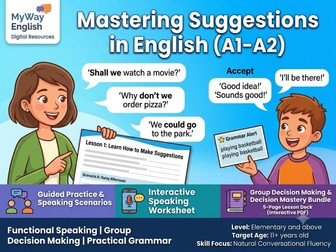
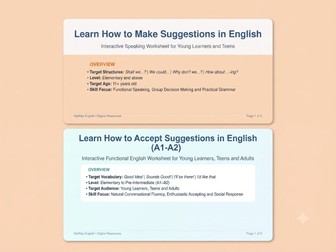
Real-Life English Conversations: Making & Accepting Suggestions Speaking Bundle (A1–A2) Looking for a clean, low-prep way to get your Elementary and Pre-Intermediate students speaking naturally? When learners run out of varied phrasing or default to blunt “Yes/No” answers, group decision-making tasks can stall quickly. This 2-resource bundle gives your students the exact functional tools, grammar patterns, and enthusiastic intonation they need to make, negotiate, and accept plans with real confidence! You receive two complete 5-slide interactive worksheets. Part 1: Learn How to Make Suggestions Target Structures: Shall we…? | Why don’t we…? | We could… | How about…-ing? Structure: Core grammar breakdown - Controlled verb form check ->3 scenario roleplays (Rainy Afternoon, Surprise Party, After-School Plans) -> Dialogue writing & Voice Challenge. Part 2: Learn How to Accept Suggestions Target Vocabulary: Good idea! | Sounds good! | I’d like that. | I’ll be there! Structure: Phrase guide & intonation tips -> Dialogue completion exercise-> Interactive social roleplays (Lunch Plans, Weekend Trip) ->Dialogue writing & Voice Challenge.
How to Make Suggestions in English (Elementary Level Speaking Worksheet)Quick View
MyWayEnglish-2026

How to Make Suggestions in English (Elementary Level Speaking Worksheet)

(0)
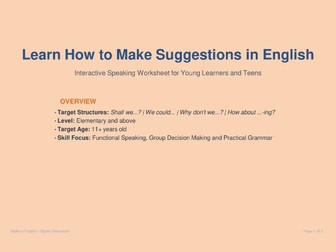
This is a complete Speaking Worksheet which will help your ESL/EFL students move beyond repetitive phrases like “Let’s go…” or “Do you want to…?”. This interactive functional English resource, designed specifically for young learners and teens (ages 11+), breaks down core grammar rules into clear, memorable steps and gives students immediate, practical speaking output through real-life group decision-making tasks. What’s Included in This Resource? This resource works as a standalone speaking worksheet. Page 1: Lesson Overview & Target Outcomes Clear goals covering age, level, target structures, and core skills. Page 2: Target Grammar Breakdown & Rules Guided focus on Shall we…?, Why don’t we…?, We could…, and How about…-ing? Includes a prominent Grammar Alert highlighting the gerund (-ing) exception following How about. Page 3: Controlled Grammar Check 5 fast fill-in-the-blank practice sentences to lock in verb structures before speaking. Page 4: Pair Work Speaking Scenarios 3 real-life decision-making prompts (The Rainy Afternoon, The Surprise Party, After-School Plans) with vocabulary idea banks. Page 5: Practical Output & Voice Challenge A short dialogue writing task plus a Voice Note Challenge where students record and submit their spoken conversation to their teacher.
How to Accept Suggestions in English (A1-A2)Quick View
MyWayEnglish-2026

How to Accept Suggestions in English (A1-A2)

(0)
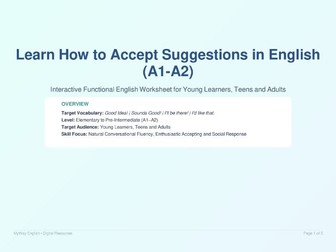
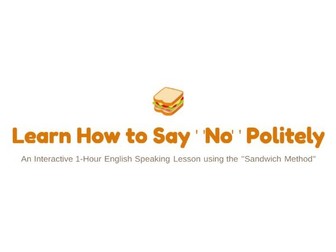
Learn how to accept suggestions in English (A1-A2)! Interactive ESL speaking worksheet with pair work roleplays for young learners, teens, and adults building practical, real-life conversational fluency. Help your English learners sound natural, warm, and confident when responding to social plans! Moving beyond basic responses like “Yes” or “Okay,” this 5-page interactive speaking resource gives students practical functional language to accept suggestions enthusiastically in everyday conversations. Suitable for young learners, teens, and adult ESL/EFL students at Elementary and Pre-Intermediate levels ( A1–A2). What’s Included in This Resource? This resource is delivered as a 5-page PDF that functions as both an online slide presentation deck and a printable pair-work worksheet: Page 1: Overview and Target Outcomes Clear goals covering target level, age adaptability, vocabulary focus, and skill goals. Page 2: Core Vocabulary Breakdown Direct visual guides for four key target phrases: “Good idea!”, “Sounds good!”, “I’d like that.”, and “I’ll be there!” Includes explicit usage rules and a Teacher’s Speaking Tip on friendly, rising intonation. Page 3: Controlled Dialogue Practice with 4 fill-in-the-blank practice conversations to build confidence and check grammar before speaking. Page 4: Pair-Work Interactive Roleplays. Two structured scenario prompts (Lunch Plans and Weekend Activities) with built-in vocabulary idea banks to maximize student talk time. Page 5: Writing Task and Voice Challenge. A 4-line scriptwriting prompt plus a Voice Note Assignment encouraging students to record their dialogues and send them to their teacher to practice pronunciation. Perfect for a focused 15–20 minute functional speaking stage within a broader lesson on weekend plans or social interaction.
Essential Conversational Strategies.  Saying "No" and  Interrupting Politely for ESL/EFL Intermediate Level Teenagers and AdultsQuick View
MyWayEnglish-2026

Essential Conversational Strategies. Saying "No" and Interrupting Politely for ESL/EFL Intermediate Level Teenagers and Adults

2 Resources
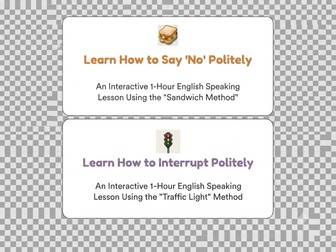
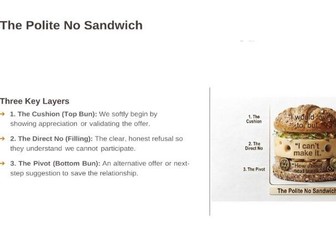
This bundle gives teachers a structured, zero-prep solution to teach students how to decline requests gracefully and step into fast-moving conversations with confidence. Learn How to Say “No” Politely (1-Hour Lesson) The “Sandwich Method” ([1. The Cushion] + [2. The Direct No] + [3. The Pivot]). Teaches students to cushion refusals using polite openers (“I’d love to, but…”, “I’m really honored, but…”). Provides functional language for setting clear personal and academic boundaries. Features real-world scenarios: declining a last-minute homework copier, setting boundaries at home, and handling expensive social plans. Learn How to Interrupt Politely (1-Hour Lesson) The “Traffic Light Method” ([Red: Stop & Listen] ➔ [Yellow: Prepare & Soften] ➔ [Green: Go & Share]). Teaches students how to spot natural conversational pauses (Yellow Light) and use softening phrases (“Sorry to jump in, but…”, “Can I add something quickly?”). Focuses on maintaining smooth conversation rhythm in group projects, meetings, and casual discussions. Includes realistic debate and discussion prompts to practice turn-taking in real time.
How to Agree and Disagree in EnglishQuick View
MyWayEnglish-2026

How to Agree and Disagree in English

2 Resources
Stop your intermediate ESL/EFL students from hitting conversational dead-ends! This comprehensive bundle pairs two high-impact, zero-prep lesson decks designed to transform blunt, one-word answers into natural, fluent English turns. By grounding complex speaking strategies in simple 2-step visual formulas, these lessons teach students how to agree and disagree with tone control, structural accuracy, and social politeness.
How to Disagree in English-An Interactive 45-Minute English Speaking LessonQuick View
MyWayEnglish-2026

How to Disagree in English-An Interactive 45-Minute English Speaking Lesson

(0)
Stop the Blunt “No!” Teach Natural Disagreements in 2 Easy Steps! When intermediate ESL students disagree with an opinion, they often resort to sharp, direct statements like “No!” or “You are wrong!”— making them sound overly aggressive or blunt. This zero-prep, 45-minute slide deck gives teachers a simple, plug-and-play lesson to teach natural conversational disagreements using The 2-Step Strategy.
How to Agree in English -An Interactive 45-Minute English Speaking Lesson (B1-B2)Quick View
MyWayEnglish-2026

How to Agree in English -An Interactive 45-Minute English Speaking Lesson (B1-B2)

(0)
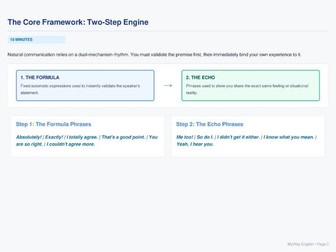
This B1–B2 ESL lesson gives teachers a ready-to-use framework to break the habit of one-word agreements (like “Yes” or “I agree”). Using the Formula and Echo Method, it teaches students how native speakers naturally agree by validating a point with a fixed expression before immediately sharing a matching experience to keep the conversation flowing. What is included in this 45-minute lesson package: The Hook: A warm-up activity featuring relatable debate prompts for both teens and adults to show how flat responses kill interaction. The Framework: A visual breakdown categorizing target phrases into Formula Phrases (validation) and Echo Phrases (shared connection). Grammar: A targeted accuracy check that explicitly shows students how to align their auxiliary verbs (So do I vs. So am I vs. Neither do I) to prevent common speaking mistakes. Real-World Practice: Side-by-side conversational scripts and interactive roleplay dilemmas (like handling cancelled plans or a grueling week) optimized for both group classes and 1-on-1 private tuition. Asynchronous Homework: An interactive “Audio Echo Challenge” where students record and send a 30-to-45-second voice note restructuring a real-life conversation.
How to Say You Don't Understand in EnglishQuick View
MyWayEnglish-2026

How to Say You Don't Understand in English

(0)
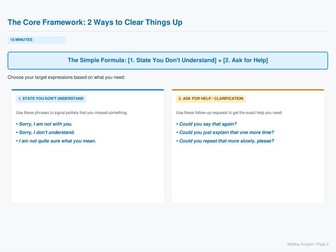
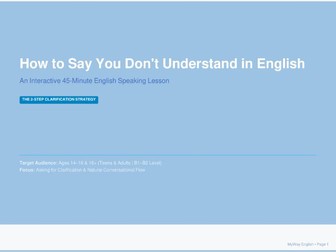
Stop the Awkward Silence: Teach Natural Clarification Phrases in 2 Easy Steps! When non-native English speakers or students face fast speech or complex explanations, they often stay silent, nod passively, or resort to direct single-word responses like “What?” or “Huh?”— which can sound blunt or dismissive. This zero-prep, 45-minute lesson slide deck gives teachers a simple, plug-and-play resource to teach natural clarification using The 2-Step Clarification Formula
How to Interrupt Politely in EnglishQuick View
MyWayEnglish-2026

How to Interrupt Politely in English

(0)
Help your ESL students break through the fear of fast-paced English conversations! Speaking confidently isn’t just about vocabulary—it’s about mastering the natural rhythm, flow, and social boundaries of discussion. This highly interactive, premium 1-hour lesson introduces The Traffic Light Method, a powerful visual framework that teaches students exactly when and how to step into a conversation smoothly and politely and what to say. Perfect for teenagers and adult learners (Intermediate to Upper-Intermediate), this resource provides actionable communication strategies for real-world academic, professional, and social environments.
How to Say ''No'' Politely in English (A2-B1)Quick View
MyWayEnglish-2026

How to Say ''No'' Politely in English (A2-B1)

(0)
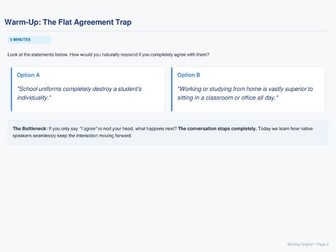
An Interactive 1-Hour English Speaking Lesson using the ‘‘Sandwich Method’’ Empower your English language learners to tackle one of life’s hardest social skills: saying “no” without feeling guilty or damaging relationships. Designed specifically for 1-on-1 online lessons, small group classes, or flipped classroom settings, this resource is compiled into a highly visual, 12-page PDF lesson card format. It is optimized for screen-sharing, sending directly to students via messaging apps like WhatsApp, or printing out for quick classroom use. Using the memorable “Sandwich Method” (Cushion- Direct No - Pivot), students will rapidly learn to build respectful, crystal-clear boundaries while practicing authentic, everyday conversational English.
How to Say ''No'' Politely in EnglishQuick View
MyWayEnglish-2026

How to Say ''No'' Politely in English

(0)
Empower your English language learners to tackle one of life’s hardest social skills: saying “no” without feeling guilty or damaging relationships.Designed specifically for 1-on-1 online lessons, small group classes, or flipped classroom settings, this resource is compiled into a highly visual, 12-page PDF lesson card format. It is optimized for screen-sharing, sending directly to students via messaging apps like WhatsApp, or printing out for quick classroom use.Using the memorable “Sandwich Method” (Cushion- Direct No - Pivot), students will rapidly learn to build respectful, crystal-clear boundaries while practicing authentic, everyday conversational English.
Learn How to Reject Suggestions in English | Interactive ESL Speaking Worksheet (A1–A2)Quick View
MyWayEnglish-2026

Learn How to Reject Suggestions in English | Interactive ESL Speaking Worksheet (A1–A2)

(0)
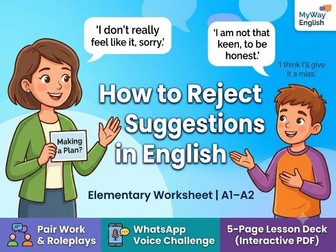
This is a 5-page PDF deck that serves as both a screen-ready digital lesson and a printable pair-work worksheet: Page 1: Overview & Learning Outcomes Clear targets covering level suitability, age adaptability, vocabulary goals, and skill focus. Page 2: Core Vocabulary Breakdown Direct usage rules and examples for three essential softening phrases: “I don’t really feel like it.” “Sorry, I think I’ll give it a miss.” “I’m not that keen, to be honest.” Includes a Teacher’s Speaking Tip on softening intonation and tone to avoid sounding harsh. Page 3: Controlled Dialogue Practice Fill-in-the-blank practice conversations designed to build student confidence with phrase structures before speaking. Page 4: Pair-Work Interactive Roleplays Structured scenario prompts with vocabulary idea banks where students practice making suggestions and politely rejecting them. Page 5: Writing Task & Voice Challenge A short 4-line dialogue writing prompt paired with a Voice Note Assignment where students record their dialogues and send them to their teacher to practice pronunciation and intonation.