Health and Financial Literacy Budget Worksheets Grades 8–12 | Decision-Making ActivitiesQuick View
Montel_Creatives

Health and Financial Literacy Budget Worksheets Grades 8–12 | Decision-Making Activities

(0)
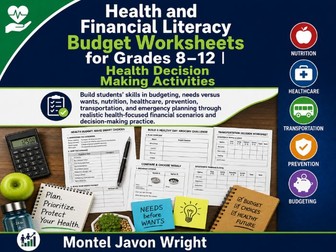
Build practical financial literacy and health decision-making skills with this engaging Grades 8–12 worksheet pack. Students apply budgeting to realistic choices involving nutrition, healthcare, transportation, prevention, wellness, and emergency expenses. Skills Covered Needs vs. wants Budgeting and cost comparison Health and safety priorities Unexpected expenses Financial trade-offs Evidence-based decision-making What’s Included Health-budget worksheets, grocery and nutrition challenges, transportation and healthcare scenarios, prevention activities, case studies, budget revision tasks, financial-health investigations, culminating budget challenges, and answer keys. Ideal For Financial literacy, health education, life skills, independent practice, group work, intervention, enrichment, and assessment. The activities support differentiation and encourage students to justify reasonable solutions rather than rely on one fixed answer. A practical, classroom-ready resource for helping secondary students make thoughtful financial and health-related decisions.
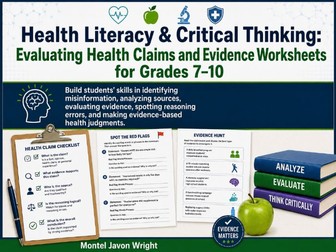
Health Literacy & Critical Thinking Worksheets Grades 7–10 | Evaluating Health Claims & EvidenceQuick View
Montel_Creatives

Health Literacy & Critical Thinking Worksheets Grades 7–10 | Evaluating Health Claims & Evidence

(0)
Health Literacy & Critical Thinking: Evaluating Health Claims and Evidence Help students become more thoughtful consumers of health information with this classroom-ready resource for Grades 7–10. Students learn how to question health claims, examine evidence, recognise misleading language, evaluate source credibility, identify bias, and make responsible evidence-based judgments. The activities are suitable for health, science, literacy, media literacy, and interdisciplinary lessons. Skills Covered Distinguishing health claims, facts, opinions, and personal experiences Spotting exaggerated, absolute, and misleading language Evaluating evidence and source credibility Identifying bias and financial interests Separating personal testimony from reliable evidence Distinguishing association from causation Recognising reasoning errors and overgeneralisation Reading research critically and identifying limitations Revising unsupported claims into accurate, appropriately qualified statements What’s Included Students work through engaging health-claim investigations covering health myths, social-media claims, nutrition labels, mental-health information, disease prevention, research evidence, source reliability, reasoning errors, competing claims, evidence ranking, and independent health-claim investigations. The resource also includes visual reference pages, student worksheets, a teacher’s guide, and answer keys. Classroom Benefits The progressive activities move beyond simple true-or-false questions. Students explain why evidence may be weak, determine what information is missing, analyse how source quality affects credibility, and consider whether conclusions are justified by the available evidence. Differentiation is straightforward through vocabulary support, modelling, sentence frames, partner work, or extension tasks involving bias, alternative explanations, research limitations, and stronger evidence. Ideal For Health education and health literacy Critical thinking and media literacy Science and research skills Social-media misinformation lessons Independent practice, group discussion, assessment, or extension work Give students practical tools for evaluating the health information they encounter every day while strengthening evidence-based reasoning, research literacy, and responsible decision-making.
Healthy Relationships and Boundaries Activities Grades 6–8 | Consent & CommunicationQuick View
Montel_Creatives

Healthy Relationships and Boundaries Activities Grades 6–8 | Consent & Communication

(0)
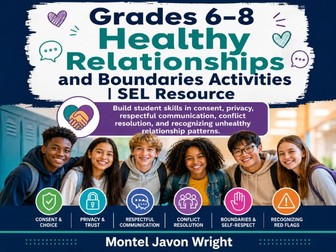
Build practical relationship skills with this ready-to-use Grades 6–8 resource focused on healthy relationships, consent, boundaries, privacy, respectful communication, conflict management, and recognising unhealthy patterns. Suitable For Grades 6–8 / approximately ages 11–14 Relationships education, personal development, wellbeing and SEL lessons Students Will Develop Understanding of healthy and unhealthy relationship behaviours Consent, personal boundaries and privacy awareness Respectful communication and active listening Conflict-resolution and decision-making skills Recognition of pressure, manipulation, control and relationship red flags Evidence-based reasoning and appropriate responses to challenging situations What’s Included Structured relationship-scenario activities and case studies Classification, reflection, rewriting and decision-making tasks Practice identifying patterns, boundaries and respectful responses Answer keys and sample responses for efficient feedback Classroom Use Ideal for whole-class teaching, small groups, partner discussion, independent work, review or assessment. Activities can be selected individually or taught as a broader sequence, with opportunities for differentiation through modelling, sentence starters, guided examples and discussion. Add this practical healthy relationships resource to your teaching toolkit for meaningful, discussion-rich learning that helps students make thoughtful, respectful and informed choices.
Health Decision-Making Skills for Grades 7–10 | Health WorksheetsQuick View
Montel_Creatives

Health Decision-Making Skills for Grades 7–10 | Health Worksheets

(0)
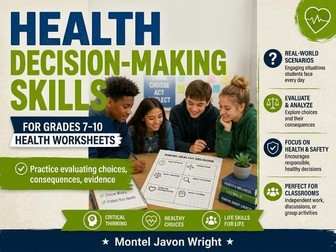
Build Smarter Health Decisions Help students develop practical health decision-making, critical thinking, and safety skills through realistic, age-appropriate scenarios. Designed for Grades 9–12 health education, this resource teaches students to identify problems, consider options, evaluate consequences and evidence, seek support, and make safer, more informed choices. Students Will Practise identifying the real decision or problem generating safe, realistic options predicting short- and long-term consequences evaluating reliable health information recognising peer pressure, emotions, risks, and missing information setting boundaries and communicating clearly seeking appropriate support justifying and reassessing decisions What’s Included 20 student worksheets 5 visual teaching posters and anchor charts complete answer keys with sample responses teacher guidance, differentiation, and assessment support scenario-based activities, case files, classification tasks, evidence evaluation, communication practice, and cumulative assessment Topics include sleep and workload, vaping and unknown substances, prescription medication safety, impaired driving, peer pressure, relationships and boundaries, privacy, social media, online safety, and reliable health information. Flexible Classroom Use Ideal for health education, PSHE, wellbeing, life-skills lessons, independent practice, small-group discussion, intervention, review, and assessment. Activities can be supported with sentence starters, organisers, partner discussion, or fewer scenarios, while advanced students can extend their reasoning through evidence-based justification and reassessment. Give students meaningful opportunities to practise the critical thinking and decision-making skills needed to protect their health, safety, and well-being.
Time Management and Wellness Planning Worksheets | Grades 6–8Quick View
Montel_Creatives

Time Management and Wellness Planning Worksheets | Grades 6–8

(0)
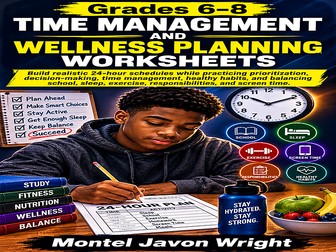
Time Management & Wellness Planning Worksheets | Grades 6–8 Help middle school students develop practical time-management, decision-making, and wellness-planning skills through realistic 24-hour scheduling activities. Students learn to balance sleep, school, homework, meals, hydration, physical activity, responsibilities, recreation, screen time, and transitions. Students Will Practise Time management and prioritisation Schedule analysis and time calculation Decision-making and problem solving Evaluating trade-offs and consequences Revising unrealistic schedules Balancing responsibilities with wellness needs Reflection and independent planning What’s Included 52-page printable resource 21 student worksheets 5 instructional charts Teacher’s guide Differentiation and assessment guidance Complete answer keys with sample responses Activities on sleep, meals, hydration, movement, screen time, schedule comparison, 24-hour audits, wellness priorities, and balanced-day planning Ideal For Health and wellness education Life skills and study skills Advisory or personal development lessons Independent, partner, or small-group work Review, reflection, and assessment Use the activities individually or as a progressive unit. Differentiation options include partially completed schedules, partner support, colour coding, time-calculation aids, written justification, and more advanced schedule analysis. A practical, classroom-ready resource for helping Grades 6–8 students make thoughtful choices about time, responsibilities, and everyday wellness.
Grades 6–8 Wellness Data Analysis Worksheets | Evidence-Based Reasoning & GraphsQuick View
Montel_Creatives

Grades 6–8 Wellness Data Analysis Worksheets | Evidence-Based Reasoning & Graphs

(0)
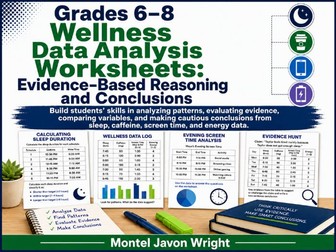
Build students’ data literacy, critical thinking, and evidence-based reasoning with this Grades 6–8 wellness data analysis resource. Using fictional scenarios about sleep, caffeine, screen time, and energy, students interpret data, identify patterns, evaluate evidence, and make cautious conclusions without confusing correlation with causation. Skills Covered Data and graph interpretation Comparing variables and identifying patterns Evaluating evidence and hypotheses Distinguishing observations from assumptions Recognising data limitations Writing evidence-based conclusions What’s Included 20 progressive student worksheets 5 visual reference charts Complete answer keys Teacher guidance, differentiation, and assessment support Investigation, recommendation, graphing, error-analysis, and capstone tasks Ideal For Independent work, group discussion, science or health lessons, data-handling practice, critical-thinking activities, homework, revision, and assessment. A practical, classroom-ready resource for helping Grades 6–8 students analyse real-world-style data, support claims with evidence, and make more thoughtful conclusions.
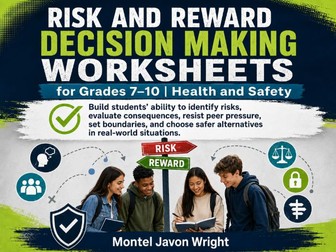
Risk and Reward Decision-Making Worksheets | PSHE Health & Safety | Ages 12–16Quick View
Montel_Creatives

Risk and Reward Decision-Making Worksheets | PSHE Health & Safety | Ages 12–16

(0)
Build safer decision-making skills with this practical risk and reward resource for Grades 7–10 (ages 12–16/Years 8–11). Ideal for PSHE, health education, life skills and personal development lessons. Students Will Identify risks, rewards and consequences Compare risky choices with safer alternatives Recognise peer pressure and unsafe thinking Practise refusal, boundary-setting and help-seeking Support decisions with evidence Develop practical safety plans Resource Includes 20 student worksheets Complete answer keys with sample responses 5 visual anchor charts Teacher introduction and implementation guide Differentiation and assessment guidance Activities cover driving safety, substance awareness, digital privacy, personal boundaries, peer pressure, risk factors, decision trees and consequences over time. Classroom Use Suitable for individual lessons, multi-day units, independent work, group discussion, homework, intervention, revision or assessment. Tasks can be simplified with modelling and word banks or extended through deeper evidence-based analysis. Download this ready-to-teach risk and reward worksheet pack to help students evaluate pressure, anticipate consequences and make safer, well-reasoned choices.
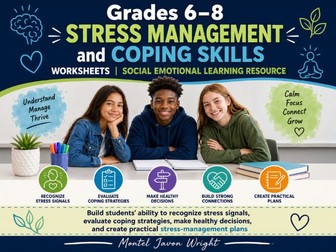
Stress Management and Coping Skills for Grades 6–8Quick View
Montel_Creatives

Stress Management and Coping Skills for Grades 6–8

(0)
Stress Management and Coping Skills for Grades 6–8 Help students recognise stress signals, evaluate healthy coping strategies, and create practical response plans with this classroom-ready SEL and wellbeing resource. Suitable For Grades 6–8, Years 7–9 and ages 11–14. Ideal for KS3 PSHE, health, advisory, counselling, pastoral support, intervention, and social-emotional learning lessons. Skills Covered Recognising physical, emotional, cognitive, and behavioural stress signals Selecting safe, realistic coping strategies Managing workloads, deadlines, distractions, and performance anxiety Comparing consequences and revising ineffective responses Building resilience, self-regulation, and help-seeking skills Resource Includes 20 scaffolded student worksheet pages Five stress-management reference charts Realistic scenarios, case studies, planning tasks, and reflections Teacher guidance, differentiation ideas, and assessment support Comprehensive answer keys with sample responses Use the activities independently, with partners, in small groups, or as a complete stress-management unit. Add this practical coping-skills resource to your teaching toolkit to support thoughtful decision-making and student wellbeing.
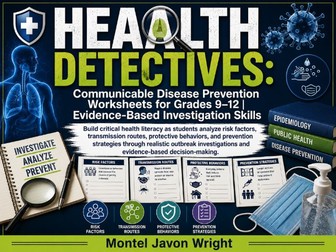
Communicable Diseases Worksheets | Disease Prevention & Outbreak Investigation Grades 9–12Quick View
Montel_Creatives

Communicable Diseases Worksheets | Disease Prevention & Outbreak Investigation Grades 9–12

(0)
Make Disease Prevention an Investigation Health Detectives is a ready-to-use communicable disease prevention resource for Grades 9–12 / ages 14–18. Through realistic school and outbreak scenarios, students build health literacy, critical thinking and evidence-based decision-making skills. Skills Covered Identifying risk factors and transmission routes Evaluating hygiene, vaccination and protective behaviours Breaking chains of transmission Distinguishing evidence from assumptions Selecting and justifying prevention strategies Included 20 student worksheets Five visual reference charts Teacher introduction and guide Complete answer keys Outbreak case files, decision-tree activities and final investigation Activities progress from core concepts to complex outbreak analysis, making differentiation straightforward through paired discussion, sentence frames, annotation and extension questions. Ideal for secondary science, health education, PSHE, review or assessment. Add this practical resource to your classroom for engaging, evidence-based learning about communicable diseases and public health.