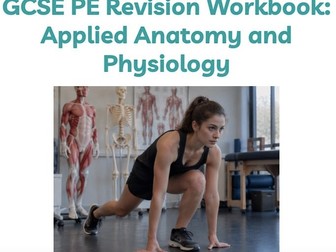
GCSE PE Revision Workbook Applied Anatomy and Physiology.
The perfect revision booklet for end of unit exmas or in prep for GCSE exam.
This booklet has worksheets, exam style questions and key words and definitions.
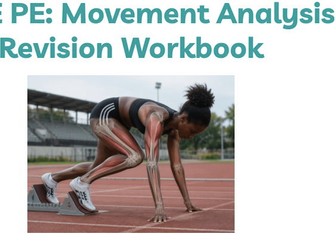
GCSE PE Movement Analysis Revision Workbook
The perfect revision booklet for end of unit exmas or in prep for GCSE exam. This booklet has worksheets, exam style questions and key words and definitions.
GCSE OCR Physical Education Health, Fitness and Well-Being Revision Workbook
The perfect revision booklet for end of unit exmas or in prep for GCSE exam. This booklet has worksheets, exam style questions and key words and definitions.
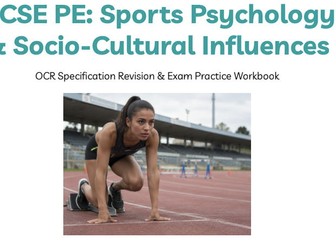
GCSE PE Sports Psychology & Socio-Cultural Influences
The perfect revision booklet for end of unit exmas or in prep for GCSE exam. This booklet has worksheets, exam style questions and key words and definitions.
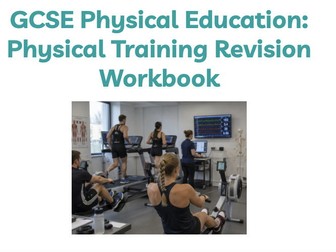
GCSE Physical Education Physical Training Revision Workbook
The perfect revision booklet for end of unit exmas or in prep for GCSE exam. This booklet has worksheets, exam style questions and key words and definitions.
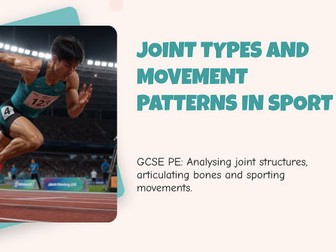
This Year 10 GCSE PE lesson explores how hinge and ball-and-socket joints are structured and how they produce movement in sporting actions. Students will:
Recap skeletal functions and articulating bones.
Identify hinge joints at the knee and elbow.
Explain flexion and extension using sporting examples.
Explore ball-and-socket joints at the shoulder and hip.
Apply abduction, adduction, rotation and circumduction to sport.
Compare mobility and stability.
Complete a practical movement-identification task.
Analyse sporting actions using an OCR-style framework.
Practise exam responses, vocabulary and peer assessment.
Finish with an exit ticket before progressing to the muscular system.
Lesson overview:
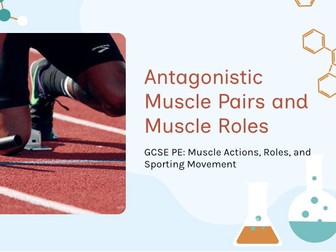
Students recap major muscle groups before learning how agonists, antagonists and fixators work together to produce and stabilise movement. They analyse antagonistic pairs in the biceps curl, shot put and football kick, then apply their knowledge in practical bench press and leg extension tasks. The lesson concludes with OCR GCSE PE exam practice using sporting examples.
Link to the OCR GCSE PE Scheme of Work
This lesson aligns with OCR GCSE (9–1) Physical Education, J587, particularly:
Component 01: Physical factors affecting performance
1.2 The skeletal and muscular systems
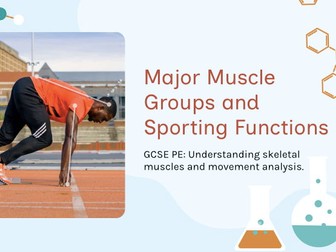
Location of the major muscle groups
The role of muscles in producing movement
Applying muscle actions to physical activities and sporting examples
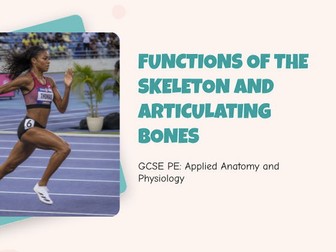
This GCSE PE lesson introduces the six main functions of the skeleton: support, protection, movement, blood cell production, mineral storage and posture maintenance. Students learn the difference between the axial and appendicular skeletons, identify major bones, and explore articulating bones at the elbow, knee, shoulder and hip.
The lesson also includes practical learning through partner bone mapping, joint-action activities and movement analysis. Students apply their knowledge to sporting actions, examine synovial joint structures, distinguish between ligaments and tendons, and complete OCR-style exam questions with mark-scheme self-assessment.


 Quick View