Beginner Japanese Hiragana Practice WorkbookQuick View
Aistl05

Beginner Japanese Hiragana Practice Workbook

(0)
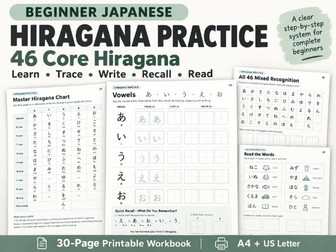
A 30-page printable Hiragana workbook for beginner Japanese learners to recognise, write, recall and read all 46 core Hiragana characters. This structured practice resource takes learners from their first Hiragana characters through to independent recognition, written recall and simple word reading. The workbook uses a gradual model → trace → copy → write → recall system. Learners initially receive Romaji support, which is gradually reduced as they develop direct recognition of Hiragana. Learning objectives Learners practise how to: recognise all 46 core Hiragana connect Hiragana characters with their sounds trace and copy character forms write Hiragana independently from sound prompts recall characters without relying on the reference chart distinguish visually similar characters read simple beginner words written in Hiragana identify characters that need further review What is included? The 30-page workbook includes: introduction and guidance for using the practice system complete 46-character Hiragana reference chart handwriting warm-up guided practice for vowels and the K, S, T, N, H, M, Y, R and W rows plus final ん model, tracing, copying and independent writing activities quick recall exercises throughout the learning sequence cumulative recognition and writing checks mixed practice across previously learned characters focused comparison of easily confused Hiragana Hiragana-to-sound and sound-to-Hiragana activities beginner word-reading activities mixed recognition, writing and reading review final recognition and writing challenges mastery tracking and targeted review pages answer keys for self-checking. The later activities deliberately move away from row-order practice. For example, the mixed-recognition work requires learners to recognise characters in a shuffled sequence, while the reading section introduces words such as ねこ, いぬ, えき, うみ, くるま, さかな and やま. Suitable for Designed primarily for complete beginners, teens and adults, the workbook can be used for Japanese lessons, tutoring, homeschool learning, revision or independent study. Teachers can use individual pages for focused character practice and review, while independent learners can work through the complete sequence. Files included Two printable PDF versions are supplied: A4 PDF — 30 pages US Letter PDF — 30 pages This is a digital printable resource. For the handwriting activities, the workbook recommends printing at 100% / Actual Size where possible. Please note: the resource practises character recognition, tracing, copying, independent writing, recall and simple reading. Formal stroke order is not taught.
Beginner Katakana Practice WorkbookQuick View
Aistl05

Beginner Katakana Practice Workbook

(0)
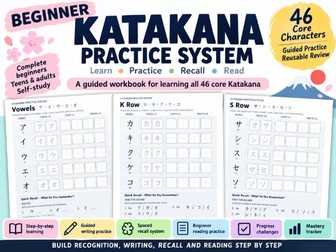
A 30-page beginner Katakana workbook for learning, recognising, writing, recalling and reading all 46 core Katakana characters. Ideal for Japanese learners, independent study, tutoring and classroom practice. This structured Japanese writing resource takes learners through the 46 core Katakana in manageable groups, beginning with the vowels and progressing through the K, S, T, N, H, M, Y, R and W rows plus final ン. A master Katakana chart provides a reference while learners build familiarity with each character. The core practice pages use a consistent MODEL → TRACE ×2 → COPY ×1 → WRITE ×3 sequence. Support is gradually reduced so learners move from seeing and tracing each character towards independent writing and recall. Romaji is provided as initial support and is deliberately reduced as the workbook progresses. Formal stroke order is not taught. The workbook then moves beyond tracing into recognition, recall, mixed practice, character discrimination and beginner reading. Later sections include Reading Essentials, mixed application activities and final challenges. Learners encounter beginner Katakana words including words for ice cream, camera, hotel, tomato, tennis, curry, cake, coffee, taxi, television, radio, bus and bread. A Mastery Tracker supports targeted review: learners can identify characters that are secure, almost there or still need practice rather than simply completing the workbook once. Answer keys are included on the final two pages for the review, reading and challenge activities. Learning objectives include: recognise the 46 core Katakana characters connect Katakana characters with their sounds practise character formation through tracing, copying and independent writing recall Katakana without constant reference to a chart distinguish easily confused characters read simple beginner Katakana words identify areas requiring further review Resource contents: 30-page printable workbook; introductory guidance and practice instructions; master Katakana chart; recognition warm-up; guided practice for all 46 core characters; Quick Recall activities; cumulative recognition and writing practice; confusion-pair work; beginner reading activities; mixed application; final recognition and writing challenges; two-page Mastery Tracker; and answer keys. Files included: two PDF versions containing the same 30-page resource A4 and US Letter for convenient printing. The A4 edition has been formatted at 210 × 297 mm, and the product’s main handwriting grids are approximately 19.4 mm square. This resource is particularly suitable for complete beginners, teens and adult learners, and can be used for Japanese lessons, tutoring, homework, revision or self-directed study.
Beginner Japanese Kanji Practice WorkbookQuick View
Aistl05

Beginner Japanese Kanji Practice Workbook

(0)
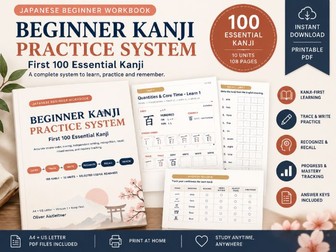
Beginner Japanese kanji practice workbook covering 100 essential kanji with stroke order, tracing, writing, recognition, recall and review activities. Help beginner Japanese learners move beyond simply looking at kanji and build active recognition and writing skills through a structured practice sequence. This 108-page printable workbook introduces 100 beginner kanji across 10 progressive units. Each kanji is presented with a core meaning, selected useful readings, a verified beginner example word and a visual stroke-order guide. Learners then move from supported tracing and copying to independent writing, recognition and recall practice. The practice system follows six stages: • Learn – connect each kanji with its core meaning, selected readings and an example word • Trace – follow progressive stroke-order frames • Write – move from copying to independent kanji writing • Recognize – identify meanings and readings without relying on the learning panel • Recall – retrieve kanji from English meaning cues • Review – revisit kanji through cumulative mixed practice What is included: • 100 beginner kanji • 10 structured learning units • Step-by-step stroke-order guides • Kanji tracing practice • Independent writing grids • Selected on and kun readings • Beginner example words with kana support • Meaning recognition activities • Reading recognition activities • Kanji recall exercises • Cumulative mixed reviews • Mastery tracking • Answer Key The ten units progress from numbers and quantities to time, people, learning, directions, movement, everyday actions, travel, nature and common descriptions. Suitable for: • Beginner Japanese learners • Independent study • Japanese tutors and their students • Homeschool language learning • Supplementary Japanese practice • Homework and revision • Adult learners Files included: • A4 printable PDF – 108 pages • US Letter printable PDF – 108 pages Both versions contain the same learning material, allowing teachers and learners to print using their preferred paper format. Important: This is a kanji-first beginner practice resource. Selected readings are provided for practical beginner use and are not intended as exhaustive dictionary entries. Romaji is not used as the learning target. This is a digital printable resource. No physical product is supplied.
Russian Cyrillic Reading Practice WorkbookQuick View
Aistl05

Russian Cyrillic Reading Practice Workbook

(0)
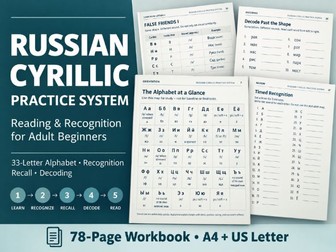
78-page Russian Cyrillic reading and recognition workbook for adult beginners, teaching all 33 letters through recognition, recall, decoding and reading practice. This structured printable resource is designed for learners beginning Russian who need to become confident reading print Cyrillic before moving further into beginner Russian vocabulary. Rather than focusing primarily on alphabet tracing, the workbook follows a progressive learning sequence: LEARN → RECOGNIZE → RECALL → DECODE → READ Learners begin with manageable groups of Cyrillic letters and gradually move towards mixed recognition and unsupported reading. The resource specifically addresses potentially confusing Cyrillic/Latin look-alike letters such as В, Н, Р, С, У and Х, helping learners avoid automatically applying familiar Latin-letter values. Learning objectives include: recognise all 33 letters of the modern Russian Cyrillic alphabet distinguish uppercase and lowercase print forms associate letters with concise beginner sound cues distinguish visually similar and potentially confusing letters understand the basic functions of the soft and hard signs recall Cyrillic forms and values without relying on an alphabet map blend letters and syllables for controlled decoding decode short Russian words directly from Cyrillic progress towards unsupported word reading Resource contents include: introductory baseline activities complete Cyrillic alphabet reference maps familiar-letter teaching and practice Cyrillic/Latin “false friend” discrimination new-letter recognition activities limited writing reinforcement soft-series vowel guidance hard and soft sign practice uppercase/lowercase recognition visual discrimination and mixed-letter scanning letter-to-sound and sound-to-letter recall timed recognition practice cumulative alphabet checkpoints controlled syllable and word decoding progressive removal of reading support word-reading activities independent Cyrillic reading practice cumulative mastery activities final assessments mastery tracker targeted review guidance six pages of answers The workbook uses English explanations and approximate sound cues as learning aids while making clear that these are not substitutes for full Russian pronunciation instruction. It is suitable for adult learners, tutors, language teachers and homeschool educators who want structured beginner practice in Russian Cyrillic recognition and decoding. It can be used for guided tuition, supplementary language study, homework, intervention/revision or independent practice. Files included: 2 PDF editions containing the same 78-page educational resource: A4 PDF US Letter PDF This is a printable digital resource. It teaches print Cyrillic recognition and reading; it is not a full Russian grammar course or a Russian cursive-handwriting course.