Teeth and Digestive System Y4 Science WorksheetsQuick View
_LukasP

Teeth and Digestive System Y4 Science Worksheets

(0)
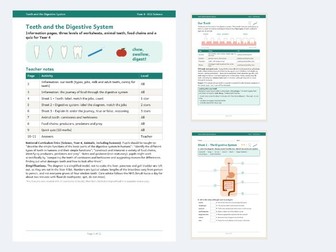
Year 4 Animals, including humans: two illustrated information pages, three star-rated worksheets (label the teeth, label the digestive system, explain it), carnivore and herbivore teeth, food chains and a 10-mark quiz, with full answers and a labelled key diagram. Print-ready PDF, 11 pages. Everything for the Year 4 teeth and digestion objectives in one printable pack. What’s included (11-page A4 PDF): Teacher notes with a page map, National Curriculum links and notes on simplifications Our Teeth: incisors, canines, premolars and molars with their jobs; 20 milk teeth and 32 adult teeth; enamel; NHS-based advice on looking after teeth The Journey of Food: mouth, oesophagus, stomach, small intestine, large intestine, rectum and anus, with a simple diagram Sheet 1 (1 star) – Teeth: label four tooth types, match them to their jobs, answer 4 questions Sheet 2 (2 stars) – The Digestive System: label a diagram from a word bank (not all words are needed) and match 7 parts to their jobs Sheet 3 (3 stars) – Explain It: order the journey, 6 true/false statements and 3 reasoning questions Animal Teeth: carnivores and herbivores compared, a sorting task and 2 questions Food Chains: producers, consumers, predators and prey; build two chains; 4 questions Quick quiz: 10 one-mark questions Full answers, including a labelled diagram Facts are checked against NHS pages (teething, tooth decay, brushing advice) and Wikipedia articles on human teeth, milk (deciduous) teeth, the digestive system and the small intestine. Numbers are given as typical values. Name/date line on pupil pages. British English spelling (oesophagus, faeces). Clear, dyslexia-friendly font (Andika). Simple original illustrations. This resource was created with AI assistance (Claude), then fact-checked and proofread in a separate review pass.
Inverted Commas Direct Speech Worksheets Y3/Y4Quick View
_LukasP

Inverted Commas Direct Speech Worksheets Y3/Y4

(0)
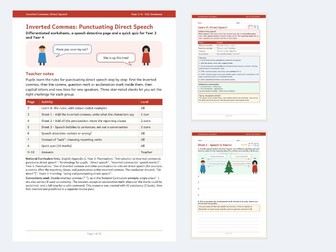
Teach and practise punctuating direct speech step by step: a colour-coded rules page, three star-rated worksheets (add the inverted commas, add all the punctuation, speech bubbles and a conversation), a speech detective page, reporting verbs and a 10-mark quiz, all with answers. Print-ready PDF, 10 pages. A complete, ready-to-print direct speech pack for lower KS2, matched to Years 3 and 4 in English Appendix 2. What’s included (10-page A4 PDF): Teacher notes with a page map, National Curriculum links and the conventions used Learn It: what direct speech is, colour-coded examples (reporting clause first or last, questions, exclamations), six rules, how to set out a conversation and the “speech sandwich” tip Sheet 1 (1 star): add the inverted commas to 8 sentences; write what two characters say; a challenge Sheet 2 (2 stars): add the inverted commas and the missing comma, full stop, question mark or exclamation mark to 8 sentences; move the reporting clause in 4 more Sheet 3 (3 stars): turn a 4-bubble cartoon into direct speech with varied reporting verbs; punctuate and set out a short conversation Speech Detective: 10 sentences to mark correct or wrong and fix Instead of “Said”: a word bank of reporting verbs and 6 sentences to improve Quick quiz: 10 one-mark questions Full answers, which also accept exclamation marks wherever the words could be exclaimed Name/date line on pupil pages. British English spelling. Clear, dyslexia-friendly font (Andika). Simple original illustrations. This resource was created with AI assistance (Claude), then fact-checked and proofread in a separate review pass.
Possessive Apostrophes Worksheets Y2 Y3 Y4Quick View
_LukasP

Possessive Apostrophes Worksheets Y2 Y3 Y4

(0)
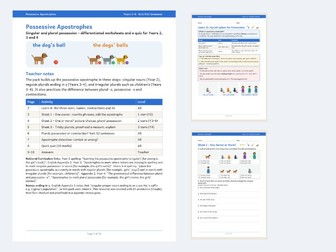
Singular possession, regular plurals and tricky plurals such as children’s: a rules page with pictures, three star-rated worksheets, a plural/possession/contraction sort, an apostrophe detective page and a 10-mark quiz, all with answers. Print-ready PDF, 10 pages. A ready-to-print possessive apostrophe pack that grows with your class, from Year 2 singular possession to Year 4 plural possession. What’s included (10-page A4 PDF): Teacher notes with a page map, National Curriculum links and a note on names ending in s (James’s, as in English Appendix 1) Learn It: the three rules in one table, a “find the owner first” tip, contractions, its and it’s, and picture examples Sheet 1 (1 star, Y2) – One Owner: rewrite 8 phrases with an apostrophe; add the apostrophe to 6 sentences Sheet 2 (2 stars, Y3–4) – One Owner or More?: choose the right phrase for 6 pictures; rewrite 6 plural phrases Sheet 3 (3 stars, Y4) – Tricky Plurals: children’s, men’s, women’s, mice’s, people’s, geese’s; proofread a short recount; explain a difference in meaning Plural, Possession or Contraction?: sort 12 sentences Apostrophe Detective: 10 sentences to mark correct or wrong and fix Quick quiz: 10 one-mark questions Full answers Name/date line on pupil pages. British English spelling. Clear, dyslexia-friendly font (Andika). Simple original illustrations. This resource was created with AI assistance (Claude), then fact-checked and proofread in a separate review pass.
Anglo-Saxons Reading Comprehension 3 Levels KS2Quick View
_LukasP

Anglo-Saxons Reading Comprehension 3 Levels KS2

(0)
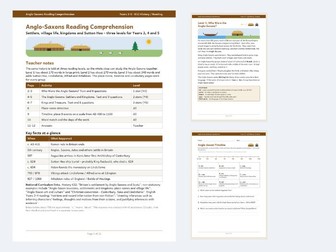
The Anglo-Saxons told at three reading levels – settlers, village life, kingdoms, Christianity and the Sutton Hoo ship burial – with questions for each level, a place-name detective page, a timeline from AD 400 to 1100, word matching, the days of the week and full answers. Print-ready PDF, 12 pages. Britain’s settlement by Anglo-Saxons is a KS2 history unit. This pack lets the whole class read about it together, with each child working at the right level. What’s included (12-page A4 PDF): Teacher notes with a level guide, National Curriculum links and a “key facts at a glance” table Level 1 (about 170 words, large print, word bank): who the Anglo-Saxons were, where they came from, houses and farming, Old English – 8 questions, including true/false Level 2 (about 270 words, word bank): Angles, Saxons and Jutes, halls and hearths, West Stow, kingdoms, Augustine and the days of the week – 9 questions Level 3 (about 340 words): adds Bede, the Sutton Hoo ship burial, Lindisfarne, Alfred, Athelstan and 1066 – 8 questions, including evidence and inference Place-name detective: -ham, -ton, -ing, -ford, -ley and -bury in 10 real English place names Timeline: place 9 events on a scale from AD 400 to 1100, with 4 questions Words from the Past: 8-word vocabulary match and the Anglo-Saxon gods behind Tuesday to Friday Answers and marking guidance for every question The history is checked against BBC Bitesize KS2 History (Anglo-Saxons), the National Trust’s Sutton Hoo history page, English Heritage’s early medieval overview and Wikipedia articles on the Anglo-Saxons, Sutton Hoo, West Stow, Augustine of Canterbury, Lindisfarne, Alfred the Great, English place names and the days of the week. The texts say where experts are not certain (for example, who was buried at Sutton Hoo) and mark early dates as approximate. Roman rule is described as lasting “more than 350 years” (AD 43 to about 410). Name/date line on question pages. British English spelling. Clear, dyslexia-friendly font (Andika). Simple original illustrations. This resource was created with AI assistance (Claude), then fact-checked and proofread in a separate review pass.
Parenthesis Worksheets Brackets Dashes Commas Y5/6Quick View
_LukasP

Parenthesis Worksheets Brackets Dashes Commas Y5/6

(0)
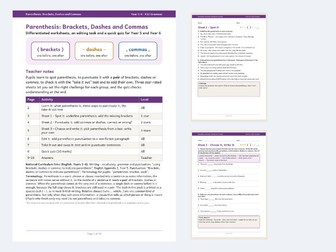
Teach, practise and check parenthesis with brackets, dashes and commas: a learn-it page with the “take it out” test, three star-rated worksheets, a non-fiction editing task, a swap-the-punctuation page and a 10-mark quiz, all with answers. Print-ready PDF, 10 pages. A complete, ready-to-print parenthesis pack for upper KS2, matched to Year 5 in English Appendix 2. What’s included (10-page A4 PDF): Teacher notes with a page map, National Curriculum links and a terminology note (pairs of marks mid-sentence; a single dash or comma when the parenthesis ends the sentence) Learn It: what parenthesis is, brackets, dashes and commas side by side, the take-it-out test, common mistakes and four kinds of extra information Sheet 1 (1 star) – Spot It: underline the parenthesis in 8 sentences; add brackets to 6 more; a challenge Sheet 2 (2 stars) – Punctuate It: add a pair of commas or dashes to 6 sentences; decide whether 8 sentences are correct or wrong and fix the errors Sheet 3 (3 stars) – Choose It, Write It: pick the right parenthesis from a box (not all are needed); write your own with three different marks; explain a writer’s choice of dashes Edit It: add the punctuation to 5 pieces of parenthesis in a short fact file about hedgehogs, then copy it out neatly Take It Out and Swap It: remove the parenthesis, then re-punctuate with dashes and commas Quick quiz: 10 one-mark questions in the style of the grammar test Full answers, with example answers for the open tasks Name/date line on pupil pages. British English spelling. Clear, dyslexia-friendly font (Andika). Simple original illustrations. This resource was created with AI assistance (Claude), then fact-checked and proofread in a separate review pass.
Fronted Adverbials Differentiated Worksheets Y3/Y4Quick View
_LukasP

Fronted Adverbials Differentiated Worksheets Y3/Y4

(0)
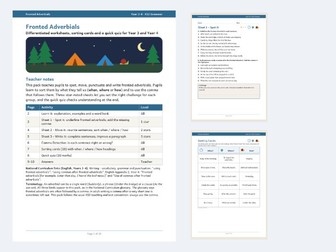
Teach, practise and assess fronted adverbials and the comma that follows them: a “learn it” page, three star-rated worksheets (spot it, move it, write it), a comma detective page, 18 when/where/how sorting cards and a 10-mark quiz, all with answers. Print-ready PDF, 10 pages. A complete, ready-to-print fronted adverbials pack for lower KS2, matched to Year 4 in English Appendix 2. What’s included (10-page A4 PDF): Teacher notes with a page map, National Curriculum links and a terminology note (adverbials can be words, phrases or clauses) Learn It: a clear explanation, when/where/how examples, the comma rule with a “read it aloud” tip, and a word bank of 18 fronted adverbials Sheet 1 (1 star) – Spot It: underline 8 fronted adverbials; add the missing comma in 6 sentences; a challenge Sheet 2 (2 stars) – Move It: rewrite 6 sentences with the adverbial at the front; sort 9 adverbials into when / where / how Sheet 3 (3 stars) – Write It: write fronted adverbials of a given type; improve a paragraph using when, where and how Comma Detective: 10 sentences to mark correct or wrong, including a sentence that needs no comma Sorting cards: 18 cards plus when / where / how header cards Quick quiz: 10 one-mark questions in the style of the grammar test Full answers, with example answers for the open tasks Name/date line on pupil pages. British English spelling. Clear, dyslexia-friendly font (Andika). This resource was created with AI assistance (Claude), then checked and proofread in a separate review pass.
Year 6 Arithmetic: 8 SATs-Style Tests + AnswersQuick View
_LukasP

Year 6 Arithmetic: 8 SATs-Style Tests + Answers

(0)
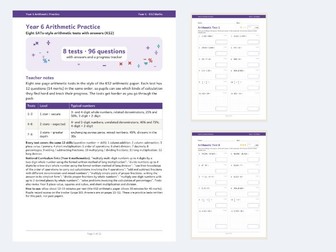
Eight one-page arithmetic tests in the style of the KS2 arithmetic paper: 96 questions (12 per test, 14 marks), rising in difficulty from 1 star to 3 stars, with squared working space, a progress tracker and full answers. Print-ready PDF, 12 pages. Short, regular arithmetic practice for Year 6. Every test has the same 12 question types in the same order, so pupils (and you) can see at a glance which calculations need more work. Each test covers: column addition and subtraction place value (× and ÷ by 10, 100 and 1,000) or squares and cubes short multiplication and short division order of operations decimals percentages of amounts adding and subtracting fractions, including mixed numbers multiplying fractions, or dividing a fraction by a whole number long multiplication (2 marks) long division (2 marks) What’s included (12-page A4 PDF): Teacher notes with the skill map, difficulty levels and National Curriculum links Tests 1–3 (1 star): friendlier numbers Tests 4–6 (2 stars): expected standard Tests 7–8 (3 stars): exchanging across zeros, mixed numbers and larger divisors Squared working space and an answer box for every question, with extra space for long multiplication and long division A progress tracker with a question-by-question skill key Answers for all 96 questions Every question and answer was generated and checked by computer. No question repeats, fractions in questions are in their simplest form, and the short and long division questions have whole-number answers. These are original practice tests written for this pack. They are not past papers. This resource was created with AI assistance (Claude), then checked in a separate review pass.
Great Fire of London Reading Comprehension KS1Quick View
_LukasP

Great Fire of London Reading Comprehension KS1

(0)
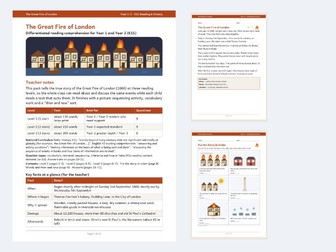
The true story of the Great Fire of London (1666) written at three reading levels for Year 1–2, with questions for each level, a picture-sequencing activity, vocabulary matching, a “then and now” firefighting sort and full answers. Print-ready PDF, 11 pages. The Great Fire of London is named in the KS1 history curriculum. This pack lets the whole class read about it together, with each child working at the right level. What’s included (11-page A4 PDF): Teacher notes with a level guide, National Curriculum links and a “key facts at a glance” table Level 1 (about 130 words, large print): 9 questions, including tick-box and true/false questions, plus a word bank Level 2 (about 210 words): 9 questions, including sequencing and inference Level 3 (about 300 words): 8 questions, including vocabulary, inference and true/false Put the Story in Order: 6 illustrated cards to cut out and sequence Words and Then-and-Now: vocabulary matching and a firefighting “1666 or today?” sort Answers and marking guidance for every question The history is checked against reference sources, including The Monument’s official history page and Pepys’s diary: 2nd September 1666 and Thomas Farriner’s bakery on Pudding Lane the dry summer and the east wind leather buckets, water squirts and fire hooks houses pulled down and gunpowder firebreaks Samuel Pepys burying his wine and Parmesan cheese about 13,200 houses destroyed Wren’s new St Paul’s the Monument (about 61 m tall, standing about 61 m from where the fire began) The texts say plainly that very few deaths were recorded at the time, and that historians think more people may have died. There is no graphic detail. Name/date line on every pupil page. British English spelling. Clear, dyslexia-friendly font (Andika). Simple original illustrations. This resource was created with AI assistance (Claude), then fact-checked and proofread in a separate review pass.
Christmas Around the World Comprehension KS2Quick View
_LukasP

Christmas Around the World Comprehension KS2

(0)
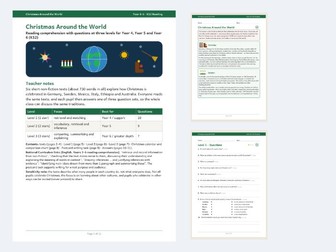
Six fact-checked non-fiction texts on Christmas in Germany, Sweden, Mexico, Italy, Ethiopia and Australia, with three levels of questions, a “Christmas calendar” sequencing task, a comparison chart, a postcard writing task and full answers. Print-ready PDF, 11 pages. A calm, informative end-of-term reading pack. Everyone reads the same six short texts (about 730 words in all) and answers one of three question sets, so the whole class can discuss the same traditions. What’s included (11-page A4 PDF): Teacher notes with a level guide, National Curriculum links and a sensitivity note Six illustrated texts: Germany: Christmas markets, Advent calendars, St Nicholas’ Day and Christmas Eve Sweden: St Lucia’s Day and saffron buns Mexico: Las Posadas, piñatas and the poinsettia Italy: the presepe and La Befana Ethiopia: Genna on 7th January, the 43-day fast and the netela Australia: a summer Christmas and Carols by Candlelight “Words to know” glossary boxes Level 1 (1 star): 10 questions, mainly retrieval, including a country-to-tradition matching task Level 2 (2 stars): 9 questions on vocabulary, retrieval and inference Level 3 (3 stars): 7 questions on comparing, summarising and explaining, with evidence The Christmas Calendar: put six celebrations in date order on a timeline, then complete a comparison chart Postcard from Around the World: a writing task with a success checklist Answers and marking guidance Every fact is checked against reference sources. The texts describe what many people in each country do, not what everyone does. Name/date line on pupil pages. British English spelling. Clear, dyslexia-friendly font (Andika). This resource was created with AI assistance (Claude), then fact-checked and proofread in a separate review pass.
Remembrance Day Reading Comprehension Y5/Y6Quick View
_LukasP

Remembrance Day Reading Comprehension Y5/Y6

(0)
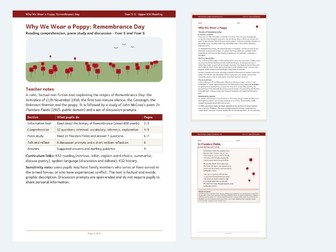
A calm, factual text about the history of Remembrance (the Armistice, the two-minute silence, the Cenotaph, the Unknown Warrior and the poppy), plus a study of “In Flanders Fields”, discussion prompts and full answers. Print-ready PDF, 9 pages. Explain why we wear a poppy with a respectful, accurate reading pack for Upper KS2. What’s included (9-page A4 PDF): Teacher notes with a sensitivity note (some pupils have family in the armed forces or have experienced conflict) “Why We Wear a Poppy”: about 600 words covering the First World War (including soldiers from India, the Caribbean and across the Empire), the Armistice at 11am on 11th November 1918, the first two-minute silence in 1919, the Cenotaph and the Unknown Warrior (1920), Moina Michael, Anna Guérin, the first Poppy Appeal (1921), and Remembrance today (red, white and purple poppies) 12 comprehension questions with marks: retrieval, vocabulary, inference, sequencing, true/false and explanation The full text of “In Flanders Fields” by John McCrae (1915, public domain), background notes and 7 poem questions (speaker, imagery, rhyme, the “torch” metaphor, repetition) “Talk and reflect”: 8 open discussion prompts and a written reflection for a class display Answers and marking guidance Name/date line on pupil pages. British English spelling. Clear, dyslexia-friendly font. This resource was created with AI assistance (Claude), then fact-checked and proofread in a separate review pass.
Gunpowder Plot Reading Comprehension Y3/Y4Quick View
_LukasP

Gunpowder Plot Reading Comprehension Y3/Y4

(0)
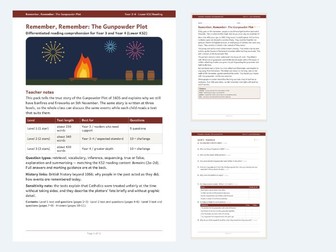
The true story of the 1605 Gunpowder Plot at three reading levels for Year 3–4, with questions, challenge tasks and full answers. Print-ready 11-page PDF. Why do we light bonfires on 5th November? This differentiated reading pack tells the true story of the Gunpowder Plot at three levels, so the whole class can read and discuss the same events. What’s included (11-page A4 PDF): Teacher notes with a level guide and page map Level 1 (about 230 words): 9 questions, plus a glossary Level 2 (about 340 words): 10 questions plus a diary-writing challenge Level 3 (about 430 words): 10 questions plus a “who wrote the letter?” reasoning challenge Question types: retrieval, vocabulary, inference, sequencing, true/false, explaining and summarising (KS2 content domains 2a–2d) Answer pages with marks and guidance for open questions Historically accurate: James I, Robert Catesby, the 36 barrels, the letter to Lord Monteagle, Guy Fawkes’s arrest around midnight on 4th November, “John Johnson”, Holbeche House, and the Yeomen of the Guard’s ceremonial search today. Catholic persecution is explained factually without taking sides, and the plotters’ fate is described briefly with no graphic detail. Name/date line on every pupil page. British English spelling. Clear, dyslexia-friendly font (Andika). This resource was created with AI assistance (Claude), then fact-checked and proofread in a separate review pass.
Diwali Reading Comprehension 3 Levels Y2–Y4Quick View
_LukasP

Diwali Reading Comprehension 3 Levels Y2–Y4

(0)
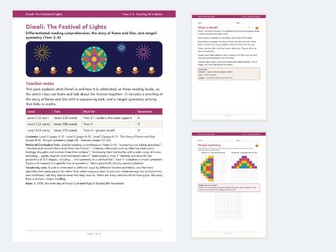
A respectful, fact-checked Diwali pack: an information text at three reading levels with questions, a retelling of the story of Rama and Sita with a sequencing task, a rangoli symmetry maths activity and full answers. Print-ready PDF, 12 pages. Diwali 2026 falls on Sunday 8th November (the main day, Lakshmi Puja). This pack explains what Diwali is and how it is celebrated, at three reading levels, so the whole class can learn about the festival together. What’s included (12-page A4 PDF): Teacher notes with a level guide, National Curriculum links and a sensitivity note Level 1 “What Is Diwali?” (about 110 words, large print): 8 questions Level 2 “A Row of Lights” (about 180 words): 9 questions. Covers the meaning of Deepavali, the lunar calendar, Lakshmi, diyas and rangoli, and Leicester’s celebrations Level 3 “Diwali Around the World” (about 270 words): 9 questions. Covers the five days, Bhai Dooj, the Sikh celebration of Bandi Chhor Divas (Guru Hargobind’s release from Gwalior Fort) and the Jain celebration of Mahavira The Story of Rama and Sita: a short, child-friendly retelling of a story from the Ramayana, with an illustration and “talk about it” prompts Rama and Sita questions: sequencing 6 events, character and inference questions Rangoli Symmetry: complete two patterns, one with a vertical and one with a horizontal mirror line, then design your own Answers for every question, including the completed symmetry patterns The texts describe what many people do rather than what everyone does, and they include Hindu, Sikh and Jain perspectives. No deities are pictured; the illustrations are simple lamps, rangoli and fireworks. Name/date line on pupil pages. British English spelling. Clear, dyslexia-friendly font (Andika). This resource was created with AI assistance (Claude), then fact-checked and proofread in a separate review pass.
Christmas Maths Mystery: Missing Golden BellQuick View
_LukasP

Christmas Maths Mystery: Missing Golden Bell

(0)
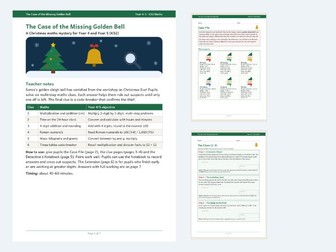
A UK-curriculum Christmas maths mystery. Pupils solve 6 multi-step clues (24-hour clock, rounding, Roman numerals, kg and g, times tables code-breaker) to rule out elf suspects and catch the thief. Includes a notebook, an extension and full worked answers. PDF, 7 pages. Santa’s golden sleigh bell has vanished on Christmas Eve! Six elves are suspects. Each clue is a multi-step maths problem, and each answer rules out one suspect until only the thief is left. A final times-tables code-breaker confirms who did it. Written for the England National Curriculum (Year 4–5), using £, metric units, the 24-hour clock and British spelling. It is not a US “grade” resource. What’s included (7-page A4 PDF): Teacher notes with curriculum objectives and timing (45–60 minutes) Case file with 6 illustrated suspect cards 6 clues: multiplication and addition (cm), time intervals on the 24-hour clock, 4-digit addition and rounding to the nearest 100, Roman numerals to 100, converting kg and g, and a code-breaker using ×/÷ facts to 12 × 12 Detective’s Notebook for recording answers and crossing out suspects Extension page (rounding to 1,000, a Roman numeral year, minutes between times, “make your own clue”) Answers with full working and common mistakes to watch for The logic has been checked by computer: each of the first five clues rules out exactly one new suspect, and exactly one elf remains. This resource was created with AI assistance (Claude), then fact-checked and proofread in a separate review pass.
Autumn & Bonfire Night SPaG Pack Y3/Y4Quick View
_LukasP

Autumn & Bonfire Night SPaG Pack Y3/Y4

(0)
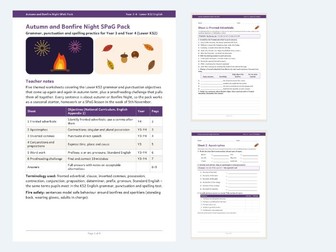
Six seasonal grammar and punctuation sheets for Lower KS2: fronted adverbials, apostrophes, inverted commas, conjunctions and prepositions, word work, and a 10-mistake proofreading challenge, with full answers. Print-ready PDF, 9 pages. Every sentence in this pack is about autumn or Bonfire Night, making it ideal for the week of 5th November, a seasonal starter or homework. What’s included (9-page A4 PDF): Sheet 1 – Fronted adverbials (Y4): identify them, add the comma, choose from a word bank, write your own Sheet 2 – Apostrophes: contractions; singular, plural and irregular plural possession (the birds’ nests, the children’s hats); correct or wrong? Sheet 3 – Inverted commas: add speech marks, then fully punctuate direct speech Sheet 4 – Conjunctions and prepositions (Y3): time, place and cause Sheet 5 – Word work: prefixes (un-, dis-, mis-, re-), a or an (including “a useful” and “an hour”), pronouns for clarity, Standard English (we were, I did) Sheet 6 – Proofreading challenge: find and fix 10 mistakes in Ruby’s Bonfire Night recount Teacher notes and answers, including acceptable alternatives Uses KS2 GPS test terminology. The sentences model fire safety (standing back, gloves, adults in charge). This resource was created with AI assistance (Claude), then fact-checked and proofread in a separate review pass.
Autumn Maths Word Problems & Reasoning Y2Quick View
_LukasP

Autumn Maths Word Problems & Reasoning Y2

(0)
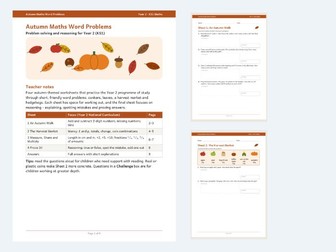
Four autumn-themed Year 2 maths sheets: three problem-solving sheets (add and subtract 2-digit numbers, £ and p with change, cm and m, ×2 ×5 ×10, fractions of amounts) and a “Prove It!” reasoning sheet, with full answers. Print-ready PDF, 9 pages. Friendly autumn word problems about conkers, leaves, a harvest market and hedgehogs. They cover the Year 2 National Curriculum and give children generous space for working out (large boxes sized for Year 2 handwriting). What’s included (9-page A4 PDF): Sheet 1 – An Autumn Walk: adding and subtracting 2-digit numbers, a missing-number problem, time (half past), and a three-number challenge Sheet 2 – The Harvest Market: an illustrated price list in pence, finding totals, change from £1, 100p = £1, making 45p with exactly 3 coins, and a “find two ways to make 65p” challenge Sheet 3 – Measure, Share and Multiply: length in cm, comparing cm and m with <, > and =, the 2, 5 and 10 times tables, sharing, and ¼, ⅓ and ¾ of amounts Sheet 4 – Prove It!: equivalence (½ and 2/4), spot the mistake, odd one out, commutativity arrays, and always/sometimes/never Teacher notes and answers with short explanations Every answer has been checked by computer, including the claims that 20p + 20p + 5p is the only 3-coin way to make 45p and that there are exactly two ways to spend 65p. This resource was created with AI assistance (Claude), then fact-checked and proofread in a separate review pass.