Calm Corner Posters - SEMH EYFS KS1Quick View
LexAndFoxPress

Calm Corner Posters - SEMH EYFS KS1

(0)
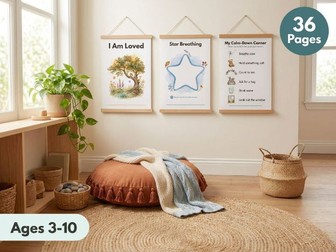
Thirty-four calm corner posters covering the whole regulation sequence - breathing, grounding, naming the feeling, self-kindness, and being ready to return to the group. Most calm corner sets stop at calming down. This one includes the return, which is the part a teacher actually has to manage. What the set covers Breathing, 8 posters - star, wave, spiral, box, rainbow, balloon belly, flower and candle, feather. Finger-traceable paths Grounding, 4 - five senses grounding, my calm place, listening ears, something soft to hold Feelings, 6 - a feelings garden of eight core feelings, how big is my feeling, where do I feel it, feelings come and go Affirmations, 6 - I am brave, I can do hard things, mistakes help me grow, I am still learning Self-kindness, 4 - talk to yourself like a friend, it is okay to ask for help, rest is not wasted time, I do not have to be perfect Reset and return, 6 - welcome to the calm corner, my calm-down choices, when I feel angry I can, when I feel worried I can, ready to return What children do Trace a breathing path with a finger to slow their breath down Name a feeling, and locate where in the body they notice it Work through the five senses to ground themselves Choose from a calm-down list when a big feeling arrives Check their body and breath before rejoining the group Why teachers and parents use this set Pre-readers use the illustrations, older children read the text, so one set covers a mixed class The sequence is complete: regulate, name, be kind, return Suits a classroom calm corner, a nurture space, a quiet area or a bedroom A setup guide for putting the corner together Soft botanical watercolour, so the corner looks calm rather than busy Notes on printing Thirty-four posters plus a setup guide. Print on A4 and laminate for durability, or frame a smaller selection. Instant PDF download, 36 pages. A4, with US Letter also included.
Recycling - Reduce Reuse Recycle KS1 KS2Quick View
LexAndFoxPress

Recycling - Reduce Reuse Recycle KS1 KS2

(0)
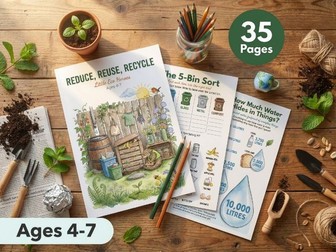
Eight materials followed from where they come from to where they go - a recycling and sustainability topic for KS1 and KS2, with a real home waste audit and tally-mark data. Children sort, survey, count and interview rather than colour in a happy planet. The pack ends with a bird feeder built from a plastic bottle. What children will explore Materials - paper, plastic, glass, metal, food waste and textiles, one spotlight each Where waste goes - the three Rs, a bottle’s journey in six panels, decomposition times Water and energy - the hidden water in everyday things, and saving electricity Data handling - a home waste audit in tally marks, and counting by category Enquiry - a family survey, and interviewing an adult about life before recycling Taking action - an eco checklist across home, school and outdoors What’s inside - 35 pages The three Rs explained, and eight material spotlight pages with four facts each Five-column waste sort with twenty items, and a bin mistakes page Decomposition time ladder, from a banana peel to materials that never break down Water footprint scale comparison and upcycling transformation pairs The bottle’s journey sequencing and a three Rs pattern set Home waste audit, family eco survey, interview an adult Count the recyclables, I spy at the recycling centre, texture detective cards Design your eco-home, ten illustrated fact cards, eco word tracing Lily’s Big Day story with comprehension questions Neighbourhood rubbish observation walk and an eco hero journal Bird feeder craft in six steps, earth promise pledge, certificate Answer key included Why teachers and parents love this pack Systems thinking: where a material comes from as well as where it ends up The waste audit produces real data to tally, count and talk about Survey and interview pages bring families into the topic Finishes with something made, not just something known Watercolour illustrations throughout Kerbside collections differ from council to council - check your local scheme before the sorting pages. Instant PDF download, 35 pages. US Letter size - on A4, print at fit to page.
Going to the Doctor - GP Visit EYFS KS1Quick View
LexAndFoxPress

Going to the Doctor - GP Visit EYFS KS1

(0)
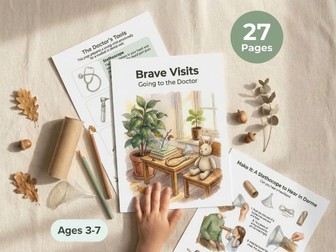
Preparing a child for a visit to the doctor - a picture sequence of what happens, six tools explained at child height, and four things to build and try at the kitchen table. The approach is demystification rather than distraction. A child who has made their own stethoscope and listened to a heartbeat walks in knowing what the real one is for. What children will explore What happens - two picture sequences through a check-up, from waiting room to goodbye The tools - six cards covering what each one looks like, does, and feels like How it feels - naming the feeling, and choosing calming strategies in advance Rehearsal - practising a check-up on a teddy before the real appointment People who help us - who greets you, who checks you, and why The four things to make A funnel stethoscope, to hear a grown-up’s heartbeat through the tube Warm water in one palm and cool in the other, to feel what a temperature check notices A gentle hand-pressure test, for the sensation of an ear check A message rolled inside a cardboard tube, showing why a doctor looks inside ears and throats Everything comes from a kitchen cupboard. Nothing to buy. What’s inside - 27 pages Two what-happens picture sequence pages Six doctor tool cards Four build-and-try experiment pages How I might feel, and a calm plan the child chooses themselves Practise on a teddy page I spy in a busy waiting room, with ten things to find Put it in order - eight steps of a check-up to cut out and sequence My brave tree, for something brave already done Adult guide pages with honest answers and language to use Why teachers and parents love this pack It says plainly that every room looks a little different from the pictures Nervous and brave are allowed to be true at the same time Pictures carry every child page, with captions read aloud, so pre-readers work independently The calm plan is chosen before it is needed, not imposed during the visit Useful for a child facing appointments, and for a people who help us topic Instant PDF download, 27 pages. A4 and US Letter. Print as many copies as you need for your class or family.
Mountains - Physical Geography KS1 KS2Quick View
LexAndFoxPress

Mountains - Physical Geography KS1 KS2

(0)
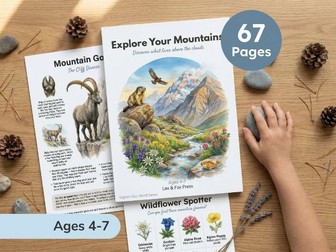
Mountain habitats from valley meadow to snow line - altitude zones, glaciers, contour maps and seven mountain species, across 67 pages for KS1 and KS2 geography. Half the pack is indoor map and diagram work, half is built for a walk, with twenty-four pocket cards to take out. What children will explore Altitude zones - a diagram of what lives where as a mountain rises Landforms - how a glacier carves a valley, and what rock layers record Rivers - tracking a stream from snowmelt down to the valley Map skills - reading a real contour map, and decoding trail markers Adaptation - seven species and the problems each has solved Mountain safety - weather, altitude, wildlife and trail rules Meet the mountain species Ibex - split hooves with hard rims and soft pads, for grip on rock Golden eagle - eyesight several times sharper than ours Marmot - an underground engineer that hibernates for up to eight months Mountain hare - white in winter, brown in summer Edelweiss - dense white hairs that work as its own sun protection Alpine salamander - a gestation of two to three years, among the longest on land Pika - cuts and dries grass into haypiles for winter What’s inside - 67 pages Seven species spotlights, each with a try-this-at-home activity Altitude zone diagram, stream source tracker, glacier formation Contour map challenge, trail marker decoder, animal sign search Wildflower spotter for eight real mountain flowers Weather watching, rock layers, and an echo investigation Mountain safety pages and a ten-question quiz I spy, mistake inspector, zoom in, odd one out, counting, word search Cut-and-build mountain scene and ten outdoor challenge cards Twenty-four pocket guide cards, discoveries map, certificate Five-page answer key Why teachers and parents love this pack Contours, glaciation and altitude zones give KS2 the real geography Independence badges on every page, and an I have learnt line to reflect on Pocket cards work on a school trip, a residential or a walk Nothing to prepare and no extra materials needed Field-guide watercolour illustrations, accurate enough to identify from Instant PDF download, 67 pages. US Letter size - on A4, print at fit to page. Print as many copies as you need for your class or family.
Growth Mindset - Thinking Traps KS1 KS2Quick View
LexAndFoxPress

Growth Mindset - Thinking Traps KS1 KS2

(0)
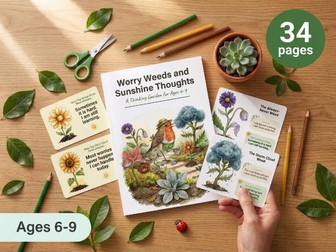
Eight unhelpful thinking patterns drawn as garden weeds for children to spot, name and replace with a sunshine thought - a growth mindset and mental wellbeing topic for KS1 and KS2. The garden metaphor does the work: weeds are sneaky rather than frightening, and every one has a sunshine thought to plant in its place. What children will explore Naming the pattern - eight thinking traps, each with its own weed character Spotting it in context - real scenarios, starting obvious and getting subtler Reframing - a sunshine thought for every weed, on cut-out cards Strategies that are theirs - building a personal weed-busting toolkit Noticing over time - a weekly tracker for the weeds they catch The eight weeds Always-Never - you always fail and will never get it right Storm-Cloud - one small worry becomes something terrible Fortune-Teller - predicts the worst before anything happens Mind-Reader - decides what other people are thinking Blame-Me - takes the blame even when it is not fair Grey-Filter - hides the good and shows only the bad Should Vine - demands perfection every time Feelings-Are-Facts - treats a worried feeling as proof What’s inside - 34 pages Eight illustrated weed cards with their sunshine thought answers Scenario pages that build from easy to subtle Weed or sunshine sorting mat with fourteen cut-out thought bubbles The Garden Path board game with a spinner, for two to four players Design your own weed for a worry the child has noticed Weed-busting toolkit page and a reusable weekly tracker Shrink the weed visual exercise and a sunshine garden celebration page Two-page adult guide with word-for-word scripts for every weed Why teachers and parents love this pack Goes past naming feelings to recognising and reframing the thought itself The scripts give an adult exact words for a bedtime, playground or after-a-mistake conversation Game, cards, sorting mat and tracker mean it is used repeatedly, not filed Botanical watercolour illustrations throughout, in keeping with the garden Instant PDF download, 34 pages. A4 and US Letter. Print on card for the weed cards and board game. Print as many copies as you need for your class or family.
Seaside and Rockpools - Coasts KS1 KS2Quick View
LexAndFoxPress

Seaside and Rockpools - Coasts KS1 KS2

(0)
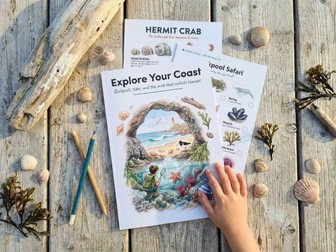
Rockpool identification, tide tracking and a one-metre beach transect - a 62-page seaside and coasts topic for KS1 and KS2, built for real fieldwork and wet afternoons. Half the pack goes outdoors with a clipboard, half works at a table - a coastal topic that survives British weather. What children will explore Rockpool life - seven creatures to identify, and a food chain from plankton to seal Tides - a tide clock log tracking high and low water across a full day Fieldwork - mark a one-metre transect, count what lives in it, keep a journal Classification - sort shells into bivalves and gastropods, label fish anatomy Coasts and people - lighthouses, beach huts and a marine litter tally Meet the rockpool Hermit crab - swaps shells, and queues up by size to do it Starfish - regrows its arms and digests food outside its body Limpet - grips like glue and returns to exactly the same spot Sea anemone - looks like a flower, hunts like a predator Oystercatcher - a beak used like a chisel on mussels and cockles Seaweed - not a plant at all, and the fastest growers add half a metre a day Puffin - up to sixty-two fish in one beak, nesting in clifftop burrows What’s inside - 62 pages Rockpool identification chart, hidden creature search, cut-out rockpool scene Tide clock log, seven-day weather and tide tracker, one-metre transect survey Shell sorting, coastal plant identification, fish anatomy and food chain Press real seaweed, grow salt crystals, make an ocean in a bottle Sandcastle engineering, pebble stacking, beach clean tally Two-day field journal, six specimen sketches, comprehension and vocabulary Spot the difference, odd one out, close-ups, what is wrong here, word searches Design a lighthouse and a beach hut Tear-out pocket cards, ten challenge cards and a certificate Why teachers and parents love this pack A real transect and tide log, so KS2 fieldwork is done rather than described Every page is tagged by independence level - solo, shared, or start together British species throughout, including oystercatcher, limpet and puffin Pocket cards tear out for a coach journey or a class trip to the coast Instant PDF download, 62 pages. A4 and US Letter. Print as many copies as you need for your class or family.
Scotland - Highlands Geography KS1 KS2Quick View
LexAndFoxPress

Scotland - Highlands Geography KS1 KS2

(0)
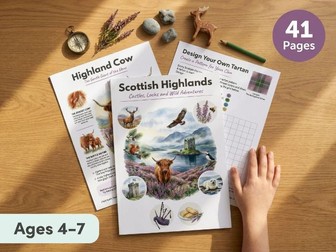
A region of the United Kingdom studied properly - Highland wildlife, castles, lochs, tartan, peat bogs and Gaelic, for KS1 and KS2 geography. Six Highland animals get a field-guide spotlight, and the pack is guided by Bramble the pine marten, a species that lives almost nowhere else in Britain. What children will explore A UK region - a hand-drawn map of Scotland, with landmarks matched to places Highland wildlife - six species, their habitats, and size comparisons Castles and clans - label a medieval castle, then design one of their own Culture and craft - tartan design on a colour grid, Harris Tweed, the bagpipe Weighing evidence - the Loch Ness question, argued both ways Gaelic - eight words traced, with their meanings Meet the Highland animals Highland cow - the gentle giant of the glens Golden eagle - almost every British pair nests in Scotland Red deer - the monarch of the glen, Britain’s largest land mammal Red squirrel - most of Britain’s remaining population lives here Atlantic puffin - the clown of the sea cliffs Grey seal - Britain holds a large share of the world’s population What’s inside - 41 pages Six animal spotlight pages and a habitat sorting activity Map of Scotland with landmark matching, and a Scottish food sort Highland Games matching and a tartan design grid Peat bog cross-section to label, and Harris Tweed sequencing Bagpipe parts to label, castle parts to label, design your own castle Loch Ness evidence page, Gaelic word tracing, animal size comparison I spy glen scene, eight mistakes, eight differences Counting and addition, comprehension story, write a postcard Twelve-piece cut-out glen scene, landscape colouring, certificate Two-page answer key Why teachers and parents love this pack A genuine UK region study, with Scottish species and Scottish industry Peat bogs and conservation bring real science into a geography topic The Loch Ness page teaches children to weigh evidence and decide for themselves Field-guide watercolour illustrations, accurate enough to identify from Works in colour or black and white Instant PDF download, 41 pages. US Letter size - on A4, print at fit to page. Print as many copies as you need for your class or family.
Pond Dipping - Habitats and Keys KS1 KS2Quick View
LexAndFoxPress

Pond Dipping - Habitats and Keys KS1 KS2

(0)
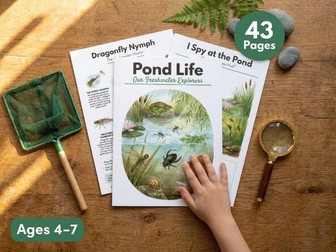
A pond dipping pack with a classification key, a food web and recording sheets - freshwater habitats for KS1 and KS2, ready for a garden pond, a park lake or a stream. The identification flowchart is a working dichotomous key, which puts this straight into the Year 4 classification objective rather than beside it. What children will explore Classification - an ID flowchart to identify real finds from a net Habitat zones - sorting creatures by surface, middle water and pond bottom Food webs - who eats whom, built up rather than given Adaptation - six creatures and how each one solves living in water Water quality - comparing a healthy pond with an unhealthy one Seasonal change - tracking one pond across the year Meet the pond creatures Dragonfly nymph - a hinged mouthpart that shoots out to seize prey Pond snail - a spiral shell, and a lung that sends it up for air Newt - an amphibian that can regrow a lost limb Water boatman - rows with oar-like legs and sings underwater Diving beetle - carries its own air supply beneath its wing cases Pond skater - stands on the surface film without breaking it What’s inside - 43 pages Six creature spotlight pages and a cut-out pond scene to build Creature identification flowchart and a pond dipping recording sheet Pond zone sorting and a food web to complete Healthy and unhealthy pond comparison, and a seasonal pond calendar Surface tension experiment with a paperclip, linked to the pond skater Paper water lily that opens on water I spy, zoom in, shadow matching and mistake inspector Reading, writing, tracing, counting, sorting, sequencing and colouring Answer key included Why teachers and parents love this pack A real classification key, so Year 4 children identify rather than label Built to go outside, with recording sheets for an actual pond visit The surface tension experiment explains the pond skater on the next page Field-guide watercolour illustrations, accurate enough to identify from Adult supervision is needed near water. In the UK, great crested newts are a protected species - look, record, and do not handle. Instant PDF download, 43 pages. A4 and US Letter. Print as many copies as you need for your class or family.
London - UK Capital City Topic KS1 KS2Quick View
LexAndFoxPress

London - UK Capital City Topic KS1 KS2

(0)
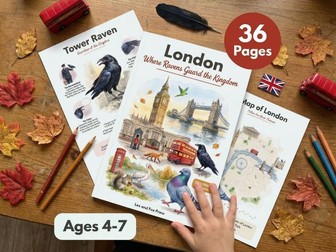
London as a capital city topic for KS1 and KS2 - landmarks, the Thames, an underground route map, the Great Fire, and the six wild animals that actually live in the city. Six spotlight pages cover the wildlife a child could genuinely see on a London visit, from the Tower ravens to the parakeets in the park. What children will explore A capital city - landmarks, the river, and how people move around a city Route finding - following coloured lines on a simplified underground map Landmark comparison - heights from a child up to The Shard Urban habitats - sorting Thames creatures by in, beside or above the water History - the Tower of London, the Crown Jewels and the Great Fire of 1666 Animal signs - working out which animal left which clue Meet the London wildlife Tower raven - the birds the old legend says guard the kingdom Red fox - hunting the streets after dark Ring-necked parakeet - a bird native to South Asia, now nesting in the parks Mute swan - the Thames bird the Crown has claimed for centuries Grey squirrel - a North American species, now the park regular Pelican - in St James’s Park since 1664, a gift from the Russian ambassador What’s inside - 36 pages Six wildlife spotlight pages, each with a try-this challenge Simplified underground map with route-finding between stations Tower of London parts to label, using a word bank Landmark height comparison and a London transport sort Thames habitat sorting and an animal clue investigation Comprehension on the Tower ravens and the Great Fire of London Counting, sorting and spot the difference on a busy street scene Trace eight London words, draw a double-decker bus step by step Tower Bridge colouring, a wearable crown to make, a scone recipe Write a postcard home, a reflection page and a certificate Answer key included Why teachers and parents love this pack A real capital city study, with history and habitats inside the geography The Great Fire comprehension links straight to the KS1 history topic Wildlife children can actually look for on a school trip or a family visit Watercolour illustrations throughout, with real landmarks Instant PDF download, 36 pages. A4 and US Letter. Print as many copies as you need for your class or family.
Volcanoes - Physical Geography KS1 KS2Quick View
LexAndFoxPress

Volcanoes - Physical Geography KS1 KS2

(0)
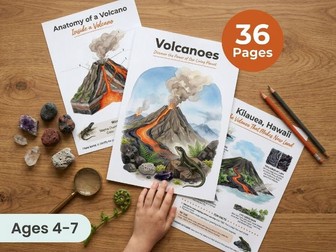
Inside a volcano, the layers of the Earth, four volcano types and eight real volcanoes to locate on a world map - a physical geography topic for KS1 and KS2. Volcanoes are framed through science, recovery and new land rather than disaster - wonder rather than worry for a younger class. What children will explore Structure - label a volcano cross-section and the layers of the Earth Eruption - sequence the five stages, and identify what comes out Classification - four volcano types by shape, and active, dormant or extinct Igneous rocks - four rocks formed from fire, and how melted rock sets Location - eight famous volcanoes matched to their place on a world map The eight volcanoes, and one on Mars Kilauea, Hawaii - the gentle giant that builds brand-new land Mount Fuji, Japan - the near-perfect cone, painted for centuries Mount Etna, Italy - the mountain that never sleeps Eyjafjallajokull, Iceland - fire beneath the ice Vesuvius, Italy - a Roman town preserved in ash Krakatoa, Indonesia - the loudest sound in recorded history Mount St Helens, USA - the mountain that changed shape Olympus Mons, Mars - the largest volcano in the solar system What’s inside - 36 pages Volcano cross-section and Earth layers labelling Eruption sequencing, volcanic close-up identification, type sorting Active, dormant or extinct sorting, and world map matching for all eight Igneous rock identification and a rock-cooling sequence Size comparison against a house and Mount Everest Volcano story with comprehension questions, plus word tracing Counting scene, odd one out and a volcanic maze Cut-and-layer volcano cross-section model to build A bicarbonate of soda eruption to run and observe Junior volcanologist certificate, cut-out badge and answer key Why teachers and parents love this pack The eruption experiment states what the model does not show - a chemical reaction, not magma Eight real volcanoes, so the mapping work uses places children can look up Links KS2 geography to the science rocks topic through the igneous pages Watercolour illustrations throughout, drawn from the real mountains
Continents and Oceans - Map Skills KS1Quick View
LexAndFoxPress

Continents and Oceans - Map Skills KS1

(0)
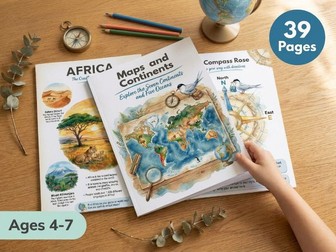
Name and locate the seven continents and five oceans, then use a compass, read a legend and draw a map - a complete map skills topic for KS1 and KS2. Each continent gets an illustrated spotlight page with its landmarks and signature animals, and the map work builds from labelling to designing a map of their own. What children will explore Continents and oceans - all seven and all five, named, located and labelled Compass directions - a compass rose page, then north, south, east and west in use Reading a map - legends, keys and symbols, including making their own Globe and flat map - why a flat map stretches the land at the top and bottom The seven continents Africa - landmarks, habitats and wildlife Antarctica - the frozen continent Asia - the largest continent Europe - countries, borders and landmarks North America - from the Arctic to the tropics Australia and Oceania - the island continent South America - rainforest, mountains and coast What’s inside - 39 pages Seven continent spotlight pages with facts, landmarks and animals Label the continents and oceans on a watercolour world map Compass rose teaching page and a treasure map to navigate Map legend comprehension, then design your own map key Globe and flat map comparison, continent silhouette matching Hemisphere sorting, landmark matching and where am I clue puzzles I spy world map, cut and place animals, design your own island Continent and ocean name tracing for handwriting Number cipher decoder, Around the World board game and a certificate Answer key included Why teachers and parents love this pack Covers the KS1 geography objectives directly - continents, oceans, compass, maps Clear instructions on every page, so sheets work as independent or cover tasks The map work progresses: label, read, interpret, then create An Arctic tern guides each page, the bird that migrates pole to pole Watercolour illustrations throughout, with real landmarks and animals Instant PDF download, 39 pages. A4 and US Letter. Print as many copies as you need for your class or family.
Christmas Around the World KS1 KS2Quick View
LexAndFoxPress

Christmas Around the World KS1 KS2

(0)
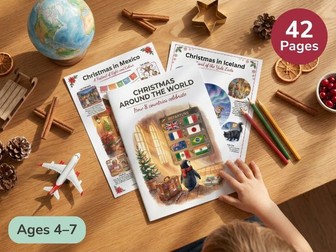
Eight countries, eight very different Christmases - a geography and festivals topic for KS1 and KS2, with a travel passport to stamp at every stop. Children compare each country with how their own family or class celebrates, so the learning lands close to home as well as far away. What children will explore Place and location - eight countries across five continents, north and south Festivals and celebrations - why the date, the food and the gift-giver change Comparison - each country set beside the children’s own traditions Maths and literacy - counting, timelines, symmetry, word tracing in eight languages The eight countries Japan - Christmas means fried chicken and strawberry sponge cake Australia - a summer Christmas, with Santa arriving at the beach Mexico - Las Posadas, lanterns and pinatas Sweden - Saint Lucia, candlelight and saffron buns Germany - where the printed Advent calendar began Ethiopia - Ganna, celebrated on 7 January Philippines - the longest Christmas season in the world Iceland - the thirteen Yule Lads and the Christmas Book Flood What’s inside - 42 pages Eight illustrated country spotlight pages and a passport to stamp A Christmas date timeline from September to January Pinata counting, Advent calendar maths and a global counting challenge Saint Lucia crown and Parol lantern to design and make Ethiopian cross symmetry pattern and a Yule Lad countdown chart Food sorting, odd one out, true or myth, spot the difference Christmas words traced in eight languages, plus a colouring scene Design your perfect Christmas page, explorer certificate and answer key Why teachers and parents love this pack One topic covers geography, culture, maths and literacy in December Cultural rather than devotional - the focus is how families celebrate Every country page ends with a comparison to the children’s own Christmas Watercolour illustrations throughout, with a penguin guide on every page Instant PDF download, 42 pages. A4 and US Letter. Print as many copies as you need for your class or family.
Playdough Mats - 10 Sets Fine Motor EYFSQuick View
LexAndFoxPress

Playdough Mats - 10 Sets Fine Motor EYFS

(0)
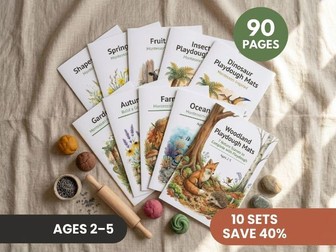
Ten themed playdough mat sets for EYFS fine motor work - rolling, pinching and pressing into painted nature scenes. Laminate once and they last for years. Each mat has one main silhouette to build plus smaller outlines to fill, so a child works from a large shape down to small precise ones in a single sitting. The ten sets Woodland - fox, hedgehog, rabbit, owl, squirrel, fawn and badger on a forest floor Garden - butterfly, ladybird, snail, frog, bee, hedgehog and robin in a flower bed Minibeasts - butterfly, ladybird, beetle, ant, dragonfly, grasshopper, caterpillar Ocean - octopus, turtle, whale, jellyfish, seahorse, clownfish and dolphin Farm - cow, pig, horse, sheep, chicken, duck and goat Dinosaur - T-rex, Triceratops, Stegosaurus, Brachiosaurus and more Autumn - pumpkins, acorns, toadstools and falling leaves Spring - blossom, bees, nests, rain, tulips and new shoots Fruit - strawberry, apple, orange, watermelon, pear and more Shapes - circle, square, triangle, star, heart, diamond and oval What children are practising Pincer grip - rolling and pinching small pieces to fill the smaller outlines Bilateral coordination - one hand steadying while the other works Hand and finger strength - flattening, pressing and squeezing Vocabulary - naming animals, habitats and shapes while they build Comparison - talking about size, number and which creature lives where What’s included Ten separate sets, each with a cover, a how-to-use page and its mats A natural playdough recipe in every set, using turmeric, cocoa, beetroot and spirulina Landscape format, printable on A4 or US Letter at 300 dpi Why teachers and parents love this collection Ten themes means a different mat each week without repeating Laminate or slip into a wipe-clean pocket and reuse across whole cohorts Painted nature scenes rather than flat outlines, so the finished mat looks like something Themes match the topics already running in an early years room Instant download, ten PDF sets. A4 and US Letter, landscape.
Kindness and Friendship - PSHE EYFS KS1Quick View
LexAndFoxPress

Kindness and Friendship - PSHE EYFS KS1

(0)
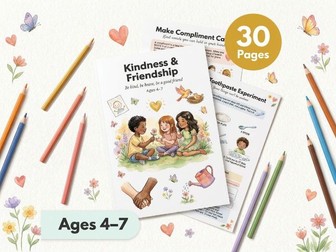
Kindness, sharing, empathy, including others and the weight of unkind words - a caring friendships topic for EYFS and KS1, with challenges that leave the page. Two things make it stick. A toothpaste demonstration shows why unkind words cannot be taken back, and the scavenger hunt ends by asking a child to do one kind thing nobody sees. What children will explore What kindness is - noticing that someone needs help, and choosing to act Sharing and turn-taking - sharing as making something bigger, not losing something Empathy - four scenarios asking how someone feels and what you could do Being a good friend - a friendship recipe with ingredients, measured out Including others - the empty chair, and the words that get someone into the game Kind and unkind words - the toothpaste squeezed out, and the attempt to put it back What’s inside - 30 pages Six theme pages, each with a hands-on challenge Ripple diagram following one kind act outward through four rings Sort ten actions into kind and unkind Kindness chain patterns, cause and effect sequences Six compliment cards to write on, cut out and give to real people Four empathy scenarios and six friendship quality cards Toothpaste demonstration with a journal page afterwards Design a kindness cape, with empathy vision and listening ears Build a friendship garden where the flowers are qualities and the gardener is the child Playground search, word tracing, a reading passage and writing Ten-act kindness scavenger hunt, ending with one nobody sees Kindness champion certificate Why teachers and parents love this pack Maps onto caring friendships and respectful relationships in the statutory PSHE strands The toothpaste lesson lands without a lecture, which is the point Compliment cards are the one craft designed to leave the child’s hands The final anonymous act teaches kindness that is not performed for credit Diverse, warmly painted children throughout Instant PDF download, 30 pages. A4 and US Letter. Print as many copies as you need for your class or family.
Christmas STEM Science Experiments KS1Quick View
LexAndFoxPress

Christmas STEM Science Experiments KS1

(0)
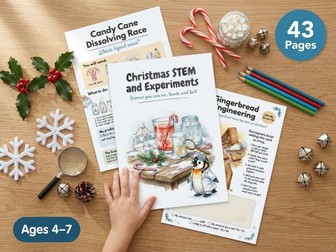
Fourteen real Christmas science experiments for KS1, with a prediction page, a results page and the working scientifically method built into every one. Chemistry, physics and engineering from kitchen and classroom materials, with a full checklist. No specialist equipment. What children will explore Working scientifically - predict, test, observe, record, conclude Chemistry - dissolving, acids and bases, chromatography, crystals, density Physics - static electricity, magnetism, insulation, sound absorption Engineering - structures, stability and forces, in three challenges The fourteen experiments Candy cane dissolving race - which liquid dissolves sugar fastest Candy cane colour separation - chromatography on filter paper Crystal snowflake growing - with a three-day observation journal Snow volcano - an acid and base reaction Cranberry colour magic - juice as a natural pH indicator Density column - honey, syrup, water and oil, then drop objects in Static tinsel - a balloon, a woolly jumper, no touching Insulation test - which material keeps ice frozen longest Frozen bubbles - ice crystals forming on a sub-zero morning Magnetic Christmas - testing eight objects with a magnet Jingle bell sound test - which materials absorb vibrations Gingerbread engineering - build a house that stands up Marshmallow towers - cocktail sticks, marshmallows, a wide base Balloon sleigh race - Newton’s third law along a string What’s inside - 43 pages Fourteen experiment cards with method, prediction and results pages Sorting across chemistry, physics and engineering, plus vocabulary tracing Comprehension story, sequencing, true-or-myth and equipment labelling Shadow matching, a counting scene and a laboratory colouring page Design your own experiment, a progress chart and an answer key Why teachers and parents love this pack A prediction is recorded first, so the method is taught, not the result alone Independence badges mark what needs an adult and what children can run alone Materials come from the cupboard - vinegar, marshmallows, balloons, bells Suits a December science club, an end-of-term carousel or a holiday project Instant PDF download, 43 pages. A4 and US Letter. Print as many copies as you need for your class or family.
Think and Move — Brain Body Coordination Activities Printable Ages 5-8Quick View
LexAndFoxPress

Think and Move — Brain Body Coordination Activities Printable Ages 5-8

(0)
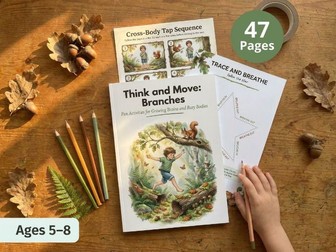
Brain breaks and movement activities for KS1 and KS2. 47 pages of cross-lateral, bilateral, balance, memory and breathing activities, with trackers and cut-out cards. Five kinds of activity Cross-lateral - cross-crawl march cards, nature path tracing, cross-body tap sequences, and an opposite commands game Bilateral - mirror drawing, double doodle, bilateral tracing paths, finger gym warm-up and rhythm cards Balance - balance poses, heel-to-toe walking, spin and spell, freeze dance, a challenge ladder and a yoga sequence Working memory - cut and sort, matching pairs, Kim’s game, sequence recall, story sequence jumble, listen and draw, pattern continuation Breathing - trace and breathe along a star, spiral and waves, square breathing, 5-4-3-2-1 grounding and a body scan What’s inside - 47 pages Cross-crawl cards for marching while counting and spelling Mirror drawings of a butterfly, a sunflower and an oak leaf Double doodle - both hands drawing matching shapes at once Six-exercise finger gym for hands and wrists Eight rhythm cards using clap, tap and drum patterns Four balance poses - tree, flamingo, eagle arms and eyes closed Cut and sort twelve animals into water, land and air Kim’s game, sequence recall cards, story sequence jumble, remember and draw Trace-and-breathe paths, square breathing and a grounding exercise Body scan to colour, noticing where energy, tension and calm sit Brain Fitness Passport - a stamp for each category completed Brain Fitness Tracker - a four-week chart across six activity areas Brain Break Mini-Cards - six quick cards to cut out and keep Parent and educator guide explaining what each category trains Answer key and certificate Why teachers use this pack Built around cross-lateral, bilateral and vestibular movement, the categories used in classrooms and OT settings Works as a two-minute reset between lessons or as a full session The mini-cards live on a lanyard or in a drawer for the moment a class needs moving Genuinely useful for wiggly learners, wet playtimes, transitions and nurture groups No screens and no equipment - print, grab a pencil, and move The passport and tracker let children see their own progress across four weeks Watercolour illustrated with a red squirrel guide throughout This is an educational activity pack. It is not intended to diagnose, treat or replace professional assessment or therapy. Instant PDF download, 47 pages. Print as many copies as you need for your class or family.
Dinosaurs & Fossils | T-Rex Triceratops Stegosaurus | Ages 4-7 | Make a FossilQuick View
LexAndFoxPress

Dinosaurs & Fossils | T-Rex Triceratops Stegosaurus | Ages 4-7 | Make a Fossil

(0)
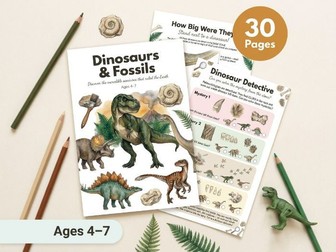
Dinosaur and fossil pack for KS1 and lower KS2. 30 pages of real palaeontology - five dinosaurs, how fossils form, dental evidence, and a fossil-making craft with clay. What children will explore How fossils form - the four stages from death to discovery, and the difference between body fossils, trace fossils and amber Reading the evidence - sharp serrated teeth mean meat, flat grinding teeth mean plants, and footprints tell you whether an animal walked or ran Mary Anning - who found an ichthyosaur at the age of twelve Deep time - Stegosaurus lived eighty million years before T-Rex. You are closer in time to T-Rex than Stegosaurus was Birds are dinosaurs - the robin on the feeder is a direct descendant of Velociraptor Meet five dinosaurs Tyrannosaurus rex - the strongest bite of any land animal, and tiny arms that still lifted 200kg each Triceratops - three horns a metre long, and T-Rex tooth marks found in the frills Stegosaurus - back plates pumped with blood for temperature control, and a brain the size of a walnut Diplodocus - twenty-five metres long, with a tail that cracked like a whip Velociraptor - turkey-sized, feathered, and the ancestor of every bird alive What’s inside - 30 pages Five dinosaur pages plus a fossil science page, four facts each Follow the four-stage fossil formation process Sort dinosaurs by diet using dental evidence, with Oviraptor as the tricky omnivore Fossil-making craft - press a shell into clay, remove it, and see the impression Scale comparison - stand beside dinosaurs drawn to scale, with Diplodocus running off the page Four detective mysteries solved with tooth, footprint and diet evidence Study footprint patterns - two legs or four, walking or running, tracking a herd Complete fossil layer patterns following geological time Six dinosaur stat cards comparing bite force, length, brain size and speed Design a dinosaur with biological reasoning, then name it using real Latin roots Dig site I Spy, counting, word tracing, reading passage, writing Build a geological cliff-face dig site from eight cut-outs Fossil Hunter Safari - find fossils in walls, gravel paths and pebble beaches Journal page and Dinosaur Explorer certificate Why teachers and parents love this pack Children reason like palaeontologists - clues, evidence, deduction - rather than memorising names The clay fossil craft compresses millions of years into ten minutes The safari needs no dig site, only a wall or a path, so it works anywhere Deep time is handled properly, which most dinosaur resources skip entirely Hand-painted botanical watercolour - dinosaurs as real animals with accurate anatomy and feather texture Instant PDF download, 30 pages. Fits A4 and US Letter. Print as many copies as you need for your class or family.
Feelings Worksheets Bundle SEL Activities Ages 4-8 Emotions Kindness MindsetQuick View
LexAndFoxPress

Feelings Worksheets Bundle SEL Activities Ages 4-8 Emotions Kindness Mindset

(0)
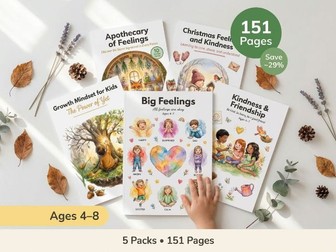
PSHE and emotional learning bundle for EYFS, KS1 and lower KS2. Five complete packs, 151 pages - feelings, kindness, growth mindset and a festive kindness tracker. What’s in the bundle Big Feelings (35 pages) - eight core emotions, a feelings thermometer, a body map, breathing exercises and face matching Kindness and Friendship (30 pages) - empathy scenarios, compliment cards, the toothpaste experiment, and a kindness scavenger hunt Growth Mindset (41 pages) - brain science for young learners, the power of yet, self-talk flip cards, comfort zone circles and a 7-day effort tracker Apothecary of Feelings (10 potion cards) - botanical cards where big feelings become ingredients: Courage Brew, Calm Tea, Kindness Elixir, Worry Wash and six more Christmas Feelings and Kindness (27 pages) - gratitude, giving, managing excitement, and an advent kindness tracker What children will do Name and explore eight core emotions across full discovery pages Build a five-level feelings thermometer to use every day Colour where emotions sit on a body map Draw their brain making new connections when they practise something Sort fixed and growth mindset statements, then flip self-talk cards from one to the other Brew botanical potions for courage, calm, kindness and worry Practise empathy with the toothpaste experiment, which children remember for years Navigate a growth mindset maze by following growth phrases Track daily effort across a week Carry out a kindness scavenger hunt where the acts are real, not written Explore three kinds of giving - things, time and kindness Sort eight items into want and need Why teachers and parents love this collection Covers the full arc: understanding feelings, being kind, building resilience The feelings thermometer and body map give children language for what they are feeling before they can explain it Works for whole-class PSHE, small group work, calm corners and one-to-one sessions The kindness scavenger hunt asks for action rather than worksheets Botanical watercolour throughout, calm enough to leave out on display Growth Mindset pack includes answer keys Instant PDF download, 151 pages across five packs. Both A4 and US Letter. Print as many copies as you need for your class or family.
Rainforest Animals Worksheets | Jungle | Ages 4-7 | Toucan Sloth Jaguar | PDFQuick View
LexAndFoxPress

Rainforest Animals Worksheets | Jungle | Ages 4-7 | Toucan Sloth Jaguar | PDF

(0)
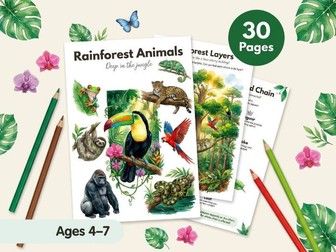
Rainforest habitat pack for KS1 and lower KS2. 30 pages on jungle ecology - forest layers, food chains, camouflage and eight animals, in vivid watercolour. What children will explore Rainforest layers - canopy, understorey and forest floor, and which animals live where Food chains - a five-link chain from plant to top predator Camouflage and warning colours - why a tree frog is bright and a jaguar is spotted Day and night - diurnal and nocturnal animals, and how the jungle changes after dark Meet eight rainforest animals Each gets a full spotlight page with a watercolour portrait, facts, habitat layer and diet. Toucan - the enormous rainbow beak Red-eyed tree frog - bright colours that warn predators off Jaguar - the jungle’s top predator Scarlet macaw - brilliant red, blue and yellow feathers Sloth - the world’s slowest mammal Chameleon - the colour-changing master Monkey - swinging through the canopy Anaconda - the giant of the river What’s inside - 30 pages Eight animal spotlight pages Rainforest layers diagram - sort animals by where they live Rainforest food chain with arrows Sounds matching - match animals to the sounds they make Day or night? Diurnal and nocturnal sorting Shadow matching, and a camouflage spotting activity I Spy jungle scene - count hidden animals in dense forest Collector flashcards - 8 cut-out animal cards Build-a-scene - cut out animals and build your own jungle Jungle explorer scavenger hunt - 10 challenges Colour by number, counting and pattern activities Word tracing - vine, leaf, roar, rain Jungle journal writing prompt Colouring page and Jungle Explorer certificate Why teachers and parents love this pack Real rainforest ecology - vertical layers, food chains, camouflage and nocturnal behaviour The layers diagram does the thing most habitat packs miss, which is teaching the rainforest as a vertical system Eleven activity types across science, geography, reading, writing, maths and art Print and go - no prep and no extra materials The most saturated watercolour palette in the range - deep greens, brilliant reds, electric blues Works well for vocabulary, sorting and fine motor in SEN settings Instant PDF download, 30 pages, US Letter. Print as many copies as you need for your class or family.
Gem Hunter Rock & Mineral Worksheets | Geology Activities Ages 4-7Quick View
LexAndFoxPress

Gem Hunter Rock & Mineral Worksheets | Geology Activities Ages 4-7

(0)
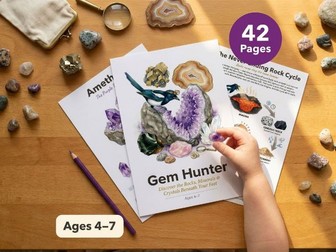
Rocks and minerals topic pack for KS1 and lower KS2. 42 pages of real geology - classification, the rock cycle, crystal structure, and a scavenger hunt that goes outdoors. Meet the minerals Amethyst - the purple crystal born from iron and heat Pyrite - the golden trickster they call fool’s gold Obsidian - volcanic glass, cooled faster than a blink Quartz - the second most common mineral on Earth Agate - banded rings built one layer per thousand years Flint - the ancient spark that lit the first fires Granite - three minerals squeezed into one speckled stone Marble - limestone transformed by the Earth’s own pressure What’s inside - 42 pages Eight collector-card spotlight pages with mineral portraits and facts Label the parts of a crystal on a scientific diagram Classify rocks as igneous, sedimentary or metamorphic Complete the rock cycle - trace the journey from magma to mountain Geological cross-section poster to colour, surface down to magma Mistake inspector - hunt for errors in a busy gem show scene Spot the difference between two cave scenes Geology word search, counting and tally challenge Reading passage about finding a crystal by a stream Guided writing prompts about your own rock collection Gem Hunter journal for recording finds 12-item rock hunting scavenger hunt to take outdoors Sensory gem dig set-up, with step-by-step instructions Junior Gem Hunter certificate and 2-page answer key Why teachers and parents love this pack Igneous, sedimentary and metamorphic are taught as the real scientific categories they are, not simplified away The scavenger hunt and journal turn any walk, playground or beach into a field trip The gem dig gives you a complete hands-on activity with household materials Pairs with a real rock collection or a museum visit Beautiful naturalist watercolour illustrations - not clipart, not cartoon Answer key included for every activity Instant PDF download, 42 pages, US Letter. Print as many copies as you need for your class or family.
All About Bugs Worksheets | Insects | Ages 4-7 | Ladybug Bee Ant | Science PDFQuick View
LexAndFoxPress

All About Bugs Worksheets | Insects | Ages 4-7 | Ladybug Bee Ant | Science PDF

(0)
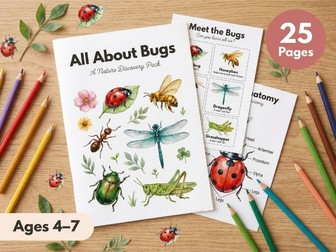
Minibeasts topic pack for KS1 and EYFS. 25 pages of real insect science - anatomy, classification and habitats, through hand-painted watercolour pages. Meet the minibeasts Ladybird - hidden wings, a taste for aphids, and no two spot patterns quite alike Honeybee - pollinator, honey-maker, and dancer of the waggle Ant - small but mighty, lifting fifty times its own weight Dragonfly - thirty miles an hour, with 360-degree vision Beetle - one insect family, four hundred thousand species Grasshopper - jumps twenty times its body length and makes music with its legs What’s inside - 25 pages Six spotlight pages, one per minibeast, each with four facts Label the parts of an insect using a word bank What makes an insect an insect - six legs, three body parts, two antennae Sort creatures by leg count, to tell insects from spiders and worms Sort creatures by flight - which of these can really fly Garden habitat page with an underground cross-section Trace six minibeast words, with letter B stroke guidance Short story about a honeybee’s busy day, with reading practice Counting, addition and pattern activities Match each minibeast to its name Find and colour six hidden minibeasts in a garden scene Botanical wreath completion certificate Why teachers and parents love this pack Real entomology - accurate anatomy, correct classification, honest science Two classification activities build the same skill different ways, by legs then by flight Each insect gets a proper spotlight page rather than a footnote The garden habitat page becomes a real minibeast hunt once it goes outside Hand-painted watercolour throughout, in the naturalist field-guide tradition, not clipart Instant PDF download, 25 pages. Fits A4 and US Letter. Print as many copies as you need for your class or family.