Year 11 Post-16 Applications PSHE LessonsQuick View
renanribeirods

Year 11 Post-16 Applications PSHE Lessons

(0)
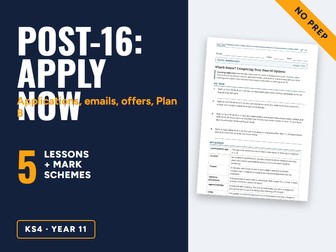
Year 11 PSHE and careers lesson pack on post-16 applications: 5 lessons on college, sixth form and apprenticeship applications, with mark schemes. Most Year 11 resources stop at interviews. This pack covers the applications themselves, so form tutors and non-specialist staff can teach every pupil how to choose a route, write to employers and plan ahead in the autumn term. What’s included 5 complete lessons of about 55 minutes, each with a full lesson plan (objectives, success criteria, starter, main, plenary, differentiation, AfL, notes for cover teachers) 5 A4 pupil worksheets: 19 Do Now questions, 39 keywords, 36 questions worth 142 marks, 5 Challenge questions and 15 exit ticket questions 5 complete mark schemes with marking guidance Scheme of work table, How to Use page and terms of use 78-page A4 PDF, print-ready Lessons Which Route? Comparing Your Post-16 Options Writing a Personal Statement for College or Sixth Form Applying for an Apprenticeship Professional Emails and Phone Calls to Employers Offers, Deadlines and Your Plan B Suitable for KS4 · Year 11 · PSHE and careers · Gatsby Benchmarks 5, 6, 7 and 8 · PSHE Association KS4 Careers and Economic wellbeing How to use Teach the lessons in order across the autumn term in PSHE, careers or extended form time. Pupils draft a personal statement, answer an apprenticeship question using the Situation, Action, Result frame, write a professional email and finish with a personal deadline tracker and Plan B. Each plan includes notes for cover teachers. Print, teach and save hours of planning on the stage of Year 11 that most resources skip.
A-Level Chemistry Practical Skills RevisionQuick View
renanribeirods

A-Level Chemistry Practical Skills Revision

(0)
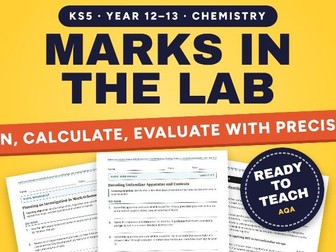
Your Year 13 pupils know the chemistry but still lose marks on Paper 3 when the apparatus is unfamiliar, when a plan has to be written in mark-scheme wording, or when a titration or uncertainty calculation goes wrong. Building original exam-style practical questions with a proper mark scheme before mocks takes hours you do not have. This pack covers the practical skills and data analysis for AQA A-Level Chemistry (7405) Paper 3, including the 12 required practicals and the Appendix 5 and 6 assessment skills (planning, implementing, analysis, evaluation). Your Year 13 pupils know the chemistry but still lose marks on Paper 3 when the apparatus is unfamiliar, when a plan has to be written in mark-scheme wording, or when a titration or uncertainty calculation goes wrong. Building original exam-style practical questions with a proper mark scheme before mocks takes hours you do not have. This pack covers the practical skills and data analysis for AQA A-Level Chemistry (7405) Paper 3, including the 12 required practicals and the Appendix 5 and 6 assessment skills (planning, implementing, analysis, evaluation). Lesson list Decoding Unfamiliar Apparatus and Contexts: what a described piece of apparatus measures, its resolution and main limitation; a three-step approach to unfamiliar set-ups; 1- to 4-mark questions Planning an Investigation in Mark-Scheme Wording: variables, range, quantities and repeats; method steps and risk statements (for example “excess”, “until constant mass”, “swirl”); marking and improving a 6-mark plan using level descriptors Titration Calculations Without the Slips: concordant titres and mean titre; scaling from a 25.0 cm³ aliquot; mass, percentage purity and hydrated salt formula; finding and correcting the five most common errors; a manganate(VII) with iron(II) calculation to the correct significant figures and units Gas Volumes and Gas-Collection Experiments: pV = nRT with SI units; expected against measured gas volume; reasons for differences; choosing a gas-collection method Uncertainty and Percentage Error: absolute and percentage uncertainty, including readings taken as a difference; combining percentage uncertainties; comparing with percentage error against a data-book value; ranking measurements and justifying a change to the method Evaluate, Conclude and Test Yourself: random error, systematic error and anomalous results; accurate, precise, repeatable and reproducible; judging whether data support a conclusion; specific improvements; a timed mixed practical-skills mini-paper with diagnosis of lost marks by skill Suitable For Key Stage: KS5 Year Group: Year 12-13 (sixth form) Exam Board: AQA (A-Level Chemistry 7405, Paper 3). Practical content also maps to OCR A (H432) Module 1 and Edexcel (9CH0) Paper 3, but the pack is labelled for AQA. Subject: Chemistry