 Quick View
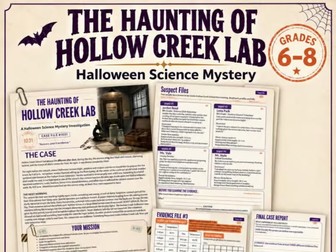
Halloween Science Mystery: The Haunting of Hollow Creek Lab | Evidence Analysis, Data & CER
Can your students solve the mystery of Hollow Creek Lab using scientific evidence?
In this Halloween science mystery, students investigate strange events at an abandoned-looking school laboratory. A specimen collection has disappeared, footprints cross the floor, a warning appears on the board, the temperature drops, and scratching is heard inside a wall.
Rumors aren’t evidence. Students examine five evidence files, compare explanations, eliminate unsupported suspects, and write a final Claim-Evidence-Reasoning (CER) explanation of what happened.
Designed for middle school science, Grades 6–8 (approximately ages 11–14), this activity gives students practice with scientific reasoning through a seasonal mystery. Use it for a Halloween lesson, science-skills review, enrichment, or a lesson before break.
Students will
Distinguish observations from inferences
Compare measurements and interpret data tables
Analyze simulated chromatography results
Create and interpret a line graph
Identify independent and dependent variables
Calculate temperature change and identify patterns
Interpret suspect timelines and airflow data
Evaluate evidence, revise hypotheses, and eliminate unsupported explanations
Write a CER explanation using evidence from at least three files
What’s included
21 pages total:
1-page teacher guide
12-page student investigation
7-page complete teacher answer key
Thank-you and terms-of-use page
Inside the student investigation
Case File #1031: The Haunting of Hollow Creek Lab
Suspect Files: Review four suspects and record an initial hypothesis
Investigator’s Evidence Log: Track observations and possible explanations
Evidence File 1 — The Footprints: Compare shoe measurements and tread patterns
Evidence File 2 — The Message: Use chromatography results to compare mystery ink
Evidence File 3 — Temperature Data: Graph temperatures, calculate change, and identify variables
Evidence File 4 — Suspect Timeline: Compare photographs, camera records, key-card records, and suspect locations
Evidence File 5 — The Scratching in the Wall: Analyze airflow data
Evidence Board: Weigh evidence for and against each suspect
Final Case Report: Write a CER explanation using at least three evidence files
Case Closed Reveal and Science Reflection