Edexcel IGCSE Chemistry Unit 4 – Organic Chemistry: Lesson 15, Making EthanolQuick View
ChemWorks

Edexcel IGCSE Chemistry Unit 4 – Organic Chemistry: Lesson 15, Making Ethanol

(0)
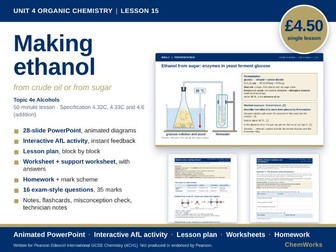
Edexcel IGCSE Chemistry (4CH1) Unit 4 Organic Chemistry, Lesson 15: Making Ethanol. A complete, ready-to-teach lesson: animated PowerPoint, interactive AfL activity, a worksheet and a scaffolded worksheet (both with answers) and homework. Fermentation or hydration of ethene? Pupils compare the two ways of making ethanol, learn the conditions for each and the reasons behind them, then set up a fermentation of glucose with yeast and test the gas. In detail: Lesson 15 compares the two ways of making ethanol, hydration of ethene and fermentation, with the conditions for each and the reasons fermentation needs its own; pairs set up a fermentation of glucose with yeast and test the gas. Practical: Class practical: fermenting glucose with yeast, and testing the gas. Walk in and teach: the lesson is planned minute by minute, with the slides, two levels of worksheet, homework and every answer ready to go. Specification points: 4.6, 4.32C, 4.33C. Chemistry-only points (ending in C), for the separate Chemistry course. What you get 28-slide animated, editable PowerPoint: worked examples that build a click at a time, an interactive AfL activity with instant feedback, and speaker notes with timings Two-page lesson plan, block by block, with the mistakes pupils usually make Worksheet with full answers Scaffolded support worksheet with full answers: the same questions, with word banks and sentences to complete Homework (about 15 marks) with its mark scheme 16 exam-style questions worth 35 marks across the worksheet and homework Student notes, flashcards (plus a text file for Quizlet or Anki) and a misconception check with key Technician notes: chemicals, amounts, apparatus, hazards and clear-up on one page Every document as PDF and editable Word Why teachers like it One idea at a time: every slide builds up a click at a time, so there is never a wall of text See straight away who has got it: a wrong answer brings up a cross, the reason and Try again; the right one brings up a tick and the reasoning Mixed classes covered: the scaffolded worksheet asks the same questions with more help, so everyone works on the same chemistry Homework is yours to set or not Every diagram and animation was drawn for this lesson: nothing is borrowed from a textbook or the web Save more on ChemWorks: this lesson is also in the Topic 4e Alcohols pack (3 lessons, £12) and the complete Unit 4 Organic Chemistry pack (22 lessons, the 2 unit tests with mark schemes and all the unit documents, £73.50). Lesson 1 of the unit is free, so you can try before you buy. Written for Pearson Edexcel International GCSE Chemistry (4CH1). Not produced or endorsed by Pearson.
Edexcel IGCSE Chemistry Unit 4 – Organic Chemistry: Lesson 11, Addition ReactionsQuick View
ChemWorks

Edexcel IGCSE Chemistry Unit 4 – Organic Chemistry: Lesson 11, Addition Reactions

(0)
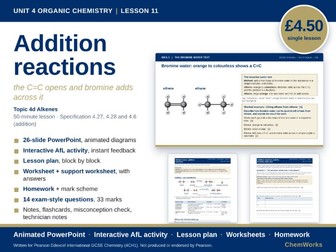
Edexcel IGCSE Chemistry (4CH1) Unit 4 Organic Chemistry, Lesson 11: Addition Reactions. A complete, ready-to-teach lesson: animated PowerPoint, interactive AfL activity, a worksheet and a scaffolded worksheet (both with answers) and homework. Bromine water losing its colour is a test every pupil must know. They see why bromine adds across the C=C, name the product, write the equation in displayed formulae, then plan a test to tell hexane from hexene. In detail: Lesson 11 is addition: bromine adds across the C=C to give one product, with the product named and the equation written in displayed formulae, and the bromine water test. In a class practical pairs plan and carry out a test to tell hexane from hexene. Practical: Class practical: telling hexane from hexene with bromine water. Walk in and teach: the lesson is planned minute by minute, with the slides, two levels of worksheet, homework and every answer ready to go. Specification points: 4.6, 4.27, 4.28. What you get 26-slide animated, editable PowerPoint: worked examples that build a click at a time, an interactive AfL activity with instant feedback, and speaker notes with timings Two-page lesson plan, block by block, with the mistakes pupils usually make Worksheet with full answers Scaffolded support worksheet with full answers: the same questions, with word banks and sentences to complete Homework (about 15 marks) with its mark scheme 14 exam-style questions worth 33 marks across the worksheet and homework Student notes, flashcards (plus a text file for Quizlet or Anki) and a misconception check with key Technician notes: chemicals, amounts, apparatus, hazards and clear-up on one page Every document as PDF and editable Word Why teachers like it One idea at a time: every slide builds up a click at a time, so there is never a wall of text See straight away who has got it: a wrong answer brings up a cross, the reason and Try again; the right one brings up a tick and the reasoning Mixed classes covered: the scaffolded worksheet asks the same questions with more help, so everyone works on the same chemistry Homework is yours to set or not Every diagram and animation was drawn for this lesson: nothing is borrowed from a textbook or the web Save more on ChemWorks: this lesson is also in the Topic 4d Alkenes pack (2 lessons, £8) and the complete Unit 4 Organic Chemistry pack (22 lessons, the 2 unit tests with mark schemes and all the unit documents, £73.50). Lesson 1 of the unit is free, so you can try before you buy. Written for Pearson Edexcel International GCSE Chemistry (4CH1). Not produced or endorsed by Pearson.
Edexcel IGCSE Chemistry Unit 4 – Organic Chemistry: Lesson 12, Catch-up and Revision (4a–4d)Quick View
ChemWorks

Edexcel IGCSE Chemistry Unit 4 – Organic Chemistry: Lesson 12, Catch-up and Revision (4a–4d)

(0)
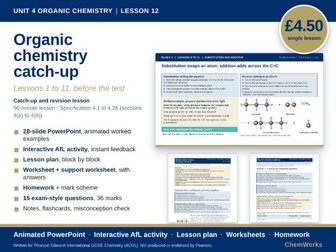
Edexcel IGCSE Chemistry (4CH1) Unit 4 Organic Chemistry, Lesson 12: Catch-up and Revision (4a–4d). A complete, ready-to-teach lesson: animated PowerPoint, interactive AfL activity, a worksheet and a scaffolded worksheet (both with answers) and homework. The lesson to teach just before the mid-unit test: it re-teaches the hardest ideas from Lessons 1 to 11 with fresh worked examples and new questions, so pupils practise rather than repeat. In detail: Lesson 12 is a full catch-up and revision lesson to teach before the mid-unit test. It goes back over sections 4(a) to 4(d) (Lessons 1 to 11): it re-teaches the ideas pupils find hardest, each with a fresh worked example, and the class then answers a clickable activity and works through a worksheet. The cases and questions are new, so pupils are not simply repeating what they did in the lessons. Walk in and teach: the lesson is planned minute by minute, with the slides, two levels of worksheet, homework and every answer ready to go. Specification points: 4.1 to 4.28. What you get 28-slide animated, editable PowerPoint: worked examples that build a click at a time, an interactive AfL activity with instant feedback, and speaker notes with timings Two-page lesson plan, block by block, with the mistakes pupils usually make Worksheet with full answers Scaffolded support worksheet with full answers: the same questions, with word banks and sentences to complete Homework (about 15 marks) with its mark scheme 15 exam-style questions worth 36 marks across the worksheet and homework Student notes, flashcards (plus a text file for Quizlet or Anki) and a misconception check with key Every document as PDF and editable Word Why teachers like it One idea at a time: every slide builds up a click at a time, so there is never a wall of text See straight away who has got it: a wrong answer brings up a cross, the reason and Try again; the right one brings up a tick and the reasoning Mixed classes covered: the scaffolded worksheet asks the same questions with more help, so everyone works on the same chemistry Homework is yours to set or not Every diagram and animation was drawn for this lesson: nothing is borrowed from a textbook or the web Save more on ChemWorks: this revision lesson is also in the complete Unit 4 Organic Chemistry pack (22 lessons, the 2 unit tests with mark schemes and all the unit documents, £73.50). Lesson 1 of the unit is free, so you can try before you buy. Written for Pearson Edexcel International GCSE Chemistry (4CH1). Not produced or endorsed by Pearson.
Edexcel IGCSE Chemistry Unit 4 – Organic Chemistry: Lesson 10, Alkenes and the C=C Double BondQuick View
ChemWorks

Edexcel IGCSE Chemistry Unit 4 – Organic Chemistry: Lesson 10, Alkenes and the C=C Double Bond

(0)
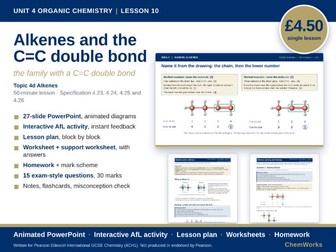
Edexcel IGCSE Chemistry (4CH1) Unit 4 Organic Chemistry, Lesson 10: Alkenes and the C=C Double Bond. A complete, ready-to-teach lesson: animated PowerPoint, interactive AfL activity, a worksheet and a scaffolded worksheet (both with answers) and homework. One double bond changes everything. Pupils meet the C=C functional group, what unsaturated means, and how to name and draw alkenes up to four carbons, including but-1-ene and but-2-ene. In detail: Lesson 10 introduces the C=C double bond as the alkenes’ functional group, what unsaturated means, the general formula, and how to name and draw alkenes up to four carbons, including but-1-ene and but-2-ene. Walk in and teach: the lesson is planned minute by minute, with the slides, two levels of worksheet, homework and every answer ready to go. Specification points: 4.23, 4.24, 4.25, 4.26. What you get 27-slide animated, editable PowerPoint: worked examples that build a click at a time, an interactive AfL activity with instant feedback, and speaker notes with timings Two-page lesson plan, block by block, with the mistakes pupils usually make Worksheet with full answers Scaffolded support worksheet with full answers: the same questions, with word banks and sentences to complete Homework (about 15 marks) with its mark scheme 15 exam-style questions worth 30 marks across the worksheet and homework Student notes, flashcards (plus a text file for Quizlet or Anki) and a misconception check with key Every document as PDF and editable Word Why teachers like it One idea at a time: every slide builds up a click at a time, so there is never a wall of text See straight away who has got it: a wrong answer brings up a cross, the reason and Try again; the right one brings up a tick and the reasoning Mixed classes covered: the scaffolded worksheet asks the same questions with more help, so everyone works on the same chemistry Homework is yours to set or not Every diagram and animation was drawn for this lesson: nothing is borrowed from a textbook or the web Save more on ChemWorks: this lesson is also in the Topic 4d Alkenes pack (2 lessons, £8) and the complete Unit 4 Organic Chemistry pack (22 lessons, the 2 unit tests with mark schemes and all the unit documents, £73.50). Lesson 1 of the unit is free, so you can try before you buy. Written for Pearson Edexcel International GCSE Chemistry (4CH1). Not produced or endorsed by Pearson.
Edexcel IGCSE Chemistry Unit 4 – Organic Chemistry: Lesson 9, Alkanes and Halogens in UV LightQuick View
ChemWorks

Edexcel IGCSE Chemistry Unit 4 – Organic Chemistry: Lesson 9, Alkanes and Halogens in UV Light

(0)
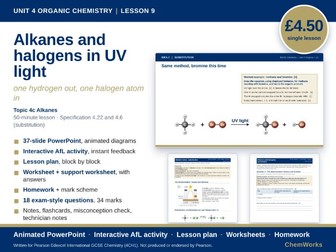
Edexcel IGCSE Chemistry (4CH1) Unit 4 Organic Chemistry, Lesson 9: Alkanes and Halogens in UV Light. A complete, ready-to-teach lesson: animated PowerPoint, interactive AfL activity, a worksheet and a scaffolded worksheet (both with answers) and homework. Alkanes have just one reaction on the specification, and it only happens in ultraviolet light. Pupils write the substitution equations for methane with chlorine and bromine, then the pattern for any alkane. In detail: Lesson 9 is the one reaction of the alkanes in the specification: substitution with a halogen, which happens only in ultraviolet light. Pupils write the equations for methane with chlorine and with bromine in displayed formulae, then the pattern for any alkane in molecular formulae. A teacher demonstration shakes bromine water with hexane in sunlight and in the dark. Practical: Teacher demonstration: bromine water and hexane, in sunlight and in the dark. Walk in and teach: the lesson is planned minute by minute, with the slides, two levels of worksheet, homework and every answer ready to go. Specification points: 4.6, 4.22. What you get 37-slide animated, editable PowerPoint: worked examples that build a click at a time, an interactive AfL activity with instant feedback, and speaker notes with timings Two-page lesson plan, block by block, with the mistakes pupils usually make Worksheet with full answers Scaffolded support worksheet with full answers: the same questions, with word banks and sentences to complete Homework (about 15 marks) with its mark scheme 18 exam-style questions worth 34 marks across the worksheet and homework Student notes, flashcards (plus a text file for Quizlet or Anki) and a misconception check with key Technician notes: chemicals, amounts, apparatus, hazards and clear-up on one page Every document as PDF and editable Word Why teachers like it One idea at a time: every slide builds up a click at a time, so there is never a wall of text See straight away who has got it: a wrong answer brings up a cross, the reason and Try again; the right one brings up a tick and the reasoning Mixed classes covered: the scaffolded worksheet asks the same questions with more help, so everyone works on the same chemistry Homework is yours to set or not Every diagram and animation was drawn for this lesson: nothing is borrowed from a textbook or the web Save more on ChemWorks: this lesson is also in the Topic 4c Alkanes pack (1 lesson, £4.50) and the complete Unit 4 Organic Chemistry pack (22 lessons, the 2 unit tests with mark schemes and all the unit documents, £73.50). Lesson 1 of the unit is free, so you can try before you buy. Written for Pearson Edexcel International GCSE Chemistry (4CH1). Not produced or endorsed by Pearson.
Edexcel IGCSE Chemistry Unit 4 – Organic Chemistry: Lesson 8, CrackingQuick View
ChemWorks

Edexcel IGCSE Chemistry Unit 4 – Organic Chemistry: Lesson 8, Cracking

(0)
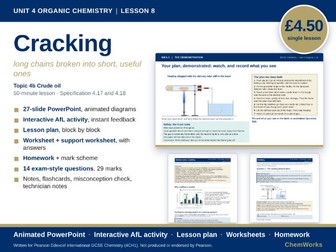
Edexcel IGCSE Chemistry (4CH1) Unit 4 Organic Chemistry, Lesson 8: Cracking. A complete, ready-to-teach lesson: animated PowerPoint, interactive AfL activity, a worksheet and a scaffolded worksheet (both with answers) and homework. Why crack long hydrocarbons at all? Supply and demand, how catalytic cracking works and how to complete a cracking equation, with the class planning the cracking of liquid paraffin before the teacher demonstrates it. In detail: Lesson 8 explains why cracking is needed, how catalytic cracking works and how to complete a cracking equation; the class plans the cracking of liquid paraffin and the teacher demonstrates it over hot porcelain chips. Practical: Teacher demonstration: cracking liquid paraffin over hot porcelain chips. Walk in and teach: the lesson is planned minute by minute, with the slides, two levels of worksheet, homework and every answer ready to go. Specification points: 4.17, 4.18. What you get 27-slide animated, editable PowerPoint: worked examples that build a click at a time, an interactive AfL activity with instant feedback, and speaker notes with timings Two-page lesson plan, block by block, with the mistakes pupils usually make Worksheet with full answers Scaffolded support worksheet with full answers: the same questions, with word banks and sentences to complete Homework (about 15 marks) with its mark scheme 14 exam-style questions worth 29 marks across the worksheet and homework Student notes, flashcards (plus a text file for Quizlet or Anki) and a misconception check with key Technician notes: chemicals, amounts, apparatus, hazards and clear-up on one page Every document as PDF and editable Word Why teachers like it One idea at a time: every slide builds up a click at a time, so there is never a wall of text See straight away who has got it: a wrong answer brings up a cross, the reason and Try again; the right one brings up a tick and the reasoning Mixed classes covered: the scaffolded worksheet asks the same questions with more help, so everyone works on the same chemistry Homework is yours to set or not Every diagram and animation was drawn for this lesson: nothing is borrowed from a textbook or the web Save more on ChemWorks: this lesson is also in the Topic 4b Crude Oil pack (4 lessons, £16) and the complete Unit 4 Organic Chemistry pack (22 lessons, the 2 unit tests with mark schemes and all the unit documents, £73.50). Lesson 1 of the unit is free, so you can try before you buy. Written for Pearson Edexcel International GCSE Chemistry (4CH1). Not produced or endorsed by Pearson.
Edexcel IGCSE Chemistry Unit 4 – Organic Chemistry: Lesson 7, Pollutants from Burning FuelsQuick View
ChemWorks

Edexcel IGCSE Chemistry Unit 4 – Organic Chemistry: Lesson 7, Pollutants from Burning Fuels

(0)
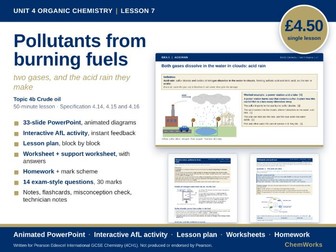
Edexcel IGCSE Chemistry (4CH1) Unit 4 Organic Chemistry, Lesson 7: Pollutants from Burning Fuels. A complete, ready-to-teach lesson: animated PowerPoint, interactive AfL activity, a worksheet and a scaffolded worksheet (both with answers) and homework. Where do the oxides of nitrogen and sulfur dioxide come from, and how do they make acid rain? Pupils follow each pollutant from source to effect, with a class practical: the acid rain dish. Walk in and teach: the lesson is planned minute by minute, with the slides, two levels of worksheet, homework and every answer ready to go. Specification points: 4.14, 4.15, 4.16. What you get 33-slide animated, editable PowerPoint: worked examples that build a click at a time, an interactive AfL activity with instant feedback, and speaker notes with timings Two-page lesson plan, block by block, with the mistakes pupils usually make Worksheet with full answers Scaffolded support worksheet with full answers: the same questions, with word banks and sentences to complete Homework (about 15 marks) with its mark scheme 14 exam-style questions worth 30 marks across the worksheet and homework Student notes, flashcards (plus a text file for Quizlet or Anki) and a misconception check with key Technician notes: chemicals, amounts, apparatus, hazards and clear-up on one page Every document as PDF and editable Word Why teachers like it One idea at a time: every slide builds up a click at a time, so there is never a wall of text See straight away who has got it: a wrong answer brings up a cross, the reason and Try again; the right one brings up a tick and the reasoning Mixed classes covered: the scaffolded worksheet asks the same questions with more help, so everyone works on the same chemistry Homework is yours to set or not Every diagram and animation was drawn for this lesson: nothing is borrowed from a textbook or the web Save more on ChemWorks: this lesson is also in the Topic 4b Crude Oil pack (4 lessons, £16) and the complete Unit 4 Organic Chemistry pack (22 lessons, the 2 unit tests with mark schemes and all the unit documents, £73.50). Lesson 1 of the unit is free, so you can try before you buy. Written for Pearson Edexcel International GCSE Chemistry (4CH1). Not produced or endorsed by Pearson.
Edexcel IGCSE Chemistry Unit 4 – Organic Chemistry: Lesson 6, Fuels and CombustionQuick View
ChemWorks

Edexcel IGCSE Chemistry Unit 4 – Organic Chemistry: Lesson 6, Fuels and Combustion

(0)
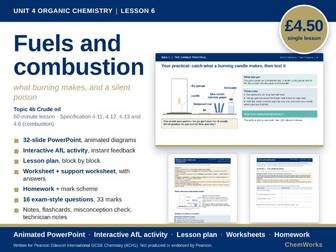
Edexcel IGCSE Chemistry (4CH1) Unit 4 Organic Chemistry, Lesson 6: Fuels and Combustion. A complete, ready-to-teach lesson: animated PowerPoint, interactive AfL activity, a worksheet and a scaffolded worksheet (both with answers) and homework. Pupils happily write carbon dioxide and water for every combustion. This lesson shows when carbon monoxide forms instead, how to balance combustion equations, and why carbon monoxide is so dangerous. In detail: Lesson 6 is complete and incomplete combustion, balancing combustion equations, and why carbon monoxide is poisonous, with a class practical on what a burning candle makes. Walk in and teach: the lesson is planned minute by minute, with the slides, two levels of worksheet, homework and every answer ready to go. Specification points: 4.6, 4.11, 4.12, 4.13. What you get 32-slide animated, editable PowerPoint: worked examples that build a click at a time, an interactive AfL activity with instant feedback, and speaker notes with timings Two-page lesson plan, block by block, with the mistakes pupils usually make Worksheet with full answers Scaffolded support worksheet with full answers: the same questions, with word banks and sentences to complete Homework (about 15 marks) with its mark scheme 16 exam-style questions worth 33 marks across the worksheet and homework Student notes, flashcards (plus a text file for Quizlet or Anki) and a misconception check with key Technician notes: chemicals, amounts, apparatus, hazards and clear-up on one page Every document as PDF and editable Word Why teachers like it One idea at a time: every slide builds up a click at a time, so there is never a wall of text See straight away who has got it: a wrong answer brings up a cross, the reason and Try again; the right one brings up a tick and the reasoning Mixed classes covered: the scaffolded worksheet asks the same questions with more help, so everyone works on the same chemistry Homework is yours to set or not Every diagram and animation was drawn for this lesson: nothing is borrowed from a textbook or the web Save more on ChemWorks: this lesson is also in the Topic 4b Crude Oil pack (4 lessons, £16) and the complete Unit 4 Organic Chemistry pack (22 lessons, the 2 unit tests with mark schemes and all the unit documents, £73.50). Lesson 1 of the unit is free, so you can try before you buy. Written for Pearson Edexcel International GCSE Chemistry (4CH1). Not produced or endorsed by Pearson.
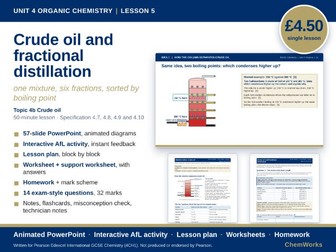
Edexcel IGCSE Chemistry Unit 4 – Organic Chemistry: Lesson 5, Crude Oil and Fractional DistillationQuick View
ChemWorks

Edexcel IGCSE Chemistry Unit 4 – Organic Chemistry: Lesson 5, Crude Oil and Fractional Distillation

(0)
Edexcel IGCSE Chemistry (4CH1) Unit 4 Organic Chemistry, Lesson 5: Crude Oil and Fractional Distillation. A complete, ready-to-teach lesson: animated PowerPoint, interactive AfL activity, a worksheet and a scaffolded worksheet (both with answers) and homework. Crude oil, the fractionating column and the trends in one lesson: why the fractions separate where they do, and why boiling point, viscosity and colour all change with chain length. In detail: Lesson 5 covers crude oil as a mixture of hydrocarbons, how the fractionating column separates it, the six fractions and their uses, and the trends in boiling point, viscosity and colour with chain length, alongside a teacher demonstration of the fractional distillation of a crude oil substitute. Walk in and teach: the lesson is planned minute by minute, with the slides, two levels of worksheet, homework and every answer ready to go. Specification points: 4.7, 4.8, 4.9, 4.10. What you get 57-slide animated, editable PowerPoint: worked examples that build a click at a time, an interactive AfL activity with instant feedback, and speaker notes with timings Two-page lesson plan, block by block, with the mistakes pupils usually make Worksheet with full answers Scaffolded support worksheet with full answers: the same questions, with word banks and sentences to complete Homework (about 15 marks) with its mark scheme 14 exam-style questions worth 32 marks across the worksheet and homework Student notes, flashcards (plus a text file for Quizlet or Anki) and a misconception check with key Technician notes: chemicals, amounts, apparatus, hazards and clear-up on one page Every document as PDF and editable Word Why teachers like it One idea at a time: every slide builds up a click at a time, so there is never a wall of text See straight away who has got it: a wrong answer brings up a cross, the reason and Try again; the right one brings up a tick and the reasoning Mixed classes covered: the scaffolded worksheet asks the same questions with more help, so everyone works on the same chemistry Homework is yours to set or not Every diagram and animation was drawn for this lesson: nothing is borrowed from a textbook or the web Save more on ChemWorks: this lesson is also in the Topic 4b Crude Oil pack (4 lessons, £16) and the complete Unit 4 Organic Chemistry pack (22 lessons, the 2 unit tests with mark schemes and all the unit documents, £73.50). Lesson 1 of the unit is free, so you can try before you buy. Written for Pearson Edexcel International GCSE Chemistry (4CH1). Not produced or endorsed by Pearson.
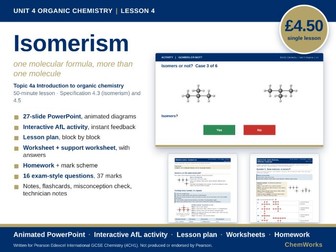
Edexcel IGCSE Chemistry Unit 4 – Organic Chemistry: Lesson 4, IsomerismQuick View
ChemWorks

Edexcel IGCSE Chemistry Unit 4 – Organic Chemistry: Lesson 4, Isomerism

(0)
Edexcel IGCSE Chemistry (4CH1) Unit 4 Organic Chemistry, Lesson 4: Isomerism. A complete, ready-to-teach lesson: animated PowerPoint, interactive AfL activity, a worksheet and a scaffolded worksheet (both with answers) and homework. Ask a class to draw every isomer of a formula and you will get the same molecule drawn twice and one missed. This lesson gives a method that finds every isomer without missing or repeating one. In detail: Lesson 4 is isomerism: what isomers are, a method for finding every isomer of a molecular formula without missing or repeating one, and the structural formulae of branched molecules. Practical: Model building: pairs build the three isomers of pentane with model kits. Walk in and teach: the lesson is planned minute by minute, with the slides, two levels of worksheet, homework and every answer ready to go. Specification points: 4.3, 4.5. What you get 27-slide animated, editable PowerPoint: worked examples that build a click at a time, an interactive AfL activity with instant feedback, and speaker notes with timings Two-page lesson plan, block by block, with the mistakes pupils usually make Worksheet with full answers Scaffolded support worksheet with full answers: the same questions, with word banks and sentences to complete Homework (about 15 marks) with its mark scheme 16 exam-style questions worth 37 marks across the worksheet and homework Student notes, flashcards (plus a text file for Quizlet or Anki) and a misconception check with key Technician notes for the model building (no chemicals used) Every document as PDF and editable Word Why teachers like it One idea at a time: every slide builds up a click at a time, so there is never a wall of text See straight away who has got it: a wrong answer brings up a cross, the reason and Try again; the right one brings up a tick and the reasoning Mixed classes covered: the scaffolded worksheet asks the same questions with more help, so everyone works on the same chemistry Homework is yours to set or not Every diagram and animation was drawn for this lesson: nothing is borrowed from a textbook or the web Save more on ChemWorks: this lesson is also in the Topic 4a Intro to Organic Chemistry pack (4 lessons, £12) and the complete Unit 4 Organic Chemistry pack (22 lessons, the 2 unit tests with mark schemes and all the unit documents, £73.50). Lesson 1 of the unit is free, so you can try before you buy. Written for Pearson Edexcel International GCSE Chemistry (4CH1). Not produced or endorsed by Pearson.
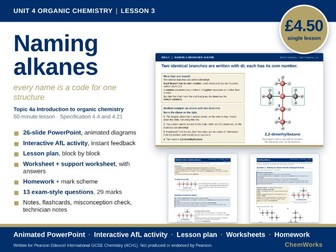
Edexcel IGCSE Chemistry Unit 4 – Organic Chemistry: Lesson 3, Naming AlkanesQuick View
ChemWorks

Edexcel IGCSE Chemistry Unit 4 – Organic Chemistry: Lesson 3, Naming Alkanes

(0)
Edexcel IGCSE Chemistry (4CH1) Unit 4 Organic Chemistry, Lesson 3: Naming Alkanes. A complete, ready-to-teach lesson: animated PowerPoint, interactive AfL activity, a worksheet and a scaffolded worksheet (both with answers) and homework. Pupils who can count carbons can still get a branched alkane’s name wrong. This lesson gives them a step-by-step method for naming unbranched and branched alkanes up to six carbons. Practical: Model building: pairs build pentane with molecular model kits. Walk in and teach: the lesson is planned minute by minute, with the slides, two levels of worksheet, homework and every answer ready to go. Specification points: 4.4, 4.21. What you get 26-slide animated, editable PowerPoint: worked examples that build a click at a time, an interactive AfL activity with instant feedback, and speaker notes with timings Two-page lesson plan, block by block, with the mistakes pupils usually make Worksheet with full answers Scaffolded support worksheet with full answers: the same questions, with word banks and sentences to complete Homework (about 15 marks) with its mark scheme 13 exam-style questions worth 29 marks across the worksheet and homework Student notes, flashcards (plus a text file for Quizlet or Anki) and a misconception check with key Technician notes for the model building (no chemicals used) Every document as PDF and editable Word Why teachers like it One idea at a time: every slide builds up a click at a time, so there is never a wall of text See straight away who has got it: a wrong answer brings up a cross, the reason and Try again; the right one brings up a tick and the reasoning Mixed classes covered: the scaffolded worksheet asks the same questions with more help, so everyone works on the same chemistry Homework is yours to set or not Every diagram and animation was drawn for this lesson: nothing is borrowed from a textbook or the web Save more on ChemWorks: this lesson is also in the Topic 4a Intro to Organic Chemistry pack (4 lessons, £12) and the complete Unit 4 Organic Chemistry pack (22 lessons, the 2 unit tests with mark schemes and all the unit documents, £73.50). Lesson 1 of the unit is free, so you can try before you buy. Written for Pearson Edexcel International GCSE Chemistry (4CH1). Not produced or endorsed by Pearson.
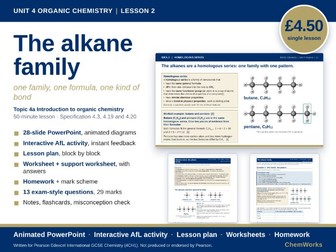
Edexcel IGCSE Chemistry Unit 4 – Organic Chemistry: Lesson 2, The Alkane FamilyQuick View
ChemWorks

Edexcel IGCSE Chemistry Unit 4 – Organic Chemistry: Lesson 2, The Alkane Family

(0)
Edexcel IGCSE Chemistry (4CH1) Unit 4 Organic Chemistry, Lesson 2: The Alkane Family. A complete, ready-to-teach lesson: animated PowerPoint, interactive AfL activity, a worksheet and a scaffolded worksheet (both with answers) and homework. Why does each alkane boil higher than the last? This lesson builds the homologous series and its general formula, so pupils can predict any member of the family and explain the trend. In detail: Lesson 2 brings in the alkanes as a homologous series, with their general formula, what saturated means, and the trend in boiling point. Walk in and teach: the lesson is planned minute by minute, with the slides, two levels of worksheet, homework and every answer ready to go. Specification points: 4.3, 4.19, 4.20. What you get 28-slide animated, editable PowerPoint: worked examples that build a click at a time, an interactive AfL activity with instant feedback, and speaker notes with timings Two-page lesson plan, block by block, with the mistakes pupils usually make Worksheet with full answers Scaffolded support worksheet with full answers: the same questions, with word banks and sentences to complete Homework (about 15 marks) with its mark scheme 13 exam-style questions worth 29 marks across the worksheet and homework Student notes, flashcards (plus a text file for Quizlet or Anki) and a misconception check with key Every document as PDF and editable Word Why teachers like it One idea at a time: every slide builds up a click at a time, so there is never a wall of text See straight away who has got it: a wrong answer brings up a cross, the reason and Try again; the right one brings up a tick and the reasoning Mixed classes covered: the scaffolded worksheet asks the same questions with more help, so everyone works on the same chemistry Homework is yours to set or not Every diagram and animation was drawn for this lesson: nothing is borrowed from a textbook or the web Save more on ChemWorks: this lesson is also in the Topic 4a Intro to Organic Chemistry pack (4 lessons, £12) and the complete Unit 4 Organic Chemistry pack (22 lessons, the 2 unit tests with mark schemes and all the unit documents, £73.50). Lesson 1 of the unit is free, so you can try before you buy. Written for Pearson Edexcel International GCSE Chemistry (4CH1). Not produced or endorsed by Pearson.
Edexcel IGCSE Chemistry Unit 4 – Organic Chemistry: Topic 4h Synthetic Polymers (2 Lessons)Quick View
ChemWorks

Edexcel IGCSE Chemistry Unit 4 – Organic Chemistry: Topic 4h Synthetic Polymers (2 Lessons)

(0)
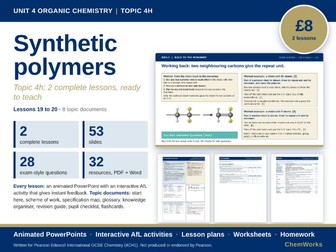
Edexcel IGCSE Chemistry (4CH1) Unit 4 Organic Chemistry, Topic 4h Synthetic Polymers: 2 complete, ready-to-teach lessons with animated PowerPoints, interactive AfL activities, worksheets, homework and topic revision resources. Polymers from monomer to landfill: addition polymers drawn both ways round, why plastics are so hard to get rid of, then polyesters and biopolyesters, finishing with the nylon rope trick. Walk in and teach. Every lesson is planned minute by minute and comes with its slides, two levels of worksheet, homework and every answer, so your planning is done before you open the file. Covers specification points 4.44–4.50C. Chemistry-only points (ending in C), for the separate Chemistry course. The lessons Lesson 19: Addition polymers: monomers, repeat units and back again (4.44, 4.45, 4.46) Lesson 20: Disposal of addition polymers, and condensation polymers: polyesters and biopolyesters (4.47, 4.48C, 4.49C, 4.50C) Practicals and demonstrations Lesson 19: Model building: pairs join ethene molecules into a chain with model kits Lesson 20: Teacher demonstration: the nylon rope trick Why teachers like it Animated slides that teach one idea at a time, with worked examples that show where the marks are earned An interactive AfL activity in every lesson: the class clicks, the slide gives instant feedback with the reason Scaffolded support worksheets with the same questions and more help, so a mixed class works on the same chemistry Original drawings and animations throughout: nothing borrowed from a textbook or the web What you get 2 complete lessons: 53 slides, 28 exam-style questions and 32 resources Every lesson: an animated, editable PowerPoint with an interactive AfL activity, a two-page lesson plan, a worksheet and a scaffolded support worksheet, both with answers, homework with mark scheme, student notes, flashcards and a misconception check Technician notes for every practical and demonstration Topic documents: Start here, scheme of work, specification map, knowledge organiser, revision guide, pupil checklist, flashcard set and glossary Every document as PDF and editable Word Price: £8, £4 a lesson (£1 less than buying the lessons singly, with the topic documents added). Better value still: the complete Unit 4 Organic Chemistry pack (22 lessons, the 2 unit tests with mark schemes and all the unit documents) for £73.50. The unit tests come only with the complete unit. Written for Pearson Edexcel International GCSE Chemistry (4CH1). Not produced or endorsed by Pearson.
Edexcel IGCSE Chemistry Unit 4 – Organic Chemistry: Topic 4g Esters (2 Lessons)Quick View
ChemWorks

Edexcel IGCSE Chemistry Unit 4 – Organic Chemistry: Topic 4g Esters (2 Lessons)

(0)
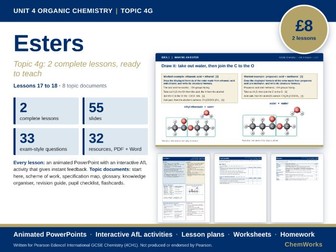
Edexcel IGCSE Chemistry (4CH1) Unit 4 Organic Chemistry, Topic 4g Esters: 2 complete, ready-to-teach lessons with animated PowerPoints, interactive AfL activities, worksheets, homework and topic revision resources. Esters and specification practical 4.43C: making, naming and drawing esters, working back to the acid and alcohol that made them, then preparing ethyl ethanoate with a reason for every step of the method. Walk in and teach. Every lesson is planned minute by minute and comes with its slides, two levels of worksheet, homework and every answer, so your planning is done before you open the file. Covers specification points 4.38C–4.43C. Chemistry-only points (ending in C), for the separate Chemistry course. The lessons Lesson 17: Esters: making them, drawing them and naming them (4.38C, 4.39C, 4.40C, 4.41C, 4.42C) Lesson 18: Practical 4.43C: preparing a sample of ethyl ethanoate (4.43C, 4.39C, 4.42C) Practicals and demonstrations Lesson 17: Class practical: making three esters in test tubes Lesson 18: Class practical: making ethyl ethanoate on a small scale Why teachers like it Animated slides that teach one idea at a time, with worked examples that show where the marks are earned An interactive AfL activity in every lesson: the class clicks, the slide gives instant feedback with the reason Scaffolded support worksheets with the same questions and more help, so a mixed class works on the same chemistry Original drawings and animations throughout: nothing borrowed from a textbook or the web What you get 2 complete lessons: 55 slides, 33 exam-style questions and 32 resources Every lesson: an animated, editable PowerPoint with an interactive AfL activity, a two-page lesson plan, a worksheet and a scaffolded support worksheet, both with answers, homework with mark scheme, student notes, flashcards and a misconception check Technician notes for every practical and demonstration Topic documents: Start here, scheme of work, specification map, knowledge organiser, revision guide, pupil checklist, flashcard set and glossary Every document as PDF and editable Word Price: £8, £4 a lesson (£1 less than buying the lessons singly, with the topic documents added). Better value still: the complete Unit 4 Organic Chemistry pack (22 lessons, the 2 unit tests with mark schemes and all the unit documents) for £73.50. The unit tests come only with the complete unit. Written for Pearson Edexcel International GCSE Chemistry (4CH1). Not produced or endorsed by Pearson.
Edexcel IGCSE Chemistry Unit 4 – Organic Chemistry: Topic 4f Carboxylic Acids (1 Lesson)Quick View
ChemWorks

Edexcel IGCSE Chemistry Unit 4 – Organic Chemistry: Topic 4f Carboxylic Acids (1 Lesson)

(0)
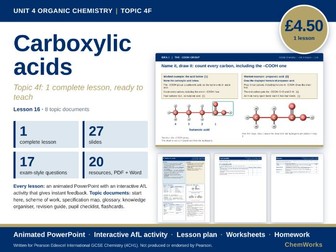
Edexcel IGCSE Chemistry (4CH1) Unit 4 Organic Chemistry, Topic 4f Carboxylic Acids: 1 complete, ready-to-teach lesson with an animated PowerPoint, interactive AfL activity, worksheets, homework and a full set of topic revision resources. Carboxylic acids in one complete lesson: naming and drawing them, writing their reactions with metals and carbonates, and a class practical that shows pupils how ethanoic acid differs from hydrochloric acid. Walk in and teach. The lesson is planned minute by minute and comes with its slides, two levels of worksheet, homework and every answer, so your planning is done before you open the file. Covers specification points 4.34C–4.37C. Chemistry-only points (ending in C), for the separate Chemistry course. The lesson Lesson 16: Carboxylic acids: the -COOH family, and how they behave as acids (4.34C, 4.35C, 4.36C, 4.37C) Practicals and demonstrations Lesson 16: Class practical: ethanoic acid against hydrochloric acid, with magnesium and sodium carbonate Why teachers like it Animated slides that teach one idea at a time, with worked examples that show where the marks are earned An interactive AfL activity: the class clicks, the slide gives instant feedback with the reason Scaffolded support worksheets with the same questions and more help, so a mixed class works on the same chemistry Original drawings and animations throughout: nothing borrowed from a textbook or the web What you get 1 complete lesson: 27 slides, 17 exam-style questions and 20 resources The lesson: an animated, editable PowerPoint with an interactive AfL activity, a two-page lesson plan, a worksheet and a scaffolded support worksheet, both with answers, homework with mark scheme, student notes, flashcards and a misconception check Technician notes for the practical Topic documents: Start here, scheme of work, specification map, knowledge organiser, revision guide, pupil checklist, flashcard set and glossary Every document as PDF and editable Word Price: £4.50, the same as the lesson on its own, with the topic documents added. Better value still: the complete Unit 4 Organic Chemistry pack (22 lessons, the 2 unit tests with mark schemes and all the unit documents) for £73.50. The unit tests come only with the complete unit. Written for Pearson Edexcel International GCSE Chemistry (4CH1). Not produced or endorsed by Pearson.
Edexcel IGCSE Chemistry Unit 4 – Organic Chemistry: Topic 4e Alcohols (3 Lessons)Quick View
ChemWorks

Edexcel IGCSE Chemistry Unit 4 – Organic Chemistry: Topic 4e Alcohols (3 Lessons)

(0)
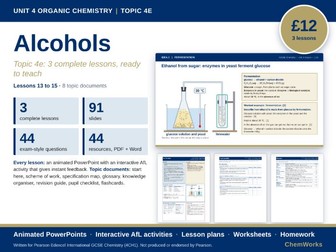
Edexcel IGCSE Chemistry (4CH1) Unit 4 Organic Chemistry, Topic 4e Alcohols: 3 complete, ready-to-teach lessons with animated PowerPoints, interactive AfL activities, worksheets, homework and topic revision resources. Alcohols for the separate Chemistry course, done thoroughly: naming and drawing, the three ways ethanol is oxidised, and fermentation against hydration of ethene, the comparison pupils have to be able to argue. Three lessons, three practicals or demonstrations. Walk in and teach. Every lesson is planned minute by minute and comes with its slides, two levels of worksheet, homework and every answer, so your planning is done before you open the file. Covers specification points 4.29C–4.33C. Chemistry-only points (ending in C), for the separate Chemistry course. The lessons Lesson 13: Alcohols: the -OH group, drawing and naming alcohols (4.29C, 4.30C) Lesson 14: Oxidation of ethanol: three routes (4.31C) Lesson 15: Making ethanol: hydration of ethene and fermentation (4.32C, 4.33C, 4.6) Practicals and demonstrations Lesson 13: Class practical: three tests on ethanol Lesson 14: Teacher demonstration: ethanol warmed with acidified potassium dichromate(VI) Lesson 15: Class practical: fermenting glucose with yeast, and testing the gas Why teachers like it Animated slides that teach one idea at a time, with worked examples that show where the marks are earned An interactive AfL activity in every lesson: the class clicks, the slide gives instant feedback with the reason Scaffolded support worksheets with the same questions and more help, so a mixed class works on the same chemistry Original drawings and animations throughout: nothing borrowed from a textbook or the web What you get 3 complete lessons: 91 slides, 44 exam-style questions and 44 resources Every lesson: an animated, editable PowerPoint with an interactive AfL activity, a two-page lesson plan, a worksheet and a scaffolded support worksheet, both with answers, homework with mark scheme, student notes, flashcards and a misconception check Technician notes for every practical and demonstration Topic documents: Start here, scheme of work, specification map, knowledge organiser, revision guide, pupil checklist, flashcard set and glossary Every document as PDF and editable Word Price: £12, £4 a lesson (£1.50 less than buying the lessons singly, with the topic documents added). Better value still: the complete Unit 4 Organic Chemistry pack (22 lessons, the 2 unit tests with mark schemes and all the unit documents) for £73.50. The unit tests come only with the complete unit. Written for Pearson Edexcel International GCSE Chemistry (4CH1). Not produced or endorsed by Pearson.
Edexcel IGCSE Chemistry Unit 4 – Organic Chemistry: Topic 4d Alkenes (2 Lessons)Quick View
ChemWorks

Edexcel IGCSE Chemistry Unit 4 – Organic Chemistry: Topic 4d Alkenes (2 Lessons)

(0)
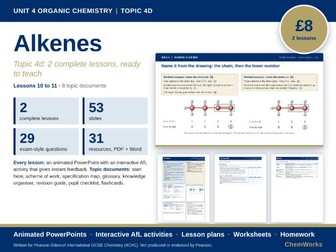
Edexcel IGCSE Chemistry (4CH1) Unit 4 Organic Chemistry, Topic 4d Alkenes: 2 complete, ready-to-teach lessons with animated PowerPoints, interactive AfL activities, worksheets, homework and topic revision resources. The C=C double bond and the bromine water test in two tight lessons: naming and drawing alkenes, addition across the double bond, and a class practical where pupils plan their own test to tell hexane from hexene. Walk in and teach. Every lesson is planned minute by minute and comes with its slides, two levels of worksheet, homework and every answer, so your planning is done before you open the file. Covers specification points 4.6, 4.23–4.28. The lessons Lesson 10: Alkenes: the C=C functional group, general formula, unsaturated, naming up to four carbons (4.23, 4.24, 4.25, 4.26) Lesson 11: Addition reactions: bromine adds across the C=C, and the bromine water test (4.27, 4.28, 4.6) Practicals and demonstrations Lesson 11: Class practical: telling hexane from hexene with bromine water Why teachers like it Animated slides that teach one idea at a time, with worked examples that show where the marks are earned An interactive AfL activity in every lesson: the class clicks, the slide gives instant feedback with the reason Scaffolded support worksheets with the same questions and more help, so a mixed class works on the same chemistry Original drawings and animations throughout: nothing borrowed from a textbook or the web What you get 2 complete lessons: 53 slides, 29 exam-style questions and 31 resources Every lesson: an animated, editable PowerPoint with an interactive AfL activity, a two-page lesson plan, a worksheet and a scaffolded support worksheet, both with answers, homework with mark scheme, student notes, flashcards and a misconception check Technician notes for every practical and demonstration Topic documents: Start here, scheme of work, specification map, knowledge organiser, revision guide, pupil checklist, flashcard set and glossary Every document as PDF and editable Word Price: £8, £4 a lesson (£1 less than buying the lessons singly, with the topic documents added). Better value still: the complete Unit 4 Organic Chemistry pack (22 lessons, the 2 unit tests with mark schemes and all the unit documents) for £73.50. The unit tests come only with the complete unit. Written for Pearson Edexcel International GCSE Chemistry (4CH1). Not produced or endorsed by Pearson.
Edexcel IGCSE Chemistry Unit 4 – Organic Chemistry: Topic 4b Crude Oil (4 Lessons)Quick View
ChemWorks

Edexcel IGCSE Chemistry Unit 4 – Organic Chemistry: Topic 4b Crude Oil (4 Lessons)

(0)
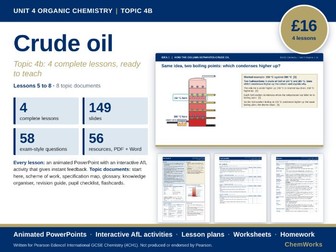
Edexcel IGCSE Chemistry (4CH1) Unit 4 Organic Chemistry, Topic 4b Crude Oil: 4 complete, ready-to-teach lessons with animated PowerPoints, interactive AfL activities, worksheets, homework and topic revision resources. Crude oil is where organic chemistry meets the real world, and it is packed with exam marks: the fractions and their trends, combustion equations, acid rain and cracking. Four lessons, each with a practical or demonstration, every minute planned for you. Walk in and teach. Every lesson is planned minute by minute and comes with its slides, two levels of worksheet, homework and every answer, so your planning is done before you open the file. Covers specification points 4.6–4.18. The lessons Lesson 5: Crude oil: a mixture of hydrocarbons, fractional distillation, the fractions and their trends (4.7, 4.8, 4.9, 4.10) Lesson 6: Fuels and combustion: complete and incomplete combustion, and why carbon monoxide is poisonous (4.11, 4.12, 4.13, 4.6) Lesson 7: Pollutants from burning fuels: oxides of nitrogen, sulfur dioxide and acid rain (4.14, 4.15, 4.16) Lesson 8: Cracking: why it is needed, how it works, and the practical (4.17, 4.18) Practicals and demonstrations Lesson 5: Teacher demonstration: fractional distillation of a crude oil substitute Lesson 6: Class practical: what a burning candle makes Lesson 7: Class practical: the acid rain dish Lesson 8: Teacher demonstration: cracking liquid paraffin over hot porcelain chips Why teachers like it Animated slides that teach one idea at a time, with worked examples that show where the marks are earned An interactive AfL activity in every lesson: the class clicks, the slide gives instant feedback with the reason Scaffolded support worksheets with the same questions and more help, so a mixed class works on the same chemistry Original drawings and animations throughout: nothing borrowed from a textbook or the web What you get 4 complete lessons: 149 slides, 58 exam-style questions and 56 resources Every lesson: an animated, editable PowerPoint with an interactive AfL activity, a two-page lesson plan, a worksheet and a scaffolded support worksheet, both with answers, homework with mark scheme, student notes, flashcards and a misconception check Technician notes for every practical and demonstration Topic documents: Start here, scheme of work, specification map, knowledge organiser, revision guide, pupil checklist, flashcard set and glossary Every document as PDF and editable Word Price: £16, £4 a lesson (£2 less than buying the lessons singly, with the topic documents added). Better value still: the complete Unit 4 Organic Chemistry pack (22 lessons, the 2 unit tests with mark schemes and all the unit documents) for £73.50. The unit tests come only with the complete unit. Written for Pearson Edexcel International GCSE Chemistry (4CH1). Not produced or endorsed by Pearson.
Edexcel IGCSE Chemistry Unit 4 – Organic Chemistry: Topic 4a Intro to Organic Chemistry (4 Lessons)Quick View
ChemWorks

Edexcel IGCSE Chemistry Unit 4 – Organic Chemistry: Topic 4a Intro to Organic Chemistry (4 Lessons)

(0)
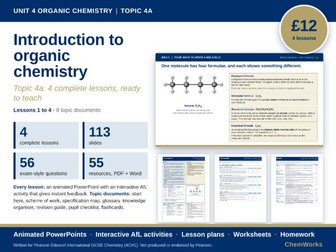
Edexcel IGCSE Chemistry (4CH1) Unit 4 Organic Chemistry, Topic 4a Intro to Organic Chemistry: 4 complete, ready-to-teach lessons with animated PowerPoints, interactive AfL activities, worksheets, homework and topic revision resources. Start organic chemistry the right way. These four lessons take your class from “what is a hydrocarbon?” to naming branched alkanes and finding every isomer of a formula, with model building in three of them so pupils see the molecules in 3D before they draw them. Walk in and teach. Every lesson is planned minute by minute and comes with its slides, two levels of worksheet, homework and every answer, so your planning is done before you open the file. Covers specification points 4.1–4.5, 4.19–4.21. The lessons Lesson 1: Organic chemistry: one molecule, four ways to write it (4.1, 4.2) Lesson 2: The alkane family: homologous series, general formula, saturated (4.3, 4.19, 4.20) Lesson 3: Naming alkanes: unbranched and branched chains up to six carbons (4.4, 4.21) Lesson 4: Isomerism, and drawing all the structures for a molecular formula (4.3, 4.5) Practicals and demonstrations Lesson 1: Model building: pairs build ethane with molecular model kits Lesson 3: Model building: pairs build pentane with molecular model kits Lesson 4: Model building: pairs build the three isomers of pentane with model kits Why teachers like it Animated slides that teach one idea at a time, with worked examples that show where the marks are earned An interactive AfL activity in every lesson: the class clicks, the slide gives instant feedback with the reason Scaffolded support worksheets with the same questions and more help, so a mixed class works on the same chemistry Original drawings and animations throughout: nothing borrowed from a textbook or the web What you get 4 complete lessons: 113 slides, 56 exam-style questions and 55 resources Every lesson: an animated, editable PowerPoint with an interactive AfL activity, a two-page lesson plan, a worksheet and a scaffolded support worksheet, both with answers, homework with mark scheme, student notes, flashcards and a misconception check Technician notes for every practical and demonstration Topic documents: Start here, scheme of work, specification map, knowledge organiser, revision guide, pupil checklist, flashcard set and glossary Every document as PDF and editable Word Price: £12: £4 for each of the 3 paid lessons, as Lesson 1 is free (£1.50 less than buying them singly, with the topic documents added). Better value still: the complete Unit 4 Organic Chemistry pack (22 lessons, the 2 unit tests with mark schemes and all the unit documents) for £73.50. The unit tests come only with the complete unit. Written for Pearson Edexcel International GCSE Chemistry (4CH1). Not produced or endorsed by Pearson.
Edexcel IGCSE Chemistry Unit 4 – Organic Chemistry: Topic 4c Alkanes (1 Lesson)Quick View
ChemWorks

Edexcel IGCSE Chemistry Unit 4 – Organic Chemistry: Topic 4c Alkanes (1 Lesson)

(0)
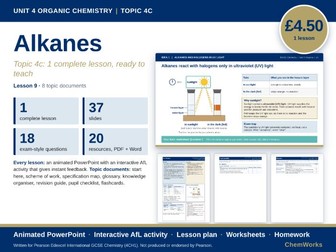
Edexcel IGCSE Chemistry (4CH1) Unit 4 Organic Chemistry, Topic 4c Alkanes: 1 complete, ready-to-teach lesson with an animated PowerPoint, interactive AfL activity, worksheets, homework and a full set of topic revision resources. The one reaction of the alkanes on the specification, taught properly: substitution with a halogen in ultraviolet light, written in displayed and molecular formulae, with a demonstration that shows pupils what difference the sunlight makes. Walk in and teach. The lesson is planned minute by minute and comes with its slides, two levels of worksheet, homework and every answer, so your planning is done before you open the file. Covers specification points 4.6, 4.22. The lesson Lesson 9: Alkanes react: substitution with halogens in UV light (4.22, 4.6) Practicals and demonstrations Lesson 9: Teacher demonstration: bromine water and hexane, in sunlight and in the dark Why teachers like it Animated slides that teach one idea at a time, with worked examples that show where the marks are earned An interactive AfL activity: the class clicks, the slide gives instant feedback with the reason Scaffolded support worksheets with the same questions and more help, so a mixed class works on the same chemistry Original drawings and animations throughout: nothing borrowed from a textbook or the web What you get 1 complete lesson: 37 slides, 18 exam-style questions and 20 resources The lesson: an animated, editable PowerPoint with an interactive AfL activity, a two-page lesson plan, a worksheet and a scaffolded support worksheet, both with answers, homework with mark scheme, student notes, flashcards and a misconception check Technician notes for the practical Topic documents: Start here, scheme of work, specification map, knowledge organiser, revision guide, pupil checklist, flashcard set and glossary Every document as PDF and editable Word Price: £4.50, the same as the lesson on its own, with the topic documents added. Better value still: the complete Unit 4 Organic Chemistry pack (22 lessons, the 2 unit tests with mark schemes and all the unit documents) for £73.50. The unit tests come only with the complete unit. Written for Pearson Edexcel International GCSE Chemistry (4CH1). Not produced or endorsed by Pearson.
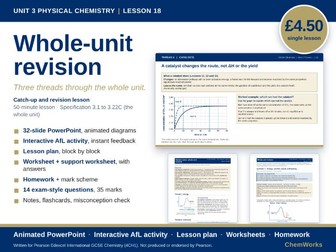
Edexcel IGCSE Chemistry Unit 3 – Physical Chemistry: Lesson 18, Whole-Unit RevisionQuick View
ChemWorks

Edexcel IGCSE Chemistry Unit 3 – Physical Chemistry: Lesson 18, Whole-Unit Revision

(0)
Edexcel IGCSE Chemistry (4CH1) Unit 3 Physical Chemistry, Lesson 18: Whole-Unit Revision. A complete, ready-to-teach lesson: animated PowerPoint, interactive AfL activity, a worksheet and a scaffolded worksheet (both with answers) and homework. The whole of Physical chemistry pulled into three threads: energy, collisions and catalysts. Pupils finally see how ΔH, rate, activation energy and yield connect. After the three threads and a “Which is bigger?” activity, pupils sit an 18-minute timed section in silence, then swap and mark a partner’s sheet with the answers. The plenary puts a full explanation in order, and the homework is final revision on two reactions the lesson never uses. Walk in and teach: the lesson is planned minute by minute, with the slides, two levels of worksheet, homework and every answer ready to go. Specification points: 3.1 to 3.22C revised, the whole unit. What you get 32-slide editable PowerPoint, with worked examples that build a click at a time, an interactive activity, and speaker notes giving the answers and timings Two-page lesson plan: the lesson at a glance, then the 50 minutes block by block Worksheet with answers (20 marks) Scaffolded support worksheet with answers: the same questions, with gap-fills and word banks Homework with mark scheme (15 marks, about 15 to 20 minutes): yours to set or not Student notes Flashcards to print and cut, plus a text file for Quizlet or Anki Misconception check with its key 14 exam-style questions worth 35 marks across the worksheet and homework 11 resources in all: the PowerPoint and 10 documents, each document as a PDF and an editable Word file (the Quizlet text file comes on top) Why teachers like it One idea at a time: every slide builds up a click at a time, so there is never a wall of text See straight away who has got it: a wrong answer brings up a cross, the reason and Try again; the right one brings up a tick and the reasoning Mixed classes covered: the scaffolded worksheet asks the same questions with more help, so everyone works on the same chemistry Every diagram and animation was drawn for this lesson: nothing is borrowed from a textbook or the web Save more on ChemWorks: this revision lesson is also in the complete Unit 3 Physical Chemistry pack (18 lessons, both unit tests with mark schemes and all the unit documents, £59.50). Lesson 1 of the unit is free, so you can try before you buy. Written for Pearson Edexcel International GCSE Chemistry (4CH1). Not produced or endorsed by Pearson.