

 Quick View
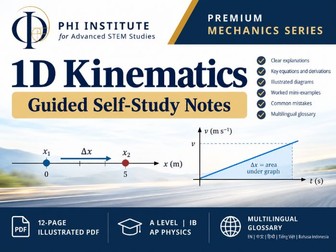
1D Kinematics Guided Self-Study Notes
One-dimensional kinematics study notes for A-level, IB and AP Physics, covering motion graphs, velocity, acceleration, SUVAT equations and free fall.
About this resource
Part of the Premium Mechanics Series, these Guided Self-Study Notes provide a clear, structured introduction to one-dimensional motion. Designed for independent learning and classroom support, they explain the physical meaning behind the equations rather than relying on memorisation.
Topics covered
Position, distance and displacement
Speed, velocity and acceleration
Average and instantaneous quantities
Position–time, velocity–time and acceleration–time graphs
Interpreting gradients and signed areas
Derivation and application of the SUVAT equations
Vertical motion and free fall under gravity
Multi-stage motion and problem-solving strategies
Calculus extension: differentiation and integration in kinematics
What makes these notes different?
The resource combines accessible explanations with mathematical rigour. Key equations are explained and derived step by step, supported by carefully labelled diagrams, three short worked mini-examples and guidance on common misconceptions.
The notes are particularly suitable for students studying physics in English as an additional language, while providing sufficient depth for more advanced learners.
Curriculum suitability
Suitable for Cambridge International AS & A Level Physics, International A-level Physics, IB Diploma Physics, AP Physics 1 and AP Physics C: Mechanics. Calculus-based material is clearly identified as an extension.
What’s included?
12-page illustrated PDF, including a compact final glossary
Clear definitions and explanations
Key equations and derivations
Motion graphs and explanatory diagrams
Three mini-examples with solutions
Common mistakes and problem-solving guidance
Multilingual glossary with Chinese, Hindi, Vietnamese and Bahasa Indonesia translations
This resource contains the Guided Self-Study Notes. Separate practice problem sets and extended worked examples are not included.
Created by the Phi Institute for Advanced STEM Studies.