Blood and Immune System Worksheets: Blood Groups, Transfusion, Antibodies, Vaccines | GCSEQuick View
DrJuarezScience

Blood and Immune System Worksheets: Blood Groups, Transfusion, Antibodies, Vaccines | GCSE

(0)
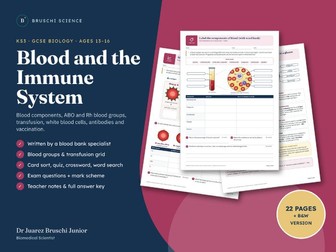
Teach blood and immunity with a pack written by a biomedical scientist who specialises in clinical haematology and the hospital blood bank. This 22-page printable A4 pack covers the components of blood, the body’s non-specific defences, phagocytes and lymphocytes, antibodies and antitoxins, ABO and Rh blood groups, safe blood transfusion and crossmatching, vaccination and herd immunity. It includes a knowledge organiser, blood labelling with a word bank, a no-word-bank challenge on the body’s defences, a red-cell transfusion compatibility grid, a vaccination graph task, a cut-and-stick card sort, a blood-group and full-blood-count data task, a 14-question multiple-choice quiz, a crossword, a word search, two pages of exam-style questions with marks (including a 6-mark question), an extension on ABO inheritance and Rh disease, and four exit tickets. Every activity page is answered in a full answer key and mark scheme at the back, so the pack works for lessons, homework, cover lessons and revision with no extra preparation. Teacher notes give curriculum links, a suggested lesson sequence and the UK and US terms used. The diagrams are original Bruschi Science artwork or adapted from Servier Medical Art (CC BY 4.0, credited on each figure). A separate black-and-white, ink-saving PDF of the whole pack is included, so it prints clearly on any school photocopier. Written in British English, with US terms given alongside, so it works in UK, US and international classrooms. The transfusion pages reflect real hospital practice: grouping, antibody screening and crossmatching, explained in plain language by Dr Juarez Bruschi Junior, Biomedical Scientist specialising in clinical haematology and blood transfusion.
Skeleton, Muscles and Movement Worksheets: Bones, Joints, Antagonistic Muscles | KS3 & GCSE PEQuick View
DrJuarezScience

Skeleton, Muscles and Movement Worksheets: Bones, Joints, Antagonistic Muscles | KS3 & GCSE PE

(0)
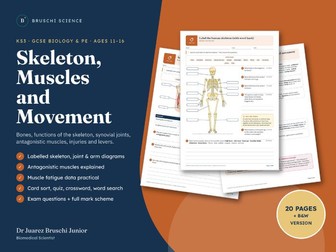
Teach the skeletal and muscular systems in Biology or GCSE PE with clear labelled diagrams, real-life injury case studies and a simple muscle-fatigue practical. This 20-page printable A4 pack covers the bones of the skeleton, the five functions of the skeleton, the structure of a long bone and bone marrow, synovial joints and the four joint types, tendons, ligaments and cartilage, antagonistic muscle pairs, fractures, sprains, osteoporosis and osteoarthritis, muscle fatigue, and the forearm as a lever. It includes a knowledge organiser, skeleton labelling with a word bank, a no-word-bank synovial joint challenge with joint types, a long-bone and functions page, an antagonistic muscles labelling page, injury case studies with a bone-density graph, a cut-and-stick card sort, a muscle-fatigue data practical, a 14-question multiple-choice quiz, a crossword, a word search, two pages of exam-style questions with marks (including a 6-mark question), an extension on levers and moments, and four exit tickets. Every activity page is answered in a full answer key and mark scheme at the back, so the pack works for lessons, homework, cover lessons and revision with no extra preparation. Teacher notes give curriculum links, a suggested lesson sequence and the UK and US terms used. The diagrams are original Bruschi Science artwork or adapted from Servier Medical Art (CC BY 4.0, credited on each figure). A separate black-and-white, ink-saving PDF of the whole pack is included, so it prints clearly on any school photocopier. Written in British English, with US terms given alongside, so it works in UK, US and international classrooms. Written by Dr Juarez Bruschi Junior, Biomedical Scientist.
Cells and Microscopy Worksheets: Animal, Plant and Bacterial Cells, Magnification | KS3 & GCSEQuick View
DrJuarezScience

Cells and Microscopy Worksheets: Animal, Plant and Bacterial Cells, Magnification | KS3 & GCSE

(0)
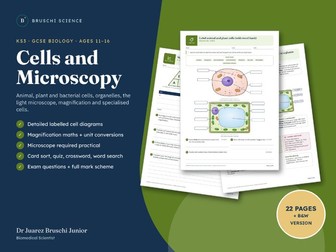
Teach cell biology and microscopy from the first cell diagram to confident magnification calculations, with every worksheet and answer ready to print. This 22-page printable A4 pack covers animal, plant and bacterial cell structure, organelle functions, eukaryotic and prokaryotic cells, the light microscope, the onion-cell microscopy required practical, magnification with unit conversions, standard form and scale bars, measuring cells with an eyepiece graticule, and specialised cells. It includes a knowledge organiser, animal and plant cell labelling with a word bank, a no-word-bank bacterial cell challenge, organelle matching, microscope labelling and focusing steps, a required-practical page with scientific drawing, a magnification maths page, a specialised cells task, a cut-and-stick card sort, a measuring-cells data task, a 14-question multiple-choice quiz, a crossword, a word search, two pages of exam-style questions with marks (including two 6-mark questions), an extension on size, scale and resolution, and four exit tickets. Every activity page is answered in a full answer key and mark scheme at the back, so the pack works for lessons, homework, cover lessons and revision with no extra preparation. Teacher notes give curriculum links, a suggested lesson sequence and the UK and US terms used. The diagrams are original Bruschi Science artwork or adapted from Servier Medical Art (CC BY 4.0, credited on each figure). A separate black-and-white, ink-saving PDF of the whole pack is included, so it prints clearly on any school photocopier. Written in British English, with US terms given alongside, so it works in UK, US and international classrooms. Written by Dr Juarez Bruschi Junior, Biomedical Scientist.
Nervous System and Reflexes Worksheets: Neurones, Reflex Arc, Synapse, Brain, Eye | GCSE BiologyQuick View
DrJuarezScience

Nervous System and Reflexes Worksheets: Neurones, Reflex Arc, Synapse, Brain, Eye | GCSE Biology

(0)
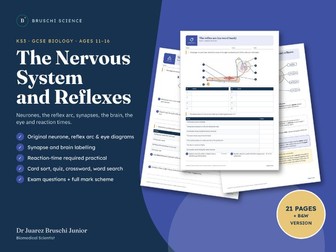
Teach the nervous system with clear original diagrams of neurones, the reflex arc, the synapse and the eye, plus the reaction-time required practical. This 21-page printable A4 pack covers neurone structure and the three types of neurone, the reflex arc, synapses and neurotransmitters, the central and peripheral nervous systems, the brain (cerebral cortex, cerebellum, medulla, hypothalamus), the eye, the pupil reflex and accommodation, reflex versus voluntary actions, and the ruler-drop reaction-time practical. It includes a knowledge organiser, motor neurone labelling with a word bank, a neurone types task, a no-word-bank reflex arc challenge with event sequencing, nervous system and synapse labelling, brain and eye labelling with function tables, a pupil reflex page, a cut-and-stick stimulus–receptor–effector–response card sort, a reaction-time and caffeine data task, a 14-question multiple-choice quiz, a crossword, a word search, two pages of exam-style questions with marks (including a 6-mark question), an extension on impulse speed and eye defects, and four exit tickets. Every activity page is answered in a full answer key and mark scheme at the back, so the pack works for lessons, homework, cover lessons and revision with no extra preparation. Teacher notes give curriculum links, a suggested lesson sequence and the UK and US terms used. The diagrams are original Bruschi Science artwork or adapted from Servier Medical Art (CC BY 4.0, credited on each figure). A separate black-and-white, ink-saving PDF of the whole pack is included, so it prints clearly on any school photocopier. Written in British English, with US terms given alongside, so it works in UK, US and international classrooms. Written by Dr Juarez Bruschi Junior, Biomedical Scientist.
Homeostasis and Kidneys Worksheets: Blood Glucose, Diabetes, Temperature, Nephron | GCSE BiologyQuick View
DrJuarezScience

Homeostasis and Kidneys Worksheets: Blood Glucose, Diabetes, Temperature, Nephron | GCSE Biology

(0)
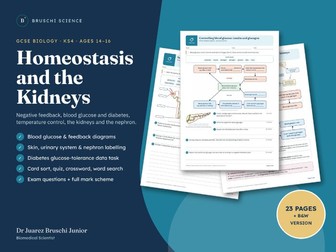
Teach homeostasis with clear feedback diagrams, real glucose tolerance data and labelled skin, urinary system and nephron diagrams, written by a biomedical scientist. This 23-page printable A4 pack covers homeostasis and negative feedback, control of blood glucose by insulin and glucagon, type 1 and type 2 diabetes and how they are diagnosed, thermoregulation by the hypothalamus and skin, the urinary system, filtration and selective reabsorption in the nephron, ADH and water balance, and dialysis and kidney transplants. It includes a knowledge organiser, a negative feedback cycle, a blood glucose control diagram to complete, a diabetes comparison page, a glucose tolerance test data task, a no-word-bank skin challenge comparing hot and cold skin, a thermoregulation page with exercise data, urinary system and nephron labelling with a plasma, filtrate and urine table, a cut-and-stick card sort, a 14-question multiple-choice quiz, a crossword, a word search, two pages of exam-style questions with marks (including a 6-mark question), an extension on ADH and kidney function tests, and four exit tickets. Every activity page is answered in a full answer key and mark scheme at the back, so the pack works for lessons, homework, cover lessons and revision with no extra preparation. Teacher notes give curriculum links, a suggested lesson sequence and the UK and US terms used. The diagrams are original Bruschi Science artwork or adapted from Servier Medical Art (CC BY 4.0, credited on each figure). A separate black-and-white, ink-saving PDF of the whole pack is included, so it prints clearly on any school photocopier. Written in British English, with US terms given alongside, so it works in UK, US and international classrooms. The diabetes and kidney pages draw on real laboratory practice (fasting glucose, HbA1c, creatinine and eGFR), explained in plain language by Dr Juarez Bruschi Junior, Biomedical Scientist.
Anatomical Terminology Worksheets: Body Planes, Cavities, Directional Terms, Regions | AnatomyQuick View
DrJuarezScience

Anatomical Terminology Worksheets: Body Planes, Cavities, Directional Terms, Regions | Anatomy

(0)
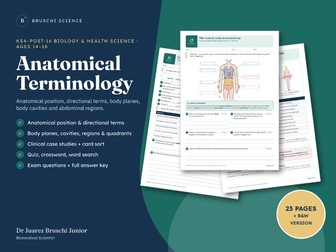
Give students the shared language of anatomy before they study any body system, with clear original diagrams and real clinical case notes to decode. This 23-page printable A4 pack covers the anatomical position (with supine and prone), directional terms, the sagittal, frontal (coronal) and transverse planes, the dorsal and ventral body cavities including the pleural and pericardial cavities, and the nine abdominal regions and four quadrants. It includes a knowledge organiser, an anatomical-position observation task, directional-term labelling and sentence practice, a body-planes diagram task, cavity labelling with and without a word bank, regions and quadrants labelling, an 18-card which-cavity sort, four clinical case studies, a 14-question multiple-choice quiz, a crossword, a word search, two pages of exam-style questions with marks (including a 6-mark question), an extension on regional terms and four exit tickets. Every activity page is answered in a full answer key and mark scheme at the back, so the pack works for lessons, homework, cover lessons and revision with no extra preparation. Two pages of teacher notes give curriculum links, a suggested lesson sequence and the UK and US terms used. The diagrams are original Bruschi Science artwork or adapted from Servier Medical Art (CC BY 4.0, credited on each figure). A separate black-and-white, ink-saving PDF of the whole pack is included, so it prints clearly on any school photocopier. Written in British English, with US terms given alongside, so it works in UK, US and international classrooms. Written by Dr Juarez Bruschi Junior, Biomedical Scientist.
Human Body Systems Worksheets: Levels of Organisation, 11 Organ Systems, Skeleton | KS3 BiologyQuick View
DrJuarezScience

Human Body Systems Worksheets: Levels of Organisation, 11 Organ Systems, Skeleton | KS3 Biology

(0)
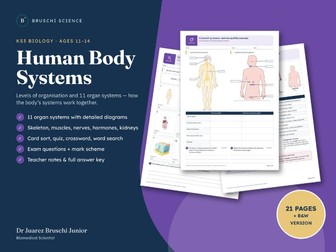
Introduce the human body as a set of systems that work together, with clear diagrams and a full set of ready-to-use activities. This 21-page printable A4 pack covers levels of organisation (cell, tissue, organ, organ system, organism), all 11 organ systems in a picture gallery, the skeleton and antagonistic muscles, the nervous and endocrine systems, the urinary system and how systems work together. It includes a knowledge organiser, a sequencing task, an 11-system picture gallery, three labelling pages, a 400 m race case study, an 18-card cut-and-stick sort, a reaction-time data task, a 14-question multiple-choice quiz, a crossword, a word search, two pages of exam-style questions with marks, a homeostasis extension and four exit tickets. Every activity page is answered in a full answer key and mark scheme at the back, so the pack works for lessons, homework, cover lessons and revision with no extra preparation. Two pages of teacher notes give curriculum links, a suggested lesson sequence and the UK and US terms used. The diagrams are original Bruschi Science artwork or adapted from Servier Medical Art (CC BY 4.0, credited on each figure). A separate black-and-white, ink-saving PDF of the whole pack is included, so it prints clearly on any school photocopier. Written in British English, with US terms given alongside, so it works in UK, US and international classrooms. Written by Dr Juarez Bruschi Junior, Biomedical Scientist.
Nutrition and Digestion Worksheets: Digestive System, Enzymes, Food Tests | KS3 & GCSE BiologyQuick View
DrJuarezScience

Nutrition and Digestion Worksheets: Digestive System, Enzymes, Food Tests | KS3 & GCSE Biology

(0)
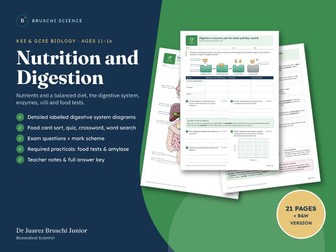
A complete, ready-to-print unit on nutrition and digestion, with detailed diagrams, the required practicals and a full answer key. This 21-page printable A4 pack covers nutrients and a balanced diet, the digestive system (labelling with and without a word bank), digestive enzymes and the lock-and-key model, bile, villi and absorption, and the food tests and amylase practicals. It includes a knowledge organiser, two levels of digestive-system labelling, a nutrients table, a picture card sort with 16 foods, food-test methods and results, an amylase-temperature data task with graph plotting, a 14-question multiple-choice quiz, a crossword, a word search, two pages of exam-style questions with marks, an extension on lactose intolerance and calorimetry and four exit tickets. Every activity page is answered in a full answer key and mark scheme at the back, so the pack works for lessons, homework, cover lessons and revision with no extra preparation. Two pages of teacher notes give curriculum links, a suggested lesson sequence and the UK and US terms used. The diagrams are original Bruschi Science artwork or adapted from Servier Medical Art (CC BY 4.0, credited on each figure). A separate black-and-white, ink-saving PDF of the whole pack is included, so it prints clearly on any school photocopier. Written in British English, with US terms given alongside, so it works in UK, US and international classrooms. Written by Dr Juarez Bruschi Junior, Biomedical Scientist.
Heart and Circulation Worksheets: Heart Diagrams, Blood Vessels, Blood and CHD | GCSE BiologyQuick View
DrJuarezScience

Heart and Circulation Worksheets: Heart Diagrams, Blood Vessels, Blood and CHD | GCSE Biology

(0)
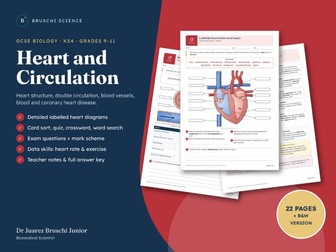
Teach the heart and circulation with accurate, beautifully labelled diagrams and every activity you need for a full GCSE unit. This 22-page printable A4 pack covers heart structure (labelling with and without a word bank), the coronary arteries, the path of blood through the heart, double circulation, arteries, veins and capillaries, blood components and coronary heart disease. It includes a knowledge organiser, two levels of heart labelling, sequencing, a cut-and-stick card sort, a heart-rate data task with graph plotting and calculations, a 14-question multiple-choice quiz, a crossword, a word search, two pages of exam-style questions with marks (including a 6-mark question), an extension on the athlete’s heart and four exit tickets. Every activity page is answered in a full answer key and mark scheme at the back, so the pack works for lessons, homework, cover lessons and revision with no extra preparation. Two pages of teacher notes give curriculum links, a suggested lesson sequence and the UK and US terms used. The diagrams are original Bruschi Science artwork or adapted from Servier Medical Art (CC BY 4.0, credited on each figure). A separate black-and-white, ink-saving PDF of the whole pack is included, so it prints clearly on any school photocopier. Written in British English, with US terms given alongside, so it works in UK, US and international classrooms. Written by Dr Juarez Bruschi Junior, Biomedical Scientist.
Respiratory System Worksheets: Lungs, Gas Exchange, Breathing and Smoking | KS3 & GCSE BiologyQuick View
DrJuarezScience

Respiratory System Worksheets: Lungs, Gas Exchange, Breathing and Smoking | KS3 & GCSE Biology

(0)
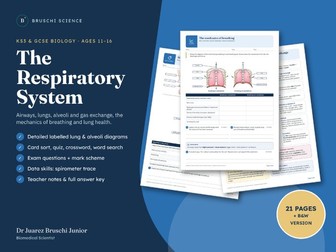
Everything you need to teach breathing and gas exchange, from the airways to the alveoli, in one printable, fully answered pack. This 21-page printable A4 pack covers the airways and lungs (labelling with and without a word bank), alveoli and gas exchange, the mechanics of breathing, the bell-jar model, inhaled versus exhaled air, and smoking and lung disease (emphysema, chronic bronchitis, lung cancer). It includes a knowledge organiser, two levels of labelling, a breathing-in or breathing-out card sort, a spirometer data task, a 14-question multiple-choice quiz, a crossword, a word search, two pages of exam-style questions with marks (including smoking data analysis), an extension on breathing at high altitude and four exit tickets. Every activity page is answered in a full answer key and mark scheme at the back, so the pack works for lessons, homework, cover lessons and revision with no extra preparation. Two pages of teacher notes give curriculum links, a suggested lesson sequence and the UK and US terms used. The diagrams are original Bruschi Science artwork or adapted from Servier Medical Art (CC BY 4.0, credited on each figure). A separate black-and-white, ink-saving PDF of the whole pack is included, so it prints clearly on any school photocopier. Written in British English, with US terms given alongside, so it works in UK, US and international classrooms. Written by Dr Juarez Bruschi Junior, Biomedical Scientist.
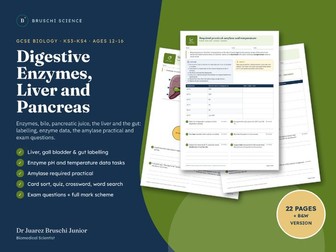
Digestive Enzymes, Liver and Pancreas Worksheets: Amylase, Protease, Lipase, Bile | KS3 & GCSEQuick View
DrJuarezScience

Digestive Enzymes, Liver and Pancreas Worksheets: Amylase, Protease, Lipase, Bile | KS3 & GCSE

(0)
Go beyond the basic digestive system with a pack on enzymes, bile and the organs that make them, written by a biomedical scientist. This 22-page printable A4 pack covers digestive enzymes and their substrates, the roles of the liver, gall bladder and pancreas, bile and emulsification, enzyme pH and temperature graphs, the digestive-enzyme practical and absorption in the small intestine. It includes a knowledge organiser, digestive-system labelling with a word bank, a no-word-bank challenge on the liver and pancreas, an enzyme table, pH and temperature data tasks, a practical page, a cut-and-stick card sort, a 14-question multiple-choice quiz, a crossword, a word search, two pages of exam-style questions with marks (including a 6-mark question), an extension and four exit tickets. Every activity page is answered in a full answer key and mark scheme at the back, so the pack works for lessons, homework, cover lessons and revision with no extra preparation. Teacher notes give curriculum links, a suggested lesson sequence and the UK and US terms used. The diagrams are original Bruschi Science artwork or adapted from Servier Medical Art (CC BY 4.0, credited on each figure). A separate black-and-white, ink-saving PDF of the whole pack is included, so it prints clearly on any school photocopier. Written in British English, with US terms given alongside, so it works in UK, US and international classrooms. Written by Dr Juarez Bruschi Junior, Biomedical Scientist.
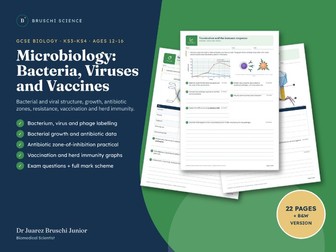
Microbiology Worksheets: Bacteria, Viruses, Antibiotics, Resistance, Vaccines, Herd Immunity | GCSEQuick View
DrJuarezScience

Microbiology Worksheets: Bacteria, Viruses, Antibiotics, Resistance, Vaccines, Herd Immunity | GCSE

(0)
Cover bacteria, viruses and vaccination in one pack, with the antibiotic-zone practical and data tasks, from a biomedical scientist. This 22-page printable A4 pack covers bacterial and viral structure, binary fission and growth, the antibiotic zone-of-inhibition practical, antibiotic resistance, the immune response, vaccination and herd immunity. It includes a knowledge organiser, bacterium, virus and phage labelling, four data tasks, a practical page, a diseases table, a cut-and-stick card sort, a 14-question multiple-choice quiz, a crossword, a word search, two pages of exam-style questions with marks, an extension and four exit tickets. Every activity page is answered in a full answer key and mark scheme at the back, so the pack works for lessons, homework, cover lessons and revision with no extra preparation. Teacher notes give curriculum links, a suggested lesson sequence and the UK and US terms used. The diagrams are original Bruschi Science artwork or adapted from Servier Medical Art (CC BY 4.0, credited on each figure). A separate black-and-white, ink-saving PDF of the whole pack is included, so it prints clearly on any school photocopier. Written in British English, with US terms given alongside, so it works in UK, US and international classrooms. Written by Dr Juarez Bruschi Junior, Biomedical Scientist.
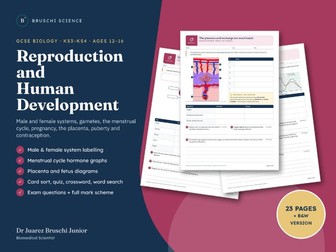
Reproduction and Human Development Worksheets: Menstrual Cycle, Placenta, Puberty, ContraceptionQuick View
DrJuarezScience

Reproduction and Human Development Worksheets: Menstrual Cycle, Placenta, Puberty, Contraception

(0)
Teach human reproduction clearly and factually with labelled diagrams, hormone graphs and exam practice. This 23-page printable A4 pack covers the male and female reproductive systems, egg and sperm cells, the menstrual cycle and its hormones, fertilisation, pregnancy and the placenta, puberty, contraception and IVF. Teach the content that matches your school policy. It includes a knowledge organiser, labelling pages for both systems and the gametes, hormone graphs, pregnancy and placenta pages, a fetal growth data task, a cut-and-stick card sort, a 14-question multiple-choice quiz, a crossword, a word search, two pages of exam-style questions with marks (including a 6-mark question), an extension and four exit tickets. Every activity page is answered in a full answer key and mark scheme at the back, so the pack works for lessons, homework, cover lessons and revision with no extra preparation. Teacher notes give curriculum links, a suggested lesson sequence and the UK and US terms used. The diagrams are original Bruschi Science artwork or adapted from Servier Medical Art (CC BY 4.0, credited on each figure). A separate black-and-white, ink-saving PDF of the whole pack is included, so it prints clearly on any school photocopier. Written in British English, with US terms given alongside, so it works in UK, US and international classrooms. Written by Dr Juarez Bruschi Junior, Biomedical Scientist.
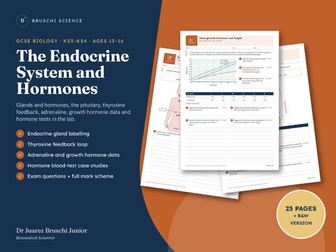
Endocrine System and Hormones Worksheets: Pituitary, Thyroxine, Adrenaline, Negative Feedback | GCSEQuick View
DrJuarezScience

Endocrine System and Hormones Worksheets: Pituitary, Thyroxine, Adrenaline, Negative Feedback | GCSE

(0)
Teach hormones with labelled glands, a thyroxine feedback loop, real-style blood-test case studies and exam practice from a biomedical scientist. This 23-page printable A4 pack covers the endocrine glands, nerves compared with hormones, the pituitary gland, thyroxine negative feedback, adrenaline, growth hormone data, hormone blood tests and endocrine disorders. It includes a knowledge organiser, gland labelling, a feedback-loop page, adrenaline and growth-hormone data tasks, a laboratory blood-test page, a cut-and-stick card sort, a 14-question multiple-choice quiz, a crossword, a word search, two pages of exam-style questions with marks (including a 6-mark question), an extension and four exit tickets. Every activity page is answered in a full answer key and mark scheme at the back, so the pack works for lessons, homework, cover lessons and revision with no extra preparation. Teacher notes give curriculum links, a suggested lesson sequence and the UK and US terms used. The diagrams are original Bruschi Science artwork or adapted from Servier Medical Art (CC BY 4.0, credited on each figure). A separate black-and-white, ink-saving PDF of the whole pack is included, so it prints clearly on any school photocopier. Written in British English, with US terms given alongside, so it works in UK, US and international classrooms. Written by Dr Juarez Bruschi Junior, Biomedical Scientist.
Genetics, DNA and Inheritance Worksheets: Punnett Squares, Alleles, Pedigrees, Meiosis | GCSEQuick View
DrJuarezScience

Genetics, DNA and Inheritance Worksheets: Punnett Squares, Alleles, Pedigrees, Meiosis | GCSE

(0)
Make inheritance clear with labelled DNA diagrams, four Punnett square crosses and a pedigree task, all with full answers. This 23-page printable A4 pack covers DNA structure and base pairing, genes, alleles and chromosomes, genotype and phenotype, monohybrid crosses with Punnett squares, family pedigrees, sex determination, and mitosis compared with meiosis. It includes a knowledge organiser, DNA and chromosome labelling, a no-word-bank challenge, four Punnett square crosses with probability questions, a pedigree analysis task, a cut-and-stick card sort, a 14-question multiple-choice quiz, a crossword, a word search, two pages of exam-style questions with marks (including a 6-mark question), an extension and four exit tickets. Every activity page is answered in a full answer key and mark scheme at the back, so the pack works for lessons, homework, cover lessons and revision with no extra preparation. Teacher notes give curriculum links, a suggested lesson sequence and the UK and US terms used. The diagrams are original Bruschi Science artwork or adapted from Servier Medical Art (CC BY 4.0, credited on each figure). A separate black-and-white, ink-saving PDF of the whole pack is included, so it prints clearly on any school photocopier. Written in British English, with US terms given alongside, so it works in UK, US and international classrooms. Written by Dr Juarez Bruschi Junior, Biomedical Scientist.