AQA 7517 Computer Science NEA Complete GuideQuick View
OliverJennings

AQA 7517 Computer Science NEA Complete Guide

(0)
A collection of resources to guide both teachers and students through the AQA 7517 Computer Science NEA. PPTs for students for each section with key ideas and how to do well and achieve marks mailmerge tools and suggestions to make marking easier Suggested headings and content for each section Suggested ideas and traps to avoid Template for outline plan and reflection sheet for students A copy of all relevent AQA (publically accessible) files for NEA AI - One part of this bundle is AI generated, I have fed my own historic marking commentary and responses into chatGPT to generate a weak/medium/strong example markers feedback for each section.
Computer Science secondary open evening activityQuick View
OliverJennings

Computer Science secondary open evening activity

(0)
This is an easy win for open evenings - an easy print and set activity for primary students transitioning into secondary for Computer Science. The theme is data representation and binary. The goal is to make each total with the fewest number of currency notes. To make this run well, load up your printer with 8 different coloured pieces of card so each note is on a different colour with the instruction page on white at the end. Could be used as a part of an introduction to base-2 number system activity with KS3 as well. Some printing and cutting required.
Computer Science 277 1&2 Practice ExamsQuick View
OliverJennings

Computer Science 277 1&2 Practice Exams

(0)
An unseen pair of practice exams for new OCR J277 Computer Science spec. Includes… Paper 1 - 1 hour - 55 Marks Paper 2 - 1 hour - 55 Marks Mark schemes for both Student analysis sheet for both These are not full 1h30m exams as they are designed for use in a timetabled lesson before mocks.
Searching Algorithms (OCR GCSE)Quick View
OliverJennings

Searching Algorithms (OCR GCSE)

(1)
The two searhcing algorithms OCR GCSE 2.1 Computing Science as interactive html documents for students to explore. Different numbers of items to search through, as well as the expected exam style output for each type. Linear Search Binary Search
Boolean Logic Game AND/OR/NOTQuick View
OliverJennings

Boolean Logic Game AND/OR/NOT

(0)
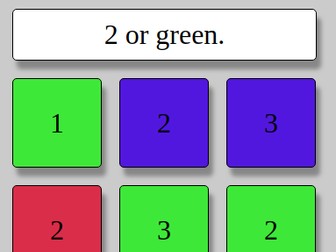
Select all the squares that match the description. Self-differentiated activity as it gets progressively harder when you get questions correct. Starts at “Blue only” style questions, then onto “Red or 1” and “Green and 2”, then onto “Green and not 2” and beyond. Requires internet connection.
Sorting Algorithms (OCR GCSE)Quick View
OliverJennings

Sorting Algorithms (OCR GCSE)

(0)
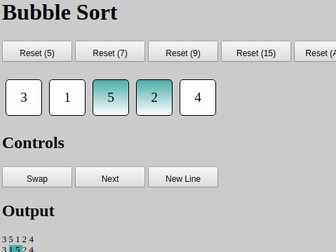
The three sorting algorithms for OCR GCSE 2.1 Computing Science as interactive html documents for students to explore. Different numbers of items to sort, as well as the expected exam style output for each type. Bubble Sort Insertion Sort Merge Sort
1&2 Bit Binary ArtQuick View
OliverJennings

1&2 Bit Binary Art

(0)
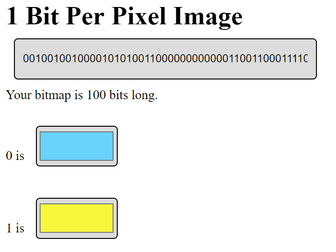
This tool creates 10 by 10 one-bit-per-pixel or two-bits-per-pixel binary images from a binary string of 0 and 1s. The choice of colour palette is left to the user with a default black and white option. Works well with snipping tool to use as part of a computing science digital portfolio. could be used in a wide variety of lessons within the context of data representation.
Using a pair of compasses to complete the dinosaur/sharkQuick View
OliverJennings

Using a pair of compasses to complete the dinosaur/shark

(6)
Linked to SSS triangles, this will practice using the compass on a smaller scale and joining up the intersecting arcs to form the spines on a stegosaurus or the teeth/fins of the shark. All lengths are given on the sheet. Differentiated as the shark sheet is harder.
Smoothie RatiosQuick View
OliverJennings

Smoothie Ratios

(2)
NC level 5/6. Treasure hunt style. Find the smoothie which tells you the ingredients and their ratios then find the questions about it, both finding the total given a part or finding a part given a total. Answers included.
Bearings BattleshipsQuick View
OliverJennings

Bearings Battleships

(3)
Place a variety of ships on the grid and either you tell them a bearing and distance (with some scale) to sink their fleet. could be pair game or reading out where the missiles go, Can be made harder/easier with different scales.
4 Angle rules - Every answer is used in the subsequent questionQuick View
OliverJennings

4 Angle rules - Every answer is used in the subsequent question

(1)
Using 4 angle rules (straight line, triangle, quadrilateral, vertically opposite), find out the first angle to help you with the second, use the second to help work out the third and so on. Includes answers with reasons. This worked well with a mid/high level year 7 group who could independently apply each rule to a separate situation.
Probability Story Board (Low Ability)Quick View
OliverJennings

Probability Story Board (Low Ability)

(1)
Probability story board for low ability year 7 / NC level 3 / NC level 4. Students write a sentence and then draw a picture as a story board, the sentence should include probability terminology,
Imperial UnitsQuick View
OliverJennings

Imperial Units

(0)
Conversion between different imperial units (no metric). Differentiated. Good for general conversion skills or multiplication and division exercise. Answers attached. Cheat sheet has all conversions needed, follow the arrows.