Wars of the Roses Cover Lesson | Year 8 History | 60-Minute Worksheet and AnswersQuick View
Im_laurw

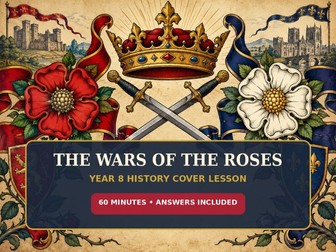
Wars of the Roses Cover Lesson | Year 8 History | 60-Minute Worksheet and Answers

(0)
A complete, illustrated 60-minute Year 8 History cover lesson introducing the Wars of the Roses. This self-contained PDF booklet requires no presentation or additional resources, making it ideal for cover lessons, independent learning, homework or revision. Students explore: • The rival Houses of Lancaster and York • The weaknesses of Henry VI • Why fighting broke out • Edward IV and Richard III • The Princes in the Tower • The Battle of Bosworth • Henry VII and the beginning of the Tudor dynasty The resource includes: • A retrieval-based starter • An accessible information text • Six comprehension questions • A chronology sequencing activity • A causes and consequences task • A supported historical judgement • Sentence starters and writing scaffolds • An extension on Bosworth and Stoke Field • Suggested timings for every activity • A complete answer and assessment guide The lesson has been designed to keep Year 8 students working independently for a full hour. The clear instructions and included answers also make it easy for a non-specialist cover teacher to deliver. Format: Illustrated, print-ready PDF Length: Three student pages plus one teacher answer page Lesson duration: Approximately 60 minutes
Black History Month Lesson | 60-Minute KS3/KS4 History | Black British HistoryQuick View
Im_laurw

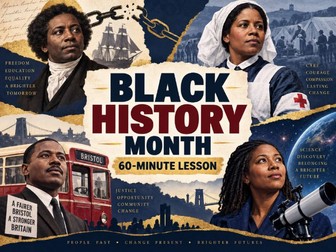
Black History Month Lesson | 60-Minute KS3/KS4 History | Black British History

(0)
A complete, fully editable 60-minute Black History Month lesson for KS3 and KS4 students. This engaging lesson explores why Black History Month remains relevant and introduces students to four significant figures from Black British history: • Olaudah Equiano • Mary Seacole • Paul Stephenson and the Bristol Bus Boycott • Dame Maggie Aderin-Pocock Students consider how Black individuals and communities have contributed to British history before completing a supported historical significance judgement. The lesson includes: • Full 60-minute lesson structure • Learning intention on every slide • DNA retrieval activity • DNA answers and self-assessment • Historical context and Big Idea • New learning note-taking task • Four illustrated historical case studies • I Do teacher model • We Do guided practice • You Do independent judgement • Sentence stems and structured support • Assessment for Learning activities • Green-pen improvement task • Independent 3–2–1 plenary • Teacher guidance within the slide notes The central enquiry asks: “Which figure is most significant to Black British history?” Students use the 3Rs—remembered, resulted in change and relevant today—to create and defend their judgement. Suitable for History, Personal Development, form time or a Black History Month programme. The resource uses mature illustrations and a clear, accessible design suitable for secondary students.
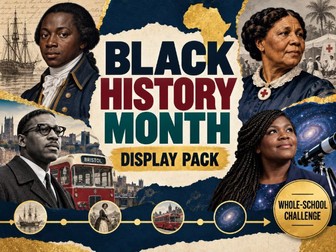
Black History Month Display Pack | Black British History Posters & Whole-School ChallengeQuick View
Im_laurw

Black History Month Display Pack | Black British History Posters & Whole-School Challenge

(0)
Create a meaningful and visually engaging Black History Month display with this fully editable secondary-school resource. The pack contains eight coordinated A4 display posters: Black History Month centrepiece Why Black History Month Matters Olaudah Equiano Mary Seacole Paul Stephenson and the Bristol Bus Boycott Dame Maggie Aderin-Pocock What Can We Do? student-action poster Whole-school Black British history timeline challenge The whole-school challenge gives each year group a different historical period. Every tutor group researches one Black British person, event, group or achievement and creates an illustrated A4 contribution to a shared school timeline. The task includes clear instructions, research expectations, success criteria and an editable hand-in date. All posters use mature illustrations and a coordinated navy, burgundy, teal, cream and gold design. Print them at A4 or enlarge them to A3. Suitable for secondary classrooms, corridors, libraries, form rooms, History departments and whole-school Black History Month activities. Fully editable PowerPoint supplied as one convenient file.
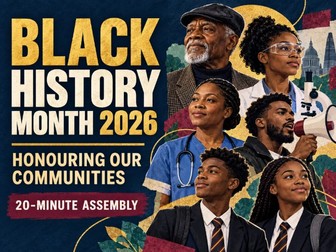
Black History Month 2026 Assembly | Honouring Our Communities | KS3–KS4Quick View
Im_laurw

Black History Month 2026 Assembly | Honouring Our Communities | KS3–KS4

(0)
A fully prepared 20-minute Black History Month assembly for secondary-school students, created around the official 2026 UK theme, Honouring Our Communities. This engaging and visually rich assembly explains: • What Black History Month is and why it is celebrated • Why Black history remains relevant today • Why Black history is an essential part of British history • How communities and ordinary people help to create history • Practical ways students can challenge racism, question stereotypes and promote inclusion Students are introduced to four significant Black British historical and contemporary figures: • Olaudah Equiano • Mary Seacole • Paul Stephenson and the Bristol Bus Boycott • Dame Maggie Aderin-Pocock The assembly ends with a practical Black History Month challenge encouraging students to research one overlooked story, share their learning and take positive action within their community. The resource includes 12 professionally designed slides, discussion opportunities, clear student actions and a complete delivery script with suggested timings in the PowerPoint speaker notes. Suitable for KS3, KS4, whole-school assemblies, form time, Personal Development, History and Citizenship.
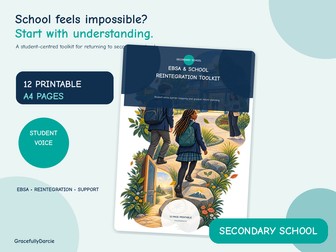
Secondary School EBSA & Reintegration Toolkit | School Anxiety, Avoidance and Attendance SupportQuick View
Im_laurw

Secondary School EBSA & Reintegration Toolkit | School Anxiety, Avoidance and Attendance Support

(0)
A practical, illustrated 12-page toolkit for supporting secondary-aged students experiencing school anxiety, emotionally based school avoidance, attendance difficulties or a gradual return following an absence. Designed for use by pastoral and attendance teams, tutors, teachers, SENCOs, SEND staff, parents and carers, the resource supports collaborative conversations and places student voice at the centre of reintegration planning. The toolkit includes: • Student perspective star • Attendance-barrier mapping activity • School pressure-point scale • Arrival and check-in plan • Reasonable-adjustments planning page • Illustrated return-to-school route map • Weekly check-in sheet • Lesson-access plan • Team-around-the-student record • Review and celebration activity Students can write, rate, map or talk through the activities with a trusted adult. The age-appropriate pages help identify patterns, reduce uncertainty, agree practical adjustments and plan manageable reintegration checkpoints. Supplied as one full-colour, 12-page A4 PDF ready to print. Please note: This is an educational support resource and not a clinical assessment, diagnosis or treatment tool.
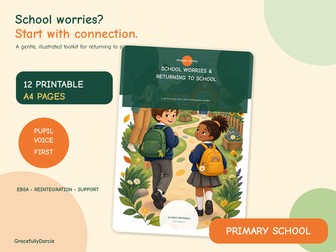
Primary School EBSA & Reintegration Toolkit | School Anxiety, Avoidance and Attendance SupportQuick View
Im_laurw

Primary School EBSA & Reintegration Toolkit | School Anxiety, Avoidance and Attendance Support

(0)
A gentle, illustrated 12-page toolkit for supporting primary-aged children experiencing school anxiety, emotionally based school avoidance, attendance difficulties or a return to school following an absence. Designed for use by teachers, SENCOs, pastoral and attendance teams, ELSAs, parents and carers, the resource helps adults understand the child’s perspective and plan realistic, manageable steps towards school. The toolkit includes: • Child-friendly school-support star • School worries and barriers checklist • School feelings scale • Calm arrival plan • Safe-school support plan • Illustrated return-to-school road map • Weekly check-in sheet • Family and school communication page • Support-plan summary • Review and celebration activity Children can draw, circle, write or talk through the activities with a trusted adult. The pages prioritise pupil voice, emotional safety, consistent home-school communication and achievable progress. Supplied as one full-colour, 12-page A4 PDF ready to print. Please note: This is an educational support resource and not a clinical assessment, diagnosis or treatment tool.
Transatlantic Slavery Knowledge Organiser | KS3 HistoryQuick View
Im_laurw

Transatlantic Slavery Knowledge Organiser | KS3 History

(0)
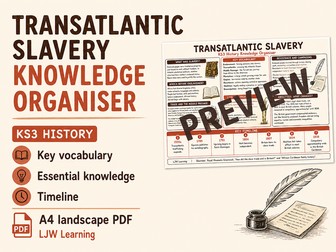
A clear, illustrated KS3 History knowledge organiser covering transatlantic slavery and the abolition movement. This accessible A4 landscape resource provides students with the essential knowledge needed to understand: • Africa before enslavement • The transatlantic slave trade • The Middle Passage • Life and labour under slavery • Resistance and rebellion • Abolition campaigns • The abolition of the British slave trade • Key individuals, vocabulary and dates The organiser includes a concise timeline from the growth of transatlantic trafficking in the 1500s to the ending of compulsory apprenticeship in 1838. It also explores the contributions of Olaudah Equiano, Mary Prince, Thomas Clarkson and William Wilberforce. Ideal for: • KS3 History lessons • Topic introductions • Revision and retrieval practice • Homework and cover work • Supporting SEND and lower-attaining learners • Student exercise books and revision folders The download contains one illustrated, print-ready A4 landscape PDF.
Tudor Full Knowledge Organiser.Quick View
Im_laurw

Tudor Full Knowledge Organiser.

(0)
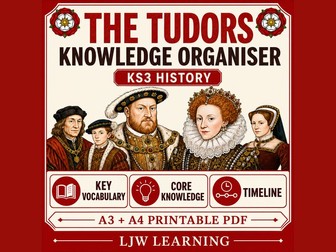
Bring Tudor history together with this illustrated knowledge organiser, featuring a red colour scheme inspired by the Tudor rose. With key knowledge, vocabulary and a chronological timeline, this resource helps pupils build their understanding of the Tudor period and revisit essential information. The illustrated layout breaks information into manageable sections, supporting learners who benefit from clear visual prompts. Ideal for: Introducing or reviewing a Tudor history topic. Supporting vocabulary and chronological understanding. Independent revision and homework. Classroom reference throughout a unit.
Holocaust Knowledge Organiser | KS3 History | Key Vocabulary & TimelineQuick View
Im_laurw

Holocaust Knowledge Organiser | KS3 History | Key Vocabulary & Timeline

(0)
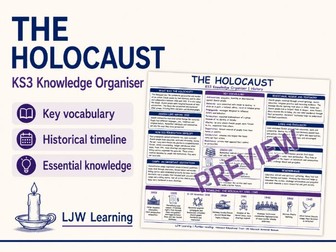
Support pupils’ understanding of the Holocaust with this detailed, illustrated KS3 history knowledge organiser. This one-page resource includes: Jewish life before 1933. Key vocabulary, including antisemitism, genocide and persecution. The development of Nazi persecution and mass murder. The distinction between concentration camps and killing centres. Resistance, rescue and testimony. A timeline of key events from 1933–1945. Liberation and remembrance. Clear sections and restrained illustrations support classroom reference, revision and homework. Designed to accompany carefully taught Holocaust lessons.
Edexcel GCSE History: The American West c1835–c1895 | Complete Revision GuideQuick View
Im_laurw

Edexcel GCSE History: The American West c1835–c1895 | Complete Revision Guide

(0)
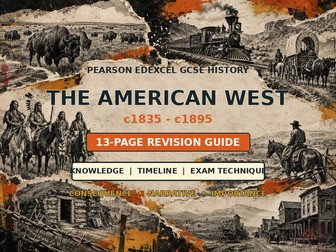
A complete 13-page revision guide for Pearson Edexcel GCSE History Paper 2, Option P3: The American West, c1835–c1895. Designed in an engaging American West graffiti-collage style, this guide condenses the full course into clear, student-friendly revision pages without sacrificing essential knowledge. Includes: • Indigenous peoples of the Plains: society, beliefs, buffalo, horses and survival • Migration, the Oregon Trail, Mormon migration and the California Gold Rush • The Permanent Indian Frontier and Fort Laramie Treaties • Homesteaders, railroads and farming the Plains • Ranching, cattle drives, cowboys and the end of the open range • Little Crow’s War, Sand Creek and Red Cloud’s War • Little Big Horn, Wounded Knee and the destruction of the buffalo • Reservations, assimilation and the Dawes Act • Lawlessness, Wyatt Earp, Billy the Kid and the Johnson County War • A complete master timeline • Key connections, consequences and historical judgements • Exam practice throughout • Current Edexcel Paper 2 technique for consequence, narrative account and importance questions Ideal for: • Independent revision • Homework • Intervention sessions • Pre-exam revision • Cover work • GCSE knowledge consolidation The guide is supplied as a full-colour, print-ready A4 PDF and follows the current Pearson Edexcel American West specification and post-2025 assessment structure.
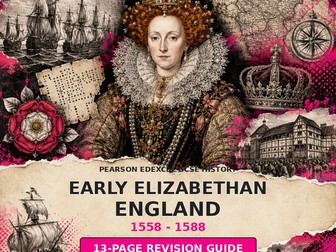
Edexcel Early Elizabethan England 1558–88 | Complete Graffiti Revision GuideQuick View
Im_laurw

Edexcel Early Elizabethan England 1558–88 | Complete Graffiti Revision Guide

(0)
A visually engaging 13-page revision guide covering the complete Pearson Edexcel Early Elizabethan England, 1558–88 British Depth Study. Created in a vibrant hot-pink historical graffiti style, the guide combines detailed GCSE knowledge with clear explanations, illustrated Tudor imagery, exam practice and revision support. The guide covers: • Elizabeth’s accession and the problems she faced in 1558 • Elizabethan government and society • The 1559 Religious Settlement • Puritan and Catholic challenges • Mary Queen of Scots • The Northern Earls, Ridolfi, Throckmorton and Babington plots • Walsingham and Elizabeth’s spy network • Relations with Spain and privateering • War in the Netherlands and the raid on Cadiz • The Spanish Armada • Education, leisure and the Elizabethan theatre • Poverty, vagabondage and government policies • Exploration and Drake’s circumnavigation • Raleigh and the attempted colonisation of Virginia • A complete master timeline • Current Edexcel Paper 2 exam technique Exam practice is included throughout for: • Describe one feature questions • Explain why questions • How far do you agree judgement questions Ideal for lesson revision, homework, intervention, independent study or GCSE exam preparation. Designed to make substantial revision content feel accessible, memorable and visually appealing.
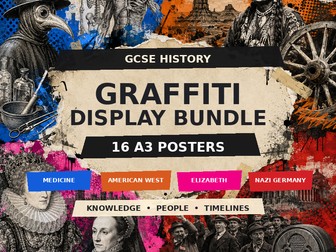
GCSE History Graffiti Display Bundle | 16 A3 Posters | Medicine, American West, Elizabeth and Nazi GQuick View
Im_laurw

GCSE History Graffiti Display Bundle | 16 A3 Posters | Medicine, American West, Elizabeth and Nazi G

(0)
Transform your History classroom with this striking collection of 16 illustrated A3 GCSE History posters. The complete bundle uses a coordinated historical graffiti style, combining monochrome imagery, torn-paper effects and four distinctive colour schemes: • Medicine in Britain – blue • The American West – orange • Early Elizabethan England – hot pink • Weimar and Nazi Germany – red Each topic contains four A3 posters: • Course at a glance • Key individuals • Key developments • Master timeline The displays include memorable historical figures and illustrations such as Red Cloud, Sitting Bull, Crazy Horse, Mary Queen of Scots, Elizabeth I, Pope Pius V, Walsingham, Stresemann, Joseph Goebbels, the Volkswagen Beetle and significant individuals from the history of medicine. The posters provide concise but meaningful historical knowledge that students can refer to throughout their course. They are suitable for classroom walls, History corridors, revision areas, open evenings and GCSE options displays. Included: • 16 full-colour A3 posters • One print-ready PDF • Large, readable classroom-display text • Illustrated historical profiles • Key dates, developments and course overviews • Exam-board-neutral poster design The content closely supports commonly taught GCSE History courses, including Pearson Edexcel options, while the posters themselves contain no exam-board branding and may be useful for other specifications where the topics overlap. Print directly at A3 or reduce to A4 for student revision sheets.
Edexcel GCSE History: The American West – Introduction, Geography and Early TensionsQuick View
Im_laurw

Edexcel GCSE History: The American West – Introduction, Geography and Early Tensions

(0)
ntroduce students to Edexcel’s The American West, c1835–c1895 with this complete, visually engaging introductory lesson. Students explore where the American West was, its important geographical features, who already lived there, why white Americans migrated west and how competing aims created tension. The 15-slide editable PowerPoint includes: DNA starter and answers Course content and assessment overview Illustrated maps of the American West Oregon, California, the Rockies, Great Plains and Mississippi River The 1840 Permanent Indian Frontier Guided map activities with answers Illustrated first-person character stories Plains Indians, migrants, settlers, miners and the US government Modelling and independent tension task Challenge question AfL whiteboard plenary Student resources and teacher answers Suitable for the Edexcel GCSE History American West thematic study and designed as Lesson 1 of the course.
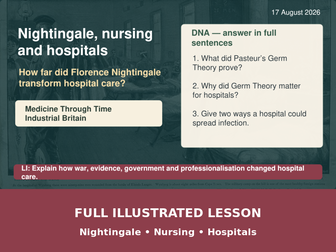
Florence Nightingale, Nursing and Hospitals | Medicine Through Time | Illustrated LessonQuick View
Im_laurw

Florence Nightingale, Nursing and Hospitals | Medicine Through Time | Illustrated Lesson

(0)
A complete, fully illustrated lesson exploring Florence Nightingale, nursing and the development of hospitals during the nineteenth century. Students investigate the conditions inside early nineteenth-century hospitals, Nightingale’s work during the Crimean War and the changes she helped introduce at Scutari. The lesson also examines her use of statistical evidence, the professionalisation and training of nurses, pavilion hospital design and the influence of war, government and changing attitudes. The lesson provides a balanced interpretation by considering Nightingale’s limitations and the contributions of Mary Seacole, scientists, government and hospital architects. The enquiry question is: “How far did Florence Nightingale transform hospital care?” This resource includes: • Illustrated title slide with DNA and learning intention • DNA answers and lesson enquiry • Clear contextual teaching • Nightingale’s work at Scutari • Statistical evidence and government reform • Nurse training and professionalisation • Changes to hospital design • Attitudes, war and government factors • Clearly modelled I DO, WE DO and YOU DO task sequence • Two illustrated student information and activity sheets • Worked examples and sentence scaffolds • Assessment for Learning activity • Independent 8-mark judgement question • Final evaluative plenary All teaching text uses Comic Sans MS and is a minimum of 20pt. The lesson is suitable for GCSE Medicine Through Time courses and can be adapted for different examination boards or higher-attaining KS3 classes.
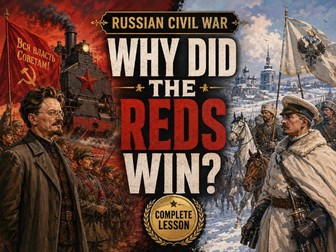
Russian Civil War Lesson: Why Did the Reds Win? | Reds vs WhitesQuick View
Im_laurw

Russian Civil War Lesson: Why Did the Reds Win? | Reds vs Whites

(0)
A complete, ready-to-teach History lesson examining why the Bolshevik Reds defeated the Whites in the Russian Civil War, 1918–1921. Students investigate the key reasons for Red victory and White defeat, including: Lenin and Trotsky’s leadership The organisation and discipline of the Red Army Bolshevik control and the Cheka War Communism White military leadership Foreign intervention Divisions between the White Armies White brutality and limited public support The importance of Bolshevik aims and motivation The lesson includes clear historical information, an illustrated Reds-versus-Whites evidence resource, structured activities and opportunities for students to categorise evidence and reach a supported judgement. Designed with accessible Comic Sans text and engaging Russian Civil War visuals. Suitable for KS3 or GCSE History and adaptable for different abilities. The PowerPoint lesson and supporting resource are fully editable and ready to use.
Industrial Medicine Review and Exam Practice | Complete GCSE History LessonQuick View
Im_laurw

Industrial Medicine Review and Exam Practice | Complete GCSE History Lesson

(0)
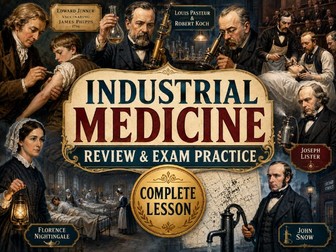
A complete, ready-to-teach illustrated revision and exam-practice lesson covering the major developments in nineteenth-century medicine. Students review and compare: Edward Jenner and vaccination Louis Pasteur and Germ Theory Robert Koch and specific microbes Anaesthetics and the removal of pain Joseph Lister and antiseptic surgery Florence Nightingale and professional nursing John Snow and the Broad Street investigation Chadwick, the Public Health Acts and Bazalgette’s sewers Rather than simply revisiting each individual, students compare the pace of change in: Understanding disease Prevention Treatment Surgery Nursing and care Public health The lesson also teaches students how to explain why change occurred by connecting factors such as science, technology, individuals, government, attitudes, communication, war and public-health crises. Includes: 18 fully editable PowerPoint slides Low-stakes retrieval practice Confidence checking and error diagnosis Complete two-page illustrated catch-up knowledge pack Coverage for pupils who missed earlier lessons Interleaved comparison activities Pace-and-impact comparison matrix Illustrated causation evidence bank Clear I do, we do and you do modelling Model connected-causation paragraph Faded writing scaffold Independent exam-style question AfL editing activity Comparative judgement plenary The revision sequence uses evidence-informed strategies including retrieval practice, metacognitive checking, interleaving, self-explanation and scaffolded independent practice. All teaching slides use accessible Comic Sans text at a minimum of 20pt. Printable resources use a minimum of 14pt.
Medieval Medicine Knowledge Organiser | AQA GCSE History: Health and the People | Illustrated A4 RevQuick View
Im_laurw

Medieval Medicine Knowledge Organiser | AQA GCSE History: Health and the People | Illustrated A4 Rev

(0)
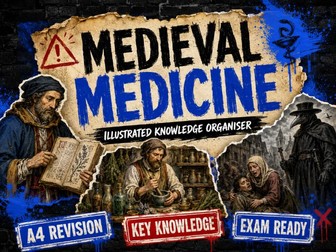
A striking, fully illustrated Medieval Medicine knowledge organiser for AQA GCSE History: Britain—Health and the People. Designed in a premium graffiti-style format, this single-page A4 revision resource combines essential knowledge with memorable historical illustrations, helping pupils revise independently without facing an overwhelming wall of text. Coverage includes: Supernatural and natural causes of disease The Four Humours, miasma and Galen Medieval treatments and prevention Physicians, apothecaries, barber surgeons and hospitals The influence and limitations of the Church The Black Death of 1348–49 Change and continuity in medieval medicine Grade 7–9 historical insight An exam-practice flashcard question The resource is supplied as an editable PowerPoint slide, making it suitable for printing, revision lessons, homework, intervention, displays or independent study. Designed using clear Comic Sans text at resource-friendly sizing, illustrated evidence and strong visual organisation. Ideal for GCSE History students studying AQA/Edexcel Medicine Through Time courses.
Renaissance Medicine Knowledge Organiser | GCSE History | Illustrated A4 Revision GuideQuick View
Im_laurw

Renaissance Medicine Knowledge Organiser | GCSE History | Illustrated A4 Revision Guide

(0)
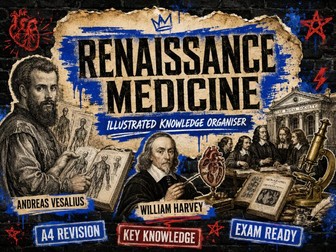
A striking, fully illustrated Renaissance Medicine knowledge organiser suitable for GCSE Medicine Through Time courses across different exam boards. Designed in a premium graffiti-style format, this single-page A4 revision resource brings together essential knowledge, historical illustrations and higher-level analysis without overwhelming pupils with a plain wall of text. Coverage includes: The context of Renaissance change Humanism, printing and changing attitudes Andreas Vesalius and developments in anatomy William Harvey and the circulation of blood Sydenham and clinical observation The Royal Society and scientific communication Hooke, Leeuwenhoek and microscopes The Great Plague of 1665 Continuing belief in the Four Humours and miasma The pace and limitations of medical change Grade 7–9 historical insight An exam-practice flashcard question The resource is supplied as an editable PowerPoint slide and is ideal for: Revision lessons Homework and independent study Intervention sessions Classroom displays Knowledge retrieval Supporting pupils who have missed lessons The clear Comic Sans text, memorable illustrations and strong visual organisation make complex knowledge accessible while retaining the detail required for GCSE History. Suitable for Medicine Through Time and Health and the People courses across different examination boards.
John Snow and Public Health | Cholera, Broad Street & Victorian Reform LessonQuick View
Im_laurw

John Snow and Public Health | Cholera, Broad Street & Victorian Reform Lesson

(0)
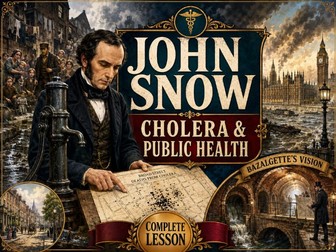
A complete, ready-to-teach illustrated History lesson exploring John Snow’s investigation of the 1854 Broad Street cholera outbreak and the wider transformation of public health in Victorian Britain. Students examine: Urbanisation, overcrowding and poor living conditions Waste, cesspits and contaminated water supplies Miasma versus water-borne explanations of disease John Snow’s 1854 Broad Street investigation Snow’s cholera map and supporting evidence The removal of the Broad Street pump handle The limitations of Snow’s investigation Edwin Chadwick’s 1842 report The limited 1848 Public Health Act The Great Stink of 1858 Joseph Bazalgette’s sewer system The compulsory 1875 Public Health Act The roles of individuals, evidence, government, crisis and engineering The lesson includes: 16 fully editable PowerPoint slides DNA retrieval activity Dedicated historical context slide Clear learning intentions Structured I do, we do and you do teaching Illustrated Broad Street evidence dossier Illustrated Victorian public-health reform resource Clear pupil instructions and timings AfL checks and discussion questions Supported judgement writing Independent exam-style practice Final plenary and exit ticket All teaching slides use accessible Comic Sans text at a minimum of 20pt. Printable pupil resources use a minimum of 14pt and are designed as complete, full-slide classroom sheets. Suitable for KS3 History, GCSE Medicine Through Time and broader thematic studies of nineteenth-century public health.
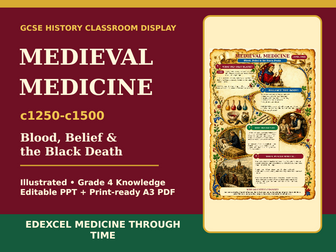
Medieval Medicine c1250–c1500 A3 Classroom Poster | Edexcel GCSE HistoryQuick View
Im_laurw

Medieval Medicine c1250–c1500 A3 Classroom Poster | Edexcel GCSE History

(0)
Bring Medieval Medicine to life with this striking, illustrated A3 classroom poster for Edexcel GCSE History. Designed to support secure Grade 4 knowledge, the poster combines clear, student-friendly explanations with memorable medieval imagery, including bloodletting, leeches, barber surgery and the Black Death. Essential content includes: • God, punishment and supernatural beliefs • The Four Humours and Theory of Opposites • Miasma, astrology and urine charts • Medieval treatments and prevention • Physicians, apothecaries and barber surgeons • Women, hospitals and monastic care • The Black Death of 1348–49 • Reasons why medical progress remained limited Perfect for classroom displays, revision, retrieval practice and helping students see the connections across the medieval period. Included: • Editable PowerPoint poster • Print-ready portrait A3 PDF • Bright, high-quality illustrated design • Clear headings and readable Grade 4 content Created for Edexcel Medicine in Britain, c1250–present, but also suitable for other GCSE Medicine Through Time courses and KS3 History.
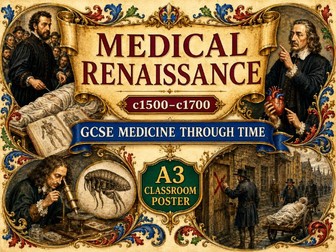
Medical Renaissance c1500–c1700 A3 Classroom Poster | GCSE Medicine Through TimeQuick View
Im_laurw

Medical Renaissance c1500–c1700 A3 Classroom Poster | GCSE Medicine Through Time

(0)
Bring GCSE Medicine Through Time to life with this bold, illustrated A3 classroom poster covering the Medical Renaissance, c1500–c1700. Designed as an attractive revision display, the poster gives students the essential knowledge needed to understand this important period of medical change and continuity. Key content includes: • Why Renaissance ideas began to change • Humanism, printing and the Royal Society • Vesalius and improvements in anatomical knowledge • Harvey’s discovery of the circulation of the blood • Hooke, microscopes and Micrographia • Sydenham’s observation and classification of disease • The Great Plague of 1665 • Continuing belief in God, miasma and the Four Humours • Why improved knowledge did not immediately lead to effective treatments The flowing illuminated-manuscript design uses bold colours, memorable historical illustrations and clear student-friendly explanations. It is ideal for classroom displays, revision walls, knowledge organisers or supporting the teaching of GCSE Medicine Through Time. Files included: • Print-ready A3 PDF • Editable PowerPoint version • High-quality illustrated design Suitable for Edexcel GCSE Medicine in Britain and easily adaptable for other GCSE history specifications.