 Quick View
John Clare 'I Am!' WJEC GCSE Paired Poetry Revision Guide & Discussion Revision Mat
Resource Overview
Unlock top marks in the WJEC GCSE English Literature paired poetry discussion with this comprehensive, visually stunning revision and preparation pack for John Clare’s ‘I Am!’.
Designed specifically to meet the high-level linguistic and structural demands of the Unit 5: Identity component, these resources break down complex contextual, structural, and thematic concepts into highly digestible, student-friendly revision mats. Perfect for independent revision, group work, or scaffolding a high-scoring 5–8 minute paired discussion.
What’s Included?
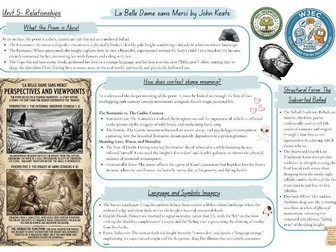
Knowledge & Context Revision Mat (Image 1)
Thematic Summary: A clear breakdown of the poem’s core themes: absolute isolation, psychological ruin, and the longing for peaceful escape.
Contextual Anchors: Explores how context shapes meaning, covering Clare’s asylum institutionalization, his rise and fall as the “Peasant Poet”, and the impact of the Industrial Revolution/Enclosure Acts.
Language & Symbolic Imagery: Close-analysis points for key quotes focusing on madness, disappearing identity, and nature as a sanctuary.
Poetic Structure & Breakdown: An in-depth visual analysis of the poem’s tripartite structure (three sestets), regular iambic pentameter acting as a “disciplined container” for madness, the disrupted opening (caesura), and the shifting/resolving rhyme scheme.
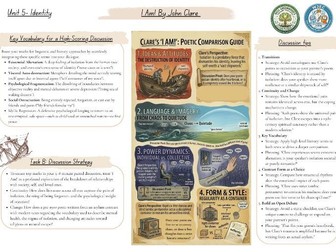
Comparison & Discussion Strategy Guide (Image 2)
Key Vocabulary for High-Scoring Discussions: A bank of sophisticated tier-3 literary terms complete with definitions and quote matches (e.g., Existential Alienation, Visceral Auto-destruction, Psychological Fragmentation, Social Ostracisation, Idyllic Regression).
Poetic Comparison Guide: Visual pillars comparing Ideas & Attitudes, Language & Imagery (Chaos vs. Quietude), Power Dynamics (Individual vs. Collective), and Form & Style (Regularity vs. Free Verse). Includes targeted “Discussion Pivots” to help students seamlessly bridge ‘I Am!’ with their partner’s poem.
Discussion Tips & Phrasing Templates: Actionable strategies and sentence frames for transitions, tracking continuity/change, embedding key vocabulary, contrasting form, and building an open debate.