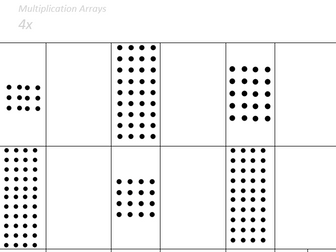
Multiplication Array worksheets for the 2, 3, 4 and 6 times tables.
The arrays allow students to develop a pictorial representation of times tables whilst encouraging the transition towards learning them as abstract concepts.
The second side of the worksheet encourages students to illustrate four different ways they can do their times tables.
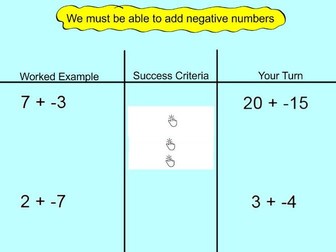
This Notebook presentation covers six lessons;
1. Adding and Subtracting past 0
2. Adding a negative
3. Subtracting a negative
4. Multiplying negatives
5. Dividing negatives
6. Mixture of the four operations
Each concept is introduced through pattern spotting and backed up through direct instruction, focused practice and then a diagnostic question and/or a Craig Barton Venn diagram.
Answers are included in the presentation.
There are also active learning suggestions, including games and challenges.
The direct instruction slides follow my “Education Scotland friendly” adaptation of Craig Barton’s example problems pairs.
I have also included my own diagnostic questions in the presentation.
If you want more questions of a similar style; Maths bot and Dynamic Maths are excellent websites where endless questions can be generated.
This Notebook presentation covers more than 15 lessons.
Equivalent Fractions
Ordering Fractions
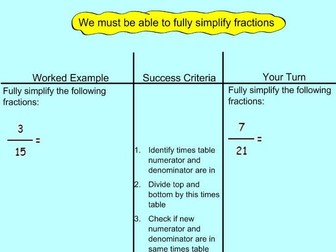
Simplifying Fractions
Identifying if fractions can be added or subtracted
Adding and subtracting fractions with the same denominator
Adding and subtracting fractions where on denominator is a multiple of another
Adding and subtracting and two proper fractions
Convert improper fractions to mixed numbers
Convert mixed numbers to improper fractions
Adding and subtracting mixed numbers
Multiplying fractions
Dividing fractions
Finding a fraction of an amount
Finding a percentage of an amount
Converting between fractions decimals and percentages
Each concept is introduced through direct instruction, focused practice and then a diagnostic question and/or a Craig Barton Venn diagram.
Answers are included in the presentation.
There are also active learning suggestions, including games and challenges.
The direct instruction slides follow my “Education Scotland friendly” adaptation of Craig Barton’s example problems pairs.
I have also included some of my own diagnostic questions in the presentation.
If you want more questions of a similar style; Maths bot and Dynamic Maths are excellent websites where endless questions can be generated.
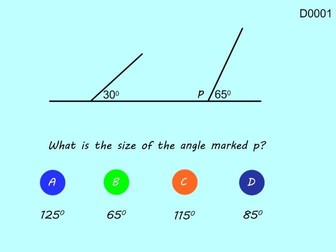
A collection of over 130 Diagnostic Questions on various mathematical topics.
I have created the vast majority myself however some I have taken from Craig Barton’s “How I wish I’d taught Maths” and rewritten in smart notebook.
For all questions I have tried to follow his “Five Golden Rules” for what makes a good diagnostic questions.
They should be clear and unambiguous
They should test a single skill or concept
Students should be able to answer in less than ten seconds
You should learn something from each incorrect response without the student needing to explain
It is not possible to answer the question correctly whilst still holding a key misconception.
I will repost this resource various times as I write new questions.
This Notebook presentation covers four lessons.
Rounding to decimals places
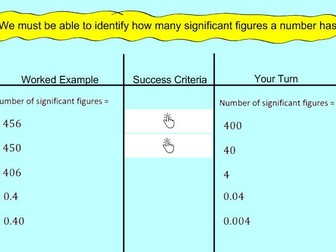
Identify how many significant figures a number has
Identifying a certain significant figure
Rounding to a given number of significant figures
Each concept is introduced through pattern spotting and backed up through direct instruction, focused practice and then a diagnostic question and/or a Craig Barton Venn diagram.
Answers are included in the presentation.
There are also active learning suggestions, including games and challenges.
The direct instruction slides follow my “Education Scotland friendly” adaptation of Craig Barton’s example problems pairs.
I have also included my own diagnostic questions in the presentation.
If you want more questions of a similar style; Maths bot and Dynamic Maths are excellent websites where endless questions can be generated.
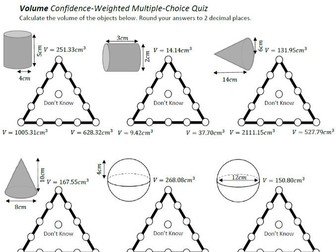
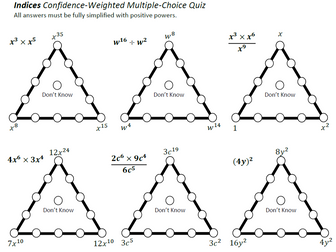
Confidence weighted multiple-choice quizzes allows practitioners to know something about the level of confidence students have in their responses. The negative scoring brings about an emotional response which is needed for the hypercorrection effect to occur.
Confidence weighted multiple-choice quizzes have been found to be more beneficial for long term learning than regular multiple choice quizzes.
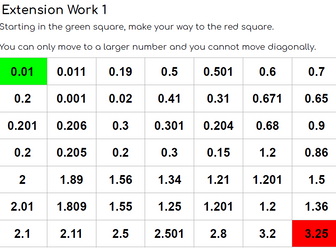
Start in the green square, make your way to the red square.
You can only move to a larger number and you cannot move diagonally.
This develops into an activity where the desired route through the maze is shown. Fill in the missing values so that you are only moving onto a larger number.
** This is my first attempt at interleaving. The practice questions include topics covered in previous slides, increasing retrieval strength.
This Notebook presentation covers more than 12 lessons.
1. Volume by counting cubes
2. Volume of Cuboids
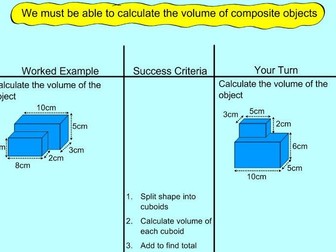
3. Volume of composite objects
4. Suface area of Cuboids
5. Cross sectional area of Prisms
6. Volume of Prisms
7. Volume of a Cylinder
8. Volume of a Cone
9. Volume of a Sphere
10. Volume of composite objects
11. Suface area of a Triangular Prism
12. Surface area of a Cylinder
Each concept is introduced through direct instruction, interleaved practice to increase retrieval strength and then a diagnostic question and/or a Craig Barton Venn diagram.
Answers are included in the presentation.
There are also active learning suggestions, including games and challenges.
The direct instruction slides follow my “Education Scotland friendly” adaptation of Craig Barton’s example problems pairs.
I have also included some of my own diagnostic questions in the presentation.
If you want more questions of a similar style; Maths bot and Dynamic Maths are excellent websites where endless questions can be generated.
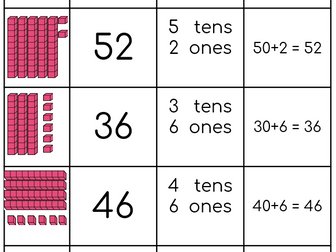
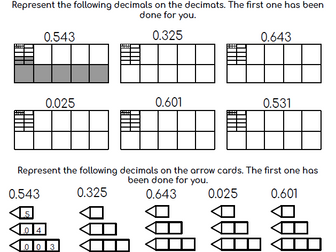
Matching activity to highlight the different ways numbers between 1 and 99 can be represented. Focusing on a pictoral representation and deconstructing the number into tens and ones.
Confidence weighted multiple-choice quizzes allows practitioners to know something about the level of confidence students have in their responses. The negative scoring brings about an emotional response which is needed for the hypercorrection effect to occur.
Confidence weighted multiple-choice quizzes have been found to be more beneficial for long term learning than regular multiple choice quizzes.
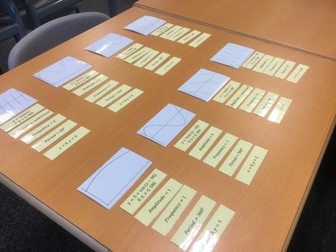
This interactive National 5/GCSE resource enables students to draw connections between the information that can be extracted from a trigonometric equation and its graph.
It also develops the students’ understanding of the trigonometric graph, domain, frequency, period and amplitude.


 Quick View