'Journey to Jo'burg' Comprehension (Y5/6)Quick View
laura_cooper_95

'Journey to Jo'burg' Comprehension (Y5/6)

(0)
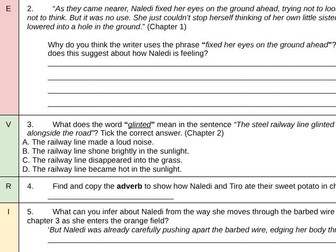
Support your pupils in developing their reading comprehension skills with this Journey to Jo’burg reading VIPERS resource, suitable for Year 5 and Year 6. Based on Beverley Naidoo’s Journey to Jo’burg, this resource provides a range of structured reading comprehension questions designed to develop and assess the key VIPERS reading skills: Vocabulary – understanding and exploring vocabulary in context Inference – using evidence to infer characters’ thoughts, feelings and motives Prediction – making predictions using evidence from the text Explain – explaining language choices, ideas and their effects Retrieval – locating and retrieving information from the text Summary – identifying and summarising the most important information and events The resource includes exam-style questions inspired by Cambridge Primary and UK SATs assessment styles, helping pupils become familiar with the language and structure of formal reading comprehension questions. Questions include a variety of formats, such as: Multiple-choice questions Find and copy questions Short-answer questions Evidence-based inference questions Explain questions requiring textual evidence Prediction questions Chronological ordering and summary questions Marks are allocated to each question, allowing pupils to practise working within an assessment framework and helping teachers to assess understanding consistently.
Year 6 Writing Assessment RubricsQuick View
laura_cooper_95

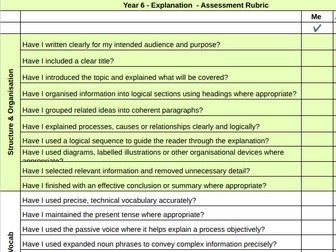
Year 6 Writing Assessment Rubrics

(0)
Save time with these comprehensive Year 6 Writing Assessment Rubrics, designed to support the National Curriculum for England and the end-of-KS2 Teacher Assessment Framework (TAF). This resource includes genre-specific success criteria for Narrative, Newspaper Report, Diary, Non-Chronological Report, Biography, Persuasive Writing, Discussion, Setting Description, Letter Writing and Explanation Texts. Each rubric is organised into Composition (Structure & Organisation), Grammar & Vocabulary, Punctuation and Handwriting, reflecting the key skills and expectations pupils should develop by the end of Year 6. The criteria are designed to support pupils in working towards the Year 6 end-of-primary writing expectations, including writing effectively for purpose and audience, developing ideas coherently, using grammar and vocabulary deliberately, applying punctuation accurately and maintaining fluent, legible handwriting. With self-assessment and teacher assessment checklists, these rubrics are ideal for formative assessment, peer assessment, independent editing, writing moderation, assessment evidence and end-of-unit writing tasks. They provide teachers with a consistent, accessible assessment tool while helping pupils understand and take ownership of the expectations for writing at the end of Key Stage 2.
Year 5 Writing Assessment RubricsQuick View
laura_cooper_95

Year 5 Writing Assessment Rubrics

(0)
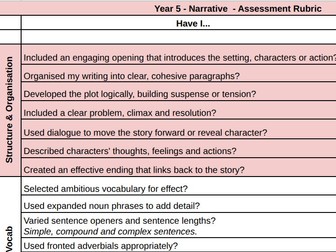
Save time with these comprehensive Year 5 Writing Assessment Rubrics, fully aligned with the National Curriculum for England. This resource includes genre-specific success criteria for Narrative, Newspaper Report, Diary, Non-Chronological Report, Biography, Persuasive Writing, Discussion, Setting Description, Letter Writing and Explanation Texts. Each rubric is divided into Structure & Organisation, Grammar & Vocabulary, Punctuation and Handwriting, with self-assessment and teacher assessment checklists to support formative assessment, peer assessment and independent editing. Ideal for classroom use, writing moderation, assessment evidence, success criteria and end-of-unit writing tasks, these rubrics help pupils understand expectations while providing teachers with a consistent assessment tool across a range of writing genres.
Year 4 Writing Assessment RubricsQuick View
laura_cooper_95

Year 4 Writing Assessment Rubrics

(0)
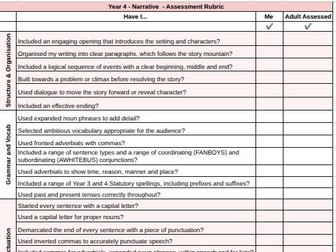
Save time with these comprehensive Year 4 Writing Assessment Rubrics, fully aligned with the National Curriculum for England. This resource includes genre-specific success criteria for Narrative, Newspaper Report, Diary, Non-Chronological Report, Biography, Persuasive Writing, Discussion, Setting Description and Letter Writing. Each rubric is divided into Structure & Organisation, Grammar & Vocabulary, Punctuation and Handwriting, with self-assessment and teacher assessment checklists to support formative assessment, peer assessment and independent editing. Ideal for classroom use, writing moderation, assessment evidence, success criteria and end-of-unit writing tasks, these rubrics help pupils understand expectations while providing teachers with a consistent assessment tool across a range of writing genres.
Year 3 Writing Assessment RubricsQuick View
laura_cooper_95

Year 3 Writing Assessment Rubrics

(0)
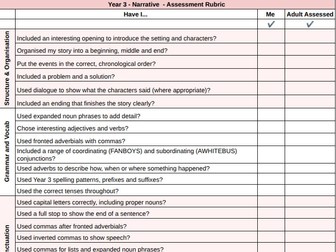
Save time with these comprehensive Year 3 Writing Assessment Rubrics, fully aligned with the National Curriculum for England. This resource includes genre-specific success criteria for Narrative, Newspaper Report, Diary, Non-Chronological Report, Biography, Persuasive Writing, Discussion, Setting Description, Letter Writing and Explanation Texts. Each rubric is divided into Structure & Organisation, Grammar & Vocabulary, Punctuation and Handwriting, with self-assessment and teacher assessment checklists to support formative assessment, peer assessment and independent editing. Ideal for classroom use, writing moderation, assessment evidence, success criteria and end-of-unit writing tasks, these rubrics help pupils understand expectations while providing teachers with a consistent assessment tool across a range of writing genres.