Resources including slides, worksheets and worked solutions relevant to the topic.
Syllabus specs covered:
2.1.1 Define and use distance, displacement, speed, velocity and acceleration.
2.1.2 Use graphical methods to represent distance, displacement, speed, velocity and acceleration.
2.1.3 Determine displacement from the area under a velocity–time graph.
2.1.4 Determine velocity using the gradient of a displacement–time graph.
2.1.5 Determine acceleration using the gradient of a velocity–time graph.
Resources including slides, worksheets, past-years and worked solutions relevant to the topic.
Syllabus specs covered:
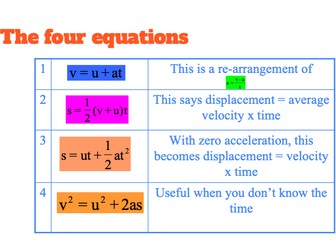
2.1.6 Derive, from the definitions of velocity and acceleration, equations that represent uniformly accelerated motion in a straight line.
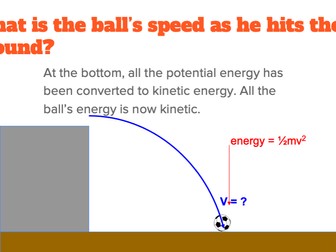
2.1.7 Solve problems using equations that represent uniformly accelerated motion in a straight line, including the motion of bodies falling in a uniform gravitational field without air resistance.
Resources including slides, worksheets, past-years and worked solutions relevant to the topic.
Syllabus specs covered:
1.1.1 Understand that all physical quantities consist of a numerical magnitude and a unit.
1.1.2 Make reasonable estimates of physical quantities included within the syllabus.
1.2.1 Recall the following SI base quantities and their units: mass (kg), length (m), time (s), current (A), temperature (K).
1.2.2 Express derived units as products or quotients of the SI base units and use the derived units for quantities listed in this syllabus as appropriate.
1.2.3 Use SI base units to check the homogeneity of physical equations
1.2.4 Recall and use prefixes and their symbols to indicate decimal submultiples or multiples of both base and derived units.
Resources including slides, worksheets, past-years and worked solutions relevant to the topic.
Syllabus specs covered:
Everything on projectile motions
2.1.9 Describe and explain motion due to a uniform velocity in one direction and a uniform acceleration in a perpendicular direction.
Resources including slides, worksheets, past-years and worked solutions relevant to the topic.
Syllabus specs covered:
1.4.1 Understand the difference between scalar and vector quantities and give examples of scalar and vector quantities included in the syllabus.
1.4.2 Add and subtract coplanar vectors.
1.4.3 Represent a vector as two perpendicular components.
Resources including slides, worksheets, past-years and worked solutions
relevant to the topic.
Syllabus specs covered:
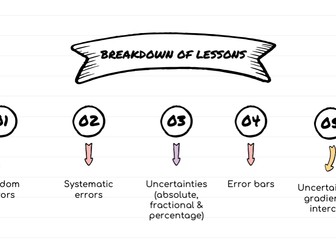
1.3.1 Understand and explain the effects of systematic errors (including zero errors) and random errors in measurements.
1.3.2 Understand the distinction between precision and accuracy.
1.3.3 Assess the uncertainty in a derived quantity by simple addition of absolute or percentage uncertainties.