The Preview may seem wierd but download format is fine!
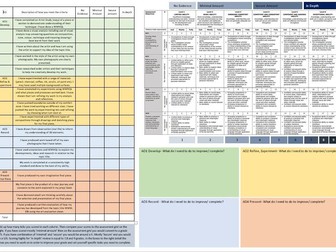
Resource details what type of tasks count towards each objective for the Edexcel GCSE Specification in Art and Design.
Students and teacher can in different pens tick the appropriate box- have they completed no work towards, minimal, secure or in depth amount towards that objective.
You can then tally up how many grades you got in each section and therefore clearly see in each AO where students are struggling.
You can then convert the grades on to the grid- so majority of minimal amount would be 2/3 grade. Secure- 4/5/6 and in depth 7,8,9 grades.
There are then four boxes where student and teacher can write in clearly what tasks need to be complete to improve each assessment objective.
The preview has some formatting issues but it downloads fine!
Topic- Day of the Dead
Worksheet covers getting students in y7,8 or 9 thinking about how to produce and present research pages they would complete at GCSE.
Firstly thinking about presentation, borders and titles.
Producing a mark making skeleton and adding some information.
Producing day of the dead skull and adding in research.
Each task shows the progress of an example on the bottom of the A3 sheet.
Design page is differentiated so that students can select patterns to suit ability. They can progress up to the difficult designs once they have conquered lower shapes and patterns or they can start at most difficult.
Sheet explains criteria for grading according to using pencil and colour pencil because of at home learning currently or limited supply in school.
Easily adaptable to then change to using paints etc if you want to.
Worksheet is on Word.
2 x Examples are PDF- One in colour. The other plain pencil for choice.
The Preview has the titles the wrong way- when you download they are vertical on the worksheet.
Please leave a review if you found helpful.
Course Guide Booklet with Photography Analysis sheets
Designed for A-Level but you can adapt for GCSE and your own school when talking about Expectations/ Materials and course structure.
Page 1: Expectations and Materials
Page 2: Course Weighting
Page 3: Course Structure (Autumn Term)
Page 4: Assessment Grid (A-Level)
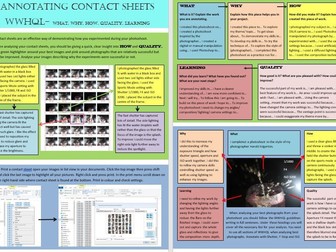
Page 5: Annotating Contact Sheets
Page 6: Annotation: WWHQL
Page 7: Photographer Research
Page 8: Analysing a Photograph
Page 9-10: Keywords
The preview has some formatting issues but it downloads fine!
The sheet breaks up how to produce a research page for KS3 level in order to practice for GCSE.
First they have to look at presentation, then design or copy Keith Haring figures and then pick out the most relevant information included on the sheet to put on to their research page.
Has a step by step example at the bottom of the worksheet.
Can be used over multiple lessons due to the time it takes.
If you find useful please leave a review.
Resource designed for students to follow step by step.
Firstly designing a page border and title.
Secondly adding in surreal design elements using the images available.
Thirdly adding in research into their designs.
Designed to be easy to use for KS3 lessons working independently. You could expand by getting them to research wider surreal elements etc.
Example included is PDF.
Worksheet is Word.
If the preview appears wierd with lines out of place it downloads fine!
Designed for GCSE and A-Level to an extent.
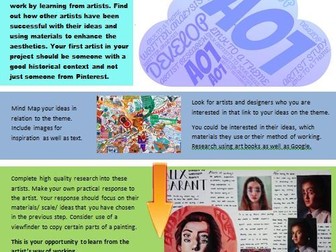
Booklet covers all areas of assessment objectives with examples of how to meet the AO1,2,3,4 criteria of the Edexcel exam board post 2016 with the new assessment grid.
Includes the analysis learning mat i have created and formatted to fit in to a booklet format.
Page 1: Expectations and Materials
Page 2: Course Weighting
Page 3: AO1: Develop
Page 4: AO2: Refine
Page 5: AO3: Record
Page 6: AO4: Present
Page 7: Assessment Grid
Page 8: Annotating your Sketchbook
Page 9-10: Artist Analysis Learning Mat
Page 11-12: Keywords
Obviously you can chop and change parts for your school such as materials and expectations etc.
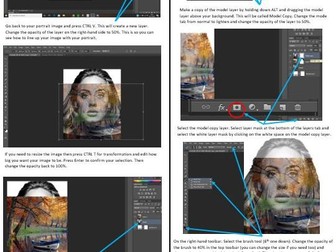
Worksheet explaining how to complete a step by step in Photoshop combining two images together.
It is a medium difficulty which introduces components such as layer masks but means the overall effect is better than a really simple exposure layering effect.
It is two times A3 in size and can print double sided.
If you found useful please leave a review.
Worksheet detailing how to visual analyse one piece of art work.
Teaches GCSE Students to interact and devop there understanding of the art work they are choosing to study in order to enhance their knowledge.
Analysis covers many areas- first description, meaning, composition, tone, form, colour, mood, process etc with key words.
Stick your art work in the middle and work your way around the boxes to build up your analysis. Eaxh box has questions, possible sentence starters etc.
If you found this resource helpful please leave a review.
Worksheet that details how to present your research in cubist style. Cubist examples and creating a study and then adding on research which students have to red through and condense down. Designed for KS3 during pandemic when they couldn’t move classrooms etc.
Research Page is Microsoft Word.
Example Research page i have done is attached in PDF form.
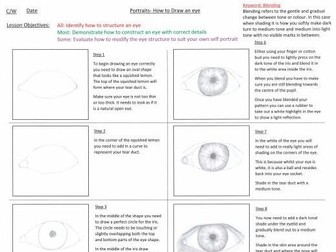
Included inside are 4 worksheets that run off the same presentation.
They each include on one page:
Title
Differentiated Lesson Objectives
Step by Step Examples
WWW/ EBI analysis examples
Keyword
There is:
Portriat- Rule of Halves Step by Step PDF
Eye Step by Step PDF
Nose and Mouth combined Step by Step PDF
Tonal Structure of the face step by step
These come with the examples drawn in.
I have also included the blank Word files of these if you want to draw your own versions on.
Bundle of 4 Research Page tasks using Word and examples are PDF.
Keith Haring Research
Day of the Dead Research
Cubism Research
Surrealism Research
Designed to be easy step by step for students to learn through and perfect for them to do at home remotely through online learning.
If the preview has lines in different places then don’t worry they should download fine.
Please leave review if you found helpful.
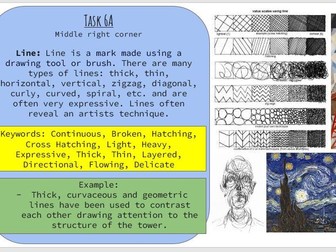
I have made this powerpoint and learning mat after years of trying to teach analysis or setting it for students as homework etc. I have had many approaches but there is always too much of a focus from students on presentation and internet information copied and pasted. Therefore I have made this to get the artist analysis done in 3-4 lessons but filled with useful content as well as personal responses. Please look through the example slides as the analysis contains sections such as hear/ see/ feel/ smell and creative writing responses which may not be for you but certainly work for my students. The things they come up with are amazing but you have to be invested as a teacher and believe in the approach. FYI I am on Edexcel Fine Art but I’m sure this approach can be used/ adapted for most exam boards. I have tried to include examples of sculpture etc for those doing art, craft and design but again it is adaptable to your needs.
There are 2 resources.
First Resource
1 Powerpoint broken into 2 sections.
Section 1: Homework or PC lesson based tasks gathering imagery and basic artist information, key themes, process, materials. (This is based off using google slides but you can easily adapt to students using powerpoint). Students then have this printed off for the next lesson which is section 2.
Section 2: Step by step annotation of art work that covers:
*- Basic artist information (writing up research from step 1)
Key themes and meaning (writing up research from step 1)
Process/ Materials/ Size (writing up research from step 1)*
Formal Elements (Line, Shape, Tone, Colour, Texture, Pattern)
Composition
Mood/Atmosphere
See/Hear/Feel/Smell
Creative Writing or Own opinion response (using see/ hear/ feel/ smell
Moving Forward
Second Resource
Colour Coded Learning Mat
This learning mat corresponds with the step by step slides. The sections are all colour coded with matching keywords to extend vocabulary. It also enables students to understand the layout of the analysis.
Teaching in Class
I have made the powerpoint so it is clearly discussion points with the class, then reading them my example based of a Delauney work of the Eiffel Tower. The students then apply this to their own artist or given artist by the teacher. I have found it extremely useful because:
-Slightly weaker students can match keywords and write using the sentence starters.
Middle students write in bullet points but provided clearer explanation with keywords.
Higher students extend their answers and are more active in the discussion. The top students feed off the teacher input and knowledge.
Most of the students stick to the layout and i do try and make sure they write small enough to do so. However the second supporting page of imagery provides them with further space to write round the edge as there is enough extra room. They can then add in for homework in spare spaces sections of drawing around the edges.
A resource designed on African Masks for KS3 (mine are Year 8) to complete while at home.
Has an example and a step by step worksheet. Worksheet has links to videos on Youtube on. Powerpoint they can run through themselves.
Please leave a Review if you found helpful.
Powerpoint Covering Aperture, ISO and Shutter Speed
Word document has Images in it use as handouts.
If you found useful then please kindly leave a review.
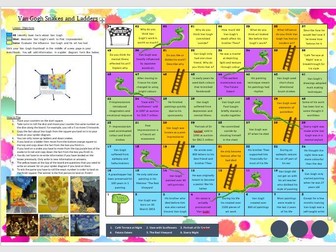
Trying to make learning fun about Van Gogh in a snakes and ladders game.
I have bought counters and foam dice online separtely to play.
Hope this can used to help your lessons.


 Quick View