Soil Sampling Laboratory PracticalQuick View
corrinedurso

Soil Sampling Laboratory Practical

(0)
This is a combination of different test for different soil samples taken from a natural and an artificial or agricultural ecosystem. It is a comparative study that suggests you take students out into each ecosystem to make abiotic and biotic observations and system observations (inputs and outputs ) and then take the samples back to the lab to perform feel test, nitrogen-potassium-phosphorus content tests, water content, soil classification, and carbon content test. A list of materials is given as well as analysis questions. It was originally designed to meet the application skills of environmental science course.
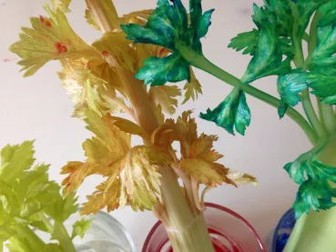
Osmosis in Celery experimentQuick View
corrinedurso

Osmosis in Celery experiment

(0)
Students use test the independent variable of the number of leaves on a celery stalk and the dependent variable is the time/distance the food coloring moves up the stalk. Good practice and example for science experiments with simple materials used including food coloring, beakers, rulers, graduated cylinders and celery stalk. T
History of life unitQuick View
corrinedurso

History of life unit

(0)
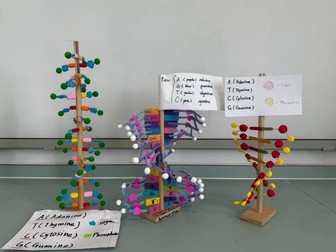
A complete unit for biology in the middle school level that is organized based on the history of living organisms on Earth. It gives a brief introduction about how Earth’s atmosphere, geography and life forms have evolved from the dawn of the Earth with multiple resources including video links and worksheet links to complete each part of the slide power-point. Teachers can follow the power-point to understand the sequencing of the different assignments starting with the vocabulary for the unit. It includes the organization of the different levels of the biosphere, classification of living organisms, the evidence for evolution, the structure of DNA, and the use of proteins as enzymes. It can be used as an introductory level for basis knowledge of biology in order to proceed to DP biology or A level
IB Biology Topic 4 Ecology pptQuick View
corrinedurso

IB Biology Topic 4 Ecology ppt

(0)
Teacher power-point with key ideas and understandings to use for ecology including option C and the higher level content. Ecosystems, communities, species, energy, nutrient cycles, conservation, population, greenhouse gases and global warming are discussed.
IB DP Biology topic 1 cells pptQuick View
corrinedurso

IB DP Biology topic 1 cells ppt

(0)
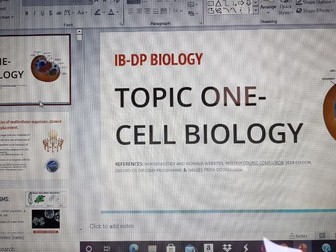
This is a tool for teachers to use to teach cells to DP biology students that cover the essential idea and understandings of topic 1. Included topics are evolution, specialization, division, magnification of eukaryotic (and prokaryotic) cells and membrane transport; as well as an introductory activity of polarity of the cell membrane and a model.
IB Biology topic 6 human physiology pptQuick View
corrinedurso

IB Biology topic 6 human physiology ppt

(0)
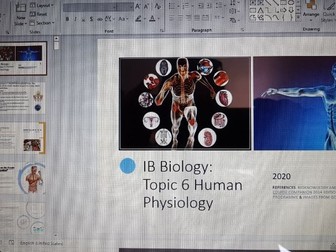
This is a teaching tool designed to aid teachers in explaining to DP students how the different systems of the human body work. The essential ideas and understandings explained include digestion and absorption, gas exchange (inhalation and exhalation), blood or circulatory system (with specific references to the pacemaker and cardiac cycle), defense against infectious diseases (immune system and pathogens), neurons and synapses (nervous system) and finally the endocrine system (hormones, homeostasis and reproduction.
IB DP Biology checklistQuick View
corrinedurso

IB DP Biology checklist

(0)
Following the IB rubric assessment for Internal Assessments, this checklist breaks down the requirements into a simpler format for teachers to assess and students to understand how to do practicals for the internal assessment for biology including the exploration, analysis and evaulation components.
The Pendulum Experiment (experimental design)Quick View
corrinedurso

The Pendulum Experiment (experimental design)

(0)
This lesson is designed to help students understand the motion of a pendulum and the variables that effect the motion. It is designed to meet MYP criterion B as well as GCSE: P1.1.4: Obtain an average value for a small distance and for a short interval of time by measuring multiples (including the period of a pendulum). It is recommended that the instructor assign different independent variables (mass of the bob, amplitude, etc) to different individuals or groups. Students gain an understanding of the scientific method, how to make a procedure, set up a data table, collect data and make a conclusion while incorporating measurements of time, mass and period of a pendulum.
Vaporization ExperimentQuick View
corrinedurso

Vaporization Experiment

(0)
This lab investigation or science experiment is designed for both GCSE and MYP science students and can be adapted for either. It meets MYP science criterion C (processing and evaluating) and GCSE (2020)P3.1.15: Demonstrate an understanding of how temperature, surface area and draught over a surface influence evaporation". It uses alcohol and the teacher would divide students into groups and share data to process, conclude and evaluate.
Density activitiesQuick View
corrinedurso

Density activities

(0)
In this laboratory investigation students will find the densities of liquids, irregular and regular shaped objects and see how accurate they are at measuring (i.e. the percentage error of the densities of the liquids). The 2020 GCSE objectives these hands on activities are meant to include are: • P1.4.2: Describe an experiment to determine the density of a liquid and of a regularly shaped solid and make the necessary calculation AND • P1.4.3: Describe the determination of the density of an irregularly shaped solid by the method of displacement and make the necessary calculation
pH lab investigationQuick View
corrinedurso

pH lab investigation

(0)
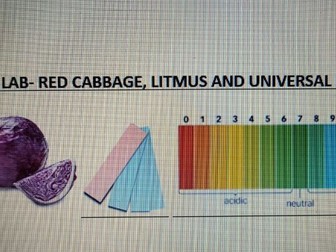
To make your own pH indicator solution using red cabbage, compare it to litmus paper and use universal indicator paper or universal indicator solution to determine the pH of different common household and scientific solutions. This investigation introduces students to familiarize them with how to interpret the data of color changes to determine if substances are acidic or basic/alkaline. Additionally, based on materials will allow them to use a pH number or value of the pH scale.
Thermal Insulators & Conductors LabQuick View
corrinedurso

Thermal Insulators & Conductors Lab

(0)
Students collect, process and evaluate data on the effect of the material on the rate of radiation. In this experiment, you will heat up water and then place it in a different container to see how good or bad the material conducts or moves heat through it. The safety, materials, hypothesis and procedure are given. Students are required to make the data table and write the conclusion.
IB Molecular Biology topic 2Quick View
corrinedurso

IB Molecular Biology topic 2

(0)
IB Biology ppt presentation for all of topic 2 molecular biology essential ideas and understandings. Biochemistry, biological molecules, proteins, enzymes, DNA structure and replication, respiration and photosynthesis are included.
Key Concepts in Chemistry Topic 1 pptQuick View
corrinedurso

Key Concepts in Chemistry Topic 1 ppt

(1)
Aligned with EDExcel chemistry requirements, this teaching tool power-point allows assessment of students ideas of atomic structure, the periodic table and ionic and covalent bonding both before and after the lesson content delivery.
Introduction to Bunsen Burner SafetyQuick View
corrinedurso

Introduction to Bunsen Burner Safety

(0)
Students are introduced to proper safety precautions and instructions to using a Bunsen burner. The use magnesium and copper carbonate as an introduction to chemical reactions.