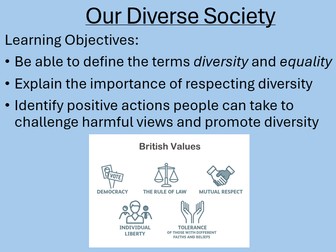
Lesson Objectives:
Be able to define the terms diversity and equality
Explain the importance of respecting diversity (and knwo the 9 protected characteristics)
Identify positive actions people can take to challenge harmful views and promote diversity
This is a fully resourced lesson that I produced and taught to Year 10 students. It can take 1 or 2 lessons, depending on how long you want the discussion activities to last (and how much your group are in to it!)
It comes with a ready-to-print hand out that students use at set points in the lesson.
There are a variety of tasks to ensure engagement is maintained. I recommend printing the case study slides in the later part of the presentation to handout out to pairs/small groups…
I really enjoyed teaching it, I hope you do too.
Looking for a GCSE revision activity that’s for ALL students? This works with all abilities, SEND, the quiet, the chatterboxes and the reluctant workers.
This revision game is an excellent way to really consolidate and assess learning at the end of each key topic. They don’t need to write anything to play, just talk!
I’ve been working on this for a couple of years now, and it is most definitely tried and tested. I’ve never played a revision game that has students thinking so hard and covering so many ideas in such a short amount of time. My students love playing it and ask when can they play it next! What’s even better is that it is so very simple, anyone can play it. It works for all, from the super bright grade 9 students to the quiet Foundation students, those with ADHD, Dyslexia, ASD, SEMH, or are just low in confidence.
Once the game is in play, the engagement, thinking, conversation is just amazing. As you circulate the room you can assess how well students have learnt the key knowledge.
The resources you’re buying cover all of GCSE Combined Science and the Separate Sciences (‘Triple’), Biology, Chemistry and Physics. There are almost 60 Game templates. All ready to play, or can be adapted easily for your own classes.
My students call it the ‘Keyword Game’ - do please message me if you come up with something a more catchy!
Basic Game:
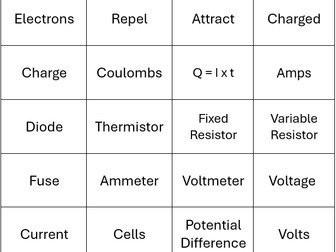
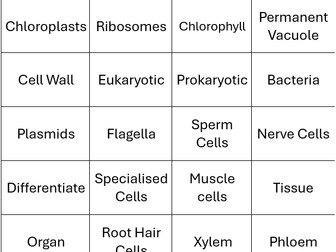
Choose a game template and print one copy between 2 (3, or 4 also works)
Students cut it up into the 32 playing cards. This takes about 4 minutes. I use a rotatrim to do this before the lesson if they’re a class that will drag this bit out!
Round 1 - Keep the cards face down in a pile. One person picks up the top card and without showing the other player has to give glues to what is on it. The other player has to guess and say what is on the card. Nothing on the card can be read out ie no first letters, parts of words or sounds like
Once the person guesses what’s on the card it goes on the points pile
if the pair a struggling on a card they can discard it and move on
Set a time limit. 90 seconds seems to be the sweet spot but I’ve also done 60 seconds for really strong classes (or I’m short on time) and 120-180 seconds for weaker groups
After time, count the number of cards on the points pile and record on the results table (it does the adding up for you as the rounds progress)
Round 2 - players now swap roles and repeat the game
Making it more fun
Once students get used to the game (I recommend 4 rounds of switching) ramp things up by putting a word limit on the clues. I recommend starting with a 5 word limit. You can then bring this down to 3.
Once they know the game template from multiple rounds, reduce the limit to 3 words, and then go to 2 or even 1!
And if they are really getting confident with the game, I absolutely recommend going to zero words. the charads that will be played out in front of you is alot of fun to watch!
It always amazes me just how much students are expected to know for their GCSE Science Courses. This revision game is an excellent way to really consolidate learning at the end of key units of learning. They don’t need to write anything to play, just talk!
I’ve been working on this for a couple of years now, and it is most definitely tried and tested. I’ve never played a revision game that has students thinking so hard and covering so many ideas in such a short amount of time. My students love playing it and ask when can they next play it! What’s even better is that it is so very simple, anyone can play it. It works for all, from the super bright grade 9 students to the quiet Foundation students with ADHD, Dyslexia, ASD, SEMH, or are just really low in confidence.
Once the game is in play, the engagement, thinking, conversation… is just amazing. As you circulate the room you get insight into how well students have actually learnt the key knowledge. You can correct spot misconceptions
I’ll explain how to play it below. The resources you’re buying cover all of GCSE Combined Science and the Separate Sciences (‘Triple’ Science). I’ve made almost 60 Game templates, all of which are ready to play, or can be adapted really easily for your own classes.
My students call it the ‘Keyword Game’ - so please message me if you come up with something a little more catchy!
Basic Game:
Choose a game template and print one copy between 2 (3, or 4 also works)
Students cut it up into the 32 playing cards. This takes about 4 minutes. I use a rotatrim to do this before the lesson if they’re a class that will drag this bit out!
Round 1 - Keep the cards face down in a pile. One person picks up the top card and without showing the other player has to give glues to what is on it. The other player has to guess and say what is on the card. Nothing on the card can be read out ie no first letters, parts of words or sounds like
Once the person guesses what’s on the card it goes on the points pile
if the pair a struggling on a card they can discard it and move on
Set a time limit. 90 seconds seems to be the sweet spot but I’ve also done 60 seconds for really strong classes (or I’m short on time) and 120-180 seconds for weaker groups
After time, count the number of cards on the points pile and record on the results table (it does the adding up for you as the rounds progress)
Round 2 - players now swap roles and repeat the game
Making it more fun
Once students get used to the game (I recommend 4 rounds of switching) ramp things up by putting a word limit on the clues. I recommend starting with a 5 word limit. You can then bring this down to 3.
Once they know the game template from multiple rounds, reduce the limit to 3 words, and then go to 2 or even 1!
And if they are really getting confident with the game, I absolutely recommend going to zero words. the charads that will be played out in front of you is just so much fun to watch!
I put this quiz together every year for my classes - a treat for the last lesson of the year!
It’s got lots questions about Science events in 2025, and lots of old favourites that I like to keep in.
I try to make it accessible for all key stages - but challenging for any year group to get full marks.
A joker round, a music round (two options) and tier breaker should make this tread the thin line of Science AND fun!
Can be done in around 40 mins, but extended to 60 mins, depending on the choice of music round and how much you want to discuss the Science!
Enjoy…and merry Christmas.
The Powerpoint and handout are designed for a 60-90 CPD session, aimed at secondary school teachers (from any subject) but could also be used in a primary setting. There are 8 tasks for attendees to carry out during the session, ensuring a more interactive training experience.
I’ve run this as a training session a few times now and the feedback has been really positive. Using an online sticky-note board really helps promote the sharing of ideas. I recommend using Lucid Sparks for this, but there are many other sites you could use. Even a physical board with real post-it notes would work well!
Aims of the session
Learn that….
Bias is something we all experience and is present in educational settings
Inclusive language has a significant impact and can promote positive messages
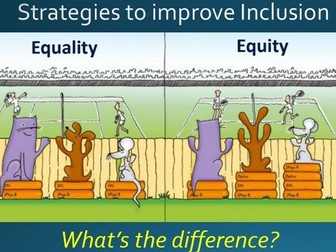
Small changes in the classroom can have a big impact on inclusion
Learn how to…
Identify how unconscious bias might affect teaching, learning, student behaviour and outcomes, and start to identify strategies to mitigate the negative impacts
Help you develop strategies for using more inclusive language
Better predict and breakdown individual/group barriers to learning
This presentation can be used on a department level or whole school.
It explores
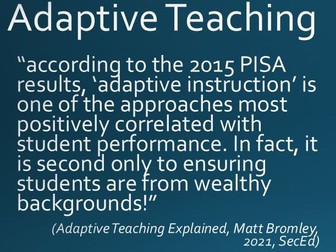
what is Adaptive Teaching?
what are its aims?
why now?
what models are there?
why is it important?
what does Adaptive Teaching look like?
how can we use it?
Lots of opportunity is built in for teams to reflect on the research, discuss and apply it to their subject area and own practice.
This resource is designed to be used by students in Yr 9, 10 or 11, regardless of the exam board (I’ve even used it with KS3!)
Each step on how to construct line graphs is laid out really simply and gives students the practice they need to master the skills, and to refer back to later.
Here’s what’s covered by this resource
variables (categoric, continuous, independent, dependent)
basic rules of drawing results tables and graphs
working out scales
plotting two sets of data
lines of best fit (straight and curved)
anomalies
means
conclusions
practice tasks
From using the exams analysis tools on our examboard’s website, it was clear that my centre could be better when it comes to Extended Response Questions (ERQs). Our students were clearly not doing as well as they could be on the ‘6 markers’. Which also dragged down their performance with questions related to the Required Practicals.
To address this, I decided to do two things, (i) make a 1,5-2hr lesson that will help build the confidence and skills our KS4 students (both the Combined Science and Separate Science pathways) in tackling these kinds of questions, and (ii) run a 1 hr CPD session with my team of Science teachers in order to improve their teaching and assesment of ERQ responses.
In the pack you will recieve
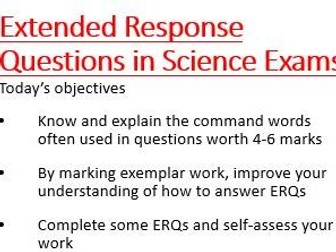
The presentation to teach and guide the 1.5-2hr lesson. It starts with explaining the importance of ERQs and the comman words used, then moves on to the teacher modelling a response (choice of three), students then get to be the examiners and acess real student reponses, they compare their mark with the actual, then students can try some 6 markers for themselves.
Handout 1 and Handout 2, to be used during the presentation - two booklets that each student (or pair of students) need a copy of. Can be used again (non-consumable) or can be written on by the students - if your budget can stretch to it. Booklet 1 has examples of real student responses to exam questions, booklet two has the markschemes. Students work on their own/in pairs/in teams as competition to agree which mark they will give each condidates response. When ready, the presenation reveals the mark that was actually awarded by the examiners (often with their commentary). Booklet 3 has 6 practice questions. Booklets 1 and 2 have markschemes and support for thse questions.
The Presentation and ressources to run your own CPD session with staff (great for TLR holders and UPS holders!) is sold separately.
After years of frsutration of not finding a good ‘one-stop-shop’ for teaching and assessing Science skills I decided to design my own pack of reources to be taught as a unit of work. It allows teachers to explicitly teach the skills, gets students to practice them and then also gives a formal assessment just in the skills that they must have in order to do well in their exams. For example, I definitely haven’t found a good resource yet for teaching standard form to Science students.
These resources are more in-line with the AQA Trilogy/Synergy and Separate Science specs, but I’m sure they’d be totally transferrable to the specs from other boards.
There are three sessions. Here’s how it works
Session 1 - this should take between 2 and 4 hours, depending on the ability of the class. Each student gets the booklet and the teacher leads them through it using the teaching PowerPoint. It’s self explanatory, with lots of opportunitity for scaffolding, modelling the skills at the board and providing informal assessment for immediate feedback and follow up. This could also be delivered in a computer suite, with the students following the PowerPoint at their own individual speeds.
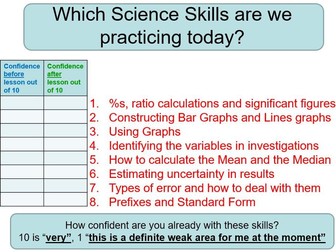
The skills covered are;
%s, ratio calculations and significant figures
Constructing Bar Graphs and Lines graphs
Using Graphs (including the tangent method for rate)
Identifying the variables in investigations (including resolution)
How to calculate the Mean and the Median
Estimating uncertainty in results
Types of error and how to deal with them
Prefixes and Standard Form
Session 2 - With the completed booklet, the students can now try a practice paper, in the appropriate tier. It’s 30 marks and takes the same format as the assessment in session 3. This can be done in pairs, groups, or under the same conditions as the actual assessment. It’s up to you!
Session 3 - The students are now ready to sit the assessment. This is designed to be a Medium Control assessment. It must be done individually, but the students are allowed their booklet and there’s no time limit. Again, it’s 30 marks, so a 50-60 min lesson is ample. It can also be given as a High Control, of course, with no booklet and a time limit. All the questions are skills specific, taken from open source past exam papers from across the three sciences - it took ages to fish them out but it was worth it!
I’ve also included proven grade boundaries to start you off, and a command words sheet. All of the session 1 and 2 materials can be shared electronically with students, or indeed loaded onto your own home learning platform.
If you have any questions, or would like to see a sample of any of the resources before you purchase, please contact me and I’ll be happy to help. michaellake247@hotmail.com
From using the exams analysis tools on our examboard’s website, it was clear that my centre could be better when it comes to Extended Response Questions (ERQs). Our students were clearly not doing as well as they could be on the ‘6 markers’. Which also dragged down their performance with questions related to the Required Practicals.
To address this, I decided to do two things, (i) make a 1,5-2hr lesson that will help build the confidence and skills our KS4 students (both the Combined Science and Separate Science pathways) in tackling these kinds of questions, and (ii) run a 1 hr CPD session with my team of Science teachers in order to improve their teaching and assesment of ERQ responses.
In the pack you will recieve
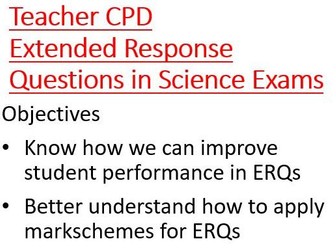
the Presentation and ressources to run your own CPD session with staff (great for TLR holders and UPS holders!)
If you’d like the resources for the 1.5-2hr lesson, please see the other resource pack for purchasing.
This resource can be used in lesson as fun activity (there are Bronze, Silver and Gold Levels) or set a student activity. Use it in class, with mini white boards perhaps, or set as a revision task to do at home.


 Quick View