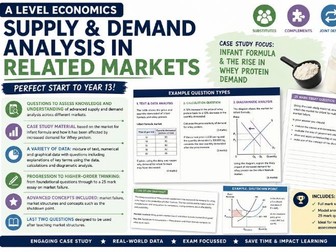
Adapted extract leading to a 20 mark question on whether Starbucks should focus on technology or customer service in response to falling market share to new rivals such as Chinese brand Luckin.
Case study on Texas Instruments and their dominance in the calculator market in the USA, although adapted for the UK. Questions in exact Paper 1 OCR format to follow, with space to answer on the paper (2,4,2,2, 8 & 12, total 30 marks mirroring Section A, mark scheme included.
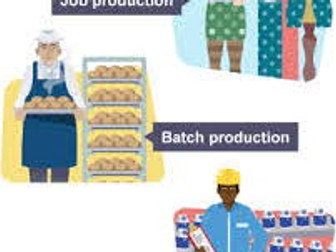
Three separate sheets, one for Job with a case study on Morgan Motors, one for Batch with a case study on Innocent drinks and one for flow with a case study on Toyota. Students read case studies and then on the sheet itself provide two advantages and two disadvantages of that method using Point Evidence Explain. For each advantage or disadvantage a key word is provided eg: meeting demand, students the are given three lines for a point, three for evidence and three for an explanation related to that term as an advantage or disadvantage. Aiming to help students develop the essential skills of application to the text and analysis hitting AO2 and AO3. Suggested chains of argument based on each advantage / disadvantage are provided on each of the three sheets for teachers. Designed with the help of Chat GPT.
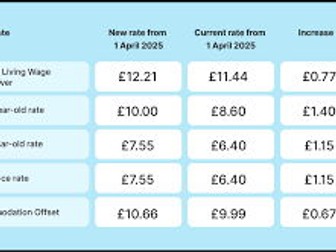
Case study material on the Minimum wage based on US article, adapted, for relevance to UK (using Chat GPT) and accessibility. Case study is one page long, followed by questions totaling 30 marks, (2,4,2,2, 8, 12) with answer space provided, so exactly mirroring OCR Paper 1 structure. MS with indicated content and answers to numerical question included. Designed to be used with Year 13 when teaching labour markets and the minimum wage.
Data response based on Paper 1 A level OCR Economics. Data on Tesla and Elon Musk and an 8 mark evaluate question to follow which requires students to use the data to evaluate the extent to which Tesla giving Musk a substantial amount of shares will result in him becoming more commited to the company, following recent concerns over his diverted attention towards US politics and other ventures such as X, all this amid worsening performance for Tesla. Presented in exam paper format, answer space and full mark scheme to follow.
OCR A Level Economics - 25 marker for paper 1 based on stimulus relating to Delta airlines plans to use AI to charge passengers price they would be willing to pay, different price for each customer. Essay requires an evaluation of first degree price discrimination regarding it’s benefit to firms compared to consumers. Full mark scheme included.
12 mark question for OCR A Level Economics with full MS. Data response where students are required to evaluate the impact on the UK economy of the requirement to be at the airport two to three hours before a flight. In exam paper format, students answer space provided.
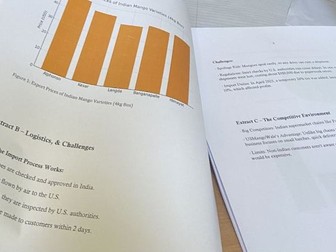
A case study on the niche market for Indian mangoes in the USA, text and charts included in three extracts, designed to align to the source material given in Edexcel exams. This is followed by five questions (4, 4, 10, 12, 20) exactly as on first section of Paper 1 or 2, first question is numerical.
Designed to assess Themes 1 & 2 so good to use at end of Year 12 or homework over the Summer break. Full mark scheme with suggested content included, again exactly following the format of the mark schemes for Paper 1 & 2 from Edexcel.
A detailed case study where a manufacturer of Solar panels and Wind Turbines needs to choose between two potential investment opportunities. Data provided includes all figures needed to do a full investment appraisal (Payback, ARR & NPV). There is also lots of information embedded in the case study which will allow students to consider other factors related to each option. I used this with my Year 13 group after finishing teaching investment appraisal and prior to setting them a 20 mark essay on the topic. I asked them to find evidence from the case study that they could use in favour or against each option and then to explain how they could develop a chain of argument based on the evidence presented. They worked in groups of two or three and then fed back. They then carried out the investment appraisal and linked their results to their previous analysis and then were required to make a final justified recommendation. A full solution is also provided as a seperate document. The resource can easily be adapted to include formal exam style questions, eg: evaluate each option and recommend which one the company should choose.
The resource consists of a fictitous scenario followed by an essay question primarily split into parts a and b, following the layout of the AS level specimen paper. I intend to use this with my Year 12 A Level students in preperation for their internal Summer exams. However, the question can be easily adapted into just one part in line with the A Level specimen paper. A full MS including suggested answer content is included along with levels of response marking schemes taken directly from the AQA website for both AS and A level.
Designed for anyone teaching CIE IGCSE Business Studies. The first resource contains a case study with text, graphs and a news article very similar to the real material used in Paper 2. The next resource contains a 12 mark question set out just as it would be on the actual Paper 2. The question is based on the topic of franchising. Finally the third resource is a help sheet which can be used with weaker students.
The assessment could be used in lesson time under timed conditions, as a homework exercise or in class as a group activity. Students could work in small groups and prepare mini-presentations that could then be peer assesed by other groups a marking sheet is provided with the question that also could be used for more formal peer assessment of written work.
The students could be asked to select key issues and then develop these into level 2 responses. The key objective is that students produce level 2 responses with a level 3 conclusion to twelve mark Paper 2 questions.
I developed this resource by taking articles on real current business stories (May 19) failure of Jamie Oliver’s restaurant chain, falling profits at Ryanair and Ford announcing job losses. I then built data response questions around each context. Extract A is on Jamie Olivers’ restaurants with 2, 2 4 , 4 and 8 mark questions to follow. Extract B is on Ryanair with 2,4,4 and 10 mark questions to follow and then Extract C is on Ford with a 20 mark essay question.
I used this with my Year 12’s to prepare them for their end of year exam which is a past AS paper. Eventhough in the AS format it is suitable for A Level by adapting the marks.
A case study taken from the BBC News website on the governments plans to ban petrol and diesel cars in the UK by 2040. The source data has been divided into extracts and two graphs are provided for interpretation and analysis. There are 8 questions following the exact format of the data response section on Paper 3 Themes in Economics. There is a calculation question, 2 marks and 4 marks questions and eight and fifteen mark questions just as on the real paper. Most questions are more micro related but there is a 4 mark macro question and the last question is a 15 mark synoptic question. Full mark scheme provided for content however, recommend using the OCR mark schemes for levels of response.
This resource can be used to prepare students for Paper 3 OCR specification but the by adapting the questions and the marks it could also be easily used for AQA Paper 3. The data is made up of two extracts on the UK housing market. Extract A questions the real cause of the housing crisis and extract B focuses on the impact of Air Bnb and the short term rentals market. There are then five questions two fifteen mark evaluation which could be adapted to AQA 10 or 25 marks, one 8 marker that could be adapted to an AQA 10 marker and two 4 markers.
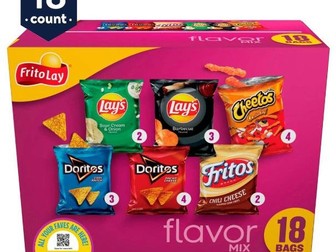
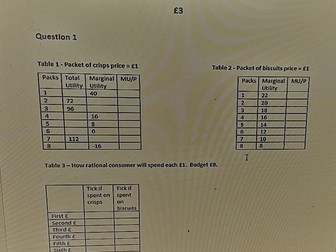
The worksheet is designed to be used after teaching the Equi-Marginal principle or could be used to teach it. Part a of the first question requires students to complete two tables for crisps and biscuits respectively, both priced at £1 per pack. Figures are provided in part for total and marginal utility from first to eighth pack of each good, students need to fill in the blanks and calculate Marginal utility per £ spent for each good. Part b then requires students to complete a third table to show how a rational consumer would spend a budget of £8 based on their answers to part a, this then leads to part c where students based on their answer to b have to state the demand for each good at a price of £1. Finally in part d students are required to use the equi-marginal principle formula to prove that the rational consumer would maximise their utility by consuming the number of crisps and number of biscuits that they have worked out in part b, in order to maximise their utility.
The second question is the same as Question 1 in parts a-d, except a pack of crisps is now priced at £4 and biscuits at £2. In part a students calculate MU per £ spent for each good based on their new prices, in part b they decide how the rational consumer would now spend each £ of their £8 budget, in partc they state demand at the new prices and in part d they once again proove the equi-marginal principle. There are then two written questions part e for 4 marks requires students to explain by using the concept of marginal utility per £ spent why demand for crisps falls by more than demand for crisps following the price rises. Part f is an 8 mark evaluation question that requires students to evaluate the extent to which the idea of the rational consumer and marginal utility theory can be of value to firms when making pricing decisions.
The first question could be used to introduce the concept and the calculations and completed as a worked example in the lesson. Students could be encouraged to discuss how the theory suggests rational behavior and then evaluate it’s application in the real world. Question 2 could then be used for homework.
A full mark scheme is provided based on the OCR H460 A Level Economics course. However, could be easily adapted and used for other boards.
Data taken from The Guardian on-line on the planned merger between Vodafone and Three (June 2023). Four questions based on the data in the form of Edexcel Paper 1 A Level, students can answer on the Question Paper. Qustions and marks (4, 4, 10, 12) Total 30 marks. Second four marker requires calculations of Market share and percentage change.
Could be used as a homework or Assessment after teaching Theme 3 on The Competitive environment and Business Growth. The last question requires students to assess the extent of Shareholders in influencing the planned merger, by considering other stakeholder influences with regard to Porters Five Forces.
A full mark scheme is provided based on actual Edexcel Mark Schemes.
I have created a resource based on this planned merger for OCR A Level Economics as well.
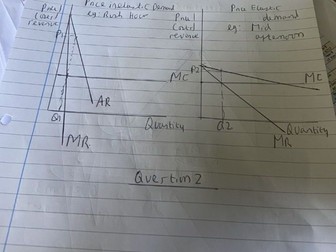
Data taken from the Guardian and car wow 2023 on the succesful impact of Tesla’s recent price reduction on sales. Questions that follow ask students to calculate PED based on information given in the data (4), explain with a suitable diagram the impact of a fall in real incomes on demand for Tesla cars (4) and then a 12 mark question which requires student to evaluate the extent to which they believe that the growth of EV substitutes from legacy manufacturers hashad the biggest impact on Tesla’s PED.
A full mark scheme is provided, following OCR A level Paper 1 specification.