 Quick View
Cambridge IGCSE Sociology: Positivism and Interpretivism – Research Methods Lesson
This resource is a Cambridge IGCSE Sociology lesson PowerPoint introducing students to the key methodological approaches of positivism and interpretivism. It is designed to help learners understand how different sociological perspectives study society and human behaviour, while making clear links to research methods and exam application.
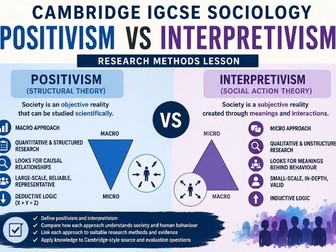
The lesson covers the main features of positivist research, including the idea that society has an objective reality that can be studied scientifically. Students are introduced to concepts such as the macro approach, quantitative methods, structured research, causal relationships, reliability, representativeness, large-scale research and deductive logic.
It also explores interpretivism, focusing on the view that society is socially constructed through individual meanings and interactions. Students examine the micro approach, qualitative and unstructured research methods, validity, small-scale in-depth research and inductive logic. The visual diagrams help reinforce the contrast between macro and micro approaches.
The learning objectives are structured to help students define positivism and interpretivism, compare the two approaches, connect each perspective with appropriate research methods and evidence, and apply their understanding to Cambridge-style source and evaluation questions.