A guide produced by a team of English Language Lead Practitioners to support the independent curation of speeches for the AQA English Spoken Language 8700 Exam.
Can be adapted for other exam boards as well.
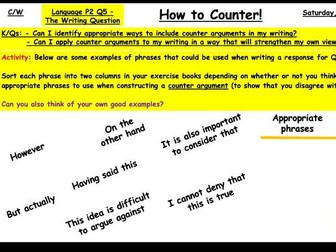
How to construct a counter argument when writing to persuade.
Previously used as an observation lesson and judged as ‘Outstanding’.
Originally taught to a mixed ability group of Year 11 students.
Follows the ‘Starter- Introduction- Guided Activity - Main Activity- Plenary’ model and comes complete with key questions (learning objectives) and, stretch challenges for the more able students and a differentiated resource for EAL students.
Examiners reports in recent years have placed a specific focus on the need to acknowledge, and subsequently rebuke, the counter argument.
Mini whiteboards and a classroom visualiser are optional for this lesson but strongly encouraged!
Images from the original lesson had to be removed due to copyright but feel free to add your own!
This is a resource for a revision lesson that is split into two sessions:
Session 1: Building AO3 and using it to strengthen AO2
Session 2: Mastering AO4 (explicit comparison)
This session was designed for a Yr 13 A Level English Language and Literature cohort who are being examined under Edexcel/Pearson. It was delivered across a full revision day but can easily be adapted to the needs of your class or be broken down into several shorter lessons.
All worksheets for the lesson provided including:
Main Lesson PowerPoint
‘Building AO3 - The Great Gatsby’ Worksheet
‘AO3 Cloze Activity’ (Othello Focus) Worksheet
‘Write This Not That’ - ‘The Great Gatsby’ Worksheet (Student Version)
‘Write This Not That’ - ‘The Great Gatsby’ (Teacher Version - Answers)
This lesson seeks to introduce students to the idea of Machiavellianism to students studying Shakespeare’s ‘Macbeth’.
This lesson was originally taught during a mock-Ofsted inspection to a GCSE class who were reading the play for the first time as part of their English Literature GCSE preparation. The lesson itself was described as ‘exemplary’ by the inspector in question during departmental feedback.
This lesson requires no printing and features examples of the following activities:
Paired/group discussion
Close reading and extract analysis
Mini white board feedback (can easily be adapted if your school doesn’t have white boards)
Live modeling of a response to an exam-style question (with a model answer already provided should you wish to use that instead).
Exploration of all Assessment Objectives relevant to GCSE study.
If you like this lesson, please consider leaving a five star review. It really helps get my lessons out there to those in need!
120 questions about ‘Othello’ , with two columns each dedicated to each of the five acts in the play (a total of 20 questions per act), and then a further two columns dedicated to questions about context and the wider play.
Very useful as a weekly homework and/or a revision resource in the lead up to exams.
Includes:
Comprehension questions
Quote filling
Quote analysis
Layout is A3 but easily adaptable to A4 if required.
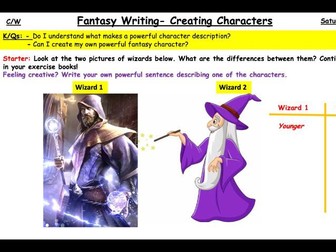
A lesson originally taught to a mixed-ability Year 8 English class as part of a Fantasy Writing unit but can be adapted for any KS3 group as needed.
The lesson PowerPoint includes a starter, introduction, building activity (with ‘Tik Tok’ task!), main writing activity with ‘pit stop’ task, and a plenary.
Stretch activities for more able written in purple and SEN scaffolding resources included in ‘hidden slides’.
Lesson extract also available in the ‘hidden slides’.
Visualiser and mini whiteboards preferable but not essential for this lesson.
Lesson graded ‘Outstanding’ by Ofsted inspector. Originally taught to a mixed ability Yr 8 class but can be adapted for any KS3 group as needed.
Stretch activities for more able and SEN scaffolding resources included.
Visualiser and mini whiteboards preferable but not essential for this lesson.
A PowerPoint lesson originally designed for independent learning and revision at home (though this can easily be adapted for classroom teaching).
Though it was originally taught to a group of A-Level English Language and Literature students, it is relevant to any exam board that has Othello as a set text.
A bundle of two Q5 models (one for each English Language paper)
Both models were awarded 40/40 by an AQA Examiner!
Models are complete with an outline of structure and some stretch activities for Grade 7-9 students.
Bundle price is 25% cheaper than buying the standalone resources.
A full model answer for English Language Paper 1 Q5 (a story) including a proposed structure that has helped my students flourish in the past.
Some SPAG errors left in to see if students will spot them!
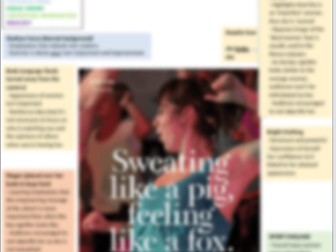
A fully annotated ‘This Girl Can’ advert- the set text for the Eduqas Media Studies GCSE.
This advert is annotated based on the REPRESENTATION (comparison) section of the exam.
All annotations are colour coded with a key for your convenience!
Very useful as both a revision resource or for someone learning about the text for the first time.
120 questions about ‘The Great Gatsby’ by F Scott Fitzgerald, with one column dedicated to each of the nine chapters in the novel (a total of 10 questions per chapter), and then a further three columns dedicated to questions about context and the wider themes designed to draw out extended answers and promote lateral thinking.
Very useful as a weekly homework and/or a revision resource in the lead up to exams.
Includes:
Comprehension questions
Quote filling
Quote analysis
Theme exploration
Character analysis
Originally produced for an A-Level English class but can be adapted for use at GCSE level.
Layout is A3 but easily adaptable to A4 if required.
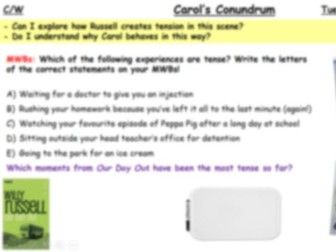
A lesson on Our Day Out by Willy Russel that explores the concept of tension in the play with a specific focus on Carol’s scene on the cliff with Mr Briggs.
Key pages for this lesson: pg 60 - 66.
Lesson includes a starter activity, a couple of discussion and writing activities, a main writing activity, and a plenary.
Optional but not necessary for this lesson: Mini White Boards, Coloured pages in student planners
Lesson produced in an Ofsted Outstanding school where are resources are reviewed and quality assured by several members of the department.
A series of three PowerPoint lessons- each dedicated to a specific scene in the first Act- originally designed for independent learning and revision at home (though can easily be adapted for classroom teaching).
These lessons were originally taught to a group of A-Level English Language and Literature students, though they are relevant to any exam board that has Othello as a set text.
Price for this bundle is 33% cheaper than buying the standalone lessons individually!
A revision booklet for ‘Macbeth’ containing activities that will strengthen understanding of all Assessment Objectives with specific focus on the following:
The plot (AO1)
Specific character focus on Macbeth and Lady Macbeth (AO1)
Several of the play’s key themes (AO1)
Analysis of structure (AO2)
Opportunities to embed context (AO3)
Authorial intention (AO3)
Exam-style questions (AO1,2,3)
Booklet for:
‘An Inspector Calls’
‘Macbeth’
‘A Christmas Carol’
‘Power and Conflict’ Anthology Poetry
Unseen Poetry
Tier 1,2, and 3 terms to aid grade 7-9 responses.
All terms come with a definition and example usage.