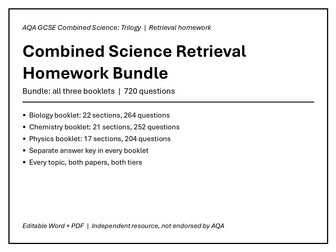
AQA Combined Science Trilogy Recall BookletsQuick View
PCPlum

AQA Combined Science Trilogy Recall Booklets

3 Resources
All three retrieval homework booklets for AQA GCSE Combined Science: Trilogy (8464) in one bundle: Biology (22 sections, 264 questions), Chemistry (21 sections, 252 questions) and Physics (17 sections, 204 questions). That is 60 one-page homework sections and 720 recall questions across both papers and both tiers, with higher tier content flagged (HT). Every booklet has a front homework tracker (date completed / teacher seen), 12 numbered questions per section with a blank answer column, and a separate full answer key at the back. The consistent layout across all three sciences makes it easy to set one section a week through the course or to use the booklets for targeted revision. Fully editable Word files plus PDFs, in a clean, print-friendly black-and-white design. Independent resource, not endorsed by AQA.
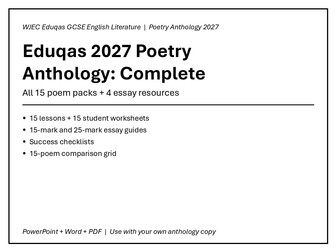
Complete EDUQAS Poetry AnthologyQuick View
PCPlum

Complete EDUQAS Poetry Anthology

19 Resources
The complete teaching and revision set for the new WJEC Eduqas GCSE English Literature Poetry Anthology (Component 1, Section B, first assessed 2027). It covers all 15 poems and both exam questions, with AO1, AO2 and AO3 built into every task. It includes 15 poem lesson packs, one for each anthology poem from “The Schoolboy” to “Origin Story”. Each pack has a 13-slide editable PowerPoint lesson and a matching student worksheet. Every lesson covers context, first reading, vocabulary, close reading, structure, retrieval and comprehension, and ends with original Eduqas-style part (a) and part (b) questions and a comparison grid. Four essay resources are also included: the 15-Mark Essay Guide, the 25-Mark Comparison Guide, the Essay Success Checklists and the 15-poem Anthology Comparison Grid. Public-domain poems are printed in full. In-copyright poems are not reproduced, so use your own anthology copy. Every file is editable PowerPoint or Word, with PDFs, in one consistent, print-friendly design. Bought separately the resources would cost £49.50.
Drummer Hodge: Eduqas 2027 Poetry LessonQuick View
PCPlum

Drummer Hodge: Eduqas 2027 Poetry Lesson

(0)
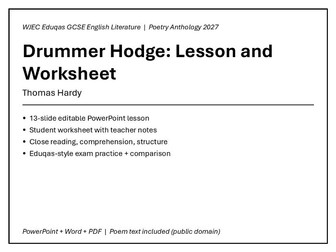
A complete lesson pack on “Drummer Hodge” by Thomas Hardy, written for the new WJEC Eduqas GCSE English Literature Poetry Anthology (Component 1, Section B, first assessed 2027). Every task builds towards AO1, AO2 and AO3. The 13-slide PowerPoint takes learners through context, a three-reading first response, key vocabulary and two close-reading sections (stanza 1: the burial; stanzas 2-3: a stranger forever). These are followed by a structure and form investigation, a four-key-word retrieval task (war, death, identity and nature), ten AO-tagged comprehension questions and context retrieval. It finishes with original Eduqas-style questions: a 15-mark part (a) on how Hardy presents death in war, and a 25-mark part (b) comparison on the effects of war. A drawing-comparisons grid suggests Disabled as a partner poem, and there is an exit ticket. The student worksheet mirrors the lesson. It has answer space, a part (a) planning frame and teacher notes on points to look for. The full poem is printed with line numbers in both the slides and the worksheet, because “Drummer Hodge” is in the public domain. Everything is fully editable PowerPoint and Word, plus PDFs, in a clean, print-friendly design. Use with your own copy of the anthology. No in-copyright poem texts are reproduced. Independent resource, not endorsed by WJEC Eduqas.
Decomposition: Eduqas 2027 Poetry LessonQuick View
PCPlum

Decomposition: Eduqas 2027 Poetry Lesson

(0)
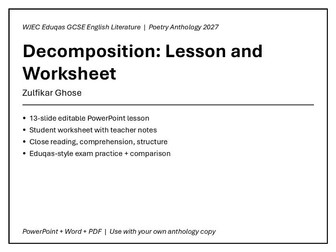
A complete lesson pack on “Decomposition” by Zulfikar Ghose, written for the new WJEC Eduqas GCSE English Literature Poetry Anthology (Component 1, Section B, first assessed 2027). Every task builds towards AO1, AO2 and AO3. The 13-slide PowerPoint takes learners through context, a three-reading first response, key vocabulary and two close-reading sections (lines 1-12: the photograph; lines 13-20: guilt). These are followed by a structure and form investigation, a four-key-word retrieval task (poverty, art, guilt and perspective), ten AO-tagged comprehension questions and context retrieval. It finishes with original Eduqas-style questions: a 15-mark part (a) on how Ghose presents how we see other people, and a 25-mark part (b) comparison on suffering. A drawing-comparisons grid suggests War Photographer as a partner poem, and there is an exit ticket. The student worksheet mirrors the lesson. It has answer space, a part (a) planning frame and teacher notes on points to look for. “Decomposition” is in copyright, so the poem is not reproduced. Learners work from their own anthology, using line references and short quotations only. Everything is fully editable PowerPoint and Word, plus PDFs, in a clean, print-friendly design. Use with your own copy of the anthology. No in-copyright poem texts are reproduced. Independent resource, not endorsed by WJEC Eduqas.
Catrin (Clarke): Eduqas 2027 Poetry LessonQuick View
PCPlum

Catrin (Clarke): Eduqas 2027 Poetry Lesson

(0)
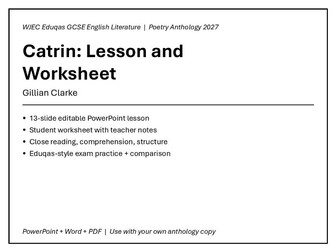
A complete lesson pack on “Catrin” by Gillian Clarke, written for the new WJEC Eduqas GCSE English Literature Poetry Anthology (Component 1, Section B, first assessed 2027). Every task builds towards AO1, AO2 and AO3. The 13-slide PowerPoint takes learners through context, a three-reading first response, key vocabulary and two close-reading sections (stanza 1: the birth; stanza 2: the teenager). These are followed by a structure and form investigation, a four-key-word retrieval task (love, conflict, family and independence), ten AO-tagged comprehension questions and context retrieval. It finishes with original Eduqas-style questions: a 15-mark part (a) on how Clarke presents the relationship between a parent and child, and a 25-mark part (b) comparison on family. A drawing-comparisons grid suggests Origin Story as a partner poem, and there is an exit ticket. The student worksheet mirrors the lesson. It has answer space, a part (a) planning frame and teacher notes on points to look for. “Catrin” is in copyright, so the poem is not reproduced. Learners work from their own anthology, using line references and short quotations only. Everything is fully editable PowerPoint and Word, plus PDFs, in a clean, print-friendly design. Use with your own copy of the anthology. No in-copyright poem texts are reproduced. Independent resource, not endorsed by WJEC Eduqas.
I Shall Return: Eduqas 2027 Poetry LessonQuick View
PCPlum

I Shall Return: Eduqas 2027 Poetry Lesson

(0)
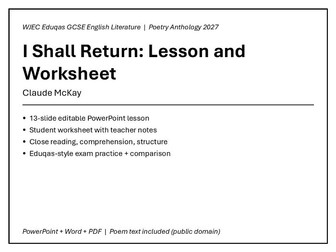
A complete lesson pack on “I Shall Return” by Claude McKay, written for the new WJEC Eduqas GCSE English Literature Poetry Anthology (Component 1, Section B, first assessed 2027). Every task builds towards AO1, AO2 and AO3. The 13-slide PowerPoint takes learners through context, a three-reading first response, key vocabulary and two close-reading sections (lines 1-8: the landscape; lines 9-14: culture and pain). These are followed by a structure and form investigation, a four-key-word retrieval task (place, home, memory and longing), ten AO-tagged comprehension questions and context retrieval. It finishes with original Eduqas-style questions: a 15-mark part (a) on how McKay presents place, and a 25-mark part (b) comparison on place. A drawing-comparisons grid suggests I Wandered Lonely as a Cloud as a partner poem, and there is an exit ticket. The student worksheet mirrors the lesson. It has answer space, a part (a) planning frame and teacher notes on points to look for. The full poem is printed with line numbers in both the slides and the worksheet, because “I Shall Return” is in the public domain. Everything is fully editable PowerPoint and Word, plus PDFs, in a clean, print-friendly design. Use with your own copy of the anthology. No in-copyright poem texts are reproduced. Independent resource, not endorsed by WJEC Eduqas.
Disabled: Eduqas 2027 Poetry LessonQuick View
PCPlum

Disabled: Eduqas 2027 Poetry Lesson

(0)
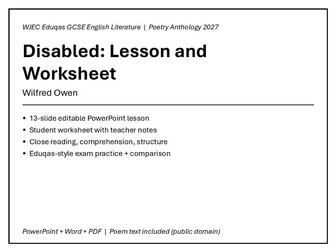
A complete lesson pack on “Disabled” by Wilfred Owen, written for the new WJEC Eduqas GCSE English Literature Poetry Anthology (Component 1, Section B, first assessed 2027). Every task builds towards AO1, AO2 and AO3. The 13-slide PowerPoint takes learners through context, a three-reading first response, key vocabulary and two close-reading sections (lines 1-20: present and past; lines 21-45: why he joined, and the return). These are followed by a structure and form investigation, a four-key-word retrieval task (war, loss, youth and isolation), ten AO-tagged comprehension questions and context retrieval. It finishes with original Eduqas-style questions: a 15-mark part (a) on how Owen presents loss, and a 25-mark part (b) comparison on the effects of war. A drawing-comparisons grid suggests Remains as a partner poem, and there is an exit ticket. The student worksheet mirrors the lesson. It has answer space, a part (a) planning frame and teacher notes on points to look for. The full poem is printed with line numbers in both the slides and the worksheet, because “Disabled” is in the public domain. Everything is fully editable PowerPoint and Word, plus PDFs, in a clean, print-friendly design. Use with your own copy of the anthology. No in-copyright poem texts are reproduced. Independent resource, not endorsed by WJEC Eduqas.
The Schoolboy: Eduqas 2027 Poetry LessonQuick View
PCPlum

The Schoolboy: Eduqas 2027 Poetry Lesson

(0)
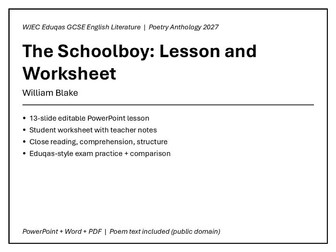
A complete lesson pack on “The Schoolboy” by William Blake, written for the new WJEC Eduqas GCSE English Literature Poetry Anthology (Component 1, Section B, first assessed 2027). Every task builds towards AO1, AO2 and AO3. The 13-slide PowerPoint takes learners through context, a three-reading first response, key vocabulary and two close-reading sections (stanzas 1-2: joy and its loss; stanzas 3-6: the caged bird). These are followed by a structure and form investigation, a four-key-word retrieval task (childhood, nature, freedom and control), ten AO-tagged comprehension questions and context retrieval. It finishes with original Eduqas-style questions: a 15-mark part (a) on how Blake presents childhood, and a 25-mark part (b) comparison on childhood. A drawing-comparisons grid suggests Blackberry Picking as a partner poem, and there is an exit ticket. The student worksheet mirrors the lesson. It has answer space, a part (a) planning frame and teacher notes on points to look for. The full poem is printed with line numbers in both the slides and the worksheet, because “The Schoolboy” is in the public domain. Everything is fully editable PowerPoint and Word, plus PDFs, in a clean, print-friendly design. Use with your own copy of the anthology. No in-copyright poem texts are reproduced. Independent resource, not endorsed by WJEC Eduqas.
Sonnet 29: Eduqas 2027 Poetry LessonQuick View
PCPlum

Sonnet 29: Eduqas 2027 Poetry Lesson

(0)
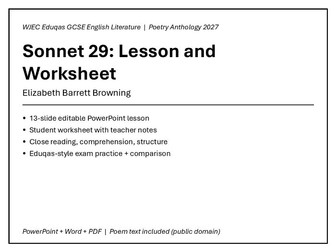
A complete lesson pack on “Sonnet 29” by Elizabeth Barrett Browning, written for the new WJEC Eduqas GCSE English Literature Poetry Anthology (Component 1, Section B, first assessed 2027). Every task builds towards AO1, AO2 and AO3. The 13-slide PowerPoint takes learners through context, a three-reading first response, key vocabulary and two close-reading sections (the octave (lines 1-8): thoughts and absence; the sestet (lines 9-14): presence). These are followed by a structure and form investigation, a four-key-word retrieval task (love, desire, absence and nature), ten AO-tagged comprehension questions and context retrieval. It finishes with original Eduqas-style questions: a 15-mark part (a) on how Barrett Browning presents love, and a 25-mark part (b) comparison on love. A drawing-comparisons grid suggests Dusting the Phone as a partner poem, and there is an exit ticket. The student worksheet mirrors the lesson. It has answer space, a part (a) planning frame and teacher notes on points to look for. The full poem is printed with line numbers in both the slides and the worksheet, because “Sonnet 29” is in the public domain. Everything is fully editable PowerPoint and Word, plus PDFs, in a clean, print-friendly design. Use with your own copy of the anthology. No in-copyright poem texts are reproduced. Independent resource, not endorsed by WJEC Eduqas.
I Wandered Lonely as a Cloud: Eduqas LessonQuick View
PCPlum

I Wandered Lonely as a Cloud: Eduqas Lesson

(0)
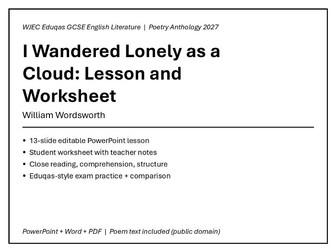
A complete lesson pack on “I Wandered Lonely as a Cloud” by William Wordsworth, written for the new WJEC Eduqas GCSE English Literature Poetry Anthology (Component 1, Section B, first assessed 2027). Every task builds towards AO1, AO2 and AO3. The 13-slide PowerPoint takes learners through context, a three-reading first response, key vocabulary and two close-reading sections (stanzas 1-2: the encounter; stanzas 3-4: joy and memory). These are followed by a structure and form investigation, a four-key-word retrieval task (nature, memory, solitude and joy), ten AO-tagged comprehension questions and context retrieval. It finishes with original Eduqas-style questions: a 15-mark part (a) on how Wordsworth presents nature, and a 25-mark part (b) comparison on nature. A drawing-comparisons grid suggests I Shall Return as a partner poem, and there is an exit ticket. The student worksheet mirrors the lesson. It has answer space, a part (a) planning frame and teacher notes on points to look for. The full poem is printed with line numbers in both the slides and the worksheet, because “I Wandered Lonely as a Cloud” is in the public domain. Everything is fully editable PowerPoint and Word, plus PDFs, in a clean, print-friendly design. Use with your own copy of the anthology. No in-copyright poem texts are reproduced. Independent resource, not endorsed by WJEC Eduqas.
Cousin Kate: Eduqas 2027 Poetry LessonQuick View
PCPlum

Cousin Kate: Eduqas 2027 Poetry Lesson

(0)
A complete lesson pack on “Cousin Kate” by Christina Rossetti, written for the new WJEC Eduqas GCSE English Literature Poetry Anthology (Component 1, Section B, first assessed 2027). Every task builds towards AO1, AO2 and AO3. The 13-slide PowerPoint takes learners through context, a three-reading first response, key vocabulary and two close-reading sections (stanzas 1-3: the betrayal; stanzas 4-6: anger and defiance). These are followed by a structure and form investigation, a four-key-word retrieval task (love, betrayal, class and reputation), ten AO-tagged comprehension questions and context retrieval. It finishes with original Eduqas-style questions: a 15-mark part (a) on how Rossetti presents betrayal, and a 25-mark part (b) comparison on love. A drawing-comparisons grid suggests Dusting the Phone as a partner poem, and there is an exit ticket. The student worksheet mirrors the lesson. It has answer space, a part (a) planning frame and teacher notes on points to look for. The full poem is printed with line numbers in both the slides and the worksheet, because “Cousin Kate” is in the public domain. Everything is fully editable PowerPoint and Word, plus PDFs, in a clean, print-friendly design. Use with your own copy of the anthology. No in-copyright poem texts are reproduced. Independent resource, not endorsed by WJEC Eduqas.
Eduqas 2027 Anthology Comparison GridQuick View
PCPlum

Eduqas 2027 Anthology Comparison Grid

(0)
A complete at-a-glance comparison tool for the WJEC Eduqas GCSE English Literature specification, Component 1 Section B. It covers all 15 poems in the new Poetry Anthology for first assessment in 2027, from The Schoolboy to Origin Story. The overview grid gives the poet, dates, collection or context, form and structure, key themes and the strongest comparison partners for every poem, with the reason for each link. That is exactly what students need when choosing a second poem from memory in the 25-mark part (b) question. A nine-theme matrix maps war and conflict, love, family, nature, childhood, memory, place and identity, guilt, and power and society across the anthology. Two photocopiable sheets follow: a single-poem revision sheet and a comparison planner. No poem texts are reproduced, so use it alongside your own anthology copy. Fully editable Word file plus PDF. Ideal for revision lessons, display and independent study. Use with your own copy of the anthology. No in-copyright poem texts are reproduced. Independent resource, not endorsed by WJEC Eduqas.
Blackberry Picking: Eduqas 2027 Poem LessonQuick View
PCPlum

Blackberry Picking: Eduqas 2027 Poem Lesson

(0)
A complete lesson pack on “Blackberry Picking” by Seamus Heaney, written for the new WJEC Eduqas GCSE English Literature Poetry Anthology (Component 1, Section B, first assessed 2027). Every task builds towards AO1, AO2 and AO3. The 13-slide PowerPoint takes learners through context, a three-reading first response, key vocabulary and two close-reading sections (stanza 1: desire; stanza 2: disappointment). These are followed by a structure and form investigation, a four-key-word retrieval task (childhood, nature, desire and disappointment), ten AO-tagged comprehension questions and context retrieval. It finishes with original Eduqas-style questions: a 15-mark part (a) on how Heaney presents the past, and a 25-mark part (b) comparison on the past. A drawing-comparisons grid suggests Origin Story as a partner poem, and there is an exit ticket. The student worksheet mirrors the lesson. It has answer space, a part (a) planning frame and teacher notes on points to look for. “Blackberry Picking” is in copyright, so the poem is not reproduced. Learners work from their own anthology, using line references and short quotations only. Everything is fully editable PowerPoint and Word, plus PDFs, in a clean, print-friendly design. Use with your own copy of the anthology. No in-copyright poem texts are reproduced. Independent resource, not endorsed by WJEC Eduqas.
Dusting the Phone: Eduqas 2027 Poetry LessonQuick View
PCPlum

Dusting the Phone: Eduqas 2027 Poetry Lesson

(0)
A complete lesson pack on “Dusting the Phone” by Jackie Kay, written for the new WJEC Eduqas GCSE English Literature Poetry Anthology (Component 1, Section B, first assessed 2027). Every task builds towards AO1, AO2 and AO3. The 13-slide PowerPoint takes learners through context, a three-reading first response, key vocabulary and two close-reading sections (lines 1-12: imagining the worst; lines 13-22: waiting). These are followed by a structure and form investigation, a four-key-word retrieval task (love, obsession, anxiety and waiting), ten AO-tagged comprehension questions and context retrieval. It finishes with original Eduqas-style questions: a 15-mark part (a) on how Kay presents love, and a 25-mark part (b) comparison on love. A drawing-comparisons grid suggests Sonnet 29 as a partner poem, and there is an exit ticket. The student worksheet mirrors the lesson. It has answer space, a part (a) planning frame and teacher notes on points to look for. “Dusting the Phone” is in copyright, so the poem is not reproduced. Learners work from their own anthology, using line references and short quotations only. Everything is fully editable PowerPoint and Word, plus PDFs, in a clean, print-friendly design. Use with your own copy of the anthology. No in-copyright poem texts are reproduced. Independent resource, not endorsed by WJEC Eduqas.
War Photographer: Eduqas 2027 Poetry LessonQuick View
PCPlum

War Photographer: Eduqas 2027 Poetry Lesson

(0)
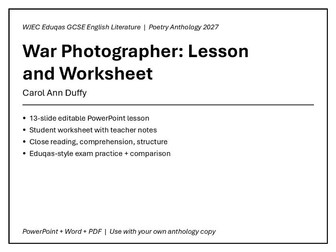
A complete lesson pack on “War Photographer” by Carol Ann Duffy, written for the new WJEC Eduqas GCSE English Literature Poetry Anthology (Component 1, Section B, first assessed 2027). Every task builds towards AO1, AO2 and AO3. The 13-slide PowerPoint takes learners through context, a three-reading first response, key vocabulary and two close-reading sections (stanzas 1-2: the dark room; stanzas 3-4: memory and indifference). These are followed by a structure and form investigation, a four-key-word retrieval task (suffering, conflict, guilt and indifference), ten AO-tagged comprehension questions and context retrieval. It finishes with original Eduqas-style questions: a 15-mark part (a) on how Duffy presents suffering, and a 25-mark part (b) comparison on suffering. A drawing-comparisons grid suggests Decomposition as a partner poem, and there is an exit ticket. The student worksheet mirrors the lesson. It has answer space, a part (a) planning frame and teacher notes on points to look for. “War Photographer” is in copyright, so the poem is not reproduced. Learners work from their own anthology, using line references and short quotations only. Everything is fully editable PowerPoint and Word, plus PDFs, in a clean, print-friendly design. Use with your own copy of the anthology. No in-copyright poem texts are reproduced. Independent resource, not endorsed by WJEC Eduqas.
Remains (Armitage): Eduqas 2027 Poetry LessonQuick View
PCPlum

Remains (Armitage): Eduqas 2027 Poetry Lesson

(0)
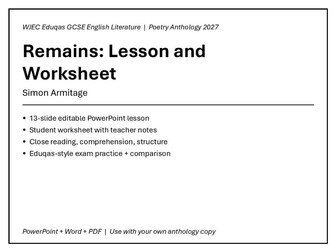
A complete lesson pack on “Remains” by Simon Armitage, written for the new WJEC Eduqas GCSE English Literature Poetry Anthology (Component 1, Section B, first assessed 2027). Every task builds towards AO1, AO2 and AO3. The 13-slide PowerPoint takes learners through context, a three-reading first response, key vocabulary and two close-reading sections (lines 1-16: the shooting; lines 17-30: the aftermath). These are followed by a structure and form investigation, a four-key-word retrieval task (conflict, guilt, memory and trauma), ten AO-tagged comprehension questions and context retrieval. It finishes with original Eduqas-style questions: a 15-mark part (a) on how Armitage presents memory, and a 25-mark part (b) comparison on the effects of conflict. A drawing-comparisons grid suggests Disabled as a partner poem, and there is an exit ticket. The student worksheet mirrors the lesson. It has answer space, a part (a) planning frame and teacher notes on points to look for. “Remains” is in copyright, so the poem is not reproduced. Learners work from their own anthology, using line references and short quotations only. Everything is fully editable PowerPoint and Word, plus PDFs, in a clean, print-friendly design. Use with your own copy of the anthology. No in-copyright poem texts are reproduced. Independent resource, not endorsed by WJEC Eduqas.
Kamikaze: Eduqas 2027 Poetry LessonQuick View
PCPlum

Kamikaze: Eduqas 2027 Poetry Lesson

(0)
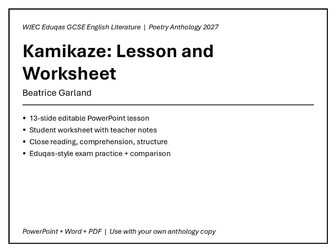
A complete lesson pack on “Kamikaze” by Beatrice Garland, written for the new WJEC Eduqas GCSE English Literature Poetry Anthology (Component 1, Section B, first assessed 2027). Every task builds towards AO1, AO2 and AO3. The 13-slide PowerPoint takes learners through context, a three-reading first response, key vocabulary and two close-reading sections (lines 1-18: the flight; lines 19-42: return and rejection). These are followed by a structure and form investigation, a four-key-word retrieval task (duty, honour, family and shame), ten AO-tagged comprehension questions and context retrieval. It finishes with original Eduqas-style questions: a 15-mark part (a) on how Garland presents duty, and a 25-mark part (b) comparison on conflict. A drawing-comparisons grid suggests Disabled as a partner poem, and there is an exit ticket. The student worksheet mirrors the lesson. It has answer space, a part (a) planning frame and teacher notes on points to look for. “Kamikaze” is in copyright, so the poem is not reproduced. Learners work from their own anthology, using line references and short quotations only. Everything is fully editable PowerPoint and Word, plus PDFs, in a clean, print-friendly design. Use with your own copy of the anthology. No in-copyright poem texts are reproduced. Independent resource, not endorsed by WJEC Eduqas.
Origin Story: Eduqas 2027 Poetry LessonQuick View
PCPlum

Origin Story: Eduqas 2027 Poetry Lesson

(0)
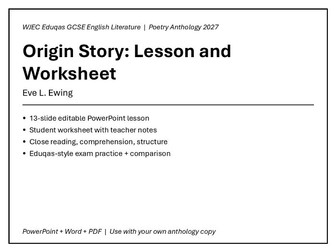
A complete lesson pack on “Origin Story” by Eve L. Ewing, written for the new WJEC Eduqas GCSE English Literature Poetry Anthology (Component 1, Section B, first assessed 2027). Every task builds towards AO1, AO2 and AO3. The 13-slide PowerPoint takes learners through context, a three-reading first response, key vocabulary and two close-reading sections (stanza 1: how they met; stanza 2: love as a comic book). These are followed by a structure and form investigation, a four-key-word retrieval task (love, family, memory and fragility), ten AO-tagged comprehension questions and context retrieval. It finishes with original Eduqas-style questions: a 15-mark part (a) on how Ewing presents love, and a 25-mark part (b) comparison on family. A drawing-comparisons grid suggests Catrin as a partner poem, and there is an exit ticket. The student worksheet mirrors the lesson. It has answer space, a part (a) planning frame and teacher notes on points to look for. “Origin Story” is in copyright, so the poem is not reproduced. Learners work from their own anthology, using line references and short quotations only. Everything is fully editable PowerPoint and Word, plus PDFs, in a clean, print-friendly design. Use with your own copy of the anthology. No in-copyright poem texts are reproduced. Independent resource, not endorsed by WJEC Eduqas.
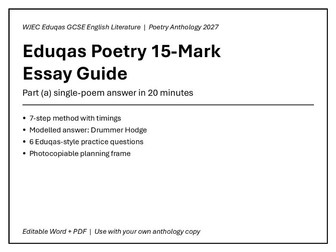
Eduqas Poetry 15-Mark Essay Guide 2027Quick View
PCPlum

Eduqas Poetry 15-Mark Essay Guide 2027

(0)
Written for the WJEC Eduqas GCSE English Literature specification, Component 1 Section B, using the new Poetry Anthology for first assessment in 2027. This guide teaches students how to plan and write the part (a) single-poem answer (15 marks, about 20 minutes), where AO1, AO2 and AO3 are equally weighted. Inside you’ll find a plain-English breakdown of the three assessment objectives and a proven 7-step, 20-minute method with timings: key words, annotation, overview, beginning, middle and end points, a beginning-versus-ending bonus, and personal response. Sentence starters are included for every step. A complete modelled answer on Drummer Hodge (Thomas Hardy) is built step by step, with a commentary on why it scores highly. There are six original Eduqas-style practice questions across the anthology and a photocopiable planning frame that works for any poem. Fully editable Word file plus PDF, in a clean, print-friendly design. Ideal for teaching, intervention, homework and revision. Use with your own anthology copy. Use with your own copy of the anthology. No in-copyright poem texts are reproduced. Independent resource, not endorsed by WJEC Eduqas.
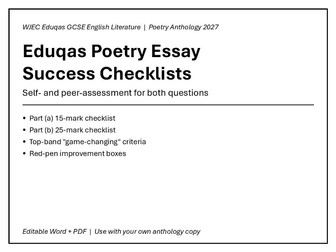
Eduqas Poetry Essay Success ChecklistsQuick View
PCPlum

Eduqas Poetry Essay Success Checklists

(0)
Self- and peer-assessment checklists for the WJEC Eduqas GCSE English Literature specification, Component 1 Section B: the new Poetry Anthology, for first assessment in 2027. There is one checklist for each question: part (a), the single-poem answer (15 marks), and part (b), the comparison (25 marks). Each checklist sets out the core success criteria for a secure answer, then the “game-changing” criteria that push students towards the top band. These include links between the beginning and end of a poem, context used to explain why poets differ, form compared rather than identified, and a sustained argument. Evidence columns ask students to find each feature in their own writing, not just tick it, and a red-pen improvement box supports redrafting. The checklists work with any poem in the anthology and suit lessons, marking feedback, peer assessment and mock preparation. Fully editable Word file plus PDF. Use with your own copy of the anthology. No in-copyright poem texts are reproduced. Independent resource, not endorsed by WJEC Eduqas.
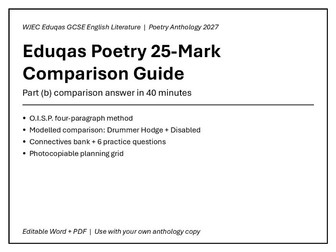
Eduqas Poetry 25-Mark Comparison Guide 2027Quick View
PCPlum

Eduqas Poetry 25-Mark Comparison Guide 2027

(0)
Written for the WJEC Eduqas GCSE English Literature specification, Component 1 Section B, using the new Poetry Anthology for first assessment in 2027. This guide tackles the part (b) comparison question (25 marks, about 40 minutes), where AO1, AO2 and AO3 are equally weighted and only comparative points are credited. Students learn the memorable four-paragraph O.I.S.P. method (“Oranges Involve Some Peeling”): Overview, Ideas and images, Structure and Personal response, at 10 minutes each. It comes with a checklist for choosing the second poem from memory. A complete modelled comparison of Drummer Hodge (Hardy) and Disabled (Owen) shows how to weave context into every paragraph and compare methods rather than list them. Also included are a comparative connectives bank, six original Eduqas-style practice questions and a photocopiable O.I.S.P. planning grid. Fully editable Word file plus PDF, in a clean, print-friendly design. Pairs perfectly with the 15-Mark Essay Guide. Use with your own anthology copy. Use with your own copy of the anthology. No in-copyright poem texts are reproduced. Independent resource, not endorsed by WJEC Eduqas.