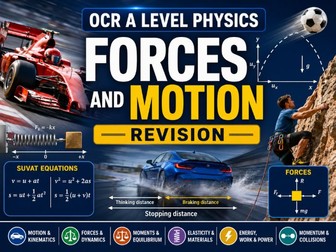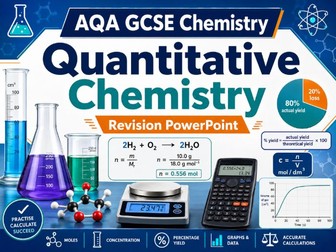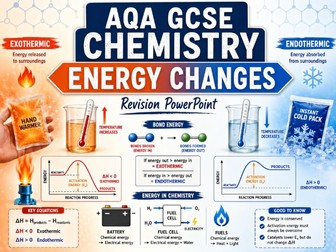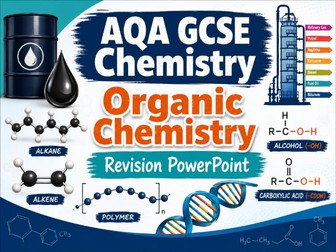
Edexcel GCSE Extracting Metals & Equilibria PPTQuick View
ironicfe

Edexcel GCSE Extracting Metals & Equilibria PPT

(0)
Edexcel GCSE Chemistry revision PowerPoint for extracting metals, recycling, life-cycle assessment, reversible reactions and equilibria. This editable PowerPoint resource supports students revising Edexcel GCSE Chemistry: Extracting Metals and Equilibria. It is designed for classroom display and follows a clear revision structure with Do Now retrieval, teacher modelling, mini-whiteboard checks, independent book practice and correction slides. Higher tier content is also included, such as displacement reactions as redox reactions, oxidation and reduction in terms of electron transfer, half-equation ideas, biological extraction methods, Le Chatelier’s principle and the effects of changing concentration, temperature and pressure on equilibrium position. Each topic begins with a Do Now Activity using a DNA-style retrieval format. These questions revisit previous learning and help students settle quickly into revision. Each Do Now activity is followed by a full answer slide so students can self-correct before moving on. After each key teaching point, the PowerPoint includes three short mini-whiteboard questions designed to test knowledge, understanding and common misconceptions. These questions are quick enough for whole-class AFL while still helping teachers identify gaps in understanding. The resource also includes book-practice questions for independent written work. These are followed by clear answer-note slides so students who make mistakes can correct their work and improve their written GCSE Chemistry responses. Students practise recalling the reactivity series, explaining why different metals need different extraction methods, identifying oxidation and reduction, explaining displacement reactions, evaluating recycling and life-cycle assessment, describing the Haber process and applying equilibrium ideas using accurate exam terminology. This resource is suitable for: Edexcel GCSE Chemistry Edexcel Combined Science Chemistry Year 10 and Year 11 revision Foundation and Higher tier students Higher tier redox and equilibrium content Intervention lessons Retrieval practice Exam preparation Whole-class teaching Mini-whiteboard questioning Required practical and application revision Cover lessons with teacher guidance Included file type: Editable PowerPoint (.pptx) The resource can be used as a complete revision lesson sequence, split into shorter intervention sessions, or used to target specific weaknesses in extracting metals, redox, recycling, life-cycle assessment and equilibria before assessments and GCSE exams.
Edexcel GCSE Fuels & Earth Science PPTQuick View
ironicfe

Edexcel GCSE Fuels & Earth Science PPT

(0)
Edexcel GCSE Chemistry Fuels and Earth Science revision PowerPoint covering crude oil, combustion, cracking and atmosphere, with answers. This editable PowerPoint resource supports students revising Edexcel GCSE Chemistry: Fuels and Earth Science. It is designed for classroom display and follows a clear revision structure with Do Now retrieval, teacher modelling, deep-dive explanation slides, mini-whiteboard checks, independent book practice and correction slides. The resource covers key chemistry content including crude oil, hydrocarbons, alkanes, fractional distillation, fractions and their uses, properties of hydrocarbons, combustion, incomplete combustion, atmospheric pollutants, carbon monoxide, sulfur dioxide, oxides of nitrogen, hydrogen versus petrol, cracking, alkenes, the Earth’s early atmosphere, changes in atmospheric gases, oxygen production, carbon dioxide reduction, gas tests, greenhouse gases, climate change and the composition of today’s atmosphere. Each topic begins with a Do Now Activity using a DNA-style retrieval format. These questions revisit previous learning and help students settle quickly into revision. Each Do Now activity is followed by a full answer slide so students can self-correct before moving on. After each Must Know point, the PowerPoint includes a deep-dive explanation to strengthen understanding and help students make clearer links between key ideas. This supports students in moving beyond simple recall towards stronger GCSE explanation answers. After each deep-dive section, there are three short mini-whiteboard questions designed to test knowledge, understanding and common misconceptions. These questions are quick enough for whole-class AFL while still helping teachers identify gaps in understanding. Students practise defining key terms, explaining fractional distillation, comparing properties of hydrocarbons, writing combustion equations, explaining pollutants and their effects, describing cracking, explaining changes in the atmosphere over time and using accurate chemistry terminology in exam-style answers. This resource is suitable for: Edexcel GCSE Chemistry Edexcel Combined Science Chemistry Year 10 and Year 11 revision Foundation and Higher tier students Intervention lessons Retrieval practice Exam preparation Whole-class teaching Mini-whiteboard questioning Atmosphere and organic chemistry revision Cover lessons with teacher guidance Included file type: Editable PowerPoint (.pptx) The resource can be used as a complete revision lesson sequence, split into shorter intervention sessions, or used to target specific weaknesses in fuels, crude oil, combustion, cracking, the atmosphere and climate-change chemistry before assessments and GCSE exams.
Edexcel GCSE Chemistry Key Concepts PPTQuick View
ironicfe

Edexcel GCSE Chemistry Key Concepts PPT

(0)
Edexcel GCSE Chemistry Key Concepts revision PowerPoint covering atomic structure, bonding, substance properties and calculations. This editable PowerPoint resource supports students revising Edexcel GCSE Chemistry: Key Concepts in Chemistry. It is designed for classroom display and follows a clear revision structure with Do Now retrieval, teacher modelling, mini-whiteboard checks, independent book practice and correction slides. The resource covers key chemistry content including atomic structure, the development of the atomic model, subatomic particles, isotopes, relative atomic mass, Mendeleev and the periodic table, atomic number, metals and non-metals, electronic configuration, ionic bonding, covalent bonding, properties of ionic substances, properties of simple covalent substances, giant covalent structures, diamond, graphite, graphene, fullerenes, polymers, metallic bonding, limitations of models, relative formula mass, empirical formula, molecular formula, conservation of mass, reacting masses and concentration calculations. Higher tier content is also included, such as relative atomic mass from isotope abundance, empirical and molecular formula calculations, mole-based reacting mass calculations, concentration calculations and extended explanation questions on bonding, structure and properties. Each topic begins with a Do Now Activity using a DNA-style retrieval format. These questions revisit previous learning and help students settle quickly into revision. Each Do Now activity is followed by a full answer slide so students can self-correct before moving on. After each key teaching point, the PowerPoint includes three short mini-whiteboard questions designed to test knowledge, understanding and common misconceptions. These questions are quick enough for whole-class AFL while still helping teachers identify gaps in understanding. Students practise recalling key definitions, explaining atomic structure, comparing historical atomic models, calculating numbers of protons, neutrons and electrons, describing bonding, drawing dot-and-cross diagrams, linking structure to properties, using formulae, balancing equations and completing key chemistry calculations. This resource is suitable for: Edexcel GCSE Chemistry Edexcel Combined Science Chemistry Year 10 and Year 11 revision Foundation and Higher tier students Higher tier calculation practice Intervention lessons Retrieval practice Exam preparation Whole-class teaching Mini-whiteboard questioning Cover lessons with teacher guidance Included file type: Editable PowerPoint (.pptx) The resource can be used as a complete revision lesson sequence, split into shorter intervention sessions, or used to target specific weaknesses in atomic structure, bonding, properties of substances and chemistry calculations before assessments and GCSE exams.
Edexcel GCSE Rates & Energy Changes PPTQuick View
ironicfe

Edexcel GCSE Rates & Energy Changes PPT

(0)
Edexcel GCSE Chemistry revision PowerPoint for rates of reaction, collision theory, catalysts and energy changes, with answers. This editable PowerPoint resource supports students revising Edexcel GCSE Chemistry: Rates of Reaction and Energy Changes. It is designed for classroom display and follows a clear revision structure with Do Now retrieval, teacher modelling, mini-whiteboard checks, independent book practice and correction slides. The resource covers key chemistry content including practical methods for measuring rate of reaction, calculating mean rate, units of rate, reaction graphs, collision theory, activation energy, concentration, pressure, surface area, temperature, catalysts, enzyme catalysts, reaction profiles, exothermic reactions, endothermic reactions, energy transfer, bond breaking, bond making and overall energy change. Higher tier content is also included, such as calculating rates in mol/s, interpreting reaction profiles in more detail, explaining catalysts in terms of lower activation energy and using bond energies to calculate the overall energy change of a reaction. Each topic begins with a Do Now Activity using a DNA-style retrieval format. These questions revisit previous learning and help students settle quickly into revision. Each Do Now activity is followed by a full answer slide so students can self-correct before moving on. After each key teaching point, the PowerPoint includes three short mini-whiteboard questions designed to test knowledge, understanding and common misconceptions. These questions are quick enough for whole-class AFL while still helping teachers identify gaps in understanding. The resource also includes book-practice questions for independent written work. These are followed by clear answer-note slides so students who make mistakes can correct their work and improve their written GCSE Chemistry responses. Students practise calculating rates of reaction, interpreting rate graphs, explaining the effect of changing reaction conditions, applying collision theory, describing catalysts, identifying activation energy, comparing exothermic and endothermic reactions, interpreting reaction profiles and completing bond-energy calculations. This resource is suitable for: Edexcel GCSE Chemistry Edexcel Combined Science Chemistry Year 10 and Year 11 revision Foundation and Higher tier students Higher tier rate and bond-energy calculations Intervention lessons Retrieval practice Exam preparation Whole-class teaching Mini-whiteboard questioning Required practical and graph-skills revision Cover lessons with teacher guidance Included file type: Editable PowerPoint (.pptx) The resource can be used as a complete revision lesson sequence, split into shorter intervention sessions, or used to target specific weaknesses in rates of reaction, collision theory, catalysts, exothermic reactions, endothermic reactions and energy-change calculations before assessments and GCSE exams.
Edexcel GCSE Groups Periodic Table PPTQuick View
ironicfe

Edexcel GCSE Groups Periodic Table PPT

(0)
Edexcel GCSE Chemistry Groups in the Periodic Table revision PowerPoint covering Group 1, Group 7 and Group 0, with DNA retrieval and answers. This editable PowerPoint resource supports students revising Edexcel GCSE Chemistry: Groups in the Periodic Table. It is designed for classroom display and follows a clear revision structure with Do Now retrieval, teacher modelling, deep-dive explanation slides, mini-whiteboard checks, independent book practice and correction slides. Higher tier content is also included, such as explaining the reactivity trends of Group 1 and Group 7 in terms of electron transfer, electrostatic attraction, shielding, atomic radius, oxidation and reduction in halogen displacement reactions, and predicting properties of elements further down a group. Each topic begins with a Do Now Activity using a DNA-style retrieval format. These questions revisit previous learning and help students settle quickly into revision. Each Do Now activity is followed by a full answer slide so students can self-correct before moving on. After each key teaching point, the PowerPoint includes a deep-dive explanation to strengthen students’ understanding before they answer questions. This helps students move beyond simple recall and understand why chemical trends happen across the periodic table. After each deep-dive section, there are three short mini-whiteboard questions designed to test knowledge, understanding and common misconceptions. These questions are quick enough for whole-class AFL while still helping teachers identify gaps in understanding. The resource also includes book-practice questions for independent written work. These are followed by clear answer-note slides so students who make mistakes can correct their work and improve their written GCSE Chemistry responses. Students practise recalling group names, describing properties of alkali metals, halogens and noble gases, explaining trends in reactivity, writing word and symbol equations, predicting chemical behaviour, explaining displacement reactions and improving exam-style answers using accurate chemistry terminology. This resource is suitable for: Edexcel GCSE Chemistry Edexcel Combined Science Chemistry Year 10 and Year 11 revision Foundation and Higher tier students Higher tier periodic table content Intervention lessons Retrieval practice Exam preparation Whole-class teaching Mini-whiteboard questioning Cover lessons with teacher guidance Included file type: Editable PowerPoint (.pptx) The resource can be used as a complete revision lesson sequence, split into shorter intervention sessions, or used to target specific weaknesses in periodic table and group chemistry before assessments and GCSE exams.
OCR A A Level Physics: Materials Classroom ResourceQuick View
ironicfe

OCR A A Level Physics: Materials Classroom Resource

(0)
A classroom-ready PowerPoint resource for teaching OCR A A Level Physics Materials. This lesson is designed for projector display, with larger font sizes, clear sequencing, and regular opportunities for retrieval, explanation, checking for understanding and written practice. Built using a DNA-style Do Now structure, this resource helps students move from prior knowledge recall into deeper conceptual understanding of the topic. It is especially useful for whole-class teaching, revision lessons, intervention sessions, or exam preparation. What is included: A full PowerPoint lesson resource DNA-style Do Now slides before each topic A matching answer slide after each Do Now Clear Must Know points for each section Deep dive explanation slides after each Must Know point to strengthen understanding 3 short-answer whiteboard questions after key teaching points: knowledge check understanding check misconception check Answers provided for all whiteboard questions Bookwork questions for students to answer in their books Model notes / answers so students can self-check and improve Classroom-friendly formatting for on-board display Topics covered: Deformation and compression Hooke’s Law Force-extension graphs Elastic potential energy Stress and strain Young modulus Stress-strain graphs Elastic and plastic deformation Ductile and brittle behaviour Practical methods for investigating force-extension and material properties Focus of the resource: Secure understanding of core definitions and relationships Develop confidence with graph interpretation Address common misconceptions Strengthen explanations for written answers Support students with structured notes and regular retrieval Build exam readiness through repeated short-response practice Ideal for: First teaching of OCR A Materials Revision lessons Sixth form intervention Cover lessons with clear structure Exam preparation and recap This resource is designed to reduce teacher preparation time while giving students a clear, well-scaffolded route through a challenging topic.
Edexcel GCSE Chemical Changes RevisionQuick View
ironicfe

Edexcel GCSE Chemical Changes Revision

(0)
Edexcel GCSE Chemistry Chemical Changes revision PowerPoint covering acids, salts, titration and electrolysis, with DNA retrieval and answers. This editable PowerPoint resource supports students revising Edexcel GCSE Chemistry: Chemical Changes. It is designed for classroom display and follows a clear revision structure with Do Now retrieval, teacher modelling, mini-whiteboard checks, independent book practice and correction slides. The resource covers key Chemical Changes content including acids and alkalis, indicators, pH, strong and weak acids, reactions of acids with metals, neutralisation, salts, titration, gas tests for hydrogen and carbon dioxide, soluble and insoluble salts, preparing pure dry salts, electrolysis of molten ionic compounds, electrolysis of aqueous solutions, products at electrodes, half equations and purification of copper. Higher tier content is also included, such as strong and weak acids, hydrogen ion concentration and pH, ionic equations, redox in terms of electron transfer, half equations, electrolysis of aqueous solutions and copper purification. Each topic begins with a Do Now Activity using a DNA-style retrieval format. These questions revisit previous learning and help students settle quickly into revision. Each Do Now activity is followed by a full answer slide so students can self-correct before moving on. After each key teaching point, the PowerPoint includes three short mini-whiteboard questions designed to test knowledge, understanding and common misconceptions. These questions are quick enough for whole-class AFL while still helping teachers identify gaps in understanding. The resource also includes book-practice questions for independent written work. These are followed by clear answer-note slides so students who make mistakes can correct their work and improve their written GCSE Chemistry responses. Students practise recalling key definitions, using correct chemical terminology, writing word and symbol equations, explaining acid reactions, describing practical methods, interpreting titration procedures, predicting salts and electrolysis products, and improving exam-style explanations. This resource is suitable for: Edexcel GCSE Chemistry Edexcel Combined Science Chemistry Year 10 and Year 11 revision Foundation and Higher tier students Higher tier electrolysis and acid content Intervention lessons Retrieval practice Exam preparation Whole-class teaching Mini-whiteboard questioning Required practical revision Cover lessons with teacher guidance Included file type: Editable PowerPoint (.pptx) The resource can be used as a complete revision lesson sequence, split into shorter intervention sessions, or used to target specific Chemical Changes weaknesses before assessments and GCSE exams.
Edexcel GCSE Light & EM Spectrum PPTQuick View
ironicfe

Edexcel GCSE Light & EM Spectrum PPT

(0)
Edexcel GCSE Physics revision PowerPoint for light, lenses and the electromagnetic spectrum, with DNA retrieval and answers. This editable PowerPoint resource supports students revising Edexcel GCSE Physics: Light and the Electromagnetic Spectrum. It is designed for classroom display and follows a clear revision structure with Do Now retrieval, teacher modelling, mini-whiteboard checks, independent book practice and correction slides. The resource covers key light and electromagnetic spectrum content including ray diagrams, reflection, refraction, total internal reflection, specular and diffuse reflection, colour, absorption, transmission, lenses, focal length, real and virtual images, magnification, the electromagnetic spectrum, transverse waves, visible light, radiation and temperature, black body radiation, global warming, health risks of electromagnetic waves, uses of electromagnetic waves, radio waves and changes in atoms and nuclei. Physics-only and Higher tier content is included where appropriate, such as lenses, total internal reflection, black body radiation, radiation balance, refraction using wavefront diagrams and radio wave transmission. Each topic begins with a Do Now Activity using a DNA-style retrieval format. These questions revisit previous learning and help students settle quickly into revision. Each Do Now activity is followed by a full answer slide so students can self-correct before moving on. After each key teaching point, the PowerPoint includes three short mini-whiteboard questions designed to test knowledge, understanding and common misconceptions. These questions are quick enough for whole-class AFL while still helping teachers identify gaps in understanding. The resource also includes book-practice questions for independent written work. These are followed by clear answer-note slides so students who make mistakes can correct their work and improve their written GCSE Physics responses. Students practise drawing and interpreting ray diagrams, explaining reflection and refraction, applying the law of reflection, describing colour and filters, calculating magnification, recalling the order of the electromagnetic spectrum, comparing wavelengths and frequencies, explaining uses and hazards of EM radiation, and using accurate physics terminology. This resource is suitable for: Edexcel GCSE Physics Edexcel Combined Science Physics Physics-only light and lens content Higher tier EM spectrum content Year 10 and Year 11 revision Foundation and Higher tier students where appropriate Intervention lessons Retrieval practice Exam preparation Whole-class teaching Mini-whiteboard questioning Cover lessons with teacher guidance Included file type: Editable PowerPoint (.pptx) The resource can be used as a complete revision lesson sequence or split into shorter intervention sessions depending on your class needs.
Edexcel GCSE Magnetism motor effect and EM induction Revision PPTQuick View
ironicfe

Edexcel GCSE Magnetism motor effect and EM induction Revision PPT

(0)
Edexcel GCSE Physics revision PowerPoint for magnetism, the motor effect, electromagnetic induction and transformers, with DNA retrieval and answers. This editable PowerPoint resource supports students revising Edexcel GCSE Physics: Magnetism, the Motor Effect and Electromagnetic Induction. It is designed for classroom display and follows a clear revision structure with Do Now retrieval, teacher modelling, mini-whiteboard checks, independent book practice and correction slides. The resource covers key magnetism content including magnetic poles, permanent magnets, induced magnets, magnetic materials, magnetic fields, field-line direction, plotting magnetic field patterns, the Earth’s magnetic field, electromagnetism, solenoids, electromagnets, Fleming’s left-hand rule, the motor effect, force on a conductor, electric motors, electromagnetic induction, generators, alternators, dynamos, microphones, loudspeakers, transformers and the National Grid. Physics-only and Higher tier content is included where appropriate, such as Fleming’s left-hand rule, the motor effect, force on a current-carrying conductor, electromagnetic induction, generator output, transformer equations and power transmission through the National Grid. Each topic begins with a Do Now Activity using a DNA-style retrieval format. These questions revisit previous learning and help students settle quickly into revision. Each Do Now activity is followed by a full answer slide so students can self-correct before moving on. After each key teaching point, the PowerPoint includes three short mini-whiteboard questions designed to test knowledge, understanding and common misconceptions. These questions are quick enough for whole-class AFL while still helping teachers identify gaps in understanding. The resource also includes book-practice questions for independent written work. These are followed by clear answer-note slides so students who make mistakes can correct their work and improve their written GCSE Physics responses. Students practise describing magnetic fields, explaining attraction and repulsion, comparing permanent and induced magnets, explaining electromagnets, applying Fleming’s left-hand rule, calculating force on a conductor, describing the generator effect, comparing alternators and dynamos, explaining transformers and using transformer equations accurately. This resource is suitable for: Edexcel GCSE Physics Edexcel Combined Science Physics Physics-only magnetism content Higher tier motor effect and induction content Year 10 and Year 11 revision Foundation and Higher tier students where appropriate Intervention lessons Retrieval practice Exam preparation Whole-class teaching Mini-whiteboard questioning Cover lessons with teacher guidance Included file type: Editable PowerPoint (.pptx) The resource can be used as a complete revision lesson sequence or split into shorter intervention sessions depending on your class needs.
Edexcel GCSE Particle Model PPTQuick View
ironicfe

Edexcel GCSE Particle Model PPT

(0)
Edexcel GCSE Physics revision PowerPoint for the particle model, density, changes of state, thermal energy and gases, with DNA retrieval and answers. This editable PowerPoint resource supports students revising Edexcel GCSE Physics: The Particle Model. It is designed for classroom display and follows a clear revision structure with Do Now retrieval, teacher modelling, mini-whiteboard checks, independent book practice and correction slides. The resource covers key particle model content including solids, liquids and gases, particle arrangement, density, calculating density, finding the density of regular and irregular objects, changes of state, conservation of mass, physical and chemical changes, internal energy, specific heat capacity, specific latent heat, heating and cooling graphs, gas pressure, temperature, Kelvin and Celsius scales, pressure-volume relationships and work done on gases. Physics-only and Higher tier content is included where appropriate, such as gas pressure and volume, using the equation for a fixed mass of gas at constant temperature, and explaining how doing work on a gas increases its temperature. Each topic begins with a Do Now Activity using a DNA-style retrieval format. These questions revisit previous learning and help students settle quickly into revision. Each Do Now activity is followed by a full answer slide so students can self-correct before moving on. After each key teaching point, the PowerPoint includes three short mini-whiteboard questions designed to test knowledge, understanding and common misconceptions. These questions are quick enough for whole-class AFL while still helping teachers identify gaps in understanding. The resource also includes book-practice questions for independent written work. These are followed by clear answer-note slides so students who make mistakes can correct their work and improve their written GCSE Physics responses. Students practise using the density equation, converting units, explaining changes of state, describing particle motion, calculating specific heat capacity, calculating latent heat, interpreting heating and cooling graphs, explaining gas pressure using particles and applying pressure-volume relationships accurately. This resource is suitable for: Edexcel GCSE Physics Edexcel Combined Science Physics Physics-only particle model content Higher tier gas pressure content Year 10 and Year 11 revision Foundation and Higher tier students where appropriate Intervention lessons Retrieval practice Exam preparation Whole-class teaching Mini-whiteboard questioning Cover lessons with teacher guidance Included file type: Editable PowerPoint (.pptx) The resource can be used as a complete revision lesson sequence or split into shorter intervention sessions depending on your class needs.
Edexcel GCSE Radioactivity Revision PPTQuick View
ironicfe

Edexcel GCSE Radioactivity Revision PPT

(0)
Edexcel GCSE Physics revision PowerPoint for radioactivity, atomic structure, radiation types, half-life, uses, dangers and nuclear reactions. This editable PowerPoint resource supports students revising Edexcel GCSE Physics: Radioactivity. It is designed for classroom display and follows a clear revision structure with Do Now retrieval, teacher modelling, mini-whiteboard checks, independent book practice and correction slides. The resource covers key radioactivity content including atomic structure, protons, neutrons and electrons, atomic number, mass number, isotopes, ions, electron energy levels, radioactive decay, alpha radiation, beta radiation, gamma radiation, background radiation, activity, count rate, ionisation, nuclear equations, half-life, decay curves, uses of radioactivity, dangers of ionising radiation, irradiation, contamination, medical tracers, radiotherapy, nuclear fission, chain reactions, nuclear reactors and nuclear fusion. Physics-only content is included where appropriate, such as uses and dangers of nuclear radiation, medical applications, nuclear fission, controlled chain reactions, nuclear reactors and nuclear fusion in stars. Each topic begins with a Do Now Activity using a DNA-style retrieval format. These questions revisit previous learning and help students settle quickly into revision. Each Do Now activity is followed by a full answer slide so students can self-correct before moving on. After each key teaching point, the PowerPoint includes three short mini-whiteboard questions designed to test knowledge, understanding and common misconceptions. These questions are quick enough for whole-class AFL while still helping teachers identify gaps in understanding. The resource also includes book-practice questions for independent written work. These are followed by clear answer-note slides so students who make mistakes can correct their work and improve their written GCSE Physics responses. Students practise interpreting nuclear symbols, calculating protons, neutrons and electrons, comparing alpha, beta and gamma radiation, explaining ionisation, balancing nuclear equations, calculating half-life, reading decay graphs, distinguishing irradiation from contamination, explaining safe handling of radioactive sources and describing fission and fusion. This resource is suitable for: Edexcel GCSE Physics Edexcel Combined Science Physics Physics-only radioactivity content Year 10 and Year 11 revision Foundation and Higher tier students where appropriate Intervention lessons Retrieval practice Exam preparation Whole-class teaching Mini-whiteboard questioning Cover lessons with teacher guidance Included file type: Editable PowerPoint (.pptx) The resource can be used as a complete revision lesson sequence or split into shorter intervention sessions depending on your class needs.
Edexcel GCSE Waves Revision PPTQuick View
ironicfe

Edexcel GCSE Waves Revision PPT

(0)
Edexcel GCSE Physics revision PowerPoint for waves, wave speed, reflection, refraction, ultrasound and seismic waves, with DNA retrieval and answers. This editable PowerPoint resource supports students revising Edexcel GCSE Physics: Waves. It is designed for classroom display and follows a clear revision structure with Do Now retrieval, teacher modelling, mini-whiteboard checks, independent book practice and correction slides. The resource covers key waves content including wave basics, energy transfer, transverse waves, longitudinal waves, wavelength, amplitude, frequency, period, wave speed, measuring wave speed, sound waves, water waves, ripple tanks, reflection, refraction, absorption, transmission, colour, ultrasound, human hearing range, sonar and seismic waves. Physics-only and Higher tier content is included where appropriate, such as reflection and refraction of waves, absorption and transmission of light, ultrasound imaging, calculating distance using echoes, and using P and S waves to explore the structure of the Earth. Each topic begins with a Do Now Activity using a DNA-style retrieval format. These questions revisit previous learning and help students settle quickly into revision. Each Do Now activity is followed by a full answer slide so students can self-correct before moving on. After each key teaching point, the PowerPoint includes three short mini-whiteboard questions designed to test knowledge, understanding and common misconceptions. These questions are quick enough for whole-class AFL while still helping teachers identify gaps in understanding. The resource also includes book-practice questions for independent written work. These are followed by clear answer-note slides so students who make mistakes can correct their work and improve their written GCSE Physics responses. Students practise identifying wave features, comparing transverse and longitudinal waves, using wave speed equations, calculating speed, distance, time, frequency and wavelength, explaining reflection and refraction, describing ultrasound applications and explaining how seismic waves provide evidence for the Earth’s internal structure. This resource is suitable for: Edexcel GCSE Physics Edexcel Combined Science Physics Physics-only waves content Higher tier waves content Year 10 and Year 11 revision Foundation and Higher tier students where appropriate Intervention lessons Retrieval practice Exam preparation Whole-class teaching Mini-whiteboard questioning Cover lessons with teacher guidance Included file type: Editable PowerPoint (.pptx) The resource can be used as a complete revision lesson sequence or split into shorter intervention sessions depending on your class needs.
Edexcel GCSE Physics Revision PPT BundleQuick View
ironicfe

Edexcel GCSE Physics Revision PPT Bundle

(0)
Complete Edexcel GCSE Physics revision PowerPoint bundle covering 13 key topics, with DNA retrieval, whiteboard checks and answers. This editable bundle contains 13 Edexcel GCSE Physics revision PowerPoints designed for whole-class teaching, intervention, retrieval practice and exam preparation. Each PowerPoint is classroom-display friendly and follows a consistent structure so students know exactly how to revise, practise and correct their work. The bundle is designed to support both Edexcel GCSE Physics and Edexcel Combined Science Physics revision, with clear teacher modelling, short-answer questions and answer slides throughout. The 13 revision PowerPoints cover key Edexcel GCSE Physics content, including: Key Concepts of Physics Conservation of Energy Energy: Forces Doing Work Motion and Forces Forces and Their Effects Forces and Matter Waves Light and the Electromagnetic Spectrum Radioactivity and Atomic Structure Astronomy Electricity, Circuits and Static Electricity Magnetism and the Motor Effect Electromagnetic Induction Each topic begins with a Do Now Activity using a DNA-style retrieval format. These questions revisit previous learning and help students settle quickly into revision. Each Do Now activity is followed by a full answer slide so students can self-correct before moving on. After each key teaching point, the PowerPoints include three short mini-whiteboard questions designed to test knowledge, understanding and common misconceptions. These are ideal for quick AFL, identifying gaps and correcting misunderstandings before students move on to independent practice. Each PowerPoint also includes book-practice questions for independent written work. These are followed by clear answer-note slides so students who make mistakes can correct their responses and improve their GCSE Physics explanations. Across the bundle, students practise: recalling key definitions and equations using correct physics terminology interpreting graphs and diagrams carrying out calculations converting units explaining energy transfers describing forces and motion using electricity and circuit rules explaining waves, light and the EM spectrum applying radioactivity concepts answering short exam-style questions correcting common misconceptions This bundle is suitable for: Edexcel GCSE Physics Edexcel Combined Science Physics Year 10 and Year 11 revision Foundation and Higher tier students Intervention lessons Exam preparation Retrieval practice Whole-class teaching Mini-whiteboard questioning Cover lessons with teacher guidance Revision sessions before assessments or GCSE exams Included file type: Editable PowerPoint presentations (.pptx) The resources can be used as a full revision programme, split across intervention sessions, used as weekly retrieval lessons, or selected individually to target specific areas of weakness before exams.
Edexcel GCSE Physics: Energy – Forces Doing Work Revision PowerPointQuick View
ironicfe

Edexcel GCSE Physics: Energy – Forces Doing Work Revision PowerPoint

(0)
A complete classroom-ready revision PowerPoint for Edexcel GCSE Physics: Energy – Forces Doing Work. This resource is designed for whole-class teaching, intervention, revision lessons, and exam preparation. It follows a clear and consistent structure so students are repeatedly guided from recall, to understanding, to application. The PowerPoint is designed for classroom display on the board, with large text, clear sections, short-answer questioning and model answers throughout. Topics covered This resource supports revision of: Work done Energy transferred by a force Work done against gravity Gravitational potential energy Kinetic energy Work done against friction Energy dissipation Power as rate of energy transfer Mechanical power Efficiency calculations Useful and wasted energy transfers What is included Each topic begins with a Do Now Activity using a retrieval-style DNA structure. This includes questions from: Last lesson Last month Last topic Last year / exam-style recall Each Do Now slide is followed by a full answer slide so students can self-correct immediately. After every key teaching point, there are three short whiteboard questions designed to check: Knowledge Understanding Common misconceptions All whiteboard questions have answer slides, making the resource ideal for live questioning, AFL, intervention groups and rapid correction. Each section also includes book practice questions for students to answer independently. These are followed by answer-note slides, allowing students who did not get the questions right to correct their work and improve their written explanations. Skills developed This resource helps students practise: Recalling and using equations Substituting values correctly Converting units, such as grams to kilograms and kilojoules to joules Explaining energy transfers clearly Distinguishing between useful and wasted energy Calculating work done, GPE, KE, power and efficiency Writing short, accurate GCSE Physics answers Correcting misconceptions before exam practice Why this resource is useful This PowerPoint is particularly useful for intervention because it does not simply give students information. It repeatedly models how to think through physics questions and gives students regular opportunities to practise. The structure makes it easy for teachers to use as a full revision lesson, a sequence of intervention sessions, or as part of exam preparation. The questioning is short enough for mini-whiteboards but still challenging enough to expose misunderstandings. Suitable for Edexcel GCSE Physics Combined Science Physics revision Year 10 and Year 11 Intervention lessons Exam preparation Retrieval practice Whole-class teaching Cover lessons with teacher guidance Foundation and Higher tier students Resource format Editable PowerPoint presentation. The resource can be used as a complete lesson sequence or split into shorter revision sessions.
AQA GCSE Rates & Equilibrium PPTQuick View
ironicfe

AQA GCSE Rates & Equilibrium PPT

(0)
AQA GCSE Chemistry revision PowerPoint for rates of reaction, catalysts, reversible reactions and equilibrium, with DNA retrieval and answers. This editable PowerPoint resource supports students revising AQA GCSE Chemistry: The Rate and Extent of Chemical Change. It is designed for classroom display and follows a clear revision structure with Do Now retrieval, teacher modelling, mini-whiteboard checks, independent book practice and correction slides. The resource covers key chemistry content including rate of reaction, calculating mean rate, units of rate, reaction graphs, factors affecting rate, collision theory, activation energy, concentration, pressure, surface area, temperature, catalysts, reaction profiles, reversible reactions, energy changes in reversible reactions, dynamic equilibrium and the effect of changing conditions on equilibrium. Higher tier content is also included, such as calculating rates in mol/s, using Le Chatelier’s principle, and explaining the effects of concentration, temperature and pressure on equilibrium position. Each topic begins with a Do Now Activity using a DNA-style retrieval format. These questions revisit previous learning and help students settle quickly into revision. Each Do Now activity is followed by a full answer slide so students can self-correct before moving on. After each key teaching point, the PowerPoint includes three short mini-whiteboard questions designed to test knowledge, understanding and common misconceptions. These questions are quick enough for whole-class AFL while still helping teachers identify gaps in understanding. The resource also includes book-practice questions for independent written work. These are followed by clear answer-note slides so students who make mistakes can correct their work and improve their written GCSE Chemistry responses. Students practise calculating rates of reaction, interpreting reaction graphs, explaining collision theory, describing the role of catalysts, identifying activation energy on reaction profiles, explaining reversible reactions and applying Le Chatelier’s principle using accurate exam terminology. This resource is suitable for: AQA GCSE Chemistry AQA Combined Science Chemistry Year 10 and Year 11 revision Foundation and Higher tier students Higher tier equilibrium content Intervention lessons Retrieval practice Exam preparation Whole-class teaching Mini-whiteboard questioning Cover lessons with teacher guidance Included file type: Editable PowerPoint (.pptx) The resource can be used as a complete revision lesson sequence or split into shorter intervention sessions depending on your class needs.
Edexcel GCSE Physics Key Concepts PPTQuick View
ironicfe

Edexcel GCSE Physics Key Concepts PPT

(0)
Edexcel GCSE Physics Key Concepts revision PowerPoint for SI units, unit conversions, prefixes and standard form, with DNA retrieval and answers. This editable PowerPoint resource supports students revising Edexcel GCSE Physics: Key Concepts of Physics. It is designed for classroom display and follows a clear revision structure with Do Now retrieval, teacher modelling, mini-whiteboard checks, independent book practice and correction slides. The resource covers essential physics skills including SI base units, derived units, SI prefixes, multiples and submultiples of units, converting between length, mass and time units, standard form, significant figures and using correct units in calculations. Each topic begins with a Do Now Activity using a DNA-style retrieval format. These questions revisit previous learning and help students settle quickly into revision. Each Do Now activity is followed by a full answer slide so students can self-correct before moving on. After each key teaching point, the PowerPoint includes three short mini-whiteboard questions designed to test knowledge, understanding and common misconceptions. These questions are quick enough for whole-class AFL while still helping teachers identify gaps in students’ basic physics skills. The resource also includes book-practice questions for independent written work. These are followed by clear answer-note slides so students who make mistakes can correct their work and improve their confidence with GCSE Physics calculations. Students practise recalling SI units, recognising derived units, using prefixes such as kilo, milli, micro and nano, converting between units, writing numbers in standard form, changing standard form into ordinary numbers and avoiding common calculation errors. This resource is suitable for: Edexcel GCSE Physics Edexcel Combined Science Physics Year 10 and Year 11 revision Foundation and Higher tier students Intervention lessons Retrieval practice Exam preparation Whole-class teaching Mini-whiteboard questioning Numeracy support in science Cover lessons with teacher guidance Included file type: Editable PowerPoint (.pptx) The resource can be used as a complete revision lesson, a short intervention sequence, or as a skills-focused starter resource throughout the GCSE Physics course.
Edexcel GCSE Physics: Conservation of Energy Revision PowerPointQuick View
ironicfe

Edexcel GCSE Physics: Conservation of Energy Revision PowerPoint

(0)
Edexcel GCSE Physics Conservation of Energy revision PowerPoint for whole-class teaching, intervention, retrieval practice and exam preparation. This editable PowerPoint resource supports students revising Edexcel GCSE Physics: Conservation of Energy. It is designed for classroom display and follows a clear lesson structure with retrieval, modelling, short whiteboard checks, independent practice and correction slides. The resource covers key conservation of energy content including energy stores, energy transfer pathways, gravitational potential energy, kinetic energy, closed systems, dissipated energy, wasted energy, thermal conductivity, insulation, efficiency, reducing unwanted energy transfers, renewable and non-renewable energy resources, reliability of energy supply and environmental impacts. Each topic begins with a Do Now Activity using a DNA-style retrieval format. These questions revisit previous learning and help students settle quickly into revision. Each Do Now activity is followed by an answer slide so students can self-correct before moving on. After each key teaching point, the PowerPoint includes three short mini-whiteboard questions designed to test knowledge, understanding and common misconceptions. This makes the resource useful for AFL, intervention lessons and identifying gaps in understanding quickly. The PowerPoint also includes book-practice questions for students to complete independently. These are followed by clear answer-note slides so students who make mistakes can correct their work and improve their written GCSE Physics responses. Students practise recalling key terms, using equations, explaining energy changes, calculating GPE and kinetic energy, calculating efficiency, comparing energy resources and improving their use of scientific terminology. This resource is suitable for: Edexcel GCSE Physics Edexcel Combined Science Physics Year 10 and Year 11 revision Foundation and Higher tier students Intervention lessons Retrieval practice Exam preparation Whole-class teaching Mini-whiteboard questioning Cover lessons with teacher guidance Included file type: Editable PowerPoint (.pptx) The resource can be used as a complete revision lesson sequence or split into shorter intervention sessions depending on your class needs.
Edexcel GCSE Motion and Forces Revision PPTQuick View
ironicfe

Edexcel GCSE Motion and Forces Revision PPT

(0)
Edexcel GCSE Physics Motion and Forces revision PowerPoint for whole-class teaching, intervention, retrieval practice and exam preparation. This editable PowerPoint resource supports students revising Edexcel GCSE Physics: Motion and Forces. It is designed for classroom display and follows a clear revision structure with Do Now retrieval, teacher modelling, mini-whiteboard checks, independent book practice and correction slides. The resource covers key Motion and Forces content including scalar and vector quantities, distance and displacement, speed and velocity, distance-time graphs, acceleration, velocity-time graphs, Newton’s laws, resultant forces, weight, mass, circular motion, inertia, momentum, reaction time, thinking distance, braking distance, stopping distance and factors affecting stopping and braking distance. Each topic begins with a Do Now Activity using a DNA-style retrieval format. These questions revisit previous learning and help students settle quickly into revision. Each Do Now activity is followed by a full answer slide so students can self-correct before moving on. After each key teaching point, the PowerPoint includes three short mini-whiteboard questions designed to test knowledge, understanding and common misconceptions. These questions are short enough for quick AFL but still reveal whether students can apply the physics correctly. The resource also includes book-practice questions for independent written work. These are followed by clear answer-note slides so students who make mistakes can correct their work and improve their exam-style written responses. Students practise recalling key definitions, using equations, interpreting graphs, explaining force and motion ideas, carrying out calculations, identifying misconceptions and improving the accuracy of their physics terminology. This resource is suitable for: Edexcel GCSE Physics Edexcel Combined Science Physics Year 10 and Year 11 revision Foundation and Higher tier students Intervention lessons Retrieval practice Exam preparation Whole-class teaching Mini-whiteboard questioning Cover lessons with teacher guidance Included file type: Editable PowerPoint (.pptx) The resource can be used as a complete revision lesson sequence or split into shorter intervention sessions depending on your class needs.
Edexcel_GCSE_Physics_Astronomy_Revision_DNA_WhiteboardQuick View
ironicfe

Edexcel_GCSE_Physics_Astronomy_Revision_DNA_Whiteboard

(0)
Edexcel GCSE Physics Astronomy revision PowerPoint for whole-class teaching, intervention, retrieval practice and exam preparation. This editable PowerPoint resource supports students revising Edexcel GCSE Physics: Astronomy. It is designed for classroom display and follows a clear revision structure with Do Now retrieval, teacher modelling, mini-whiteboard checks, independent book practice and correction slides. The resource covers key Astronomy content including the solar system, gravity and orbits, weight and mass, gravitational field strength, planets, moons, dwarf planets, artificial satellites, orbital speed, circular motion, the origin of the universe, the Big Bang theory, redshift, cosmic microwave background radiation, the life cycle of stars and the formation of naturally occurring elements. Each topic begins with a Do Now Activity using a DNA-style retrieval format. These questions revisit previous learning and help students settle quickly into revision. Each Do Now activity is followed by a full answer slide so students can self-correct before moving on. After each key teaching point, the PowerPoint includes three short mini-whiteboard questions designed to test knowledge, understanding and common misconceptions. These questions are quick enough for whole-class AFL while still helping teachers identify gaps in understanding. The resource also includes book-practice questions for independent written work. These are followed by clear answer-note slides so students who make mistakes can correct their work and improve their written GCSE Physics responses. Students practise recalling key astronomy facts, explaining orbital motion, distinguishing between speed and velocity in circular orbits, describing evidence for the Big Bang theory, explaining redshift, sequencing the life cycle of stars and using accurate scientific terminology. This resource is suitable for: Edexcel GCSE Physics Physics-only Astronomy content Year 10 and Year 11 revision Higher tier students Intervention lessons Retrieval practice Exam preparation Whole-class teaching Mini-whiteboard questioning Cover lessons with teacher guidance Included file type: Editable PowerPoint (.pptx) The resource can be used as a complete revision lesson sequence or split into shorter intervention sessions depending on your class needs.
Edexcel GCSE Electricity Revision PPTQuick View
ironicfe

Edexcel GCSE Electricity Revision PPT

(0)
Edexcel GCSE Physics Electricity revision PowerPoint for circuits, resistance, mains safety and static electricity, with DNA retrieval and answers. This editable PowerPoint resource supports students revising Edexcel GCSE Physics: Electricity, Circuits and Static Electricity. It is designed for classroom display and follows a clear revision structure with Do Now retrieval, teacher modelling, mini-whiteboard checks, independent book practice and correction slides. The resource covers key electricity content including atomic structure, charge, current, electron flow, conventional current, circuit symbols, series circuits, parallel circuits, measuring current and potential difference, charge flow, energy transferred, resistance, Ohm’s law, I-V graphs, ohmic and non-ohmic components, filament lamps, diodes, thermistors, LDRs, electrical power, energy transfer in appliances, a.c. and d.c., mains electricity, three-core cable, electrical safety and static electricity. Each topic begins with a Do Now Activity using a DNA-style retrieval format. These questions revisit previous learning and help students settle quickly into revision. Each Do Now activity is followed by a full answer slide so students can self-correct before moving on. After each key teaching point, the PowerPoint includes three short mini-whiteboard questions designed to test knowledge, understanding and common misconceptions. These questions are quick enough for whole-class AFL while still helping teachers identify gaps in understanding. The resource also includes book-practice questions for independent written work. These are followed by clear answer-note slides so students who make mistakes can correct their work and improve their written GCSE Physics responses. Students practise recalling key circuit rules, drawing and interpreting circuit diagrams, using electricity equations, explaining resistance, comparing series and parallel circuits, interpreting I-V graphs, describing mains safety features and improving their scientific terminology. This resource is suitable for: Edexcel GCSE Physics Edexcel Combined Science Physics Year 10 and Year 11 revision Foundation and Higher tier students Intervention lessons Retrieval practice Exam preparation Whole-class teaching Mini-whiteboard questioning Cover lessons with teacher guidance Included file type: Editable PowerPoint (.pptx) The resource can be used as a complete revision lesson sequence or split into shorter intervention sessions depending on your class needs.
Edexcel GCSE Forces and Matter Revision PPTQuick View
ironicfe

Edexcel GCSE Forces and Matter Revision PPT

(0)
Edexcel GCSE Physics Forces and Matter revision PowerPoint for springs, elasticity and pressure, with DNA retrieval and answers. This editable PowerPoint resource supports students revising Edexcel GCSE Physics: Forces and Matter. It is designed for classroom display and follows a clear revision structure with Do Now retrieval, teacher modelling, mini-whiteboard checks, independent book practice and correction slides. The resource covers key Forces and Matter content including springs, compression and tension, elastic potential energy, elastic and inelastic distortion, Hooke’s law, spring constant, force-extension graphs, the limit of proportionality, elastic potential energy stored in a spring, atmospheric pressure, pressure in fluids, pressure calculations, pressure due to a column of liquid, pressure differences and upthrust. Each topic begins with a Do Now Activity using a DNA-style retrieval format. These questions revisit previous learning and help students settle quickly into revision. Each Do Now activity is followed by a full answer slide so students can self-correct before moving on. After each key teaching point, the PowerPoint includes three short mini-whiteboard questions designed to test knowledge, understanding and common misconceptions. These questions are quick enough for whole-class AFL while still helping teachers identify gaps in understanding. The resource also includes book-practice questions for independent written work. These are followed by clear answer-note slides so students who make mistakes can correct their work and improve their written GCSE Physics responses. Students practise recalling key definitions, using equations, converting units, interpreting force-extension graphs, explaining elastic and inelastic behaviour, calculating spring constant, calculating elastic potential energy, explaining atmospheric pressure and applying pressure equations in fluid contexts. This resource is suitable for: Edexcel GCSE Physics Edexcel Combined Science Physics Physics-only content Higher tier pressure in fluids content Year 10 and Year 11 revision Foundation and Higher tier students where appropriate Intervention lessons Retrieval practice Exam preparation Whole-class teaching Mini-whiteboard questioning Cover lessons with teacher guidance Included file type: Editable PowerPoint (.pptx) The resource can be used as a complete revision lesson sequence or split into shorter intervention sessions depending on your class needs.