As an in class task and for homework my Year 6 English Class created cards which have a picture, some literal questions and some inference questions. They had already used some that I had bought and this was a reinforcement activity to help them understand the type of question they might have. I have uploaded it in Word so you can edit and add what you like.
23 different pen pal letters that you can give the class to answer. I have taken inspiration from various sources and tried to make them as real as possible.
Two stars and a wish labels that give instant feedback for children on their writing. I have uploaded them in Word so that you can adapt as you wish.
Narrative
Persuasive Advert
Playscript
Non-chronological Report
Formal letter to inform
A Formal Letter to persuade
Biography
Descriptive writing.
Diary
Newspaper
Persuasive argument
I give these to the children to peer mark the work of a random person. They use the tick sheet and then put two stars and wish underneath them. I have uploaded in Word so that you can adapt as you wish.
Bring renewable energy to life with this engaging and highly visual classroom information hunt designed for upper primary learners. Perfect for Year 5 and Year 6 topic lessons, science, geography or sustainability units, this resource gets children moving around the classroom while developing their understanding of different energy sources and their impact on the environment.
This pack includes:
10 renewable and non-renewable energy posters
Information hunt worksheet
Discussion and challenge tasks
Environmental links and sustainability focus
Visually appealing resources throughout
Energy sources included:
Solar
Wind
Hydropower
Geothermal
Biomass & biofuels
Marine energy
Hydrogen energy
Nuclear power
Natural gas
Coal power
The activities encourage reading for information, teamwork, discussion and critical thinking while supporting environmental awareness and sustainability education. Ideal for display-based learning, carousel activities, scavenger hunts or end-of-unit revision.
Created for a bespoke “We Are Environmentalists” topic but suitable for any sustainability or renewable energy unit.
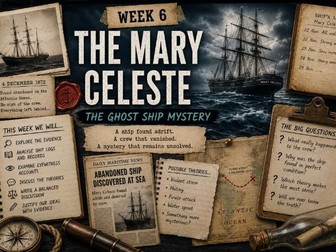
In the final week of the Mysteries unit, pupils investigate the famous mystery of the Mary Celeste, the abandoned ship discovered drifting in the Atlantic Ocean in 1872 with no sign of its crew. Through evidence stations, ship logs, cargo records, eyewitness accounts and historical reports, children explore the clues left behind and evaluate the many theories surrounding one of history’s greatest maritime mysteries.
The writing focus for the week is balanced discussion writing. Pupils analyse arguments for and against different explanations before planning and writing formal discussion texts using evidence to support their ideas. Throughout the week, children develop skills in presenting balanced viewpoints, organising arguments clearly, using formal tone and reaching reasoned conclusions based on the evidence available.
Drama, expert panels, speaking and listening activities and collaborative investigation tasks are woven throughout the sequence to encourage critical thinking and deeper reasoning. Perfect for Upper KS2, this immersive week combines historical mystery, evidence-based debate and purposeful non-fiction writing in a highly engaging and atmospheric context.
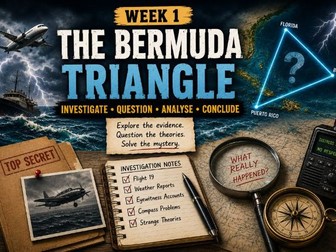
In this exciting mystery-themed English unit, children become investigators as they explore the famous mystery of the Bermuda Triangle through evidence stations, expert panel discussions and formal email writing.
Throughout the week, pupils analyse maps, eyewitness reports, weather evidence and the disappearance of Flight 19 before debating possible explanations including dangerous weather, human error, equipment failure and strange theories. Drama and speaking & listening activities encourage children to think critically, challenge ideas politely and justify opinions using evidence.
The writing outcome for the week is a formal investigation email in which children explain their own theory about the Bermuda Triangle mystery using evidence gathered during the lessons.
Included in this pack:
Detailed lesson planning
Evidence station posters
Recording sheets
Expert panel role cards
Desk mats and journalist question sheets
Vocabulary mats and sentence starters
Planning sheets
WAGOLL model text
Writing scaffold posters
Handwriting writing framework
Gamma presentation outlines
Perfect for upper KS2 and Year 6 classes studying mysteries, critical thinking, formal writing and evidence-based discussion.
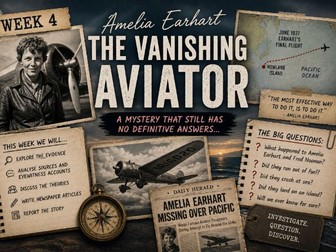
In this exciting week of the Mysteries unit, pupils investigate the disappearance of pioneering aviator Amelia Earhart during her attempt to fly around the world in 1937. Through photographs, radio transcripts, maps, eyewitness reports and evidence stations, children explore one of history’s most famous unsolved mysteries while developing their ability to analyse reliability, compare theories and justify opinions using evidence.
The writing focus for the week is newspaper articles and online news reports. Pupils take on the role of journalists and investigators, gathering evidence before planning and writing balanced reports exploring the possible explanations behind Earhart’s disappearance. Throughout the week, children develop skills in formal tone, paragraph organisation, reader engagement and presenting evidence clearly and effectively.
Drama, expert panels, speaking and listening activities and collaborative investigation tasks are woven throughout the sequence to encourage critical thinking and purposeful discussion. Perfect for Upper KS2, this immersive week combines historical mystery, evidence-based reasoning and high-quality non-fiction writing in a highly engaging context.
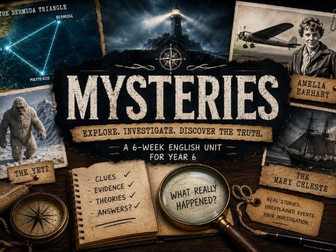
Step into a world of unexplained events, strange disappearances and legendary creatures in this engaging 6-week Year 6 English unit. Through a series of real-life mysteries including the Bermuda Triangle, the Flannan Isles Lighthouse mystery, Amelia Earhart, the Yeti and the Mary Celeste, pupils become investigators, journalists and discussion writers as they analyse evidence, debate theories and present balanced conclusions.
The unit combines visual literacy, speaking and listening, drama, hot seating, evidence stations and structured writing opportunities to develop critical thinking and high-quality written outcomes. Writing genres include formal emails, newspaper articles, blog posts and balanced discussion texts, all carefully scaffolded with planning sheets, role cards, success criteria and differentiated writing frameworks.
Designed for Upper KS2, this unit promotes engagement, reasoning and curiosity while strengthening pupils’ ability to use evidence, justify opinions and write for different audiences and purposes. Perfect for teachers looking for a highly immersive and creative English sequence with strong cross-curricular links and rich opportunities for discussion.
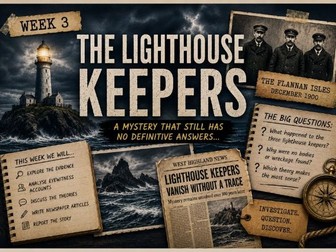
In this atmospheric week of the Mysteries unit, pupils investigate the real-life disappearance of the Flannan Isles lighthouse keepers on the remote island of Eilean Mòr. Through evidence stations, eyewitness reports, weather records and historical accounts, children explore one of Britain’s most famous unsolved mysteries while developing their ability to question evidence, compare theories and think critically.
The writing focus for the week is newspaper articles and online news reports. Pupils take on the role of journalists investigating the disappearance, gathering information from a range of sources before planning and writing their own balanced reports. Throughout the week, children develop skills in formal tone, ambitious vocabulary, paragraph organisation and presenting evidence clearly for the reader.
Drama, speaking and listening activities, role play and collaborative investigation tasks are woven throughout the sequence to create an immersive learning experience. Perfect for Upper KS2, this week combines suspense, critical thinking and purposeful writing in a highly engaging mystery context.
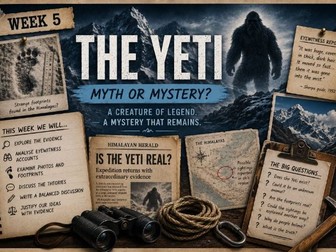
In this exciting week of the Mysteries unit, pupils investigate the legend of the Yeti, exploring whether the famous Himalayan creature could really exist. Through evidence stations, eyewitness reports, footprint analysis, photographs and scientific explanations, children examine how reliable different pieces of evidence are and develop their ability to question, debate and justify ideas using evidence.
The writing focus for the week is balanced discussion writing. Pupils explore arguments both for and against the existence of the Yeti before planning and writing their own formal discussion texts. Throughout the week, children develop skills in presenting balanced viewpoints, using formal language, organising arguments clearly and reaching reasoned conclusions supported by evidence.
Drama, expert panels, hot seating and collaborative investigation activities are woven throughout the sequence to encourage critical thinking, speaking and listening and deeper reasoning. Perfect for Upper KS2, this immersive week combines legendary mystery, evidence-based debate and purposeful non-fiction writing in a highly engaging context.
Are UFO sightings real evidence… or misunderstood events?
This exciting mystery week builds on the investigative style of Week 1 while introducing a stronger drama and communication focus. Children become UFO investigators as they analyse sightings, eyewitness reports, mysterious photographs and government files before taking part in expert panel discussions and hotline-style roleplay activities.
The week develops speaking & listening, critical thinking and formal writing through visual evidence stations, hot seating drama tasks and structured planning activities. Children examine the reliability of evidence and debate possible explanations including mistaken identity, weather phenomena, secret technology and extraterrestrial theories.
The final writing outcome is a formal email linked to the UFO investigation in which children explain and justify their own theory using evidence gathered throughout the week.
A scavenger hunt aimed at Year 5 & 6 (or older if necessary) which does not involve locks and keys but filling in a Google Form with their answer to unlock it.
Great for 30 -45 mins in Book Week.
I very much believe in modelling a task for the children especially when trying to get them to expand their writing beyond simple facts. Here I have included the tasks which I use with my Year 6 classes. The balloon problem is described in the SMART board resource (word too for those without SMART). I chose Saddam Hussein for my person as I was teaching in the Middle East and he was the evil figure that they all knew about.
The second set of resources are discussion/discursive writing and again uses a framework to help the children form their writing.
Children struggle to choose their own topic so I like to use my 'Box of Doom' and they get a random topic. The Discursive week as it is slightly different to argument I do a group activity before an individual writing task.
A game for 2 or more players. Children collect cards to make sets and review topic.
In this game the children need to collect:
Name of Religion
The symbol
The place of worship
A key teaching or festival
A game for 2 or more players. Children collect cards to make sets and review topic.
In this game the children need to collect:
Name of habitat
Picture of animal
two adaptations
A game for 2 or more players. Children collect cards to make sets and review topic.
In this game the children need to collect:
Picture
Habitat
Adaptations x2
I created these posters to go in our music room to show how musicians have demonstrated the IPC personal goals. A mixture of modern and older musicians.