Light Refraction: Spear Fishing Diagram TaskQuick View
adamsmith7281

Light Refraction: Spear Fishing Diagram Task

(0)
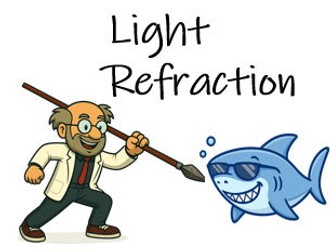
Interactive light refraction diagram using a spear-fishing context. Students label angles, media, and fish positions to show how refraction works. Full Description Engaging KS3/GCSE Science activity on light refraction using a fun spear-fishing context. Students label key features on a refraction diagram, identifying the angle of incidence, angle of refraction, normal, and the difference between observed and actual fish positions. Includes: Student worksheet (fill-in version) Answer version for self-check or teacher display Clear visual of bending toward the normal Linked literacy focus on apparent position and medium density Perfect for lessons on Refraction, Light and Waves, or Applied Physics.
Step-by-Step Guide: Resultant Force VectorsQuick View
adamsmith7281

Step-by-Step Guide: Resultant Force Vectors

(0)
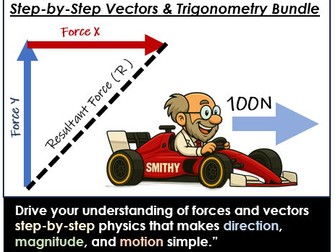
Step-by-step guide helping students calculate resultant forces, identify balanced vs unbalanced vectors, and link them to motion, acceleration, and equilibrium. This visual resource breaks down the concept of resultant forces through simple, engaging examples (car, motorbike, skier, and parachute). It aligns with the AQA KS3 and GCSE Physics (8463/8464) specification and supports the “Forces and Motion” unit. Students learn to: Identify and label forces with correct size and direction (in newtons). Distinguish between balanced and unbalanced forces. Understand that balanced forces (equal and opposite vectors) cause no change in motion. Calculate the resultant force by adding or subtracting vectors acting in opposite directions. Apply the concept to real contexts — e.g. acceleration, deceleration, constant speed, and vertical motion. Reinforce vector vs scalar ideas and link to Newton’s First and Second Laws. Perfect for classroom display, retrieval tasks, or revision summaries. Includes worked examples, consistent AQA vocabulary, and clear, student-friendly visuals with directional arrows and force labels.
Atomic City: Basic Atomic Structure LessonQuick View
adamsmith7281

Atomic City: Basic Atomic Structure Lesson

(0)
This creative PowerPoint introduces the structure of the atom through the imaginative world of Atomic City. Students meet the Proton Posse, Electron Mobsters, and Neutron Neutralisers to explore how subatomic particles create balance and stability inside atoms. Covers: Structure of the atom (nucleus, electrons, shells) Subatomic particles and their charges Atomic number, atomic mass, and neutrality rule Links to the periodic table and simple ion formation Designed for: KS3 and GCSE (AQA Combined Science or equivalent) Foundation or bridging lessons before bonding topics Includes: Fully editable PowerPoint presentation “Science Behind the Story” factual sections for clarity Engaging Atomic City narrative for recall and understanding Clear key-information summary slide Bring chemistry to life with storytelling — make subatomic science memorable and fun!
Ion Trouble in Atomic City – Ionic BondingQuick View
adamsmith7281

Ion Trouble in Atomic City – Ionic Bonding

(0)
Chaos erupts in Atomic City as Alkalis and Halogens fight for stability — until King Neon brokers peace and reveals how ionic bonding really works! Ion Trouble in Atomic City takes students straight into the electrifying world of ionic bonding! In this story-driven GCSE Combined Science (AQA 8464) resource, the Alkali gang and Halogen crew battle across Atomic City — until King Neon calls a truce and teaches them how to trade electrons for stability. Through bold visuals and humour, learners explore how metals lose electrons to form positive ions (cations) and non-metals gain electrons to form negative ions (anions). Animated scenes, dot-and-cross diagrams, and real chemical examples (LiF, NaCl, MgCl₂) show how opposite charges attract to build strong giant ionic lattices. The “Science Behind the Story” slides reinforce key GCSE ideas: ionic formulae, electrostatic forces, melting and boiling points, conduction in molten and aqueous states, and trends in Groups 1 and 7. Perfect for KS4 lessons, revision, or introducing bonding — it blends narrative, visuals, and clear science to make ionic bonding unforgettable.
Peace  in Atomic City – Covalent BondingQuick View
adamsmith7281

Peace in Atomic City – Covalent Bonding

(0)
In Atomic City, atoms stop fighting and start sharing — discover how covalent bonding creates strong, stable molecules through teamwork and story! Power Sharing in Atomic City brings covalent bonding to life through story, visuals, and humour. In this GCSE Combined Science (AQA 8464) resource, the restless atoms of Atomic City finally discover peace — not by stealing or trading electrons, but by sharing them. Students follow the Buddy System, where non-metals form friendships by sharing pairs of electrons to reach full outer shells. Illustrated slides and dot-and-cross diagrams show how molecules like water (H₂O), oxygen (O₂), and carbon dioxide (CO₂) are built through single, double, and triple covalent bonds. “The Science Behind the Story” panels explain the Octet Rule, 2,8,8,2 electron configuration, and how covalent bonds create stability. The resource also explores simple molecular and giant covalent structures — from soft graphite to hard diamond and silicon dioxide — with clear GCSE explanations of properties and bonding strength. Perfect for KS4 lessons, revision, or storytelling hooks before teaching bonding — it combines clarity, creativity, and curriculum precision to make covalent bonding unforgettable.
Atomic City: Electron stabilityQuick View
adamsmith7281

Atomic City: Electron stability

(0)
Bring chemistry to life in Atomic City, where the Electron Mob and Proton Posse clash until the Noble Gas Kings restore peace! Welcome to Atomic City, where chemistry comes alive through story! This creative GCSE Combined Science (AQA 8464) resource blends narrative and science to make electron configuration and noble gases memorable and accessible. Students meet the Electron Mob and Proton Posse, locked in rivalry until the Noble Gas Kings restore calm — teaching that “if you’ve got 8, you’re great!” Clear, illustrated slides explain the 2,8,8,2 rule, electron shells for the first 20 elements, and why atoms become stable with full outer shells. Includes engaging character profiles (Helium, Neon, Argon, Krypton, Xenon, Radon & Oganesson), real-world uses, group trends, and “Science Behind the Story” explanations linking every metaphor to GCSE keywords. Perfect for KS4 lessons, revision, or introducing the periodic table — combining visual storytelling, humour, and clear scientific reasoning to boost recall and understanding.
Carbon Triplets in Atomic City – IsotopesQuick View
adamsmith7281

Carbon Triplets in Atomic City – Isotopes

(0)
Meet the Carbon Triplets of Atomic City — same element, different powers! Discover isotopes through story, science, and the secrets of stability. The Carbon Triplets in Atomic City turns isotopes into unforgettable characters. In this GCSE Combined Science (AQA 8464) resource, students meet C-12 the Diamond Crusher, C-13 the Spectral Scanner, and C-14 the Radioactive Reaper — three brothers with identical protons but different neutron counts, bringing atomic structure to life. Through vibrant storytelling and “Science Behind the Story” panels, learners explore what makes isotopes the same element yet different in mass and stability. The slides clearly explain stable vs. radioactive isotopes, mass number differences, and real-world uses in medicine, archaeology, and nuclear energy. Includes Atomic Trumps-style character cards, key diagrams, and GCSE definitions linking each isotope to its scientific role — from C-14 radiocarbon dating to C-13 tracer studies and C-12 atomic mass standard. Perfect for KS4 lessons or revision, this resource blends narrative, visuals, and precise science to make isotopes memorable and meaningful.
Atomic City & Metallic BondingQuick View
adamsmith7281

Atomic City & Metallic Bonding

(0)
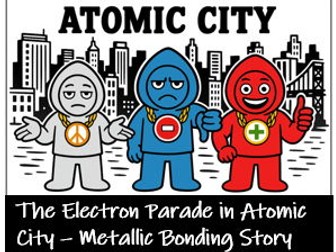
Join the Electron Parade in Atomic City — where metal atoms share their sparks and create the sea of electrons that makes metals strong and conductive! The Electron Parade in Atomic City turns metallic bonding into a visual, story-driven adventure. In this GCSE Combined Science (AQA 8464) resource, students meet the metal atoms of Atomic City as they throw the ultimate Electron Parade — sharing outer electrons freely to form the sea of delocalised electrons that gives metals their signature strength, shine, and conductivity. Illustrated slides show how positive metal ions are held together by a shared electron sea, explaining why metals conduct electricity, bend without breaking, and have high melting points. “Science Behind the Story” panels unpack the electrostatic attraction between ions and electrons, valence electrons, and how charge, ion size, and delocalisation affect bond strength. Includes Higher Tier content on magnesium, aluminium, and transition metals, linking atomic structure to real-world properties. Perfect for KS4 lessons or revision, this resource makes metallic bonding memorable through clear visuals, storytelling, and solid scientific accuracy.
Atomic City: Complete Bonding & Atomic Structure Story CollectionQuick View
adamsmith7281

Atomic City: Complete Bonding & Atomic Structure Story Collection

6 Resources
Step into Atomic City, where chemistry comes alive through story, character, and science. This complete bundle brings together six fully illustrated PowerPoint lessons covering every key stage of atomic structure and bonding for GCSE Combined Science (AQA 8464). Each resource combines accurate science, creative storytelling, and visual clarity to make abstract ideas engaging and memorable for students. Includes: Atomic City: Basic Atomic Structure – Introduces atoms, subatomic particles, and layout of the periodic table. Atomic City: Electron Stability – Explains why full outer shells make atoms stable. Ion Trouble in Atomic City – Covers ionic bonding through a creative conflict-and-truce storyline. Peace in Atomic City – Explores covalent bonding and the “Buddy System” of shared electrons. Atomic City & Metallic Bonding – Describes the sea of delocalised electrons and metallic properties. Carbon Triplets in Atomic City – Teaches isotopes through the story of the Carbon-12, 13, and 14 brothers. Perfect for: KS4 Chemistry lessons, homework, or revision. Introducing bonding and structure in an engaging, story-driven way. Supporting AO1 knowledge, AO2 application, and AO3 explanation with strong curriculum alignment. Save 33% when purchasing the complete Atomic City series — a creative and coherent way to teach atomic structure and bonding.
Vectors and Trigonometry Step-by-Step Physics MasterclassQuick View
adamsmith7281

Vectors and Trigonometry Step-by-Step Physics Masterclass

4 Resources
Build student confidence in vectors, forces, and trigonometry with this clear, structured bundle of step-by-step GCSE Physics resources. Each PowerPoint breaks complex vector and trig problems into simple, guided stages — ideal for teaching, revision, or independent learning. Includes: Resultant Vectors & Pythagoras’ Theorem – Combine forces using scale diagrams and right-angle triangles. Step-by-Step Guide: Resultant Force Vectors – Calculate magnitude and direction with clear worked examples. Trigonometry Step-by-Step Guide – Apply sine, cosine, and tangent to resolve components and forces. Vector Diagrams Step-by-Step – Draw, label, and analyse vector triangles accurately for real-world contexts. Perfect for: GCSE Physics and Combined Science (AQA, Edexcel, OCR). Classroom teaching, revision sessions, and homework. Strengthening mathematical reasoning and graphical skills. Save over 35% with this complete vectors and trigonometry toolkit — clear explanations, consistent formatting, and printable student examples.
Resultant Vectors & Pythagoras TheoremQuick View
adamsmith7281

Resultant Vectors & Pythagoras Theorem

(0)
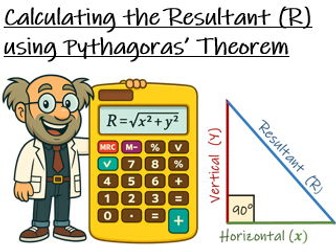
A clear, step-by-step GCSE Science guide to finding resultant vectors using Pythagoras’ Theorem. Includes formulas, examples, and memory tips. Overview This resource provides a clear, step-by-step visual guide to calculating resultant vectors using Pythagoras’ Theorem — ideal for GCSE Science and Physics lessons. It helps students understand how to find the resultant of two perpendicular vectors (such as forces, velocities, or displacements) using simple geometry. The sheet breaks down the process with: A labelled right-angled triangle showing vector components. Worked examples that model good exam technique. A memory phrase (“Square it, Add it, Root it!”) to reinforce the method. Space for guided or independent practice. Students learn how to: Identify horizontal and vertical vector components. Apply Pythagoras’ Theorem to find the magnitude of a resultant. Calculate missing components in vector problems. Describe both the direction and magnitude of a resultant vector. This resource supports key learning in forces and motion, resultant vectors, and geometry in physics, and is suitable for both Foundation and Higher tiers.
Vector Diagrams Step-by-StepQuick View
adamsmith7281

Vector Diagrams Step-by-Step

(0)
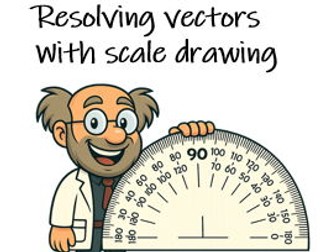
A clear, student-friendly step-by-step guide to constructing and analysing vector diagrams. This visual resource breaks down vector diagrams into simple, manageable steps. Students learn how to: • Draw force vectors to scale using a ruler and protractor • Apply the tip-to-tail method to combine forces • Draw and measure the resultant force • Find both the magnitude and direction of a resultant Includes clear diagrams, labelled examples, and a worked example of a 5 N North and 4 N East scenario leading to a 6.4 N resultant. Ideal for supporting lessons, revision, or independent study for mixed-ability classes.
Trigonometry step by step guideQuick View
adamsmith7281

Trigonometry step by step guide

(0)
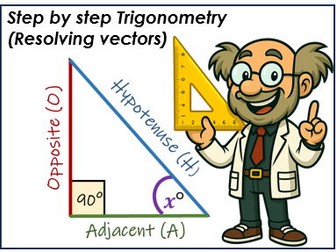
Step-by-step SOH CAH TOA guide with worked examples for finding angles and sides in right-angled triangles. Perfect for GCSE Maths. Description (ready to paste): A clear, step-by-step visual guide for students learning how to use trigonometry to find angles or sides in right-angled triangles. This two-page resource introduces the SOH-CAH-TOA mnemonic, explains Opposite/Adjacent/Hypotenuse labelling, and includes fully worked examples with calculator guidance. Perfect for GCSE Maths, Physics, or Combined Science lessons, revision, or homework. Includes: Mnemonic for remembering trig ratios Worked example for finding an angle using sine Worked example for finding a side using cosine Clear calculator instructions and accuracy checks Student-friendly layout with colour coding Ideal for KS3–KS4 learners, foundation and higher tiers. Printable or PowerPoint-ready for classroom use.