AQA GCSE:  A Christmas Carol Mega Bundle –  14 Lesson Scheme of Work with Homework & Revision PacksQuick View
msresources1979

AQA GCSE: A Christmas Carol Mega Bundle – 14 Lesson Scheme of Work with Homework & Revision Packs

(0)
A**QA GCSE A Christmas Carol – Complete Mega Bundle (14 Lessons + Homework + Revision) ** The ultimate, fully‑planned scheme of work for teaching A Christmas Carol at GCSE. This mega bundle gives you everything you need to teach the novella with confidence: 14 complete lessons, retrieval practice, homework, quotation drills, analysis mats, context resources and exam‑focused tasks. Every resource is classroom‑ready, fully editable and designed to save you hours of planning. What’s Included 14 Full Lessons Complete PowerPoints, guided tasks, model responses, context teaching, quizzes, vocabulary work, and exam‑style questions. 12 Weeks of Homework Activities Structured, engaging tasks that build retrieval strength, quotation recall and independent analysis. Example homework included in the preview. 18 AQA GCSE Analysis Mats High‑impact revision sheets covering language, structure, themes and character analysis. Perfect for classwork, homework or intervention. Key Quotation Drills – Rapid Recall & Analysis Targeted quotation practice to build exam‑ready confidence. Includes recall tasks, analysis prompts and modelled examples. Knowledge Retrieval Quizzes Low‑stakes quizzes covering Dickens’ context, Victorian society, plot, themes and characters. Context Resources Dickens biography, Victorian London, workhouses, Poor Law, Industrial Revolution, crime & punishment — all simplified for GCSE AO3. Extended Writing Tasks Exam‑style questions with scaffolds, sentence starters and stretch challenges. Why Teachers Love This Bundle Fully aligned with AQA GCSE English Literature Covers AO1, AO2 and AO3 throughout Ideal for whole‑class teaching, revision, intervention or homework Clear, structured lessons that reduce planning time Designed for maximum engagement with retrieval practice, quizzes and visual learning Professional, clean design suitable for KS4 classrooms Perfect For Teachers delivering A Christmas Carol for the first time Departments wanting a complete, consistent scheme Revision programmes and intervention groups Students needing structured, accessible resources Save Hours of Planning This Mega Bundle gives you a full, exam‑ready scheme from start to finish. Every lesson, every homework, every revision sheet — all in one place.
Power & Conflict Revision Pack (11 Poems) – Knowledge OrganisersQuick View
msresources1979

Power & Conflict Revision Pack (11 Poems) – Knowledge Organisers

(0)
Power & Conflict Revision Pack (11 Poems) – Knowledge Organisers A high‑quality set of 11 detailed knowledge organisers for the AQA GCSE Power & Conflict poetry cluster. Each organiser breaks down context, line‑by‑line analysis, language and structural devices, themes, and comparison links — giving students everything they need for confident revision and exam preparation. Designed for KS4 English Literature, this pack is ideal for revision lessons, homework, intervention, independent study, or classroom display. What’s Included 11 full knowledge organisers covering: Bayonet Charge Charge of the Light Brigade Exposure Kamikaze London My Last Duchess Ozymandias Remains The Émigrée War Photographer Poppies Each organiser includes: Context Line‑by‑line analysis Key quotations Language & structural devices Themes Comparison suggestions Influences on the poet Why Teachers Love This Pack Saves hours of planning Clear, student‑friendly layout Perfect for revision, homework, or cover lessons Supports all abilities Matches AQA exam expectations Great for printing or projecting in class Perfect For GCSE English Literature revision Year 10 & Year 11 exam preparation Intervention groups Independent study Classroom displays Homework booklets
Power & Conflict Poetry – 7‑Lesson Mega Bundle (Slides, Student Tasks & GCSE Knowledge Organisers)Quick View
msresources1979

Power & Conflict Poetry – 7‑Lesson Mega Bundle (Slides, Student Tasks & GCSE Knowledge Organisers)

(0)
Power & Conflict Poetry – 7‑Lesson Mega Bundle (Slides, Student Tasks & GCSE Knowledge Organisers) AQA English Literature · Complete Teaching Unit This exceptional Mega Bundle brings together seven fully resourced, high‑quality lessons on key poems from the AQA Power & Conflict cluster. Each lesson is designed to be engaging, challenging and completely ready to teach, with visually rich slides, structured analysis tasks and meaningful activities that support students in developing strong GCSE‑level responses. The bundle includes complete lessons on: Bayonet Charge, Remains, War Photographer, Poppies, Kamikaze, The Émigrée, and Charge of the Light Brigade — forming a cohesive, expertly sequenced unit that covers a wide range of themes, contexts and poetic techniques. Every lesson is supported by a GCSE revision Knowledge Organiser tailored to each poem. These organisers consolidate key quotations, context, themes, language techniques and structural features, giving students a clear, accessible reference point for revision and exam preparation. Across the unit, students explore each poem through guided annotation, close language analysis, contextual understanding and structured writing practice. The lessons include thought‑provoking starter activities, deep‑dive analysis slides, whole‑class and independent tasks, and carefully scaffolded opportunities for extended writing. The resources are designed to stretch higher‑attaining students while remaining accessible to mixed‑ability GCSE classes. Teachers value this bundle for its clarity, depth and ease of use. Every lesson is classroom‑ready, saving hours of planning while maintaining a high level of academic challenge. The combination of engaging slides, challenging pupil tasks and detailed knowledge organisers makes this bundle ideal for first teaching, revision, intervention or cover lessons. This Mega Bundle is perfectly suited to GCSE English Literature (AQA Power & Conflict) and can also be used with high‑ability KS3 and KS4 groups preparing for the demands of GCSE poetry study.
The Émigrée – Full GCSE Poetry Lesson (Slides, Student Tasks & Analysis)   AQA Power & ConflictQuick View
msresources1979

The Émigrée – Full GCSE Poetry Lesson (Slides, Student Tasks & Analysis) AQA Power & Conflict

(0)
This complete, ready‑to‑teach lesson on The Émigrée has been designed specifically for GCSE English Literature and the AQA Power & Conflict cluster. It provides everything needed for high‑quality first teaching, revision, or cover lessons, and follows the same clear structure and analytical depth as your other Power & Conflict resources. The lesson guides students through the poem’s language, structure, themes and context, while exploring Rumens’ portrayal of identity, memory, exile and the emotional pull of a lost homeland. Students begin with a starter activity that encourages them to reflect on language, culture and belonging, helping them connect personally with the poem’s themes. The resource then introduces the concept of an émigrée and provides accessible contextual information about Rumens, displacement, and political exile. First impressions are gathered through a guided WHO/WHERE/WHEN/WHAT approach before the lesson moves into detailed close reading of each stanza. Students analyse key quotations such as “sunlight‑clear”, “time rolls its tanks”, “like a hollow doll”, and “my shadow falls as evidence of sunlight”, exploring Rumens’ use of metaphor, personification, symbolism and sensory imagery. Throughout the lesson, students complete whole‑class and independent annotation tasks that help them break down figurative language, tone, structure and writer’s craft. Themes such as identity, exile, memory, belonging and political oppression are explored in depth, allowing students to understand both the emotional and political dimensions of the poem. A structured paragraph scaffold supports students in writing analytical responses using embedded quotations, and the lesson concludes with a reflective plenary that encourages students to consider the poem’s message and the speaker’s complex relationship with her past. Teachers value this resource because it saves significant planning time, offers clear and accessible explanations, and works effectively with mixed‑ability GCSE classes. It is ideal for first teaching, revision, homework, intervention or cover lessons, and aligns seamlessly with the rest of your Power & Conflict series. The lesson’s strong emphasis on identity, memory and writer’s craft ensures that students gain a deep and meaningful understanding of the poem. This resource is perfectly suited to GCSE English Literature (AQA Power & Conflict) and can also be used with high‑ability KS3 and KS4 groups who are being introduced to conflict poetry or exploring themes of identity and displacement.
Kamikaze – Full GCSE Poetry Lesson (Slides, Student Tasks & Analysis)Quick View
msresources1979

Kamikaze – Full GCSE Poetry Lesson (Slides, Student Tasks & Analysis)

(0)
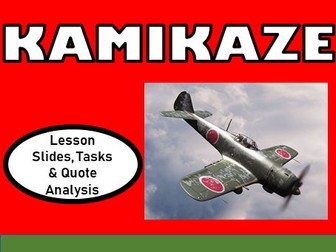
Kamikaze – Full GCSE Poetry Lesson (Slides, Student Tasks & Analysis) AQA Power & Conflict · Beatrice Garland This complete, ready‑to‑teach lesson on Kamikaze has been created specifically for GCSE English Literature and the AQA Power & Conflict cluster. It provides everything needed for high‑quality first teaching, revision, or cover lessons, following the same clear structure and analytical depth as your other Power & Conflict resources. The lesson guides students through the poem’s language, structure, themes and context with clarity, while also exploring the cultural expectations placed on kamikaze pilots, the emotional pressures of honour‑based societies, and the long‑term consequences of the pilot’s decision on his family. The resource includes a full set of teaching slides covering contextual information, first impressions, guided analysis and narrative voice. Students begin with an image‑based starter activity that encourages them to consider the symbolism and cultural significance of kamikaze pilots before moving into accessible context slides on honour culture and Japan during the Second World War. A strong focus is placed on narrative perspective, encouraging students to consider why the poem is told through the daughter’s voice and why the pilot himself never speaks. Close reading tasks and structured analytical prompts support GCSE students in developing high‑quality written responses, and a paragraph scaffold is included to help them embed quotations effectively. The lesson concludes with a reflective plenary that invites students to consider the poem’s message and the implications of the pilot’s choice. Teachers value this resource because it saves significant planning time, offers clear and accessible explanations, and works effectively with mixed‑ability GCSE classes. It is ideal for first teaching, revision, homework, intervention or cover lessons, and it aligns seamlessly with the rest of your Power & Conflict series. The lesson’s strong emphasis on context, narrative voice and writer’s craft ensures that students gain a deep and meaningful understanding of the poem. This resource is perfectly suited to GCSE English Literature (AQA Power & Conflict) and can also be used with high‑ability KS3 and KS4 groups who are being introduced to conflict poetry or preparing for more advanced analytical work.
War Photographer: Full GCSE Lesson with Teaching Slides, Pupil Tasks & Quote AnalysisQuick View
msresources1979

War Photographer: Full GCSE Lesson with Teaching Slides, Pupil Tasks & Quote Analysis

(0)
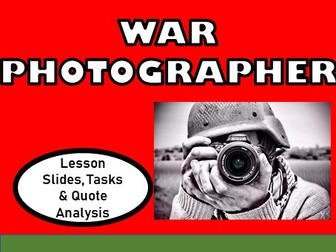
War Photographer – Full GCSE Poetry Lesson (Slides, Student Tasks & Analysis) AQA Power & Conflict · Carol Ann Duffy This complete, ready‑to‑teach lesson on War Photographer is designed specifically for GCSE English Literature (AQA Power & Conflict). It provides everything needed for high‑quality first teaching, revision, or cover lessons. The resource mirrors the structure and clarity of your other Power & Conflict lessons — clear explanations, scaffolded tasks, and strong analytical focus. Students explore the poem’s language, structure, themes and context through guided analysis, annotation tasks and discussion activities. The lesson also examines the moral dilemmas faced by war photographers and the contrast between conflict zones and everyday life in the West. What’s Included Teaching Slides (context, first impressions, guided analysis) Image‑based starter activity Vocabulary task Deep‑dive analysis slides Whole‑class annotation Independent annotation tasks Themes overview (moral dilemmas, Western attitudes, trauma) Close reading tasks Paragraph writing scaffold High‑quality visuals and clear explanations Everything is designed to be exam‑ready, classroom‑ready, and easy to deliver. Lesson Breakdown Starter Activity Students analyse real war photography to build context and emotional understanding. Context: War Photography & Moral Dilemmas Clear, student‑friendly slides explaining the role of war photographers, the dangers they face, and the ethical challenges behind documenting suffering. First Impressions Students complete a guided WHO/WHERE/WHEN/WHAT response. Deep‑Dive Language Analysis Annotation Tasks Whole‑class and individual annotation tasks help students break down figurative language, tone, structure and writer’s craft. Themes & Ideas Students explore: Moral responsibility Western detachment from foreign conflict Trauma and emotional burden The ethics of photography The contrast between war zones and everyday life Writing Support A structured paragraph scaffold supports students in writing analytical responses using embedded quotations. Plenary A reflective question encourages students to evaluate the poem’s message and impact. Why Teachers Love This Resource Saves hours of planning Clear, accessible explanations Works for mixed‑ability GCSE classes Perfect for first teaching or revision Matches the style of your other Power & Conflict lessons Ideal for cover lessons, homework or intervention Strong focus on context, morality and writer’s craft Perfect For GCSE English Literature (AQA Power & Conflict) First teaching Revision lessons Homework tasks Cover lessons Intervention groups KS4 introduction to conflict poetry
Remains: Full GCSE Lesson with Teaching Slides, Pupil Tasks & Quote AnalysisQuick View
msresources1979

Remains: Full GCSE Lesson with Teaching Slides, Pupil Tasks & Quote Analysis

(0)
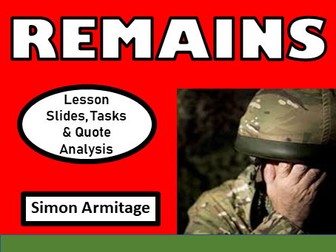
Remains – Full GCSE Poetry Lesson (Slides, Student Tasks & Analysis) AQA Power & Conflict · Simon Armitage This complete, ready‑to‑teach lesson on Remains is designed specifically for GCSE English Literature (AQA Power & Conflict). It provides everything needed for high‑quality first teaching, revision, or cover lessons. . Students explore the poem’s language, structure, themes and context through guided analysis, annotation tasks and discussion activities. The lesson also introduces the psychological impact of conflict, helping students understand the poem’s portrayal of trauma, guilt and memory. ** What’s Included ** Teaching Slides (context, PTSD background, first impressions) Vocabulary Starter (semantic field of trauma) Video Link to The Not Dead (the documentary that inspired the poem) Diamond 9 Emotional Ranking Task Close Reading Tasks Whole‑Class Annotation Group Annotation Task Key Images & Phrases Analysis Structure & Form Breakdown Themes Overview (trauma, guilt, memory, war) Paragraph Writing Scaffold Plenary Discussion Question High‑quality visuals and clear explanations Everything is designed to be exam‑ready, classroom‑ready, and easy to deliver. Lesson Breakdown Starter Activity Students explore a semantic field of trauma to establish tone and context. Context: PTSD & Modern Conflict Clear, student‑friendly slides explaining PTSD, flashbacks, and the psychological effects of war — essential for understanding the poem. Documentary Clip A short extract from The Not Dead introduces the real soldier whose experience inspired the poem. First Impressions Students complete a guided WHO/WHERE/WHEN/WHAT response. Deep‑Dive Language Analysis Annotation Tasks Whole‑class and group annotation tasks help students break down figurative language, tone, structure and writer’s craft. Structure & Themes Students explore how the poem shifts between past and present, and how Armitage uses form to reflect trauma and memory. Writing Support A structured paragraph scaffold supports students in writing analytical responses using embedded quotations. Plenary A reflective question encourages students to evaluate the poem’s impact. Why Teachers Love This Resource Saves hours of planning Clear, accessible explanations Works for mixed‑ability GCSE classes Perfect for first teaching or revision Matches the style of other Power & Conflict lessons Ideal for cover lessons, homework or intervention Strong focus on context, trauma and writer’s craft Perfect For GCSE English Literature (AQA Power & Conflict) First teaching Revision lessons Homework tasks Cover lessons Intervention groups High‑ability KS3 introduction to conflict poetry
Poppies – Full GCSE Poetry Lesson (Slides, Student Tasks & Quote Analysis)Quick View
msresources1979

Poppies – Full GCSE Poetry Lesson (Slides, Student Tasks & Quote Analysis)

(0)
**AQA Power & Conflict · Jane Weir ** This complete, ready‑to‑teach lesson on Poppies is designed for GCSE English Literature (AQA Power & Conflict) and provides everything needed for high‑quality first teaching, revision, or cover lessons. The resource mirrors the structure and clarity of your Bayonet Charge lesson — clear explanations, scaffolded tasks, and strong analytical focus. Students explore the poem’s language, structure, themes and context through guided analysis, annotation tasks and exam‑style writing practice. What’s Included Teaching Slides (context, first impressions, guided analysis) Vocabulary Starter (connotations + tone building) Five Quote Analysis Slides Student Tasks (annotation, technique identification, quote explosions) Structure & Form Breakdown Themes Overview GCSE PEE/TEE Paragraph Scaffold Exam‑Style Question High‑quality visuals and clear explanations Lesson Breakdown Starter: Connotation and vocabulary activity using key words from the poem Context: Jane Weir, Armistice Sunday, remembrance First Impressions: Guided 5‑step summary Deep‑Dive Language Analysis Structure & Form: Enjambment, time shifts, emotional progression Themes: Loss, remembrance, motherhood, the personal cost of conflict Writing Practice: GCSE‑style analytical paragraph with scaffold **Why Teachers Love This Resource ** Saves hours of planning Clear, accessible explanations Works for mixed‑ability GCSE classes Perfect for first teaching or revision Matches the style of other Power & Conflict lessons Ideal for cover lessons, homework or intervention **Perfect For GCSE English Literature (AQA Power & Conflict) ** First teaching Revision lessons Homework tasks Cover lessons Intervention groups KS4 introduction to conflict poetry
Charge of the Light Brigade: Full GCSE Lesson with Teaching Slides, Pupil Tasks & Quote AnalysisQuick View
msresources1979

Charge of the Light Brigade: Full GCSE Lesson with Teaching Slides, Pupil Tasks & Quote Analysis

(0)
A complete, ready‑to‑teach lesson on The Charge of the Light Brigade by Alfred, Lord Tennyson, designed for KS3.4 and as part of a wider introduction to the GCSE Power and Conflict poetry cluster. This lesson includes teaching slides, pupil tasks, vocabulary, close reading, and quote analysis, making it ideal for mixed‑ability English classes. This is Lesson 2 in a full unit, but it also works effectively as a stand‑alone poetry lesson. ** What’s Included** Fully explained teaching slides Context: Crimean War, Balaclava, miscommunication, Tennyson as Poet Laureate Key vocabulary from the poem Close reading questions Quote analysis (“quote explosions”) Pupil tasks and written activities Technique identification (repetition, metaphor, alliteration, anaphora, rhythm) PEE paragraph scaffolding Challenge questions for higher‑ability pupils Optional comparison links (Exposure, Ozymandias, Remains) Learning Focus Understanding the content and ideas in The Charge of the Light Brigade Exploring Tennyson’s language choices Identifying poetic techniques Analysing quotations in depth Linking ideas to themes of conflict, bravery and obedience Building confidence with GCSE‑style analytical writing Why This Lesson Works Clear, structured slides reduce planning time Tasks are scaffolded for accessibility High‑challenge analysis stretches more able pupils Suitable for KS3 and GCSE foundation groups Ideal for whole‑class teaching, intervention, or cover lessons Part of a Complete Unit This lesson forms part of a Power & Conflict poetry unit covering key poems with slides, tasks, vocabulary, and analysis. Each lesson is available individually and as a full bundle.
Bayonet Charge: Full GCSE Lesson with Teaching Slides, Pupil Tasks & Quote AnalysisQuick View
msresources1979

Bayonet Charge: Full GCSE Lesson with Teaching Slides, Pupil Tasks & Quote Analysis

(0)
A complete, ready‑to‑teach lesson on Bayonet Charge by Ted Hughes, designed as an introduction to the GCSE Power and Conflict poetry cluster. This lesson includes teaching slides, pupil tasks, vocabulary, close reading, and quote analysis, making it ideal for mixed‑ability English classes. This is Lesson 1 in a 7‑lesson unit but also works effectively as a stand‑alone poetry lesson. What’s Included Fully explained teaching slides Key vocabulary from the poem Context and first impressions Close reading questions Quote analysis (“quote explosions”) Pupil tasks and written activities Technique identification (simile, metaphor, imagery, enjambment) PEE paragraph scaffolding Learning Focus Understanding the content and ideas in Bayonet Charge Exploring Hughes’ language choices Identifying poetic techniques Analysing quotations in depth Linking ideas to themes of conflict Building confidence with GCSE‑style analytical writing **Why This Lesson Works ** Clear, structured slides reduce planning time Tasks are scaffolded for accessibility High‑challenge analysis stretches more able pupils Suitable for GCSE groups Ideal for whole‑class teaching, intervention, or cover lessons Part of a Complete 7‑Lesson Unit This lesson forms part of a Power & Conflict poetry unit covering key poems with slides, tasks, vocabulary, and analysis. Each lesson is available individually and as a full bundle.
SMART Goals & Habit Building Lesson | Goal Setting for PSHE, Life Skills, Careers (KS3–KS4)Quick View
msresources1979

SMART Goals & Habit Building Lesson | Goal Setting for PSHE, Life Skills, Careers (KS3–KS4)

(1)
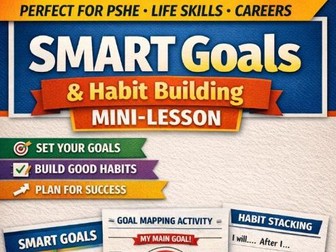
Help your students set meaningful goals and build positive habits with this SMART Goals & Habit Building Lesson — a ready‑to‑teach resource for PSHE, Life Skills, Tutor Time, and Careers education. **Continue the learning with the full 6‑Lesson High School Careers Unit here: ** KS4 Careers Education: Six Complete Lessons with Ready-to-Use Resources https://www.tes.com/teaching-resource/resource-13220971 This lesson is designed as a perfect standalone activity or as part of a complete Careers programme. It helps students understand how to set Specific, Measurable, Achievable, Relevant, and Time‑Bound goals, while learning how to stack habits that support long‑term success. What’s Included Engaging PowerPoint slides introducing SMART goals and habit stacking Goal Mapping Worksheet — students plan steps toward their main goal Habit Stacking Worksheet — attach new habits to existing routines Teacher Guide — clear instructions and discussion prompts Student Reflection Sheet — encourages self‑awareness and motivation Perfect For PSHE / Life Skills / Advisory Careers Week Tutor Time KS3 & KS4 SEN support Goal‑setting and motivation lessons Why Teachers Love This Resource Easy to teach and ready to print Encourages self‑reflection and growth mindset Builds employability and personal development skills Works as a one‑off lesson or part of a full Careers scheme Connect to the Full Careers Programme If your students enjoy learning about SMART goals and habit building, they’ll love continuing their journey with the full 6‑Lesson Careers Unit, which includes: Strengths & Skills CV Writing Interview Skills Job Sectors Future Planning Employability Skills View the full Careers Unit here: https://www.tes.com/teaching-resource/resource-13220971
An Inspector Calls – Complete 10‑Lesson Scheme of Work (GCSE English Literature)Quick View
msresources1979

An Inspector Calls – Complete 10‑Lesson Scheme of Work (GCSE English Literature)

(0)
**A complete, ready‑to‑teach 10‑lesson Scheme of Work for An Inspector Calls, written specifically for GCSE English Literature. ** This Mega Bundle takes students from first introduction to confident analytical writing, with high‑quality slides, differentiated tasks and clear modelling throughout. Every lesson is designed to build knowledge, deepen understanding and prepare students for exam‑style responses. Designed for busy teachers who want a fully resourced, highly engaging and expertly structured GCSE unit that supports every learner—while saving hours of planning time. What’s Included (10 Full Lessons) Each lesson is fully planned with retrieval, modelling, analysis tasks, discussion prompts and AO‑focused writing practice. Lesson 1 – Context & Priestley’s Purpose Edwardian society, capitalism vs socialism, and the play’s message. Lesson 2 – Mr Birling Arrogance, capitalism, dramatic irony and responsibility. Lesson 3 – Sheila Birling Character development, guilt and the generational divide. Lesson 4 – Gerald Croft Privilege, morality and the treatment of Eva Smith. Lesson 5 – Gerald & Daisy Renton Power imbalance, exploitation and social responsibility. Lesson 6 – Sheila vs Mrs Birling Conflict, morality and rising tension in Act Two. Lesson 7 – Real vs Ideal Self Appearance vs reality and character hypocrisy. Lesson 8 – Eric Birling Guilt, responsibility and Eric’s dramatic function. Lesson 9 – The Inspector’s Final Speech Priestley’s message, structure and the play’s climax. Lesson 10 – Themes of the Play Responsibility, class, gender, guilt, morality and social change. Why This Bundle Works for GCSE Clear, consistent lesson structure High‑quality slides with strong modelling Differentiated tasks for mixed‑ability classes AO1, AO2 and AO3 embedded throughout Retrieval practice and revision built in Ideal for first teaching, revision or intervention Saves hours of planning Perfect For GCSE English Literature (AQA, Edexcel, OCR, WJEC) Years 9–11 Whole‑class teaching, revision or cover lessons Teachers wanting a polished, complete unit
An Inspector Calls – GCSE Exam Practice Lesson (Top‑Grade Essay Writing)Quick View
msresources1979

An Inspector Calls – GCSE Exam Practice Lesson (Top‑Grade Essay Writing)

(0)
**An Inspector Calls – GCSE Exam Practice Lesson (How to Write a Top‑Grade Essay) ** A complete, ready‑to‑teach GCSE exam‑skills lesson for An Inspector Calls, designed to help students write confident, analytical, top‑grade essays. This lesson breaks down the entire writing process step‑by‑step, with clear modelling, differentiated tasks and high‑quality examples that show students exactly what examiners are looking for. Perfect as a standalone revision lesson, an intervention session, or an add‑on to any existing scheme of work. What This Lesson Covers How to plan a high‑grade GCSE Literature essay How to analyse quotations effectively (AO2) How to link ideas to context and Priestley’s message (AO3) How to structure paragraphs clearly (PEEZ / PETAL / your school’s preferred model) How to develop a sustained argument across a full essay How to evaluate Priestley’s methods and intentions What’s Included High‑quality teaching slides Step‑by‑step modelling of the full writing process Differentiated tasks for all learners Model paragraphs and sentence starters Planning grids and writing frames A full GCSE‑style exam question Challenge tasks for high attainers Clear success criteria linked to AO1, AO2 and AO3 Why Teachers Love This Lesson Makes essay writing accessible and structured Supports weaker writers while stretching the strongest Provides clear, visual modelling of what good looks like Ideal for revision, intervention or exam preparation Works with any exam board (AQA, Edexcel, OCR, WJEC) **Perfect For: ** GCSE English Literature Years 9–11 Revision lessons Intervention groups Homework or flipped learning Standalone exam‑skills sessions
Macbeth Acts 1–5 – Complete  Scheme for GCSE (Years 8–10) | Lessons, Activities & Revision WorkbooksQuick View
msresources1979

Macbeth Acts 1–5 – Complete Scheme for GCSE (Years 8–10) | Lessons, Activities & Revision Workbooks

(0)
A complete Macbeth Scheme of Work for Years 8–10 — fully resourced, structured, and ready to teach. This premium bundle covers Acts 1–5 of Macbeth in a clear, accessible, and academically rigorous way. Designed for KS3–KS4 transition and ideal for GCSE preparation, it includes full lesson slides; engaging activities, and printable revision‑ready workbooks for every act. Ideal for GCSE teachers who want a complete, zero‑prep Shakespeare unit that builds student confidence and strengthens essential analytical skills with ease. What’s Included Full lesson PowerPoints for every scene (Acts 1–5) Printable student workbooks (study + revision) Scene‑by‑scene comprehension questions Key quotation analysis tasks Character and theme tracking Context and vocabulary support Retrieval practice starters Exam‑style analytical writing tasks End‑of‑act review activities Differentiated tasks for mixed‑ability classes Everything is fully editable and classroom‑ready. Curriculum Fit/Designed for: Year 8–10 English KS3/4 Shakespeare units GCSE foundation skills Transition classes preparing for GCSE Literature The scheme builds the core skills needed for GCSE success: Quotation selection Analytical writing Inference Understanding of structure, character, and theme Why This Scheme Works Clear, consistent structure across all five acts High‑quality visuals and clean academic design Scaffolded tasks for lower‑ability learners Challenge activities for higher‑ability students Revision‑ready workbook tasks Ideal for homework, intervention, or cover lessons Teachers can deliver the entire play with confidence, even if teaching Macbeth for the first time. Assessment & Revision Each act includes: Short‑answer questions Extended analytical tasks Quotation analysis Character/theme development End‑of‑act review tasks The workbooks double as revision booklets, ideal for pre‑GCSE consolidation. Perfect For Full Shakespeare units GCSE preparation Mixed‑ability classes Homework booklets Revision sessions SEN/EAL support (clear layout + scaffolded tasks) Bundle Value Purchasing the acts separately would cost significantly more. This bundle provides the complete Macbeth teaching unit in one place, saving you hours of planning and giving students a structured, high‑quality learning experience.
World War Two Complete Unit – 9 Full Lessons, Activities & Worksheets (Years 5–9, KS2/KS3 History)Quick View
msresources1979

World War Two Complete Unit – 9 Full Lessons, Activities & Worksheets (Years 5–9, KS2/KS3 History)

(0)
**World War II COMPLETE Unit – Nine Full Lessons ** A rich, cinematic, ready‑to‑teach journey through the Second World War. Each individual lessons costs £3 but with this bundle they are reduced to only £1.25 per lesson pack - exceptional value for a full-term, ready-to-teach scheme. This complete World War II teaching unit gives you 9 full lessons, each packed with engaging activities, source analysis, writing tasks, debates, maps, timelines and structured worksheets. It’s everything you need to teach a full term of WWII — done for you. A fully resourced, high‑impact unit that brings clarity, confidence and consistency to every lesson. Teachers love this unit because it is: Brilliantly designed Chronological and cohesive Deep, meaningful and academically rigorous Engaging for Grades 4–8 A huge time‑saver You’re not just getting lessons — you’re getting a complete curriculum sequence from the Causes of WWII to the Atomic Bomb. Why Teachers Love This Resource ✔ Hours of learning This bundle contains enough content for a full term’s teaching. Every lesson is complete, structured and classroom‑ready. ✔ Zero prep required Slides, worksheets, tasks, sources, writing frames, debates, diaries — everything is included. Just open and teach. ✔ Rich, varied activities Students analyse propaganda, write Blitz diaries, debate ethical questions, explore maps, timelines and primary sources, and reflect on the human impact of war. ✔ Clear progression The unit follows a powerful chronological journey: Causes → Blitz → Evacuees → Propaganda → Anne Frank → Pearl Harbor → Stalingrad → D‑Day → Atomic Bomb ✔ Engaging for all learners High‑impact visuals, structured tasks, accessible explanations and stretch opportunities for higher‑ability students. What’s Included Each of the 9 lessons includes: Full PowerPoint lesson Worksheets & graphic organisers Source analysis tasks Writing activities Discussion/debate prompts Assessment opportunities Clear teacher instructions High‑quality visuals Printable and digital‑friendly formats Lessons included: Causes of World War II The Blitz Evacuees Propaganda Anne Frank Pearl Harbor Stalingrad D‑Day The Atomic Bomb Perfect For: History units Literacy‑rich lessons Cross‑curricular writing Cover lessons Whole‑class teaching Homeschooling Why This Unit Stands Out This isn’t a quick worksheet pack. It’s a premium, brilliantly crafted, curriculum‑level unit that gives teachers everything they need to deliver meaningful, engaging and academically strong WWII lessons. Teachers save hours. Students stay engaged. Learning becomes memorable. Ready to Teach Today Download the full bundle and transform your WWII unit with lessons that are: rich, rigorous, engaging and completely ready to go.
Charlotte’s Web Novel Study | 10‑Lesson Reading & Writing UnitQuick View
msresources1979

Charlotte’s Web Novel Study | 10‑Lesson Reading & Writing Unit

(0)
Engage your students in a complete, chapter‑by‑chapter journey through Charlotte’s Web with this 10‑lesson reading and writing unit. Designed for Years 3-5, this pack covers the entire novel with a rich mix of comprehension, vocabulary, writing, and discussion activities that build confidence and deepen understanding. Each lesson includes clear learning objectives, print‑ready worksheets, and differentiated tasks to support a wide range of learners. Perfect for whole‑class teaching, small‑group work, or independent reading rotations. **What’s Included ** 10 fully planned lessons covering the entire book Reading comprehension activities (retrieval, inference, prediction, summarizing) Creative and structured writing tasks (character descriptions, diary entries, persuasive writing, setting descriptions, and more) Vocabulary development with context clues and word‑meaning tasks Discussion prompts to build speaking and listening skills Chapter‑aligned worksheets for easy printing Teacher answer keys (if you have them — optional to include) Flexible pacing suitable for 2–3 weeks of instruction Skills Covered: Understanding character motivation and development Identifying themes such as friendship, loyalty, and courage Analyzing key events and cause/effect Using evidence from the text to support answers Developing structured, grade‑appropriate writing Expanding vocabulary through contextual analysis Perfect For: Novel studies Guided reading groups Literacy centers Sub plans Homeschool instruction Why Teachers Love This Pack Saves hours of planning Easy to follow — consistent structure across all lessons Engaging tasks that work for mixed‑ability classrooms Supports Common Core‑aligned reading and writing skills Printer‑friendly, classroom‑ready design
Of Mice and Men – 7‑Lesson Teaching Bundle (Complete Unit for KS3/KS4 English Literature)Quick View
msresources1979

Of Mice and Men – 7‑Lesson Teaching Bundle (Complete Unit for KS3/KS4 English Literature)

(0)
Of Mice and Men – 7‑Lesson Teaching Bundle (KS3/KS4 English Literature) Cinematic Slides • Guided Questions • Worksheets Transform your Of Mice and Men unit into a cinematic classroom experience. This complete 7‑lesson bundle blends visual storytelling, guided analysis, and ready‑to‑teach resources that save hours of planning while keeping every learner engaged.It’s everything you need to deliver lessons that feel richer, run smoother, and leave a lasting impact. What’s Inside 7 full lessons covering key chapters, characters, and themes Cinematic PowerPoints with warm, film‑style visuals Guided reading questions for every chapter Differentiated worksheets for mixed‑ability groups Retrieval starters, plenaries, and stretch tasks Editable Word and PowerPoint files for easy adaptation Why Teachers Love It Zero prep — everything’s ready to teach Consistent, premium design across all lessons Scaffolded tasks for lower‑ability learners Stretch challenges for higher‑ability students Perfect for KS3 and GCSE foundation groups Ideal for revision, homework, or full‑unit teaching Lesson Overviews Lesson 1 Setting, atmosphere, and first impressions Lesson 2 George & Lennie: character study Lesson 3 Life on the ranch + Crooks Lesson 4 Curley’s Wife: power, gender, isolation Lesson 5 Dreams, symbolism, foreshadowing Lesson 6 Conflict, tension, and key turning points Lesson 7 Tragedy, themes, and final analysis Curriculum Links KS3 English Literature Themes: Friendship, Dreams, Loneliness, Power, Gender
Private Peaceful Guided Reading Questions and Activities KS2/KS3Quick View
msresources1979

Private Peaceful Guided Reading Questions and Activities KS2/KS3

(0)
**Private Peaceful – Guided Reading Booklet (KS2 / KS3) ** This complete guided reading booklet for Private Peaceful by Michael Morpurgo provides ready‑to‑use comprehension, discussion, and inference questions for every chapter of the novel. Designed for KS2 and KS3, this resource is ideal for whole‑class guided reading, small‑group work, homework, or reading interventions. **Skill Development ** The questions are carefully structured to build essential literacy and empathy skills: Retrieval and literal comprehension Inference and deduction Prediction and reflection Character and theme analysis Empathy and moral understanding What’s Included A complete guided reading booklet covering all chapters of Private Peaceful 12–15 carefully designed questions per chapter section Focus on comprehension, inference, prediction, and discussion Suitable for Years 5–7 / KS2–KS3 Printable and digital‑friendly — ready to use immediately Ideal for teachers, cover lessons, or home learning Classroom Uses Whole‑class reading sessions Guided reading groups Independent comprehension tasks Assessment of reading and inference skills Supply or cover lesson ready Curriculum Links Supports reading comprehension, inference, deduction, and discussion objectives across KS2 and KS3. Perfect for literacy lessons, guided reading, and World War I novel study units exploring courage, brotherhood, and sacrifice.
200‑Word Writing Challenge – Creative Writing Booklet for KS3 & KS4Quick View
msresources1979

200‑Word Writing Challenge – Creative Writing Booklet for KS3 & KS4

(0)
**200‑Word Writing Challenge – Creative Writing Booklet for KS3 & KS4 ** Bring creativity, confidence, and structure to every English lesson with this fantastic pupil writing booklet designed for KS3 and KS4. The 200‑Word Writing Challenge turns short writing tasks into powerful skill‑building opportunities — perfect for starters, warm‑ups, homework, cover lessons, or weekly writing practice. Students enjoy the freedom to craft imaginative responses, while teachers appreciate the clear structure, peer‑assessment routines, and built‑in self‑editing support. Why Teachers Love It No‑prep, ready‑to‑use booklet — simply print and go Engaging prompts that spark creativity and enthusiasm Technique checklist to reinforce narrative and descriptive writing Peer‑assessment and self‑correction pages that build independence 12‑week literary glossary for tracking new devices and vocabulary Perfect For KS3 & KS4 English Creative writing units Writing stamina practice Early finishers Homework tasks Cover lessons Skills Covered Narrative and descriptive writing Dialogue and characterisation Editing and revising Literary devices and vocabulary development Peer feedback and reflection What’s Inside 12‑week printable writing booklet Weekly 200‑word creative prompts Model text for technique analysis Peer‑assessment and self‑editing sheets Literary glossary tracking pages Engaging, structured, and fun — this booklet helps every pupil become a more confident, skilled writer in just 200 words at a time.
Inventors of Tomorrow: STEM Invention Project + Dragon's Den  Pitch (Years 5 - 7)Quick View
msresources1979

Inventors of Tomorrow: STEM Invention Project + Dragon's Den Pitch (Years 5 - 7)

(0)
Inventors of Tomorrow – The Inventions Project Creative STEM & Design Thinking Unit | Upper Primary & Lower Secondary Inspire creativity, problem‑solving and innovation with this two‑part invention project. Students explore real‑world problems, design their own inventions, and present their ideas in a Dragon’s Den–style pitch. Perfect for end‑of‑term projects, enrichment weeks, STEM days, or cross‑curricular learning. Part 1 — Discover, Explore & Design Students begin their journey as young inventors. They will: Identify everyday problems and brainstorm possible solutions Explore how inventions start with needs, challenges and curiosity Sketch and label their own prototype ideas Develop early concepts using guided prompts and visual examples Build confidence through creative thinking and discussion Outcome of Part 1: Each student finishes with a fully developed invention idea and a labelled design ready for refinement. Part 2 — Create, Advertise & Pitch Students turn their invention into a polished, persuasive product. They will: Create an advertisement for their invention Write a persuasive letter explaining why their invention should be produced Prepare a Dragon’s Den–style pitch using persuasive language and visuals Reflect on how their invention could improve lives or solve real problems Celebrate their creativity in a final Inventors Showcase Outcome of Part 2: Students complete a full invention portfolio and deliver a confident pitch. What’s Included Fully illustrated PowerPoint slides for Part 1 & Part 2 Design templates (sketch pages, planning sheets, brainstorming prompts) Persuasive writing worksheets Advertisement templates Pitch preparation sheets Reflection pages Home extension tasks Teacher guidance with learning objectives and differentiation ideas Why Teachers Love This Resource Blends STEM, literacy and creativity Works for individuals, pairs or groups Highly engaging for Years 4–8 Ideal for project‑based learning and end‑of‑term activities Students feel like real inventors from start to finish
Growth Mindset Lesson Pack – Brain Science, Resilience & Reflection Activities (KS2–KS3)Quick View
msresources1979

Growth Mindset Lesson Pack – Brain Science, Resilience & Reflection Activities (KS2–KS3)

(0)
Growth Mindset Lesson Pack – Brain Science, Resilience & Reflection Activities ( KS2–KS3) Empower your students to think like learners, not quitters. This complete Growth Mindset lesson pack blends brain science, resilience strategies, and creative reflection tasks to help pupils aged 9–14 understand how effort rewires the brain and builds success. What’s Inside: Engaging lesson slides that explain the science of learning and neuroplasticity in pupil‑friendly language. Three challenge tasks — Impossible → Possible Storyboard, Micro‑Wins Masterplan, and Teach It Forward Mini‑Speech — designed to deepen reflection and confidence. Printable worksheets and plenary prompts for individual or group use. Zero‑prep format: ready to teach, visually credible, and classroom‑tested for KS2–KS3 / Grades 4–8. Why Teachers Love It Builds resilience and self‑belief through practical reflection. Perfect for PSHE or end‑of‑unit lessons. Works beautifully as a stand‑alone mini‑lesson or as part of your Growth Mindset unit. Designed with academic realism visuals — credible for upper primary and early secondary learners.