Differentiated revision resource for KS3 biology regarding respiration and photosynthesis including leaf adaptation. Could be used to support KS4 pupils in Science.
looking at the differences between plant and animal cells, labelling and determining the function through an activity with worksheet and powerpoint for lesson with question and answers for KS3/ year 7 science/ biology
IAL Edexcel A-level
2.10 Describe how ionization energies are influenced by the number of protons in the nucleus, electron shielding and sub-shell from which the electron is removed.
2.11 Describe how successive ionization energies provide evidence for the existence of quantum shells and the group the element belongs to and how the first ionization energy gives evidence of subshells
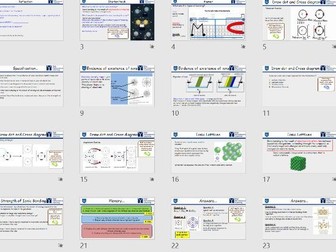
A-level powerpoint for IAL Edexcel Chemistry specification on Ionic bonding with answers
includes dot and cross diagrams, misconceptions on lattices and strength of bonding
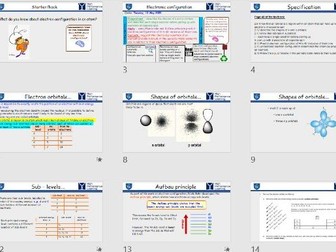
IAL Edexcel CHemistry electronic configuration including aufbau principal and Hunds rules
2.9 Know that an orbital is a region within an atom that can hold up to 2 electrons of opposite spin
2.12 describe the shapes of s and p orbitals
2.13 know that orbitals in subshells
i – each take a single electron before pairing up
Ii- pair up with 2 electrons of opposite spin
2.14 Predict electron configuration of H to Kr inclusive of their ions
2.15 understand electron configuration determines the chemical properties of an element.
2.16 Know the s,p, d,f blocks in the periodic table relate to their subshells
IAL Edexcel Chemistry A-level
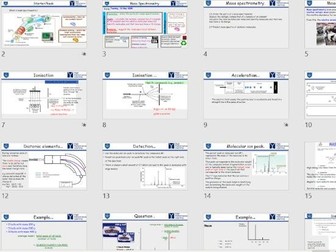
2.6 State the parts of a mass spectrometer.
Deduce the isotopic composition of a sample of an element
Calculate the relative molecular mass and identify molecules and that ions may have a +2 charge.
2.7 Predict mass spectra of diatomic molecules
Pupils need to be able to name lab equipment correctly.
This gives the names and diagrams of equipment.
KS3 , KS4, How science works, HSW, chemistry apparatus, labels, diagram, experiment
a webpage made to gives links to videos on youtube so pupils do not need to search for themselves as well as webpages where they can find past papers/revision notes etc.
This ensures they can independently learn the content and support their understanding.
KS4, chemistry, revision, independent learning, aspiring individuals, whole course, support
Electronic configuration powerpoint with worksheet with answers for iGCSE Edexcel specification. could be used for any exam board or Year 9.
answers are on the powerpoint.
GCSE, iGCSE, Chemistry, AQA, OCR, EDEXCEL
lesson with powerpoint and differentiated worksheet with answers for the atomic structure lesson a for iGCSE Edexcel
Could be used for Year 9.
GCSE, iGCSE, aqa, edexcel, cambridge, ocr,
covalent bonding powerpoint for iGCSE Edexcel with worksheets with answers in the powerpoint.
ALthough the objectives for iGCSE Edexcel it could be used for OCR, AQA, Cambridge etc for GCSE chemistry
IAL Edexcel Chemistry shapes of molecules with answers in ppt
3.15 be able to distinguish between polar bonds and polar molecules and predict whether or not a given molecule is likely to be polar ( testing for polar molecules)
3.16 understand the principles of the electron-pair repulsion theory, used to interpret and predict the shapes of simple molecules and ions
3.17 understand the terms ‘bond length’ and ‘bond angle’
3.18 know and be able to explain the shapes of, and bond angles in, BeCl2, BCl3, CH4, NH3, NH4+, H2O, CO2, gaseous PCl5 , SF6 and C2H4
3.19 be able to apply the electron-pair repulsion theory to predict the shapes of, and bond angles in, molecules and ions analogous to those in 3.18
IAL Chemistry specification.
Isoelectronic ions, polarisation, ionic radii
3.7 Understand reasons for the trends in ionic radii down a group in the periodic table and for the isoelectronic ions N3- to Al3+
3.8 Understand the meaning of polarization as applied to ions
3.9 Understand that polarizing power of a cation depends on its radius and charge and the polarizability of an anion also depends on its radius and charge
IAL Edexcel chemistry with questions and answers
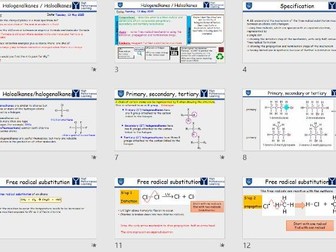
primary, secondary and tertiary halogenalkanes
4.18 understand the mechanism of the free radical substitution reaction between an alkane and a halogen:
i using free radicals, which are species with an unpaired electron, represented by
a single dot
ii showing the initiation step of the mechanism, with curly half-arrows for free radical formation
iii showing the propagation and termination steps of the mechanism
iv having limited use in synthesis because of further substitution reactions
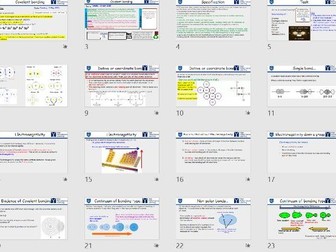
IAL chemistry lesson on covalent and dative bonds with answers.
3.10 understand that covalent bonding is the strong electrostatic attraction between two nuclei and the shared pair of electrons between them, based on the evidence:
i the physical properties of giant atomic structures
ii electron density maps for simple molecules
3.11 be able to draw dot-and-cross diagrams to show electrons in covalent substances, including:
i molecules with single, double and triple bonds
ii species with dative covalent (coordinate) bonds, including Al2Cl6 and the ammonium ion
3.13 understand the meaning of the term ‘electronegativity’ as applied to atoms in a
covalent bond
3.14 know that ionic and covalent bonding are the extremes of a continuum of bonding type and be able to explain this in terms of electronegativity differences, leading to bond polarity in bonds and molecules, and to ionic bonding if the electronegativity is large enough
3.12 be able to describe the different structures formed by giant lattices of carbon atoms, including graphite, diamond and graphene, and discuss the applications of each
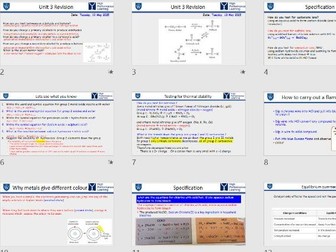
IAL Edexcel CHemistry unit 3 revision worksheet with powerpoint with answers.
Good for a revision lesson for Year 12 to know the basic facts including flame test colours, testing for carbonates, sulphates, nitrates, trends etc etc
IAL Edexcel Chemistry for KS5
4.4 understand the concepts of homologous series and functional group
4.9 know the general formula of alkanes and cycloalkanes, and understand that they are hydrocarbons (compounds of carbon and hydrogen only) which are saturated (contain single bonds only) know prefixes for compounds up to C10
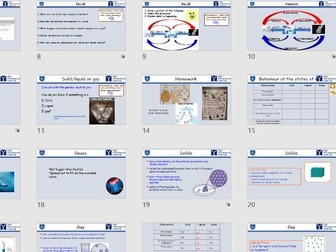
full chemistry lessons & worksheets for the topic states of matter
GCSE, KS3, worksheets, differentiated, questions and answers
IGCSE chemistry, AQA , OCR, science, cambridge
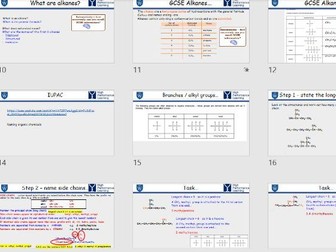
Introduction to the organic chemistry topic which focuses on alkanes and isomers. There are worksheets where the answers are in the powerpoints. The lesson objectives are linked to iGCSE Edexcel chemistry but can be used for other specifications e.g. ocr, aqa, cambridge
filtration, chromatography with retention factor and distillation whole lesson powerpoints with worksheets and answers.
GCSE chemistry, AQA, Edexcel, iGCSE, Cambridge


 Quick View
 Quick View
 Quick View
 Quick View
 Quick View
 Quick View
 Quick View
 Quick View
 Quick View
 Quick View