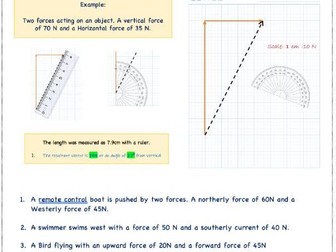
A clear and simple exercise to help students with resolving vectors and finding Resultant Vectors using Scale Diagrams.
Built to satisfy the GCSE AQA Physics specification, but useful with all GCSE Physics courses.
This could also be completed electronically (in Word) by the students - a good ‘distance learning’ or eHomework.
There is a lesson ppt as well.
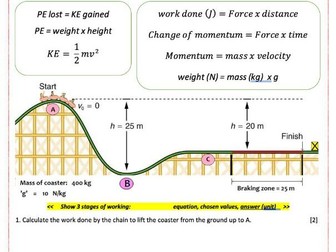
Summative Task involving:
Kinetic - potential exchanges of energy
Work done by brake force
Momentum and velocity calculations
Impulse and change of momentum , linking to passenger safety
AQA physics GCSE
Requisties - plastercine, string, A3 sheets.
Set of resources I made for a lesson obs. Pupils discover how and why we have a national grid by solving the challenge cards handed out at different times.
Differentiate your lesson by who you give the challenge cards to and which role pupils carry out, as well as questioning and hint post it notes.
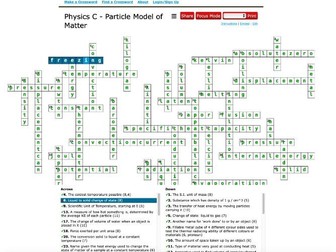
I made this as a revision tool for a CORONA VIRUS distance learning revision lesson. It will work just as well in a classroom …
The crossword can be done online - so we as a class collaborated and I projected my version which students volunteered or were asked to give answers.
Crossword here:
https://crosswordlabs.com/view/physics-c-particle-model-of-matter
Answer sheet attached as image.
Please rate and comment feedback on this free resource.
Rating free resources will bump them up the search list.
Just a teacher trying to help others for free.
This is a resource designed as a discovery simulation practical for pupils to try in the lesson on PC or at home.
It details the straight line relationship between Resultant Force and Acceleration.
Let me know what you think.
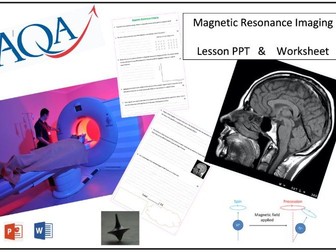
A Lesson on MRI:
Detailed powerpoint describing the mechanism
Linked to a video
With a worksheet + Markscheme
Made by me, a teacher, for other teachers for FREE
Please rate this - so that free resources come up in the search feed.
Lets begin a revolution of free high quality resources.
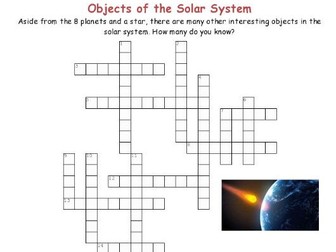
Comets, Meteors, Fireballs and Dwarf Planets make up some of the exotic bodies in our solar system.
Aimed at GCSE Astronomy students, this crossword has some handy definitions to objects in the solar system.
There is a handy clues sheet in case you need it for differentiation purposes or younger students.
Please rate and comment :)
A brief walkthrough of star trail analysis worksheet for GCSE Astronomy.
The mathematics is challenging in parts and may be advisable to have a hint sheet to hand for scaffolding.
**FREE RESOURCE BECAUSE I DON'T BELIEVE IN CHARGING MY FELLOW COLLEAGUES. WE'RE POOR ENOUGH ALREADY!**
This is great as a revision activity.
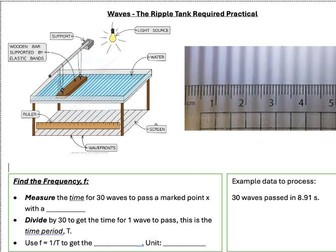
Written as a walkthrough to remind students how to measure and determine the speed, frequency and wavelength of waves in the Ripple Tank practical.
The task has example measurements for them to process as practice.
Answers on the second page.
Resource is free, please use as you wish. Please rate and comment to push free things up the algorithm. Thanks, and please share some of your stuff :)
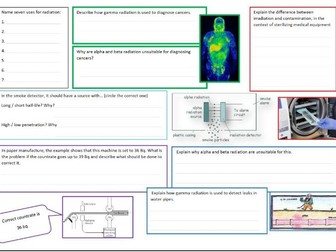
This activity will test the student’s understanding of Radioactivity and their ability to link properties and half-life to the applications of Radiation.
Format: A3 tasksheet with clear images and probing questions to really test students’ understanding and articulation
My students have found this to be invaluable as a resource for revising or learning to link properties and half-life.
This resource, along with all of my stuff, is free for you to use as you wish. All I ask is that you review it, so we can push free things to the front of the algorithm. If you have any feedback, or enjoyed using it, please rate and comment. Thanks and please share anything you have made with us. Good luck my fellow teachers!
This is a pupil led research work with images and a template space for work - students create a magazine article on Rilles and Wrinkle Ridges.
They will need access to information or the internet. Could be a useful research lesson or homework.
It has a peer assessment space and pupil response form at the end as well
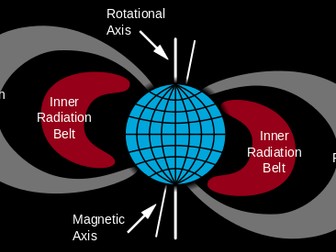
This is a research task on Van Allen belts with a criteria and an answer form template.
I find that pupils produce better work when given the structure / expected product. Of course, the criteria should be modified with levels / grades and a peer assessment form, but this is easily done should you wish.
GCSE Astronomy - The equation of Time exercise.
Please share your stuff too! I know it's a pain, but we need to help each other out here.
Please don't charge for resources - this is a great forum for resources and it sucks that TES are wrecking it by allowing it to be monetised.
Rate and review if you liked this resource. Thanks. :)
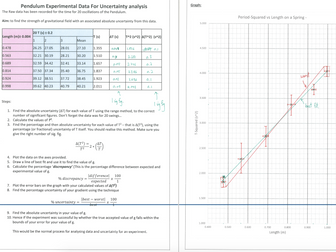
This is an exercise in data handling, uncertainty propagation, graphical plotting and finding the uncertainty of a gradient.
The purpose is walk students through the process of analysing data and concluding with a result and absolute uncertainty on their value for g.
The error bars come out quite large so as to show a clear example of a ‘worst line of best fit’ within the error bars.
This took my yr 13s a full lesson, with intermittent interventions from myself.
Students enjoyed the task and their confidence with data handling has moved forward as a result.
An worked solution has been included and ppt is included. Uncertainties given to 1 sig fig as is the norm.


 Quick View
 Quick View
 Quick View
 Quick View
 Quick View
 Quick View
 Quick View
 Quick View
 Quick View
 Quick View
 Quick View