This lesson was created using the latest AQA A-Level Specification (published June 2019) although content and activities may be useful for other specifications.
Key content covered in this Lesson:
Key questions
Key assumptions of the Biological Approach
The Brain vs. The Mind
The Genetic Basis of Behaviour
Twin Studies
Video: What identical twins separated at birth teach us about genetics
Genotype and Phenotype
Genotype
Phenotype
Activity: Apply it - Phenylketonuria (PKU)
Evolutionary and Behaviour
Exam practice: Application Question
Evaluation worksheet
Evaluation points
Exam practice: Comparison Essay with Mark Scheme
Example Comparison Paragraph
Plenary: Discussion question
To request lessons, provide feedback or if you have had any issues opening any resources of my resources, please feel free to contact jb_resources@outlook.com.
Reviews and feedback are always welcome.
This lesson was created using the latest AQA A-Level Specification (published June 2019) although content and activities may be useful for other specifications.
Key content covered in this Lesson:
Key Questions
The Biological Approach to Explaining OCD
Genetic Explanations of OCD
Family Studies
Candidate Genes
OCD is Polygenic
Different types of OCD
Neural Explanations of OCD
The Role of Serotonin
Decision-Making Systems
Activity: Concepts - Jack
Evaluation worksheet
Evaluation points
Exam Practice with Mark Scheme: 16 Mark Essay with Application
Activity: Planning worksheet
Plenary: Consolidation Question
To request lessons, provide feedback or if you have had any issues opening any resources of my resources, please feel free to contact jb_resources@outlook.com.
Reviews and feedback are always welcome.
This lesson was created using the latest AQA A-Level Specification (published June 2019) although content and activities may be useful for other specifications.
Key content covered in this Lesson:
Key Questions
Aims of Drug Therapy
Selective Serotonin Reuptake Inhibitors (SSRIs)
How SSRIs work
Video: 2-Minute Neuroscience – SSRIs
Activity: Fill in the Blanks
Combining SSRis work with Other Treatments
Alternative to SSRIs
Exam Practice with Mark Scheme: Short answer questions
Evaluation worksheet
Evaluation points
Exam Practice with Mark Scheme: Evaluation questions
Plenary: Consolidation Question
To request lessons, provide feedback or if you have had any issues opening any resources of my resources, please feel free to contact jb_resources@outlook.com.
Reviews and feedback are always welcome.
Full lesson for paper 2 Psychology edexcel criminal psychology on Eysenck Personality Theory of Criminality. Lesson includes all resources needed including the EPT, articles and starter exam questions.
This contains all 14 lessons in the Psychological Problems topic for AQA GCSE Psychology. It also contains a Homework booklet, a Starter booklet and the entire Development Workbooklet.
An introduction to mental health. How the incidence of significant mental health problems changes over time
Characteristics of mental health, eg positive engagement with society, effective coping with challenges.
Cultural variations in beliefs about mental health problems.
Increased challenges of modern living, eg isolation.
Increased recognition of the nature of mental health problems and lessening of social stigma.
Effects of significant mental health problems on individuals and society
Individual effects, eg damage to relationships, difficulties coping with day to day life, negative impact on physical wellbeing.
Social effects, eg need for more social care, increased crime rates, implications for the economy.
Characteristics of clinical depression. Differences between unipolar depression, bipolar depression and sadness.
The use of International Classification of Diseases in diagnosing unipolar depression: number and severity of symptoms including low mood, reduced energy levels, changes in sleep patterns and appetite levels, decrease in self-confidence.
Theories of depression. Interventions or therapies for depression
Biological explanation (influence of nature): imbalance of neurotransmitters, eg serotonin in the brain.
Psychological explanation (influence of nurture): negative schemas and attributions.
Use of antidepressant medications.
Cognitive behaviour therapy (CBT).
How these improve mental health, reductionist and holistic perspectives. Wiles’ study of the effectiveness of CBT.
Characteristics of addiction. The difference between addiction/dependence and substance misuse/abuse.
The use of International Classification of Diseases in diagnosing addiction (dependence syndrome), including a strong desire to use substance(s) despite harmful consequences, difficulty in controlling use, a higher priority given to the substance(s) than to other activities or obligations.
Theories of addiction. Interventions or therapies for addiction
Biological explanation (influence of nature): hereditary factors/genetic vulnerability. Kaij’s twin study of alcohol abuse.
Psychological explanation (influence of nurture): Peer influence.
Aversion therapy.
Self-management programmes, eg self-help groups, 12 step recovery programmes.
How these improve mental health, reductionist and holistic perspectives.
This lesson was created using the latest AQA A-Level Specification (published June 2019) although content and activities may be useful for other specifications.
Key content covered in this Lesson:
Key questions
Philosophical roots
Wilhelm Wundt
Controlled Methods
Freud’s Psychodynamic Approach
The Behaviourist Approach
The Humanistic Approach
The Cognitive Approach
Social Learning Theory
the Biological Approach
Cognitive Neuroscience
Activity: Summarising the Approaches
Worksheet: Timeline Activity
Video: Is Psychology a Science?
The Emergence of Psychology as a Science
Exam practice: 8 Mark Question with Mark Scheme
Plenary: Discussion Question
To request lessons, provide feedback or if you have had any issues opening any resources of my resources, please feel free to contact jb_resources@outlook.com.
Reviews and feedback are always welcome.
WJEC Psychology Unit 1: Biological approach
Booklet created and designed for students to work through during lessons which gives them a foundation of knowledge to succeed in their AS exam.
Booklet includes all 3 assumptions, relationship formation, drug therapy inc AO3, Raine et al, inc AO3 and evaluation of whole approach.
Students LOVE the booklets and they use it as a good revision resource as well!
This bundle was created using the latest AQA A-Level Specification (published June 2019) although content and activities may be useful for other specifications.
This bundle includes 8 complete lessons (.ppt) with activities:
Origins of Psychology
The Behaviourist Approach
Social Learning Theory
The Cognitive Approach
The Biological Approach
The Psychodynamic Approach
The Humanistic Approach
Comparison of Approaches
Please see individual lessons for further details of included content.
To request lessons, provide feedback or if you have had any issues opening any resources of my resources, please feel free to contact jb_resources@outlook.com.
Reviews and feedback are always welcome.
Single PDF file which contains all the necessary theories and studies needed for Biological Psychology (Edexcel). Research methods are included. Each theory and studies are accompanied with relevant and detailed AO1 + AO3
Theories include:
Psychodynamic Theory (Freud)
The Role of Evolution and Natural Selection to explain human behaviour, including aggression
The Role of Hormones in Explaining Aggression
Brain functioning as an explanation for aggression
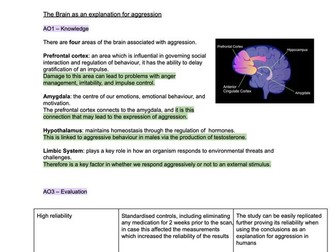
The Brain as an explanation for aggression
Effect of recreational drugs on synaptic transmission
Synaptic Transmission
Scanning Techniques
Studies include:
Brendgen (TWIN STUDY)
Heston (ADOPTION STUDY)
Raine et al.
Other studies are also mentioned for AO3
To request lessons, provide feedback or if you have had any issues opening any resources of my resources, please feel free to contact me on jb_resources@outlook.com (responses are usually very prompt).
Key content included:
Key Questions
The Genetic Basis of Schizophrenia
Family Studies
Gottesman’s Research (1991)
Candidate Genes (Ripke et al., 2014)
The Dopamine Hypothesis
Hyperdopaminergia in the Subcortex
Hypodopaminergia in the Subcortex
Summarising The Dopamine Hypothesis
Neural Correlates of Negative Symptoms
Neural Correlates of Positive Symptoms
Evaluation worksheet
Evaluation points
Exam Practice: Essay Question with Mark Scheme
Plenary: Consolidation Question
This lesson was created using the latest AQA A-Level Specification (published June 2019) although content and activities may be useful for other specifications.
Key content covered in this Lesson:
Key Questions
How to Compare Approaches
Activity: Comparison Summary Table
Comparing the Biological Approach to the Behaviorist Approach
Model Comparison Paragraph
Exam practice: Comparison Essays
Comparing the Cognitive Approach to the Psychodynamic Approach
Structuring Comparison Essays
Exam practice with Mark Scheme: Comparison Essay
Mark scheme
Model Comparison Paragraph
Plenary: Consolidation Question
To request lessons, provide feedback or if you have had any issues opening any resources of my resources, please feel free to contact jb_resources@outlook.com.
Reviews and feedback are always welcome.
This bundle was created using the latest AQA A-Level Specification (published June 2019) although content and activities may be useful for other specifications.
This bundle includes a complete lesson and activities for the A-Level Psychopathology Topic.
The 10 lessons included in this bundle are:
Definitions of Abnormality
Characteristics of Phobias
The Behavioural Approach to Explaining Phobias
The Behavioural Approach to Treating Phobias
Characteristics of Depression
The Cognitive Approach to Explaining Depression
The Cognitive Approach to Treating Depression
Characteristics of OCD
The Biological Approach to Explaining OCD
The Biological Approach to Treating OCD
Please see individual lessons for further details of the content included.
A comprehensive revision guide covering all aspects of the Biological Psychology A Level unit, suitable for the Edexcel A Level Psychology 2015 specification.
Contemporary study included: Brendgen.
Revision guides are also available for Cognitive, Social, Learning, Clinical and Criminal units.
Former A Level student: “I am so grateful for the hours and hours that you put into making those revision guides, because they were the most helpful thing to use, and you should sell them because they are far better than any textbook I have bought!”
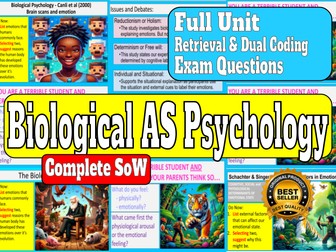
Biological AS Psychology
Leave a review for a FREE single resource
Biological AS Psychology Unit Bundle:
https://www.tes.com/teaching-resource/biological-as-psychology-13123475
Biological AS Psychology. These resources have been meticulously crafted, offering a differentiated and engaging approach that enables efficient progression through content.
Built to the highest standards and grounded in current research, the unit incorporates dual coding and retrieval practices at its core. A consistent color scheme is also utilized to enhance both your delivery and students’ comprehension.
Biological AS Psychology:
The Biological Approach Introduction
Canli et al 2000 CIE
Dement Kleitman Sleep Dreams CIE
Schachter Singer CIE
By leaving a review of any of our resources, you can claim a FREE single resource from our ever-expanding library. Just send a message to the email above, which is checked daily.
upsidelearning1@gmail.com
Best FREE Resources (Upside Learning)
FREE - Computer Safety - https://www.tes.com/teaching-resource/-13121810
FREE - Coraline Neil Gaiman (Lesson 1) - https://www.tes.com/teaching-resource/resource-13108829
FREE - Gothic Literature (Lesson 1) - https://www.tes.com/teaching-resource/-13109342
FREE - Physics IGCSE (Lesson 1) - https://www.tes.com/teaching-resource/-13118154
Biological AS Psychology
Full topic covering the following lessons
1: Symptoms and features of depression
2: Issues and debates - nature vs nurture
3: Cognitive theory of depression
4: Genetic explanation of addiction
5: Genetic explanation of depression
6: Learning theories of addiction
7: Treatments of addiction
8: Treatments of depression
9: symptoms and features of depression
10: Young et al study
11: Caspi et al study
This idea and the accompanying resources are designed to engage young people in discussion about the brain, how it controls behaviour and whether we are always fully responsible for our actions, using podcasts as a stimulus
This is a whole-class activity involving group work, self-directed learning and practical applications.
AS level psychology - Approaches AQA spec
Introduction and biological approach. Please let me know what you think!
Ive converted the smart board file to powerpoint, but it doesn't look at good. Hope this is useful for those without notebook software!
This is a brief and general introduction to the biological approach to psychology. It is intended to be used when teaching the Cambridge AS Psychology syllabus, but has the potential for wider usage.


![A-Level Psychology - THE BIOLOGICAL APPROACH [Approaches in Psychology]](https://l.imgt.es/resource-preview-imgs/02a1d726-dcc4-4288-8a8f-edb7cb6f3c69%2Fl5app.png?profile=res-img-med-legacy-v2) Quick View
Quick View![A-Level Psychology - THE BIOLOGICAL APPROACH TO EXPLAINING OCD [Psychopathology Topic]](https://l.imgt.es/resource-preview-imgs/8fd7f8c1-d83c-4593-8193-5e233904debb%2FScreenshot20240322131524.crop_975x731_1%2C0.preview.png?profile=res-img-med-legacy-v2)
![A-Level Psychology - THE BIOLOGICAL APPROACH TO TREATING OCD [Psychopathology Topic]](https://l.imgt.es/resource-preview-imgs/c454c40d-475c-4f2c-8722-d866cfef5e14%2Fl10.crop_979x735_2%2C0.preview.png?profile=res-img-med-legacy-v2)

![A-Level Psychology - ORIGINS OF PSYCHOLOGY [Approaches in Psychology]](https://l.imgt.es/resource-preview-imgs/9c0beec9-dfe0-4396-9025-72f130724268%2Fl1approach.crop_958x718_0%2C1.preview.png?profile=res-img-med-legacy-v2)
![A-LEVEL PSYCHOLOGY - APPROACHES IN PSYCHOLOGY [COMPLETE TOPIC - Includes Slides and Worksheets]](https://l.imgt.es/resource-preview-imgs/08280360-b8cd-4818-9dd2-7878a524650f%2FScreenshot20240401152139.crop_984x738_2%2C0.preview.png?profile=res-img-med-legacy-v2)

![A-Level Psychology - COMPARISON OF APPROACHES: ESSAY PLANNING LESSON [Approaches in Psychology]](https://l.imgt.es/resource-preview-imgs/0f226226-185a-4000-8180-135571335ed1%2FScreenshot20240401150644.crop_975x731_0%2C0.preview.png?profile=res-img-med-legacy-v2)
![A-LEVEL PSYCHOLOGY - PSYCHOPATHOLOGY TOPIC [COMPLETE TOPIC]](https://l.imgt.es/resource-preview-imgs/2a05ac6e-0aa1-4891-ba1f-c7c258e6c8d2%2FScreenshot20240324142421.crop_962x722_0%2C0.preview.png?profile=res-img-med-legacy-v2)