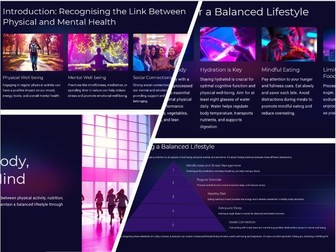
1x Assembly from the Empowering Minds Bundle. Great as an assembly on it’s own or as part of the series. Why not buy the bundle to have all 10 sessions. Ready to use straight away or customizable to your school context.
"Healthy Body, Healthy Mind: The Importance of Physical and Mental Wellness"
Learning Outcomes:
• Recognise the link between physical activity, nutrition, and mental health.
• Learn simple ways to maintain a balanced lifestyle through healthy habits.
• Understand how sleep, exercise, and mindful practices contribute to overall well-being.
Could be used for an assembly for 11-18 year olds or as a tutor time session or even as a support resource.
Empowering Minds Series:
Bouncing Back: The Power of Resilience
The Growth Mindset: Unlocking Your Potential
Building Bridges: The Importance of Positive relationships
Healthy Body, Healthy Mind: The importance of Physical and Mental Wellness
The Power of Gratitude: Finding Positivity in every day
Digitial Well-being: Thriving in an Online World
Fail Forward: Embracing Failure as Part of Success
The Power of Kindness: Creating a culture of care
Finding balance: Managing stress and academic pressure
Setting Goals: Mapping your Path to success
This resource includes a complete unit of work for the Soul, Mind and Body unit of the OCR A-level Religious Studies, though could be adapted for other exam boards. Included are a whole unit of PowerPoint slides covering the whole spec, a workbook which matches the slides, a revision activity of a unit overview map, two exemplar essays and a set of links to further resources/revision notes.
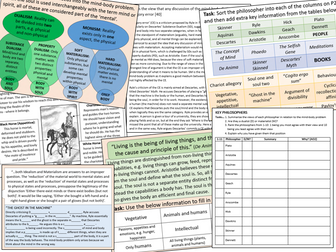
Covered in this unit of work are Plato and Aristotle’s beliefs on the soul, including discussion of whether the soul is immortal; an introduction to the mind body problem, e.g. the Ship of Theseus; Descartes’ substance dualism; property dualism; hard materialists, such as Skinner and Dawkins, with criticism from Dennett; soft materialism, including Hick; and Ryle’s category error.
A complete unit of work all ready to go!
Hope you enjoy and happy teaching :)
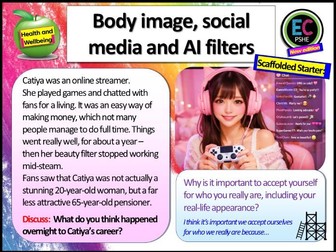
Brand new for 2026 - how are AI filters and social media affecting our body image? In this lesson students delve into ‘filter dysmorphia’ - a new but growing phenomenon affecting the mental health of teens.
Students will investigate how filters are creating completely unrealistic beauty standards - and how with the help of AI, almost undetectable filters are being applied not just to images, but to the videos of influencers and peer social media users too. Students will discover what is behind ‘Instagram Face’, why everyone is starting to look the same as each other in their uploads and the effect this is having on social media users. They will also discover useful and practical ways to relieve any negative thoughts or dysmorphia and the real message of the lesson - the importance of being authentic.
Includes clip tasks, spot the filter edits tasks, literacy tasks and much more.
All editable, will last one hour, suitable for new 2026 RSHE guidelines.
We are confident you’ll be pleased with this resource – however, if you have any issues at all, contact us at info@ecpublishing.co.uk and we’ll help you straight away. If you try to contact us through Tes we may not for be alerted for days so may not be able to help you on time.
Who are EC Resources?
EC Resources are the top TES PSHE providers and are a group of teachers who work together to create easy to use, high quality and editable lessons and units of work. We have created lessons for The Children’s Commissioner, The Bank of England, The British Legion, MACS Charity, Tes, LikeToBe Careers, the Criminal Cases Review Commission (UK Gov) and have also completed PSHE and Citizenship commissions for schools across the UK.
Please visit our Tes store https://www.tes.com/teaching-resources/shop/EC_Resources for everything PSHE, RSE, RE and Citizenship.
email info@ecpublishing.co.uk
Teaching PSHE, RE or Citizenship GCSE next year? Why not join our Citizenship and PSHE teachers Facebook group, with 12,000 other teachers, for guidance, advice and resource sharing.
84 Slides for DP Philosophy Core Theme: Being Human, focusing on the key concept of Mind and Body, but could be useful for A level metaphysics too.
Includes classical arguments for Dualism from Descartes and Plato, challenges from monists, including contemporary physicalists, ancient views of mind and body from Greece and India, and a consideration of mind and body fit into Abrahamic belief systems.
Approximately 15-18 hours worth of materials and activities.
Healthy body/ Healthy mind/ Diet/ Sleep/ Exercise/ Limiting stress/ Whole school/ Assembly ideas/ Secondary/ Primary
This 10 -15 minute assembly looks at the Science behind some well known theories and offers practical advise to ensure they can be as healthy as possible and the major benefits of this.
It also looks at the link between the body and mind and why both need and deserve to be in top condition.
The pack contains:
Full powerpoint
A ‘how to use’ word document with synopsis, help with delivery and customisation ideas.
Thanks for looking
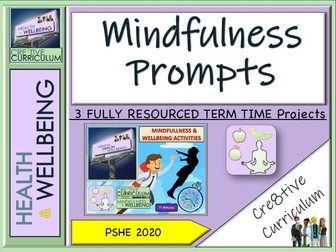
Mindfulness and Wellbeing PowerPoint full of mini activities for students to complete / Think about and pause for Reflection. Product Code: RSE/C8/TL/14
1 x 30 slide editable Mindfulness PowerPoint with the prompts to show on the big screen
1 x set of Mindfulness Prompt cards that can be printed and laminated
1 x Set of Blank Tickets for students to come up with their own activities or Questions
And we have included our set of FREE positive wellbeing posters.
Part of out Cre8tive Curriculum Core Theme ‘Mental Health and Wellbeing’
Our Philosophy
We aim to help you equip students with the knowledge and skills to take ownership of their own learning. our PSHE 2020 Products come ‘Ready-to-Teach’ with everything you need to teach fun and creative lessons. Our products are teacher-designed, classroom tested & student approved.
Cre8tive Curriculum resources are suitable for both KS2 Primary students & secondary school students and are mapped to both PSHE Association guidelines & DfE Statutory Guidelines for Relationship and RSE , Physical Health and Wellbeing. (Linking to: RSE, Living in the Wider World and Health and Wellbeing)
Check out some more of our most popular resources:
☞ MISOGYNY ANDREW TATE + TOXIC MASCULINITY UNIT
☞ Masculinity + Misogyny Explored (Ks4)
☞ Boys to men - Masculinity (Ks3)
☞ What is Toxic Masculinity? (Ks3)
☞ Incels Extremism Misogyny (Ks4) (Ks5)
☞ Sexism in society (Ks4) (Ks3)
☞ What is Feminism? (Ks4) (Ks3)
☞ Sexual Harassment (Ks4)
About This Resource
This comprehensive, ready-to-teach scheme of work uses Banksy’s iconic street and protest art as a rich, culturally relevant springboard for deep literary and visual analysis. Designed with the IB Language & Literature course in mind, it is equally well suited to any A-Level, GCSE, or high school English or Art & Culture unit that demands critical thinking, analytical writing, and creative response.
Across 13 carefully sequenced lessons, students move from first impressions and biographical context through to essay planning, scholarly research practice, and a hands-on stencil-making creative project. Every lesson is discussion-rich, written-task-heavy, and built around Banksy’s most thought-provoking works — making abstract analytical skills feel urgent, exciting, and genuinely relevant to students’ lives.
What’s Included in This Presentation (44 Slides)
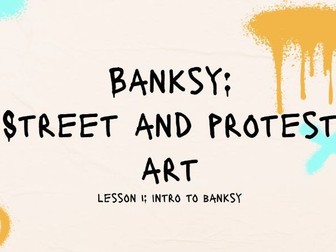
• Lesson 1 �� Introduction to Banksy: Starter discussion prompts on graffiti vs. vandalism; analysis of Banksy’s famous quotation; BBC documentary clip integration
• Lesson 2 – IB Fields of Inquiry: Mapping Banksy’s work onto the five IB fields (culture/identity/community; beliefs/values/education; politics/power/justice; science/technology/environment; art/creativity/imagination)
• Lesson 3 – Culture, Identity & Community I: Visual analysis of key artworks using a structured analysis table; paired discussion activity on location, juxtaposition, and visual hierarchy
• Lesson 4 – Culture, Identity & Community II: Guided questions on cultural symbols, identity, and community; 200–300 word analytical paragraph task
• Lessons 5 & 6 – Essay Plan Practice: Image-based prompt on environmentalism, violence, and loss of innocence; scaffolded essay planning
• Lessons 7 & 8 – Beliefs, Values & Education: Analysis of Banksy’s museum interventions; intertextual link to the ‘Napalm Girl’ photograph; exploration of irony, humour, and the role of the viewer
• Lesson 9 – Politics, Power & Justice: Comparative analysis task; analytical paragraph writing using juxtaposition, irony, symbolism, and subversion; Bethlehem wall mural discussed in geopolitical context
• Lesson 10 – Art, Creativity & the Imagination: Comparative activity with Andy Warhol’s Campbell’s Soup Cans; multi-perspective response task (art critic, child, 1960s housewife, IB student)
• Lessons 11 & 12 – Scholarly Research Practice: Extended Essay preparation; research skills and academic source use
• Lesson 13 – Essay Practice: Social critique analysis using Banksy’s Bethlehem wall piece
• Homage to Banksy – Creative Project: stencil-making activity for students to create their own protest art. Includes samples of student work.
Objective: Students will understand the effects of alcohol on the brain and
body, including short-term and long-term impacts.
Includes an outline of the body worksheet
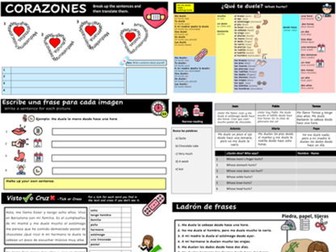
This resource is to practice body parts and pains. It has different Conti style activities IT IS EDITABLE:
Vocabulary
What is missing? Game
match the word with the picture
Sentence builder
Listen and tick the word I say
Beat the teacher
Sentence stealer
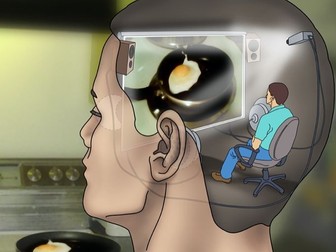
Read my mind
Faulty echo
Sentence bingo
Break the flow
Tick or cross
Narrow reading
Write sentences following the pictures
Trapdoor
Find the treasure (speaking game)
Stars and stealers (game)
Sentence race (mini whiteboard game)
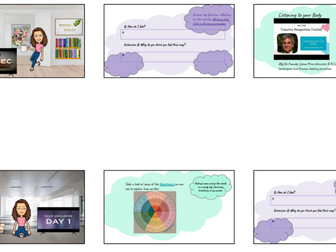
Mindfulness lesson: MyLife Founder Jaime Price discusses R.A.I.N techniques and trauma healing practices, including electronic resources, questions, reflections & a guided meditation.
This activity works best through Google slides/classroom. When uploading in Google Classroom I recommend you select ‘copy for each student’ so they can directly edit the presentation. :) Hyperlinks do not work in Microsoft powepoint. - you must link yourself sorry!
Can be used in microsoft.
Like all my Mindfulness lessons - Perfect for WFH!!!
Created in Google Slides - convert back for optimum use (Font = caveat) otherwise alter text size.
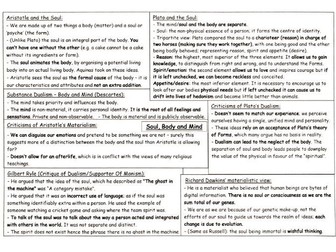
A Level revision and overview for the mind, body and soul topic. Main focus is on Plato and Aristotle, but includes many other scholar's views. Can be used for revision for students, or as handouts for a summary of the topic. Really helps with essay planning. Concise but extremely useful.
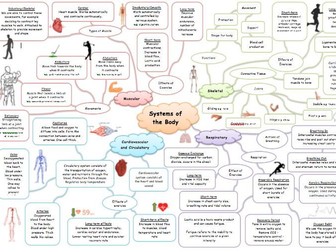
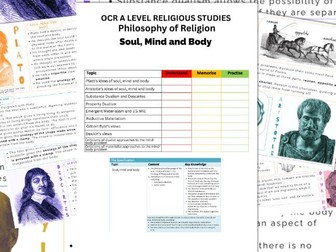
All the content for Soul, Body and Mind summarised into one A4 page! Some of the information overlaps on the thumbnail but all you have to do is click the “enable content” button once you open the word document and that rectifies the problem.
Transform your teaching of the Mind, Soul & Body topic with a complete, high-quality set of lessons designed specifically for the OCR A-Level Philosophy of Religion specification. This resource pack provides everything needed to deliver the topic confidently, creatively and with academic depth.
What’s Included:
Fully-resourced lessons covering:
• Plato’s substance dualism
• Aristotle’s hylomorphism
• Descartes’ substance dualism
• Ryle’s behaviourism
• Dawkins’ materialism
• Plus a wide range of scholarly perspectives, key debates and evaluative angles
Clear explanations + teacher notes
Complex ideas are broken down clearly without losing philosophical rigour. Each lesson includes guided teacher summaries, stimulus material and carefully selected scholarly quotations.
Exam-focused support
Activities structured around retrival, AO1/AO2 skills, essay planning guidance, practice questions and model paragraph structures to build strong evaluation and critical writing skills.
End of unit Great Debate
A dynamic and interactive whole-class debate on Materialism vs Dualism with assigned roles, evidence packs and challenge questions. Ideal for consolidating learning and preparing students for extended essays.
Why teachers love this resource:
• Saves hours of planning
• Encourages high-level philosophical thinking
• Builds confidence in understanding complex theories
• Helps students secure top-level AO2 evaluation marks
• Ready to use immediately or adaptable for personalised delivery
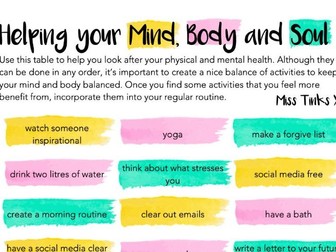
Use this resource to help you look after your physical and mental health. Although they can be done in any order, it’s important to create a nice balance of activities to keep your mind and body balanced. Once you find some activities that you feel more benefit from, incorporate them into your regular routine.
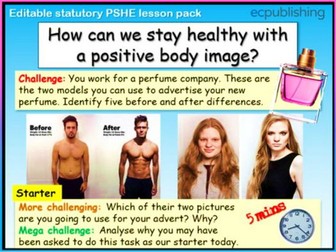
3 LESSONS PSHE body image / self -esteem lessons - (introduction lesson observed as outstanding). 3 full lessons: Includes:
3x 1 hour PowerPoints, worksheets, clips, well differentiated, KS3/ KS4. These resources have been designed to be engaging, detailed and easy to follow. All our PSHE and Citizenship resources are editable (so easy to adapt for your classes) and are designed to last one hour each. Includes lessons on: body image and the media, eating disorders and media pressure and male body image.
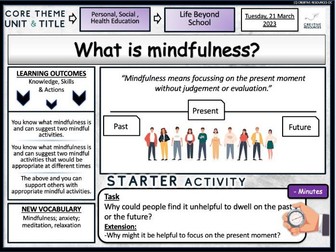
What is mindfulness? Practicing Mindfulness techniques in class. A fully-resourced lesson (1 hour +) which can be used by teachers to deliver a detailed PSHE / Citizenship / KS4 Personal Development lesson
Learning Outcomes:
You know what mindfulness is and can suggest two mindful activities.
You know what mindfulness is and can suggest two mindful activities that would be appropriate at different times
The above and you can support others with appropriate mindful activities
Key terms
Mindfulness; anxiety; meditation, relaxation
Each Lesson Pack Contains:
1 Fully Editable Careers PowerPoint (Learning Outcomes, Confidence Checkers, Assessment of Learning, Variety of Tasks, Video Embedded URL Clips, Engaging Premium Quality Slides, Extra Support Websites, Challenging & Thoughtful Questioning) Assessment Opportunity (Confidence Checker)
The lesson includes a detailed PowerPoint, variety of student facing tasks and comprehension tasks These resources have been designed to be engaging, informative and pick up and teach.
Why not check out some of our latest PSHE super bundles below:
Personal Finance as a young adult
Online Safety + Staying Safe
Y12 Survival Kit - Personal Safety
Y11 Survival Kit - Revision + Exam Stress
British Values Explored Bundle
PSHE - Debating Topical Issues
Society, Body Image + Peer Pressure
Finance Risk + Online Safety
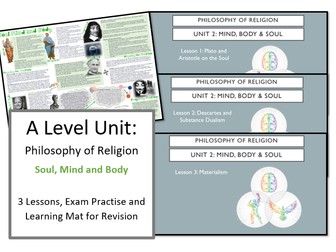
This is a unit of 3 two-hour lessons for the OCR unit on Philosophy of Religion: Soul, Mind and Body. Lessons cover a variety of tasks, activities and learner styles, geared towards the final exam. Also included is the A3 and A4 Learning Mats / Revision Mat for this topic.
Lessons are:
Plato and Aristotle on Soul
Descartes’ Substance Dualism
Materialism
Learning Mat on Soul, Mind and Body
Each lesson also includes assessment of the arguments proposed and an essay-style question for discussion and development.
Free 30-page workbook with this unit!
Please give feedback! I am always happy to respond to comments - whether positive or constructive - this will help to improve the quality of my resources in the future and, more importantly, the quality of students’ Philosophy education in general - which is what we’re all here for!
This resource contains OCR A LEVEL RS revision notes, revision checklist, OCR specification and possible questions for SOUL MIND AND BODY.
Using tutoring experience after having sat this exam myself, I have personally created these notes. These notes are presented in an easy-to-use format. Colour coding, diagrams and a simple layout makes learning easy. I’ve seen first-hand the results they can achieve. I’m confident that they will be an invaluable resource to you.
If you are a student aiming to revise and review crucial topics, this resource is tailored to you!
This paper is designed for the OCR specification, therefore both the topics and the question format are identical to those you have studied or seen before.
TOPICS INCLUDED (Soul mind and body):
Plato’s views on Soul mind and body
Aristotle’s views on Soul mind and body
Descartes and substance dualism
Property dualism
Reductive materialism
J.S. Mill and Emergent Materialism
Gilbert ryle views on soul mind and body
Dawkins views on soul mind and body


 Quick View