Eduqas GCSE Music - AoS 1 - Musical Forms and Devices [Part I] - SIX LESSONS*Quick View
NPTJ

Eduqas GCSE Music - AoS 1 - Musical Forms and Devices [Part I] - SIX LESSONS*

(1)
AoS 1: Musical Forms and Devices – PART 1 BINARY, TERNARY, RONDO - SIX LESSONS* This is a 50-page PPT, as an Intro to Baroque, Classical and Romantic Music, covering Binary, Ternary and Rondo form in detail. Instead of trying to work chronologically, which always ends up being skewed towards earlier music, there are seven examples taken from across the centuries, to explain Binary, Ternary and Rondo. Musical examples from Purcell, Handel, JS Bach, Mozart, Brahms, R. Schumann, and Tchaikovsky. There are also three COMPOSING TASKS to put students’ understanding into practice. The bundle ALSO includes Sibelius and XML files for three of the pieces, to allow classroom performance. There is a focus on the Eduqas Appendix C, to cover lots of the terms there, with the rest to be covered in Part 2, soon! There are three mini-tests throughout the course, each worth 12-marks, and split into three groups of four, of increasing difficulty, so something for everyone. The resource comes as a 50-page PowerPoint, and an accompanying 16-page student workbook (PDF). *It is estimated that the course will take approx. six lessons, but of course this depends on how long schools’ lessons are, the prior experience of the students, and other factors. Please look at my TES shop for other resources. Thank you.
Eduqas GCSE Music - AoS 1 - Musical Forms and Devices [Part II] - SIX LESSONS*Quick View
NPTJ

Eduqas GCSE Music - AoS 1 - Musical Forms and Devices [Part II] - SIX LESSONS*

(0)
AoS 1: Musical Forms and Devices – PART 2 THEME & VARIATIONS, ALBERTI BASS, OSTINATO, DESCANT, ROUNDS, CANONS, TREMOLO, DIVISI, DRONE, MUTED* This is a 99-page PPT, following on from AoS1 Part 1, covering: Theme & Variations Alberti Bass Ostinato Descant Rounds Canons Drones Plus performance techniques, such as tremolo, divisi, falsetto, pizzicato, accents, sustained notes, and mutes And textures such as layered, imitation and countermelody Instead of trying to work chronologically, which always ends up being skewed towards earlier music, there are eleven examples, plus supporting pieces, taken from across the Baroque, Classical and Romantic eras. Musical examples from the likes of Elgar, Mozart, Purcell, Wagner, Mendelssohn, Vaughan Williams and Mahler, with supporting pieces by Schubert, Tchaikovsky… and Chuck Berry :) There are also three COMPOSING TASKS to put students’ understanding into practice. There is a focus on the Eduqas Appendix C, to cover lots of the terms there, with the rest to be covered in Part 1! There are eleven mini-tests throughout the course, each worth 12-marks, and split into three groups of four. The resource comes as a 99-page PowerPoint, and an accompanying 36-page student workbook (PDF), with YouTube links. The price reflects that this will last half a term’s lessons. *It is estimated that the course will take approx. six lessons, but of course this depends on how long schools’ lessons are, the prior experience of the students, and other factors. Please look at my TES shop for other resources. Thank you.
Baroque Music - Western Classical Music Eras - Music History and StylesQuick View
TheMusicEspionage

Baroque Music - Western Classical Music Eras - Music History and Styles

(0)
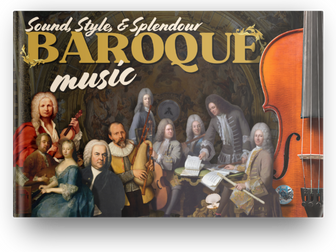
Baroque Music – Western Classical Music Eras: Music History and Styles is a comprehensive and engaging teaching resource designed to help music teachers effectively cover all the key elements of the Baroque period and its role in the development of Western classical music. Perfect for secondary music education or introductory college-level courses, this resource explores the historical, cultural, and musical innovations that shaped the Baroque era, including the rise of opera, the birth of the orchestra, and the development of new forms such as the concerto, fugue, and oratorio. With a clear and structured approach, it provides students with valuable insight into one of the most influential and expressive periods of music history. The resource includes a fully editable and visually engaging 95+ slide presentation, broken into six clear, curriculum-aligned chapters: Introduction to the Baroque Period Monody, the Birth of the Opera and Other Vocal Styles Instrumental Music and Other Styles of Baroque Typical Instruments and Orchestration Listening Habits of Baroque Composers and other Important People! Top Ten Characteristics of Baroque Music Each slide is filled with embedded YouTube videos and music examples to enhance learning and keep students engaged. To support and reinforce learning, the resource also includes five fun and informative worksheets. This guides students through researching Baroque composers, musical forms and key vocabulary, and finish with an interactive composition activity using a digital audio workstation (DAW). To support teachers, a detailed answer sheet is also provided, helping to guide class discussion, structure marking, and save valuable planning time.
Classical Music - Western Classical Music Eras - Music History and StylesQuick View
TheMusicEspionage

Classical Music - Western Classical Music Eras - Music History and Styles

(0)
Classical Music – Western Classical Music Eras: Music History and Styles is a clear and engaging teaching resource designed to support music educators in exploring the Classical period and its lasting influence on Western classical music. Ideal for secondary and introductory college-level study, this resource examines the historical, cultural, and musical developments of the era, featuring composers such as Haydn, Mozart, and Beethoven. It explores the growing importance of the orchestra, key instruments of the period, and the rise of the pianoforte, which transformed musical expression. Students will learn about defining styles including the Galant style and Empfindsamer Stil, alongside major instrumental forms such as the symphony, sonata form, and concerto, including cadenzas and the use of Alberti bass. Through a structured and accessible approach, this resource offers valuable insight into one of music history’s most balanced, expressive, and influential periods. The resource includes a fully editable and visually engaging 120+ slide presentation, broken into six clear, curriculum-aligned chapters: Introduction to the Classical Period Classical and the change from Baroque Operatic music in the Classical Period Instrumental music and Styles Typical Instruments and Orchestration Classical Listening Habits Classical Composers Top Ten Characteristics of Classical Music Each slide is filled with embedded YouTube videos and music examples to enhance learning and keep students engaged. To support and reinforce learning, the resource also includes five fun and informative worksheets. This guides students through researching Baroque composers, musical forms and key vocabulary, and finish with an interactive composition activity using a digital audio workstation (DAW). To support teachers, a detailed answer sheet is also provided, helping to guide class discussion, structure marking, and save valuable planning time.
Renaissance Music - Western Classical Music Eras - Music History and StylesQuick View
TheMusicEspionage

Renaissance Music - Western Classical Music Eras - Music History and Styles

(0)
Renaissance Music – Western Classical Music Eras: Music History and Styles is a comprehensive and engaging teaching resource designed to help music teachers effectively cover all the key elements of the Renaissance period and its role in the development of Western classical music. Perfect for secondary music education or introductory college-level courses, this resource explores the historical, cultural, and musical shifts that defined the Renaissance, providing a clear and structured approach to teaching this rich era of music history. The resource includes a fully editable and visually engaging 80+ slide presentation, broken into six clear, curriculum-aligned chapters: Introduction to the Renaissance Period Musical Characteristics of Renaissance Music Instruments and Orchestration Printed Sheet Music and the Printing Press Renaissance Composers and Key Examples Top Ten Characteristics of Renaissance Music Each slide is filled with embedded YouTube videos and music examples to enhance learning and keep students engaged. To support and reinforce learning, the resource also includes five fun and informative worksheets. These guide students through researching Renaissance composers, musical forms, the printing press, and key vocabulary, and finish with an interactive composition activity using a digital audio workstation (DAW). To support teachers, a detailed answer sheet is also provided, helping to guide class discussion, structure marking, and save valuable planning time.
Eduqas GCSE Music - POP MUSIC (AoS4: Popular Music) - PPT and WorkbookQuick View
NPTJ

Eduqas GCSE Music - POP MUSIC (AoS4: Popular Music) - PPT and Workbook

(1)
EDUQAS GCSE MUSIC – POP MUSIC (AoS4) A PowerPoint and accompanying Student Workbook, designed to take students through the genre of Pop Music, all within the context of listening practice, and exam-style questioning. This is Lesson 1 of a series, exploring all the Eduqas-prescribed genres of Popular music, and as such, the listening exercises are between 3 and 5 marks. This helps teachers who are less-familiar with the style, and are uncertain of which examples to use. Listening exercises on songs by: Cee-Lo Green Paloma Faith Beverley Knight PPT and Workbook both have ad-free YouTube links, with timings. Please see my TES shop for other PPTs and Workbooks in the Popular Music series, coving all prescribed styles for the Eduqas GCSE Music. Slightly updated version added on 05.11.24
GCSE Music - Year 10 - Musical ElementsQuick View
NPTJ

GCSE Music - Year 10 - Musical Elements

(5)
GCSE MUSIC – KEY MUSICAL ELEMENTS This 36-page PPT is a great way to kick off the GCSE course, providing an accessible introduction to (or refresher of!) key musical elements: Pulse Metre (including regular and irregular) Rhythm (including syncopation, off-beat rhythms, dotted rhythms and triplets) Chords (including triads and inversions) Melody-writing Basic arranging for ensemble It is expected that most students will have encountered many of these at Key Stage 3, and so whilst this PPT can act as an introduction with clear explanations, it can also act as a useful refresher, with the exercises very much aimed at Key Stage 4. Students will need access to keyboard or guitars, and notation software or manuscript paper. Update (19.09.24): I have added answers to the PPT, so that it could be used by a non-specialist teacher, or even set as cover / homework. Please have a look at my other GCSE Music resources. Thank you!
Eduqas GCSE Music - ROCK MUSIC (AoS4: Popular Music) - PPT and WorkbookQuick View
NPTJ

Eduqas GCSE Music - ROCK MUSIC (AoS4: Popular Music) - PPT and Workbook

(1)
EDUQAS GCSE MUSIC - ROCK MUSIC (AoS4) A PowerPoint and accompanying Student Workbook, designed to take students through the genre of Rock Music, all within the context of listening practice, and exam-style questioning. Plus, an explanation of falsetto, with a listening exercise, within the world of Pop/Rock. This helps teachers who are less-familiar with the style, and are uncertain of which examples to use. Listening exercises on songs by: Rainbow Girlschool Lenny Kravitz AC/DC Bon Jovi PPT and Workbook both have YouTube links (updated October 2023), with timings. This is Lesson 2 of a series, exploring all the Eduqas-prescribed genres of Popular music.
Music Cover Work: Film MusicQuick View
megrose99

Music Cover Work: Film Music

(1)
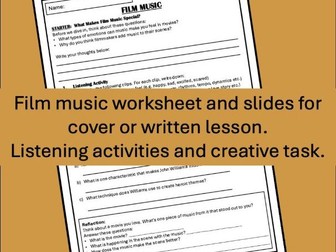
Double sided worksheet and teacher slides for a music cover lesson on film music. Suitable for both Key Stage 3 and Key Stage 4. The lesson includes six short activities: a starter, listening task, composition task (without instruments), a film technique question, reading activity and reflection. The lesson has been designed to be delivered without instruments or computers, though the lesson is easily adaptable to include a practical element should you wish. Prior teaching on the elements of music is recommended. This is the perfect music lesson for a written music lesson or cover lesson with a non-specialist. Please note: This resource includes both printable materials and audio files (MP3 format). Enjoyed this resource? Your feedback helps to improve and create new materials. Thank you for taking the time to leave a review! Discover more cover work topics at: https://www.tes.com/teaching-resources/shop/megrose99
Eduqas GCSE Music – 20 Quick Questions – AoS1 Musical Forms and Devices – Practice Paper / Mock ExamQuick View
NPTJ

Eduqas GCSE Music – 20 Quick Questions – AoS1 Musical Forms and Devices – Practice Paper / Mock Exam

(0)
AN END-OF-UNIT PRACTICE PAPER, COMPRESSED INTO ONE LESSON A quick (53’) exam-practice sample assessment containing 20 separate pieces of music, that can be done within one (60’) lesson. This paper focuses on Area of Study 1: Musical Forms and Devices, and includes essays, dictation and comparisons. 20 separate extracts of music covering all topics within Area of Study 1 5 Questions on JS Bach’s Badinerie 5 Questions on Baroque Music 5 Questions on Classical Music 5 Questions on Romantic Music Questions include: 3 Dictation questions 3 Comparison questions 3 Essay questions (1 x Baroque, 1 x Classical, 1 x Romantic) Each question is worth five marks, rather than the usual 12, and contains shorter extracts, each played twice. This is perfect as an end-of-unit assessment, to give students practice at exam questions, but testing them on just one Area of Study. This TES bundle includes: PDF of all 20 Questions and Mark Scheme PDF of just the 20 Questions (in case you need to set these remotely) PDF of just the Mark Scheme (ditto) Information about accessing the audio Extracts include music by Haydn, Fauré, Vivaldi, Berlioz, Stamitz, Dvorak and Ditters von Dittersdorf. This would also work well for Year 10s, as an introduction to exam-style questioning. A full, free, audio file is available from the author. Please have a look at my other GCSE Music resources. Thank you!
MUSIC GENRES CALENDAR 2025-26Quick View
wats_ed_consultancy

MUSIC GENRES CALENDAR 2025-26

(0)
This is the 4th Year of the calendar and still at its simplest level the purpose of this calendar is to offer a wide-ranging selection of music: different styles, genres, origins, artists, historical periods and so on. As part of an interesting and robust music curriculum, children need to hear and experience music and musical styles and artists that they may not otherwise have the opportunity to hear. The idea was to create a calendar of a song a day. 190 school days… 190 songs. (+2 for those with different school schudeules) These songs could be used in whatever way the user thinks best – on entry to the classroom in the morning, as assembly music, as a calming session after breaktimes of lunchtimes, or as an introduction to a music lesson. This resource includes this year’s calendar ONLY. Full week-to-View Calendar YouTube Playlist of all songs This year I am asking a fee of £3.50, for a complete resource that will last you all year. I am proud of the product and feel that for the extensive hours spent creating it £3.50 is well worth it!
GCSE Music – Revision – Musical Styles – Tonality – Tempo – Rhythm – DynamicsQuick View
NPTJ

GCSE Music – Revision – Musical Styles – Tonality – Tempo – Rhythm – Dynamics

(1)
Musical Styles – Tonality – Tempo – Rhythm – Dynamics The GCSE Music Specification includes many terms that students need to know, and be able to identify, but which aren’t covered by many of the styles of music studied. Many students struggle with recognising musical elements on a printed score, so this resource comprises 20 short extracts of music, 17 of which have skeleton scores, as in the exam. Each extract has four questions attached, covering the terms associated with: Musical Styles Tonality Tempo Rhythm Dynamics The extracts cover a wide range of music, featuring music from the likes of Abba, Count Basie, Anthrax, Tupac, Berlioz, Whitney Houston, Al Green, JS Bach, Pluto Shervington, Sting, and Dame Judi Dench! The resource comes with a link to FREE audio, running for 37’, either as one file or 20 separate files: perfect for a revision lesson, or as homework. The bundle includes the full paper and mark scheme, plus the PDF question paper and mark scheme separately, in case you want to set it remotely. Please have a look at my shop for a wide variety of resources to support the GCSE Music course. www.tes.com/teaching-resources/shop/NPTJ
ABRSM Aural Tests - Musical Styles and PeriodsQuick View
c_holdich

ABRSM Aural Tests - Musical Styles and Periods

(1)
This sheet is to be used alongside the Aural Help sheet for Grades 5, 6, 7 and 8. It provides a useful chart showing the features of each style and period, as well as suggested composers, as is required in the aural part of an ABRSM music examination. It would also be useful for use in the music classroom, in particular those studying for GCSE, As Level and A Level music.
2024 Music Summer QuizQuick View
MissScates

2024 Music Summer Quiz

(6)
AMMENDMENT PICTURE ROUND Q2 ANSWER SHOULD BE **BEYONCE ** Music Summer Quiz Includes PPT Audio files Answer Sheet Round 1 - Intros Round 2 - Songs Turning 10 Round 3 - Classical Covers Round 4 - 4 Pics 1 Singer Round 5 - Reverse Round 6 - Film Round 7 - Football Round 8 - Finish The Lyrics Round 9 - Decades Round 10 - Rock Covers Round 11 - Disney Round 12 - 2024 Hits
Music Christmas Quiz 2025Quick View
MissScates

Music Christmas Quiz 2025

(4)
A super fun, well presented, teacher-lead music quiz with 8 rounds (to fill an hour lesson). Answer sheet is included, as well as the PowerPoint presentation and a link to the GoogleDrive. Rounds include: Santa Speedrun Christmas Covers Seasonal Selfies 8-Bit Blizzard Snowy Scenes Yule or False Mash-Up Mayhem Sing It Santa!
Eduqas GCSE Music - SOUL (AoS4: Popular Music) - PPT and WorkbookQuick View
NPTJ

Eduqas GCSE Music - SOUL (AoS4: Popular Music) - PPT and Workbook

(0)
EDUQAS GCSE MUSIC – SOUL (AoS4) A PowerPoint and accompanying Student Workbook, designed to take students through the genre of Soul, all within the context of listening practice, and exam-style questioning. This is Lesson 4 of a series, exploring all the Eduqas-prescribed genres of Popular music, and as such, the listening exercises are between 6 and 10 marks. This helps teachers who are less-familiar with the style, and are uncertain of which examples to use. Listening exercises on songs by: Etta James Otis Redding Barry White Billy Joel Marvin Gaye PPT and Workbook both have ad-free YouTube links, with timings. NB If the links say that YouTube can’t find the video, just refresh, and it appears. (Don’t ask me why!) Please see my TES shop for other PPTs and Workbooks in the Popular Music series, coving all prescribed styles for the Eduqas GCSE Music.
Musical Futures Style Worksheet PostersQuick View
blagmusic

Musical Futures Style Worksheet Posters

(4)
This sheet contains key information for Guitar, Bass, Piano/Keyboard, and Drums. Along with common chords and scales it shows common chord progressions including a 12 bar blues in A. Guitar chords, Bass Line Patterns, Piano/Keyboard Chords, Drum Beat Patterns, Worsheet, Poster.
Music History Unit: The Periods of MusicQuick View
melzere

Music History Unit: The Periods of Music

(0)
This 22 page workbook is a complete unit for students to begin working their way through the time periods of music history. There are biographies, listening, composition, and performance activities throughout the workbook along with rubrics for the performance tasks. Included in this file are a workbook with quarter/eighth note language and one with crotchet/quaver language as well as an answer key for your convenience. My Grade 6 pupils really enjoy this unit and find the work both challenging and satisfying.
Making music in Rondo formQuick View
chparpara105

Making music in Rondo form

(2)
Simple ideas to create a rondo form story about Vivaldi’s Spring 1 and then create music for this story. For general teachers and music teachers in elementary schools.
Introduction to Music History - PowerpointQuick View
ecox2511

Introduction to Music History - Powerpoint

(6)
A powerpoint presentation aimed at Introducing Year 12 students to the development of Western Classical music. This could also be used with GCSE classes. Use alongside listening examples of your choice.