AAQ in Applied Science - Unit F181: Science in societyQuick View
srshaw89

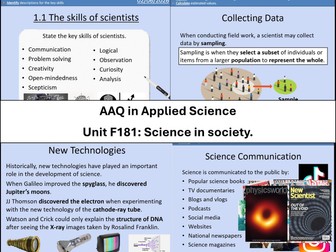
AAQ in Applied Science - Unit F181: Science in society

15 Resources
Course: OCR Level 3 Alternative Academic Qualification Cambridge Advanced Nationals in Applied Science. Unit F181: Science in society Topic Area 1.1 The skills of scientists Topic Area 2: Handling scientific data 2.1 Types of scientific data 2.2 Collecting scientific data 2.3 Storage and presentation of scientific data 2.4 Interpreting data Topic Area 3: Scientific developments 3.1 Hypothesis, theory, and law 3.1.1 Scientific use of terms 3.1.2 Scientific theory vs scientific law 3.2 Using new technologies in science 3.2.1 New technologies play an important part in continuing scientific development 3.2.2 Limitations and risks of new technologies in society 3.3 Implications and limitations of scientific developments 3.3.1 Considerations for scientific developments 3.3.2 Contemporary issues that science will need to solve in the future Topic Area: 4 Communicating science 4.1 Methods of communication 4.1.1 Communicating science to the public using the media 4.1.2 Communicating science between experts: 4.2 Plagiarism 4.3 Using science to inform decision making 4.4 Problems with communicating science 4.4.1 Public trust in the scientific community and developments 4.4.2 Bias in science communication
AAQ Applied Science F181 Science in Society: Topic Area 4  Communicating scienceQuick View
danielkwest

AAQ Applied Science F181 Science in Society: Topic Area 4 Communicating science

(0)
OCR AAQ Applied Science F181 Science in Society: Topic Area 4 Communicating science For previous FREE sample work see here: https://www.tes.com/teaching-resource/resource-13481144 The following FREE bundle contains PowerPoints for the whole topic. All PowerPoints are** fully aligned with the specification** and OCR’s F181 Scheme of Work. Exam questions are also included (with mark scheme). PowerPoints: 4.1.1 Communicating science to the public using the media 4.1.2 Communicating science between experts 4.2 Plagiarism 4.3 Using science to inform decision making 4.4.1 Public trust in the scientific community and developments 4.4.2 Bias in science communication . All PowerPoints are designed for a typical 1 hour lesson and include: . Title slide Specification points Starter activity Main ideas from the specification Summary table of advantages and disadvantages Exam questions (and answers) Lesson summary and recall Homework and further resources (with embedded links) _ All ANSWERS to questions and INFO can be found in the “notes” section of the PowerPoint
AAQ Applied Science F181 Science in Society: Topic Area 3 Scientific developmentsQuick View
danielkwest

AAQ Applied Science F181 Science in Society: Topic Area 3 Scientific developments

(0)
OCR AAQ Applied Science F181 Science in Society: Topic Area 3 Scientific developments For previous FREE sample work see here: https://www.tes.com/teaching-resource/resource-13481144 The following FREE bundle contains PowerPoints for the whole topic. All PowerPoints are** fully aligned with the specification** and OCR’s F181 Scheme of Work. Exam questions are also included (with mark scheme). PowerPoints: ** 3.1.1 Scientific use of terms 3.1.2 Scientific theory vs scientific law 3.2.1 New technologies play an important part in continuing scientific development 3.2.2 Limitations and risks of new technologies in society 3.3.1 Considerations for scientific developments 3.3.2 Contemporary issues that science will need to solve in the future . All PowerPoints are designed for a typical 1 hour lesson and include: . Title slide Specification points Starter activity Main ideas from the specification Summary table of advantages and disadvantages Exam questions Lesson summary and recall Homework and further resources (with embedded links) _ All ANSWERS to questions and INFO can be found in the “notes” section of the PowerPoint
AAQ Applied Science F181 Science in Society: Topic Area 2  Handling scientific dataQuick View
danielkwest

AAQ Applied Science F181 Science in Society: Topic Area 2 Handling scientific data

(1)
OCR AAQ Applied Science F181 Science in Society: Topic Area 2 Handling scientific data For previous FREE sample work see here: https://www.tes.com/teaching-resource/resource-13481144 The following FREE bundle contains PowerPoints for the whole topic. All PowerPoints are fully aligned with the specification and OCR’s F181 Scheme of Work. Exam questions are also included (with mark scheme). PowerPoints: 2.1 Types of scientific data 2.2 Collecting scientific data 2.3.1 How Scientific data can be stored on databases 2.3.2 Scientific data can be represented in different graphical forms 2.4 Interpreting data . All PowerPoints are designed for a typical 1 hour lesson and include: . Title slide Specification points Starter activity Main ideas from the specification Summary table of advantages and disadvantages Exam questions Lesson summary and recall Homework and further resources (with embedded links) _ All ANSWERS to questions and INFO can be found in the “notes” section of the PowerPoint
AAQ Applied Science F181 Science in Society: Topic Area 1 What scientists do...Quick View
danielkwest

AAQ Applied Science F181 Science in Society: Topic Area 1 What scientists do...

(1)
OCR AAQ Applied Science F181 Science in Society: Topic Area 1 What scientists do… The following FREE bundle contains PowerPoints for the whole topic. All PowerPoints are fully aligned with the specification and OCR’s F181 Scheme of Work. Exam questions are also included (with mark scheme). PowerPoints: 1.1 The skills of scientists 1.2.1 Steps in the Scientific Method 1.2.2 The scientific method is a non-linear process 1.3.1 Scientists can work alone, in a team, collaboratively 1.3.2 Successful collaborations in science 1.3.3 International Scientific Organisations 1.4 The role of scientists . Topic areas 2, 3 and 4 can be found here: https://www.tes.com/teaching-resources/shop/danielkwest/Understanding the world . All PowerPoints are designed for a typical 1 hour lesson and include: . Title slide Specification points Starter activity Main ideas from the specification Summary table of advantages and disadvantages Exam questions and answers Lesson summary and recall Homework and further resources (with embedded links) _ All ANSWERS to questions and INFO can be found in the “notes” section of the PowerPoint.
AAQ Applied Science OCR F181 Science in Society Topic area 2Quick View
Ssn77

AAQ Applied Science OCR F181 Science in Society Topic area 2

(0)
Claude ai generated powerpoints (worksheets to follow). These have not been checked thoroughly yet. The powerpoints follow the specification exactly. The homework slides may be more useful as worksheets, but the whole powerpoint can be used as a revision resource
AAQ Applied Science OCR F181 Science in Society Topic area 1Quick View
Ssn77

AAQ Applied Science OCR F181 Science in Society Topic area 1

(0)
Claude ai generated powerpoints (worksheets to follow). These have not been checked thoroughly yet. The powerpoints follow the specification exactly. The homework slides may be more useful as worksheets, but the whole powerpoint can be used as a revision resource
AAQ Applied Science OCR F181 Science in Society Topic area 3Quick View
Ssn77

AAQ Applied Science OCR F181 Science in Society Topic area 3

(0)
Claude ai generated powerpoints (worksheets to follow). These have not been checked thoroughly yet. The powerpoints follow the specification exactly. The homework slides may be more useful as worksheets, but the whole powerpoint can be used as a revision resource
AAQ Applied Science OCR F181 Science in Society Topic area 4Quick View
Ssn77

AAQ Applied Science OCR F181 Science in Society Topic area 4

(0)
Claude ai generated powerpoints (worksheets to follow). These have not been checked thoroughly yet. The powerpoints follow the specification exactly. The homework slides may be more useful as worksheets, but the whole powerpoint can be used as a revision resource
OCR AAQ in Applied Science: 3.2 Using New Technologies in ScienceQuick View
srshaw89

OCR AAQ in Applied Science: 3.2 Using New Technologies in Science

(0)
Course: OCR Level 3 Alternative Academic Qualification Cambridge Advanced Nationals in Applied Science. Unit F181: Science in society Topic Area: 3 Scientific developments □ Key concepts of each type of new technology □ Advantages of the new technologies to further scientific development □ How scientific disciplines might be supported by these technologies • Robotics and automation. • Computer-aided design (CAD). • Artificial intelligence (AI) and machine learning. • Quantum computing. • Big data analytics. • Advanced imaging technologies. • Augmented and virtual reality.
OCR AAQ in Applied Science: 4.3 Using science to inform decision makingQuick View
srshaw89

OCR AAQ in Applied Science: 4.3 Using science to inform decision making

(0)
Course: OCR Level 3 Alternative Academic Qualification Cambridge Advanced Nationals in Applied Science. Unit F181: Science in society Topic Area: 4 Communicating science Different organisations that use science to inform their decision making: Government organisations Non-governmental organisations Private and commercial organisations Pressure, voluntary and charitable groups □ Know how organisations use scientific information and data □ Aims and objectives of these types of organisations □ The importance of these organisations in influencing public opinion □ The importance of these organisations in future scientific advancement
OCR AAQ in Applied Science: 3.1 Hypothesis, theory, and lawQuick View
srshaw89

OCR AAQ in Applied Science: 3.1 Hypothesis, theory, and law

(0)
Course: OCR Level 3 Alternative Academic Qualification Cambridge Advanced Nationals in Applied Science. Unit F181: Science in society Topic Area: 3 Scientific developments 3.1 Hypothesis, theory, and law Know how to write a hypothesis and predictions How a hypothesis may become a theory How the term theory is used in science and in everyday language The role of assumptions, estimations and approximations in science 3.1.2 Scientific theory vs scientific law Know how a law is different from a theory Both theories and laws require evidence and can be open to change and revision
OCR AAQ in Applied Science: 3.3 Implications and limitations of scientific developmentsQuick View
srshaw89

OCR AAQ in Applied Science: 3.3 Implications and limitations of scientific developments

(0)
Course: OCR Level 3 Alternative Academic Qualification Cambridge Advanced Nationals in Applied Science. Unit F181: Science in society Topic Area: 3 Scientific developments Know the importance of funding in science The role of private companies, charitable foundations or governments in scientific research Factors that affect research that is carried out How scientists receive funding for research What issues might arise and how they are classified as social, ethical or moral issues
OCR AAQ in Applied Science: 2.2 Collecting scientific dataQuick View
srshaw89

OCR AAQ in Applied Science: 2.2 Collecting scientific data

(0)
Course: OCR Level 3 Alternative Academic Qualification Cambridge Advanced Nationals in Applied Science. Unit F181: Science in society Topic Area 2: Handling scientific data This PowerPoint is a whole lessons included with student activities and animated answers. Methods of collecting data with their advantages and disadvantages. Observation and measurement from experiments Surveys Cohort studies Meta-studies Computer modelling Sampling techniques Random sampling Systematic sampling Using estimates Bias and diversity in science
OCR AAQ in Applied Science- Science in Society: What Scientists DoQuick View
fosterpaul

OCR AAQ in Applied Science- Science in Society: What Scientists Do

4 Resources
Lessons for the OCR Level 3 Alternative Academic Qualification in Applied Science, covering content from the F181 unit ‘Science in Society’, Topic Area 1: What scientists do. Including: The skills of scientists The scientific method The scientific community The role of scientists
OCR AAQ in Applied Science: 2.1 Types of scientific dataQuick View
srshaw89

OCR AAQ in Applied Science: 2.1 Types of scientific data

(0)
Course: OCR Level 3 Alternative Academic Qualification Cambridge Advanced Nationals in Applied Science. Unit F181: Science in society Topic Area 2: Handling scientific data This PowerPoint is a whole lessons included with student activities and animated answers. Qualitative and quantitative data Continuous and discrete data Primary and secondary data
OCR AAQ in Applied Science: 4.2 PlagiarismQuick View
srshaw89

OCR AAQ in Applied Science: 4.2 Plagiarism

(0)
Course: OCR Level 3 Alternative Academic Qualification Cambridge Advanced Nationals in Applied Science. Unit F181: Science in society Topic Area: 4 Communicating science * Complete Plagiarism * Direct Plagiarism * Self Plagiarism * Source-based Plagiarism * Accidental Plagiarism Know definition of each type of plagiarism When each type of plagiarism could occur Why people plagiarise and why it matters How to avoid plagiarism Potential consequences of plagiarism
OCR AAQ in Applied Science: 4.1 Methods of communicationQuick View
srshaw89

OCR AAQ in Applied Science: 4.1 Methods of communication

(0)
Course: OCR Level 3 Alternative Academic Qualification Cambridge Advanced Nationals in Applied Science. Unit F181: Science in society Topic Area: 4 Communicating science 4.1.1 Communicating science to the public using the media 4.1.2 Communicating science between experts Popular science books TV documentaries Blogs and vlogs Podcasts Social media Websites National newspapers Science magazines Journals Meetings and seminars Conferences Online platforms and forums The process of peer review