The Unfair Arithmetic Game KS2 SATs RevisionQuick View
Bigbear25

The Unfair Arithmetic Game KS2 SATs Revision

(0)
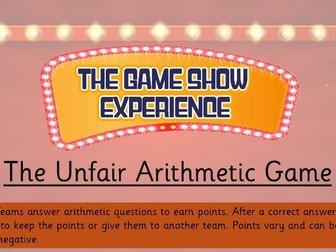
Revise KS2 arithmetic with laughter, strategy, and a little bit of chaos! The Unfair Arithmetic Game is a fast-paced, PowerPoint-based maths challenge designed to help Year 6 pupils revise for the SATs in a fun, engaging way. With 30 SATs-style questions, teams compete to earn points — but there’s a twist! Each question carries an unexpected outcome: teams might gain big, lose everything, or get hit with a silly challenge. It’s “unfair” in all the best ways and perfect for building maths confidence while having a great time. What You’ll Receive: 1x PowerPoint game file (.pptx) 30 ready-made arithmetic questions with animated slides Built-in scoring rules and instructions Editable so you can tweak or add your own questions Ideal For: KS2 SATs arithmetic revision Year 6 end-of-term maths activities Small group or full class team games Maths interventions Tutor sessions and booster groups Key Features: Fully interactive PowerPoint (no printing required) Aligned with KS2 arithmetic topics (fractions, multiplication, division, percentages, decimals) Encourages teamwork, mental maths, and strategy Designed by a UK primary teacher Fun, classroom-friendly humour How It Works: This is a digital download – no physical product will be shipped. After purchase, you’ll instantly receive the full PowerPoint game file, ready to use.
Million pound drop KS2 SATS maths revision gameQuick View
the_year6_teacher

Million pound drop KS2 SATS maths revision game

(0)
This is a game for revision for KS2 maths SATS. Suitable mainly for Year 6, but can be adapted for other year groups. The instructions are: Put the children into pairs Give each pair 20 counters and cards with A, B, C and D Each pair works out the answer the question and they have to put their counters on the correct answer card. If they are not sure, they can split their counters. When the answer is revealed, if they have counters on an incorrect answer, they lose those counters. The winning pair are the ones who have the most counters left at the end.
Maths Game for Year 6 SATs ArithmeticQuick View
elwooddowd

Maths Game for Year 6 SATs Arithmetic

(1)
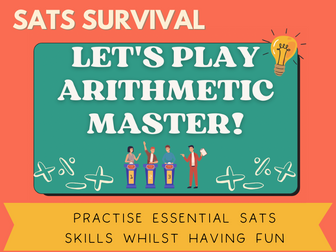
Arithmetic Master is a game I use with Year 6 in the last few weeks before the SATs. You know how it feels - when you’ve done past paper after past paper and you still need to work on retrieval but you need some ENERGY! This is a quiz which involves partner work, peer support, team names and unlimited points and my children LOVE it. Covering all of the Arithmetic question areas from Paper 1 in a quiz format. • Children work in pairs for this quiz. • For each section (PPT slide) each child will be given 2 to 3 minutes (your discretion) to answer the questions independently on their own piece of paper. • The next 2 minutes will be sharing and discussing answers with their partner. • Before sharing, they will need to decide upon a final answer as a team. • This is great for peer work, talking through HOW they came to their answer. • Points are decided by the teacher: correct answers; superb explanations; good behaviour; staying focused. • I also deduct points to maintain behaviour management: shouting out, arguing etc. I find that the children learn very quickly that it’s all a bit of fun in the midst of all their revision and behave well beyond the first couple of deductions! • Having ultimate power over the points also ensures that you can award points to children with low self esteem who need the boost. There are over 20 colourful question slides, each containing at least 6 Arithmetic questions. This quiz can easily be broken down into sections, over several sessions . I show this as a PPT presentation and everyone looks at the main smartboard but I have also included a PDF in case you need to print out or Air Drop questions. Another PPT and PDF contains the answers which I use as a class so I can see what everyone is getting out of it, what my areas of need are, giving out points and also to keep up the energy. However, this could also be used for self marking. I really hope you and your class enjoy this resource as much as we do!
The Traitors: Classroom Edition – Educational Game for KS2 & KS3Quick View
jamesrsedley

The Traitors: Classroom Edition – Educational Game for KS2 & KS3

(0)
Bring the excitement of the hit BBC show The Traitors into your classroom with this fun and flexible educational resource! Perfect for Upper Key Stage 2 (Years 5 and 6) and Key Stage 3, this game includes full instructions and all the resources you need. Easily adaptable to any subject or topic, it’s ideal for end-of-term celebrations or engaging revision sessions. Packed with intrigue, teamwork, problem solving and learning, it’s a great way to make lessons unforgettable! The game includes: Faithful and Traitor role cards Shields and special letters (Murder, Recruitment, and The Seer) Step-by-step teacher instructions A fully guided PowerPoint to lead the game slide by slide Resources for both offline (paper-based) and online (e.g. Google Classroom) play Easily adaptable to suit any subject or topic, this game turns your curriculum into an engaging and memorable experience. Whether you’re reviewing knowledge or just celebrating the end of term, The Traitors: Classroom Edition brings strategy, teamwork, and fun into every lesson.
Fun with a Ruler - Collaborative Art Project using Parabolic CurvesQuick View
swelch_resources

Fun with a Ruler - Collaborative Art Project using Parabolic Curves

(1)
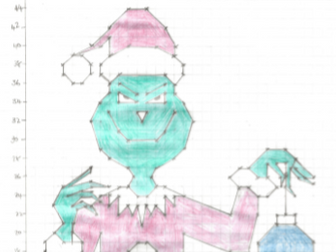
A ‘Fun with a Ruler’ art project that involves drawing parabolic curves (curves that are made by drawing a series of straight lines). This project involves your students ruling straight lines between 2 dots on a template. When they have finished drawing all of the lines they can give their artwork some colour. Each student completes a square. Join the squares together to make an eye-catching display (see image for example). Included: ♦ Template – black dots ♦ Template – light grey dots ♦ Example ♦ Display suggestion ♦ Instructions ♦ Teacher notes Level of Difficulty: Your students need to be able to use a ruler to draw straight lines between 2 points (the curves are made with straight lines … it’s like magic!). The designs can look more complicated than they actually are. Concentration is required, but the actual process is not difficult. Instructions: Simple, clear, easy-to-follow instructions are provided. One instruction per page (image and a sentence). Display the instructions via a data projector if you have access to one. Otherwise print and enlarge them and/or demonstrate on an enlarged template. Equipment: You need a ruler and a pen (black works best). Something to colour with (eg coloured pencils, watercolours, felt tip markers, chalk pastels, dye, etc) Size: Each square measures approximately 18.5cm x 18.5cm. Designed on A4 size paper. Keywords: string art, math, geometry, patterns, parabolic curves. © Suzanne Welch Teaching Resources
Year 6 SATS Maths BingoQuick View
the_year6_teacher

Year 6 SATS Maths Bingo

(0)
30 sets of bingo cards with 16 answers each, taken from a variety of questions for Year 6 for KS2 SATS revision. The set includes: 30 Bingo cards with 16 numbers on each A set of 32 questions and answers These will be a fun way of revising with Year 6. Questions include: what is 3/4 as a decimal? Round 16.7 to the nearest whole number. Find the mean of these numbers …
SATs Revision Practice Pack KS2 Maths -  "One Page Wonder!"Quick View
ambowers2

SATs Revision Practice Pack KS2 Maths - "One Page Wonder!"

(6)
A pack of 5 revision worksheets - Each one containing 46 different past paper SATs style questions, all fitted onto one double sided A4 sheet Great for keeping photocopying down whilst practising loads of past questions!There is a record sheet (including key skills) for each pupil to record their score after each attempt and try to beat it the next time! Each worksheet has similar questions & key skills but with new numbers each time in order for pupils to build confidence, fluency, and consolidate their learning. Answers for all questions are provided (as pdf and ppt) - each on a single page which can be projected onto IWB in one go or printed out on a single sheet to allow for self/peer marking. Could be done in class with support or at home for revision - Ideal for some intensive last minute SATs preparation. (PDF files) This resource is now also available as part of the 2019 SATs Ultimate organiser at https://www.tes.com/teaching-resource/2019-ks2-sats-revision-ultimate-15-in-1-maths-organiser-11989842
Maths Made Easy: KS2 Maths revision matQuick View
Deako

Maths Made Easy: KS2 Maths revision mat

(0)
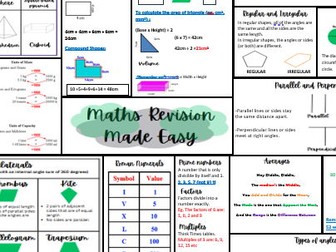
A KS2 Maths revision A3 mat to help children practise key Maths skills and concepts. This is great to use as a revision tool for Year 6 SATs and can be used weekly as a scaffold for retrieval. It covers: Quadrilaterals, 3D shapes, perimeter, area, volume, circle properties, Roman numerals, averages, properties of number, angles, units of length, mass and capacity and more! Also would be a fantastic tool in Year 7 to aid the learning process and recap prior skills.
Christmas Escape RoomQuick View
EC_Resources

Christmas Escape Room

(3)
THE ULTIMATE DIY PRINTABLE CHRISTMAS ESCAPE ROOM! Make the end of term unforgettable with this DIY printable Christmas Escape Room, designed specifically for primary students in Year 5 and 6, or possibly lower secondary (Years 7 -8 ). This easy-to-use, classroom-ready escape room is perfect for teachers searching for a print-and-go Christmas activity that’s fun, engaging, and requires zero prep. This one-two hour escape room includes a variety of printable puzzles, ciphers, maths challenges, and logic tasks - all with a festive twist. Students work in teams to crack codes, solve clues, and complete a series of Christmas-themed challenges that promote problem-solving, teamwork, and critical thinking. This resource is ideal for anyone searching for a DIY escape room for kids, printable classroom escape room, or Christmas escape room puzzles. Add some festive excitement to your classroom with this ready-made end-of-year activity your students will love! Also check out our brand new winter solstace Egyptian-themed escape room here: Ancient Egyptian Escape Room Who are EC Resources? EC Resources are a group of teachers who work together to create easy to use, high quality and editable lessons and units of work. We have created lessons for The Bank of England, The British Legion, The Children’s Commissioner, MACS Charity, Tes, LikeToBe Careers, the Criminal Cases Review Commission (UK Gov) and have also completed PSHE and Citizenship commissions for schools across the UK. You can contact us at info@ecpublishing.co.uk
Speed KS3 Activate ScienceQuick View
ychebbout

Speed KS3 Activate Science

(0)
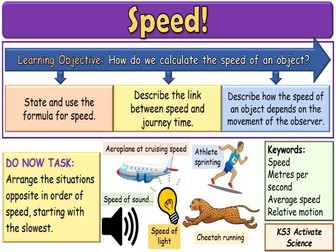
Perfect lesson resource for KS3 Physics! A fully differentiated and resourced lesson that assists students in learning about how to calculate the speed of an object . Students will use the formula for calculating speed, describe the link between speed and journey time, and describe how the speed of an object depends on the movement of the observer. The resource includes a detailed and engaging lesson PowerPoint with differentiated activities, worksheet and quizzes for students to complete. This resource is part of the motion and pressure topic and has been created for the delivery of the Activate KS3 Science course. Also great for GCSE Science. 14 slides in total for the lesson PPT
Maths and Spag SATs Game Year 6Quick View
elwooddowd

Maths and Spag SATs Game Year 6

2 Resources
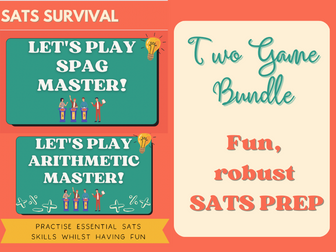
This is a bundle of two of my most popular games. Arithmetic Master and SPAG Master are games I use with Year 6 in the last few weeks before the SATs. You know how it feels - when you’ve done past paper after past paper and you still need to work on retrieval but you need some ENERGY! This is a quiz which involves partner work, team names and unlimited points and my children LOVE it. Covering all of the Punctuation and Grammar question areas from SPAG Paper 1 and all areas of Arithmetic from Maths paper 1 in a very welcome quiz format. • Children work in pairs for this quiz. • For each section (PPT slide) each child will be given 2 to 3 minutes (your discretion) to answer the questions independently on their own piece of paper. • The next 2 minutes will be sharing and discussing answers with their partner. • Before sharing, they will need to decide upon a final answer as a team. • This is great for peer work, talking through HOW they came to their answer. • Points are decided by the teacher: correct answers; superb explanations; good behaviour; staying focused. • I also deduct points to maintain behaviour management: shouting out, arguing etc. I find that the children learn very quickly that it’s all a bit of fun in the midst of all their revision and behave well beyond the first couple of deductions! • Having ultimate power over the points also ensures that you can award points to children with low self esteem who need the boost. There are over 20 colourful question slides, each containing at least 6 Arithmetic or 4 grammar questions. This quiz can easily be broken down into sections, over several sessions . I show this as a PPT presentation and everyone looks at the main smartboard but I have also included a PDF in case you need to print out or Air Drop questions. Another PPT and PDF contains the answers which I use as a class so I can see what everyone is getting out of it, what my areas of need are, giving out points and also to keep up the energy. However, this could also be used for self marking. I really hope you and your class enjoy this resource as much as we do!
Compound Shapes (rectangular)Quick View
DurhamPotter

Compound Shapes (rectangular)

(1)
A very basic worksheet that I use to find area and perimeters of compound shapes made from rectangular shapes. I give them to the students and ask them to write down some information they know from the diagrams - it is never long until the whole class is finding the missing sides, at which point we stop and discuss how this is done (and at this point I usually have to give out highlighters so they can colour the horizontal and vertical lengths different colours). Once this is done we then discuss how to calculate the perimeter and students do this for all the shapes on the sheet (I get them to do this in their book). We then look at how to calculate the areas, and again students record their working out in their book (although they show the ‘splitting up’ of the shapes on the sheet). Depending on how students have done on this I may introduce different shapes before ending with a nice Exit Card on what they’ve understood.
Fractions of Amounts Differentiated Worksheet with AnswersQuick View
MsMMaths

Fractions of Amounts Differentiated Worksheet with Answers

(0)
Suitable for both Key stage 3 and 4. This worksheet is designed to help pupils revise fractions of amounts. The worksheet is fully differentiated (mild, medium spicy and hot) allowing pupils to work at different levels simultaneously. The worksheet also features a section for pupils to self-assess their understanding and set a target for next lesson, Answers included ready to be projected onto a smartboard.
GCSE Maths Foundation Exam QuestionsQuick View
Elsie99

GCSE Maths Foundation Exam Questions

(1)
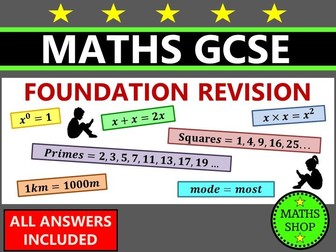
Exam Style GCSE Maths Foundation Questions perfect for the GCSE exams! These are mainly non-calculator questions suitable for foundation students. They are up-to-date exam style questions based on recent past paper questions, designed to make students think and apply methods they have been taught to solve the problems. There are 20 questions in this pack with a total of 100 marks, so they should take around 2 hours to complete. There are 2 questions of each type so that students can have a second attempt at each topic. ✎ Contents: This resource includes: • 20 worksheets – each with one multi-step exam style question. • A student recording sheet – to record marks etc. • Teachers notes. • All answers. ✦ Objectives: This resource has been designed to practice GCSE foundation exam style questions on the following topics: • Multiplying & Dividing Decimals • Factors • Lowest Common Multiple (LCM) • Linear Simultaneous Equations • Angles in a Triangle • Percentage Profit • One Quantity as a Percentage of Another • Bearings • Scale Drawing • Expand & Simplify • Factorise • Algebra Substitution • Solving Equations • Angles in Parallel Lines • Probability Tree Diagram ✦ Notes: All answers are included, so you can easily mark students work. These questions should take at around 2 hours for students to complete. ✽ Directions: Print out a set of 20 worksheets for each student. Alternatively use individual pages as required for homework etc. ✷ Suggestions: Use the student recording sheet for students to record their marks and maybe colour code red, yellow and green depending on difficulty. You could use one question of each type (e.g., all the odd numbered questions) for a test and then the other questions as a follow up to practice the topics again. ♥ You may also like: GCSE Crossover Exam Questions Level 5 GCSE Higher Exam Questions Quadratic Inequalities, Quadratic Equations and Quadratic Simultaneous Equations ☞ To view my other resources, please go to Maths Shop
GCSE Biology Maths Skills BundleQuick View
crippsy4

GCSE Biology Maths Skills Bundle

20 Resources
This bundle contains 19 worksheets for all key maths skill for GCSE Biology. Included for each skill is: Information page explaining the maths skill Worksheet of questions Answer sheet Each resource can be printed as a double sided A4 sheet perfect for in class activity or a homework. Skills are required for AQA GCSE Biology and Combined Science. Skills are also applicable in other exam boards such as Edexcel and OCR. All individual Biology Maths skills for GCSE Biology can be found below: 1.1 Units and Magnification 1.2 Surface area to Volume ratio 2 Cell Cycle Length 3 Rate of Reaction 4 Orders of Magnitude 5 Bacterial Populations 6 Percentage Change 7 Significant Figures and Decimal Places 8 Inverse Square Law 9 Averages 10 Tables 11 Standard Form 12 Ratio, Percentage, Probability, Fraction 13 Punnett Squares 14 Frequency Density 15 Areas of Shapes 16 Population size 17 Equations and Symbols 18 Biomass Transfers
Aiming at Grade 4 - GCSE Maths Revision WorkbookQuick View
tpayne89

Aiming at Grade 4 - GCSE Maths Revision Workbook

(3)
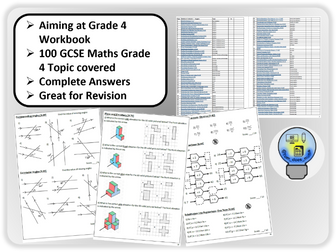
Here is a complete workbook of Grade 4 topics for GCSE Maths. Answers also included. I created this for my classes this year as they are mixed ability within foundation GCSE. I also made an aiming at grade 2 and aiming at grade 3 workbooks that I will hopefully also upload. They are great for all general work, classwork, homework, revision. To decide on the topics I did some brief analysis of recent papers and what topics came up compared to marks needed for a grade 4. If students are confident on the majority of the topics in this workbook, then they should be able to achieve a grade 4. Note in the top right corner on Page 3 there is a blank space, here I added a QR code to the answers, you could do similar. There are exactly 100 topics covered across: Four Operations Fractions Factors, Multiples and Primes Decimals Percentages Fractions, Decimals & Percentages Rounding Powers and Roots Indices Ratio Algebra Expanding & Factorising Solving Linear Equations Straight Line Graphs Inequalities Angles Angles in Polygons 2D Shapes Perimeter Area 3D Shapes Measure Time Money Compound measure Scale Drawings Transformations Similarity Probability Venn Diagrams Averages & the Range Frequency Tables Scatter Graphs
Venn DiagramsQuick View
adam_crane93

Venn Diagrams

(11)
This was delivered to a low ability year 10 class. It is quite basic and missing some of the more complicated concepts dealing with Venn diagrams. This is a PowerPoint intent on explaining how to fill a Venn Diagram with examples. I tried to include the important things to include when completing a Venn diagram. There are some generic questions contained within the slides. Slides 1-7 were seen on lesson 1 and then I gave the class examples of this type. Slides 8-18 were seen in lesson 2 (after recapping the previous slides) and further examples of this type were given to the class. Any feedback would be greatly appreciated as this is my first resource I have uploaded.
Year 6 SATs Maths Reasoning Revision Bundle | 16 Topics | SATs‑Style Questions with AnswersQuick View
MrH_teach

Year 6 SATs Maths Reasoning Revision Bundle | 16 Topics | SATs‑Style Questions with Answers

16 Resources
This comprehensive Year 6 Maths SATs Reasoning Bundle contains 16 high‑quality revision packs, providing thorough coverage of the key reasoning domains assessed in the KS2 SATs. Each pack includes carefully structured SATs‑style reasoning and problem‑solving questions with full answer sheets, supporting confident delivery in whole‑class revision, booster sessions, targeted interventions or independent practice. What’s included in the bundle: Shape Reasoning – 30 questions Algebra Reasoning – 25 questions Four Operations Reasoning – 25 questions Rounding – 25 questions Number Sequences – 33 questions Ordering Fractions, Decimals and Percentages – 12 questions Rounding Decimals – 10 questions Mean – 8 questions Angles – 14 questions Statistics – 33 questions Co‑ordinates – 25 questions Money Reasoning – 20 questions Negative Numbers – 25 questions Time Reasoning – 25 questions Reflection and Translation – 25 questions Ratio - 20 questions . Why Teachers Choose This Bundle: Fully aligned with KS2 SATs reasoning expectations Covers all major Year 6 reasoning strands Ideal for revision weeks, SATs boosters and intervention groups Suitable for whole‑class, small‑group or independent learning Excellent value compared to purchasing individual resources . This bundle provides a complete, ready‑to‑use solution for ensuring pupils are secure, confident and well‑prepared for the Y6 Maths SATs.
Maths Christmas QuizQuick View
BrightMindMaths

Maths Christmas Quiz

(0)
A Christmas Quiz with 5 rounds, including a maths round! Rounds included in this quiz are Christmas Films, Logos, Maths, Riddles, Animated Characters. Each round has 5 or 10 questions, and answers are given at the end of each round. A great way to add some maths into your end of term Christmas lessons with KS3 or KS4! Check out my other Christmas resources here: Christmas Values Activity Christmas Food Shop Activity Please consider leaving a review if you like this resource!