Current 2026 guidance
The Early Years Foundation Stage (EYFS) Statutory Framework is a legal document published by the UK Department for Education (DfE) that sets the standards all early years settings must meet for children from birth to age 5 in England. It applies to:
Nurseries
Preschools
Childminders
Reception classes in school
Other Ofsted-registered early years providers
Its Purpose
The statutory framework:
✔ Ensures children learn and develop well.
✔ Protects children’s health, welfare and safety.
✔ Promotes children’s school readiness and gives them a solid foundation for future learning.
✔ Ensures quality and consistency across childcare and early education settings.
✔ Encourages partnership working between practitioners and parents/carers.
✔ Supports inclusion and equality of opportunity for every child.
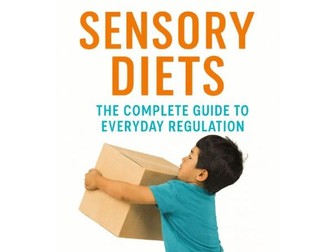
Sensory Diets (eBook)
The Complete Guide to Everyday Regulation
This digital guide provides clear, practical support for helping children feel calm, focused, and regulated throughout the day. Sensory Diets: The Complete Guide to Everyday Regulation explains how purposeful sensory input can be used proactively—at home and in school—to support emotional regulation, attention, and wellbeing.
Designed for easy reading on tablets, eReaders, and phones, this eBook breaks sensory diets down into simple, realistic strategies that fit everyday life. No specialist equipment is required—just an understanding of how sensory systems work and how to use them intentionally.
Grounded in occupational therapy principles but written in clear, accessible language, this guide helps adults understand sensory processing differences and respond with compassion rather than punishment or reactive behaviour management.
Inside this eBook you’ll find:
• A clear explanation of sensory processing and regulation
• What sensory diets are and why they work
• Step-by-step guidance to create personalised sensory diets
• Proprioceptive, vestibular, tactile, oral, and calming activities
• Morning, school-day, after-school, and bedtime routines
• Strategies for anxiety, overwhelm, meltdowns, and shutdowns
• Support for autistic children, ADHD, sensory processing differences, and trauma
• Classroom-friendly ideas and low-cost sensory strategies
• Easy-to-follow examples, checklists, and practical plans
This eBook is ideal for parents, carers, teachers, SENCOs, teaching assistants, therapists, and inclusion teams looking for a calm, proactive approach to regulation that actually works.
Sensory Diets (eBook) empowers adults to support children before difficulties escalate—helping them feel safe, settled, and ready to engage with learning and daily life.
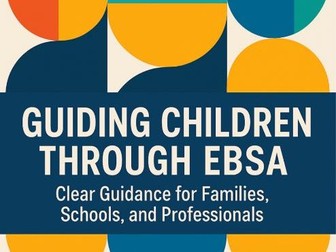
EBSA: A Step-by-Step Guide
Practical Support for Emotionally Based School Avoidance, Anxiety & School Refusal
When a child can’t face school, it’s rarely about “bad behaviour” or “lack of resilience.” It’s often fear, overwhelm, unmet needs, and a nervous system stuck in survival mode. EBSA: A Step-by-Step Guide is a calm, practical handbook for parents and professionals who need clear actions—not judgement—when attendance is falling apart.
This book breaks EBSA down into simple, manageable steps, helping you understand what’s really driving the avoidance and what to do next. You’ll learn how to reduce anxiety, rebuild trust, and create a plan that supports both the child’s wellbeing and their education—without threats, punishments, or endless battles at the front door.
Written in an accessible, supportive style, this guide walks you through assessment, planning, communication, and reintegration, with strategies that work in real family life and real school settings.
Inside you’ll find:
How to recognise EBSA early (before it escalates)
The most common causes: anxiety, autism, ADHD, sensory overwhelm, bullying, trauma, PDA profiles, unmet needs
What to say (and what not to say) when emotions are high
Step-by-step “first two weeks” actions to stabilise the situation
Practical tools: regulation routines, morning supports, visual plans, graded exposure, safe bases
Working with school: meeting scripts, reasonable adjustments, attendance plans, reduced timetables (done properly), risk assessments
When EBSA becomes a safeguarding concern and how to evidence impact
Support pathways including GP/CAMHS, school nursing, SEND routes, and EHCP links
Reintegration plans that prioritise wellbeing and prevent relapse
Templates, checklists, and example plans you can copy and use immediately
This book is ideal for parents, carers, SENCOs, teachers, pastoral teams, attendance leads, SEND case officers, and therapists supporting children and young people who feel unable to attend school.
If you’re exhausted, worried, and unsure what comes next, this guide gives you a roadmap—one step at a time—towards safety, stability, and a realistic return to learning.
100 Therapy Games for Kids
Fun, Practical Activities to Support Emotional Regulation, Communication, Confidence & Well-Being
Helping children develop emotional strength, communication skills, and confidence doesn’t have to feel clinical or overwhelming. 100 Therapy Games for Kids brings therapeutic support into everyday play—making it engaging, accessible, and effective for children of all abilities.
This practical, easy-to-use book is packed with 100 carefully designed games and activities that support emotional regulation, social skills, self-esteem, focus, and resilience. Each game is rooted in therapeutic principles but presented in a way that feels fun, playful, and child-friendly.
Whether you are supporting a child with anxiety, autism, ADHD, emotional regulation difficulties, or simply want to strengthen emotional literacy and connection, this book provides ready-to-use activities that fit seamlessly into home, school, or therapy sessions.
Inside this book you’ll find:
• Games to support emotional regulation and coping skills
• Activities that build communication, listening, and social understanding
• Play-based tools for managing anxiety, anger, and big emotions
• Confidence-building games that encourage self-expression and self-belief
• Movement-based and calming activities for focus and sensory regulation
• Simple instructions with minimal preparation required
The games are suitable for individual work or small groups and can be easily adapted for different ages, needs, and settings—including classrooms, therapy rooms, family homes, and specialist provisions.
100 Therapy Games for Kids is ideal for:
• Parents and carers
• Therapists, counsellors, and play therapists
• Teachers, SENCOs, and teaching assistants
• Early years practitioners and inclusion teams
This book offers a compassionate, strengths-based approach to supporting children—helping them learn, grow, and thrive through the power of play.
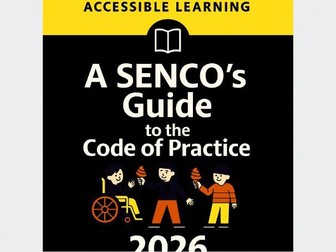
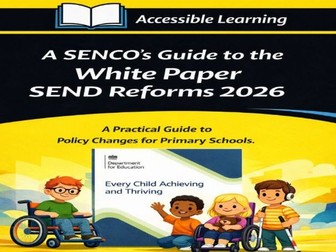
The essential handbook for every SENCO, teacher, and school leader committed to delivering outstanding SEND provision.
Clear, practical, and grounded in real-world experience, A SENCO’s Guide to the Code of Practice breaks down the complexities of the SEND framework into guidance you can actually use.
Whether you’re new to the role or an experienced practitioner navigating ever-changing expectations, this comprehensive guide helps you interpret the SEND Code of Practice with confidence. Inside, you’ll find:
Step-by-step explanations of every major section of the Code
Practical tools and strategies for identification, assessment, intervention, and review
Clear guidance on working with parents, carers, external agencies, and local authorities
Templates, checklists, flowcharts, and examples to streamline your workload
Best-practice advice for compliance, evidence gathering, and preparing for Ofsted
Updates on current policy developments, including national SEND reforms and the upcoming 2026 White Paper
Case studies showing the Code in action in real school settings
Written in plain, accessible language, this guide empowers SENCOs to fulfil their statutory duties while creating inclusive, supportive environments where every child can thrive.
A must-have reference book for SENCOs, aspiring SENCOs, senior leaders, teaching assistants, educational psychologists, and anyone working within the SEND system.
Description:
This 24-slide PowerPoint presentation offers a clear, visual, and practical introduction to the Attention Autism approach, developed by Gina Davies. Designed for teachers, SENCOs, teaching assistants, and early years professionals, this training outlines the key principles, stages, and benefits of the method.
The resource emphasises the importance of fun, visually engaging, and irresistible activities to develop attention, communication, and interaction in autistic children, including those who are non-verbal. Each stage of the Attention Autism programme is explored in detail, with real-life examples and colourful illustrations to support staff understanding.
Perfect for INSET days, staff meetings, or SEND training sessions, this ready-to-use presentation helps practitioners:
Understand the four stages of Attention Autism
Learn how to structure sessions effectively
Create WOW activities that engage even the most reluctant learners
Support non-verbal children through gesture, gaze, and anticipation
Use joy and laughter as tools for meaningful communication
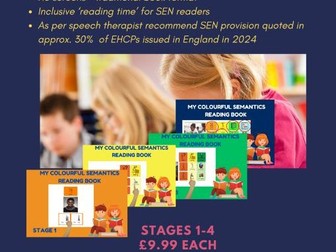
Colourful Semantics Training
This comprehensive training provides a clear, practical introduction to Colourful Semantics, supporting practitioners to confidently implement the approach within inclusive classroom and intervention settings.
The training explains each stage of Colourful Semantics and the meaning of every colour, helping staff understand how language is built step by step. Practical examples are provided throughout, allowing participants to begin using the approach immediately with pupils.
Designed to promote high-quality SEN inclusion, this training supports children with language delay, autism, speech and language needs, and communication difficulties across a range of educational settings.
Training includes:
A clear explanation of all stages and colour coding within Colourful Semantics
Practical, ready-to-use examples for immediate implementation
Strategies to support expressive and receptive language development
Guidance on embedding Colourful Semantics within inclusive classroom practice
Approaches suitable for individual, small-group, and whole-class use
Course details:
38-slide training presentation
Approx. 3 hours of CPD content
Can be delivered as a single session or spread over 3 weeks
Ideal for SEN training, staff meetings, and CPD programmes
This training is suitable for teachers, teaching assistants, SENCOs, speech and language support staff, and inclusion teams.
Qualifications introduction and purpose
The Level 3 Award in Childcare and Education prepares learners to progress to the Technical Level 3
Certificate in Childcare and Education and then on to the Technical Level 3 Diploma in Childcare and
Education (Early Years Educator) which enables them to gain the knowledge and experience which will
allow them to work with children from birth to 5 years.
The Technical Level 3 Diploma in Childcare and Education (Early Years Educator) enables learners to
enter the workforce as Early Years Educators or access Higher Education.
We have built the Diploma to meet the full and relevant criteria for Early Years Educators required by the
National College for Teaching and Leadership (NCTL). We have also incorporated the design criteria for
the 16–19 Performance Tables.
As the leading Awarding Organisation in the care sector we have surpassed the minimum requirements
set out in the full and relevant criteria to develop a qualification which reflects the priorities of
practitioners and employers to meet the needs of young children.Learners Handbook
201 pages
NCFE CACHE Level 3 Award in Childcare and
Education
QN: 601/3998/5
NCFE CACHE Technical Level 3 Certificate in
Childcare and Education
QN: 601/8436/X
NCFE CACHE Technical Level 3 Diploma in
Childcare and Education (Early Years Educator)
QN: 601/8437/1
Description:
This PowerPoint presentation offers a clear, visual, and practical introduction to the Attention Autism approach, developed by Gina Davies. Designed for teachers, SENCOs, teaching assistants, and early years professionals, this training outlines the key principles, stages, and benefits of the method.
The resource emphasises the importance of fun, visually engaging, and irresistible activities to develop attention, communication, and interaction in autistic children, including those who are non-verbal. Each stage of the Attention Autism programme is explored in detail, with real-life examples and colourful illustrations to support staff understanding.
Perfect for INSET days, staff meetings, or SEND training sessions, this ready-to-use presentation helps practitioners:
Understand the four stages of Attention Autism
Learn how to structure sessions effectively
Create WOW activities that engage even the most reluctant learners
Support non-verbal children through gesture, gaze, and anticipation
Use joy and laughter as tools for meaningful communication
How the use of colourful semantics supports those with SEN to develop literacy skills. This is an Action Research Essay for those completing the Masters Level NASENO Award 2023,
1 hour training power point for early years, primary and SEN schools. The training explains colourful semantics, where they originated, giving examples. colourful semantics is used by speech therapists to target sentence structure and writing skills.
ideal for SENCOS running training sessions
A template for sencos parents carers teachers support staff to use to complete all areas needing to be covered at an Annual review for children with EHCPS in England.
Aimed at parents, carers and SENCOS
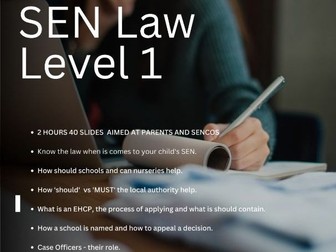
The law surrounding SEN.
EHCPS, naming schools and what it should contain.
References current government legislation followed by local authorities.
Everything you need to know when it comes to getting SEN right.
When it comes to navigating the system, SEN can be a minefield. Take back the power, know the law and how it relates to your child, their school pace, their provision and their EHCP. Avoid costly legal fees added stress and meetings.
This easy to read condensed book is a must when applying for an EHCP in 2023/24