 Quick View
AQA Trilogy B1 Diagnostic Assessment
As a teacher and private tutor, I wanted something that would allow me to identify students’ strengths and weaknesses without it feeling like yet another test. Students already sit enough summative assessments. What is often missing is a way to check understanding during a topic, so that misconceptions can be addressed and intervention can happen before the final assessment.
I also wanted these assessments to function as a genuine revision tool, rather than simply giving students another past paper to complete.
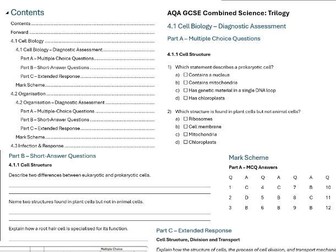
Each assessment is split into three parts:
• Part A: Multiple choice questions
These test core knowledge, key vocabulary, and quick-recall facts. They are particularly useful for identifying misconceptions early, allowing them to be addressed straight away.
• Part B: Short-answer questions
These focus on students’ ability to use keywords and processes to explain or describe ideas. This is a crucial step in helping students move from low-demand to standard-demand exam questions.
• Part C: Extended response question
We rarely give students the time or space to write at length about a topic. Curriculum pressures often mean that longer pieces of writing or “big writes” (as they are called in my son’s primary school) are set aside. Yet we still expect students to produce well-structured 6-mark answers. These questions are designed to be untimed and scaffolded, giving students the opportunity to practise linking ideas and developing extended responses.
Teachers may choose to use these assessments in several ways:
• Checking prior knowledge
What do students already know at the start of a topic? Many schools follow a spiral curriculum, yet still find themselves reteaching the same content repeatedly. Using the multiple-choice questions at the beginning of a topic quickly highlights what students already understand.
• Checking understanding during the unit
Selected questions can be used throughout the topic to monitor progress and allow for timely intervention.
• Revision and confidence-building
Used at the end of a topic, these assessments can help consolidate knowledge and build confidence ahead of a summative test.
The assessments are designed so that students of all abilities can access them. Where questions focus on higher-tier content only, this is clearly indicated.
These diagnostics are not intended to replace summative assessments. Instead, they act as practical tools for identifying what students do and do not understand, enabling teachers to intervene early, close gaps efficiently, and build secure foundations for future learning.