MOLECULAR MODELLING CHALLENGE using Molymods  (or use as posters)Quick View
MissMelville

MOLECULAR MODELLING CHALLENGE using Molymods (or use as posters)

(0)
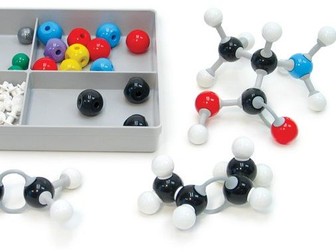
I created this resource as an interactive activity for open evenings, taster days and STEM events. Could also be used as a wall display of familiar organic molecules. You will need a good supply of Organic Chemistry Molymod sets. The idea is that learners are challenged to build organic molecules from Molymods. The molecules themselves are detailed on an A4 sheet - one per molecule. On each sheet is the IUPAC name for the molecule, the trivial name for the molecule, the molecular formula, and the skeletal structure. These range from simple molecules like ethanoic acid (vinegar) to more complex organic molecules such as neurotransmitters (dopamine, serotonin etc) and hormones (testosterone, oestrogen etc). Also included are some pharmaceutical drugs (paracetamol, morphine etc) and a few recreational drugs (heroin, nicotine etc) for comparison. There are 16 molecules altogether, each on a separate sheet. They are suitable for a range of abilities. These can be laminated for a professional look, or just colour printed. There are instructional sheets, too (including a sheet on understanding skeletal structures), and a title page for displaying on a table / wall / door. This resource would best suit Key Stage 4 (Years 10 and 11) learners who are studying organic chemistry, and A-level chemistry students , who go into more depth on this topic. Also suitable for Access to Higher Education and BTEC Science students.
Simple Flame Tests Worksheet for Metal Ion AnalysisQuick View
MissMelville

Simple Flame Tests Worksheet for Metal Ion Analysis

(0)
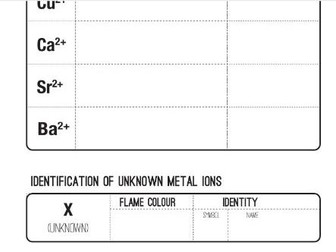
A really straightforward worksheet for learners to use when carrying out a flame test analysis to determine the identity of an unknown metal ion (X). The ions included are: copper, barium, sodium, lithium, potassium, calcium and strontium (as these have the prettiest and most characteristic colours!). These could be given in the form of chlorides or other salts. By burning a sample of each of the above in a Bunsen flame (Dipping first in hydrochloric acid - concentrated and dilute both work well), learners learn to recognise the characteristic colours of each metal ion. This allows them to identify the unknown (any of the above) by simply observing its flame colour. No procedure or health & safety included - just a sheet to record results and identity of the unknown.
Generic Simple Paper Chromatography WorksheetQuick View
MissMelville

Generic Simple Paper Chromatography Worksheet

(0)
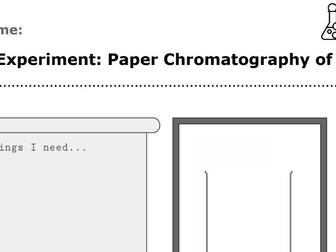
A double sided worksheet which can be used for most simple paper chromatography experiments, including food dyes, inks, pens, amino acids, plant pigments etc. There are spaces for: an apparatus / equipment list, a labelled diagram (beaker / jar only so students can customise according to the equipment they used), a health & safety checklist, before and after diagrams of chromatography paper / chromatogram, results (in a table that includes guidance on calculating Rf values), and a space for writing the identity of the components of a mixture. All with minimal words, and easy to understand guidance (No method / procedure included). I would recommend this for Key Stage 3 or low ability KS4 (I actually made this for my BTEC Applied Science students!). PDF format.