This is a structured revision lesson designed to support GCSE English Literature students in analysing the relationship between Macbeth and Lady Macbeth. The lesson focuses on developing students’ ability to move beyond simple retrieval and produce sophisticated analytical responses that meet the requirements of AO1, AO2 and AO3.
This structured GCSE revision lesson explores how J. B. Priestley uses the different generations in An Inspector Calls to present ideas about responsibility. Designed to develop analytical writing and deepen students’ understanding of Priestley’s intentions, the lesson guides students from knowledge retrieval to sophisticated GCSE-style responses.
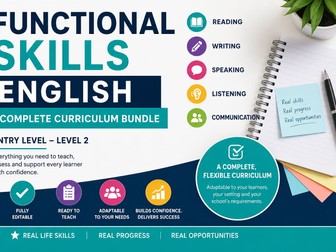
Complete Functional Skills English Curriculum Bundle (Entry Level – Level 2)
Transform your Functional Skills provision with this comprehensive, ready-to-teach Functional Skills English Curriculum Bundle. Designed to provide a complete curriculum pathway, this resource includes everything needed to deliver engaging, structured and effective lessons from Entry Level through to Level 2.
Whether you are teaching in a secondary school, FE college, sixth form, alternative provision, adult education setting or apprenticeship programme, this bundle provides a fully sequenced curriculum that can be easily adapted to meet the needs of your learners, organisation and timetable.
What’s Included?
Complete scheme of learning covering Reading, Writing, Speaking, Listening and Communication
Fully editable lesson PowerPoints
Retrieval and starter activities
Guided practice and independent tasks
Functional, real-world reading and writing activities
Vocabulary development opportunities
Exam-style practice questions
Assessment opportunities throughout
Revision and consolidation materials
Teacher modelling and scaffolded activities
Key Features
Fully editable and adaptable to suit your school’s curriculum requirements.
Suitable for mixed-ability groups and differentiated delivery
Designed to reduce teacher workload and planning time
Covers key Functional Skills skills progressively and systematically
Promotes confidence, independence and employability skills
Engaging real-life contexts that make learning meaningful and relevant
Can be used as a complete curriculum or as standalone lessons
Ideal For
Functional Skills English Entry Level 3
Functional Skills English Level 1
Functional Skills English Level 2
Further Education (FE)
Alternative Provision
Adult Learning
Apprenticeships
Secondary Intervention Programmes
Resit Students
Adaptable to Your Setting
One of the greatest strengths of this bundle is its flexibility. The curriculum has been designed to be adapted to individual learner needs, organisational requirements and local curriculum priorities. Lessons can be taught as written or modified to fit different cohorts, timetables and delivery models.
Save hundreds of hours of planning while providing learners with a coherent, high-quality Functional Skills English curriculum that builds confidence, develops essential literacy skills and prepares students for success in education, employment and everyday life.
Editable PowerPoint | NCFE-aligned | Ideal for KS4 & Post-16
This engaging, ready-to-teach PowerPoint introduces learners to Functional Skills English (Levels 1 & 2) with a strong focus on spelling strategies, high-frequency Tier 2 and 3 vocabulary, and homophone mastery. Perfect for lower-ability learners or those new to the Functional Skills route, the resource includes:
A clear breakdown of the Functional Skills English structure and assessment requirements (NCFE-aligned)
Spelling error correction tasks using real-world context and dictionary skills
Interactive activities including Think-Pair-Share, multiple choice quizzes, and I Do / We Do / You Do scaffolding
Creative extension tasks to deepen vocabulary through synonym generation and descriptive writing
Root word, prefix, and suffix recognition tasks to boost decoding and spelling skills
Homophone practice through sentence correction, gap fills, and writing tasks
A descriptive writing scaffold using sensory language and emotional tone variation
Fully editable and adaptable for classroom or remote learning. Ideal for KS4 learners, resit students, or adult learners working towards Functional Skills accreditation.
Fully Editable | NCFE & Pearson Edexcel Aligned | KS4, Resits & Adult Learners.
This comprehensive and engaging PowerPoint lesson equips learners with the knowledge and skills to identify, plan, and produce a range of non-fiction text types: articles, reviews, blogs, and leaflets. Each format is broken down with clear models, key features, vocabulary development, and scaffolded writing support—perfect for preparing learners for their Functional Skills English Level 1 and 2 writing assessments.
What’s Inside:
Clear definitions and structural breakdowns of articles, reviews, blogs, and leaflets
Form-Audience-Purpose (FAP) tasks to build awareness of tone, vocabulary, and structure
Comparative exercises to transform one format into another (e.g. letter → tweet)
Think-Pair-Share activities, quizzes, model responses, and sentence scaffolds
Article features: headlines, straplines, paragraphing, subheadings, persuasive language
Review writing with opinion, evidence, description, and recommendation
Blog writing: informal tone, personal voice, audience interaction, call to action
Leaflet design: subheadings, persuasive bullet points, contact details, layout awareness
Creative tasks including writing about films, hobbies, health campaigns, and social issues
Embedded vocabulary support (e.g. onomatopoeia, oxymoron) and SPAG correction exercises
This resource is ideal for Functional Skills learners at Levels 1 and 2, GCSE resit students, and EAL learners developing real-world writing fluency. Fully editable and suitable for in-class, remote, or independent learning.
Fully Editable PowerPoint | NCFE & Edexcel Aligned | KS4 & Post-16 Ready.
This comprehensive PowerPoint lesson supports learners in mastering the core punctuation and grammar skills required for Functional Skills English at Levels 1 and 2. The session builds on spelling strategies taught in Module 1 and expands into sentence structures, accurate punctuation, and essential grammar conventions.
What’s Included:
Engaging recap of punctuation types and their functions (commas, apostrophes, colons, semicolons, etc.)
Sentence correction activities and punctuation drills using real-world examples
Capital letter rules, speech punctuation, and correcting common grammatical errors
Grammar mini-lessons: parts of speech, subject-verb agreement, tenses, articles, and conjunctions
Scaffolded tasks using the “I Do, We Do, You Do” approach
Exercises on simple, compound, and complex sentence structures
Activities focused on using modal verbs, auxiliary verbs, and cohesive devices
Extension tasks linked to formal letter writing, descriptive writing, and analysis of poetry (e.g., My Last Duchess)
Visuals, Think-Pair-Share prompts, and contextualised writing tasks
Ideal for GCSE resits, Functional Skills preparation, and lower-ability KS4 students. Aligned with NCFE and Pearson Edexcel assessment outcomes. Adaptable for classroom delivery or online teaching.
Fully Editable | NCFE & Edexcel Aligned | Ideal for KS4 & Post-16 Learners.
This comprehensive, learner-friendly PowerPoint focuses on the vital reading skills required for Functional Skills English at both Level 1 and Level 2. Designed to enhance reading comprehension and analytical thinking, this session equips students to identify purpose, audience, tone, bias, and key details across a range of text types.
Resource Highlights:
Step-by-step guidance on reading for purpose using TAP (Text Type, Audience, Purpose)
Explicit teaching of fact vs. opinion with real-world examples and task
Skills-based reading techniques: skimming, scanning, and identifying key information
Text analysis activities covering adverts, articles, reports, emails, and more
Tasks on formal vs. informal tone and biased vs. balanced language
Focused practice on analysing persuasive devices and emotive language
Scaffolded reading comprehension tasks with modelled answers
Student-led activities including comparison questions, formal rewording tasks, and paragraph writing
Bonus Features:
Realistic reading texts such as government reports, adverts, and news stories
Embedded grammar and sentence structure revision (simple, compound, complex)
Ideal for GCSE resits, Functional Skills preparation, and EAL/ESOL support
This resource is designed to build confident, critical readers and help students meet Functional Skills English reading outcomes. Adaptable for in-class, remote, or homework use.
Fully Editable | NCFE & Pearson Edexcel Aligned | Ideal for KS4, Resits & Adult Learners.
This immersive, skill-building PowerPoint helps learners identify and analyse a wide range of language features before applying their understanding to compare texts – a key requirement in Functional Skills English reading assessments. Designed with accessibility and engagement in mind, the lesson supports both scaffolded learning and independent exam-style practice.
What’s Inside:
Clear explanations and definitions of key language features: simile, metaphor, hyperbole, rhetorical question, emotive language, rule of three, repetition
Matching and gap-fill activities to reinforce language feature knowledge
Rich descriptive examples with modelled and ‘improved’ versions to enhance analytical thinking
Visual prompts and creative tasks to develop figurative writing
Scaffolded description writing using identified language techniques
Introduction to comparison skills: how to identify similarities and differences in purpose, tone, opinions, and features across texts
Model answers using the P.E.E. (Point, Evidence, Explanation) structure
Realistic comparison prompts and practice tasks, including Venn diagram analysis
Exam-style questions and annotated examples to build confidence and application
Perfect for GCSE resit students, Functional Skills learners at Levels 1 and 2, and any KS4 pupils who benefit from highly scaffolded, visual, and applied English teaching.
Fully Editable | NCFE & Pearson Edexcel Aligned | Ideal for KS4, Resits & Adult Learners.
This rich, interactive PowerPoint helps learners develop deeper reading skills by exploring how writers use textual and organisational features for effect, and how meaning is created both explicitly and implicitly. It also strengthens learners’ inference skills—crucial for achieving Level 2 Functional Skills standards.
Key Features of the Lesson:
Clear introduction to textual, organisational, and language features (e.g. headings, subheadings, bullet points, tone, layout)
Tasks exploring implicit and inferred meaning, using real-world texts and visual cues
Activities focusing on reading between the lines, identifying bias, and understanding tone and atmosphere
IDEAS technique (Identify, Describe, Explore, Analyse, Assess) applied to develop inferential comprehension
Model answers and structured sentence stems to support written responses
Contextual vocabulary learning and dictionary tasks
Multimedia integration including film stills, images, and Think-Pair-Share prompts
Literary extract analysis (e.g. White Fang by Jack London) linked to reading for purpose and emotional inference
Final “You Do” independent tasks for assessment-style practice
Perfect for Functional Skills English Level 1 & 2, this resource is ideal for KS4 students, post-16 resitters, EAL learners, and adult learners preparing for exams. Designed for high engagement and clarity, with scaffolded progression throughout.
Fully Editable | NCFE & Pearson Edexcel Aligned | Ideal for KS4, Post-16, Resits & Adult Learners.
This detailed and highly interactive PowerPoint supports learners in understanding the format, tone, and language of formal and informal letters and emails. Aligned with Functional Skills English Level 1 & 2 writing standards, this lesson teaches students how to plan, structure, and improve written communications with clarity and purpose.
Key Features:
Clear breakdown of formal vs informal writing (tone, structure, audience, and vocabulary)
Tasks identifying formality in sample sentences and real-world scenarios
Guided practice using the DAFORREST persuasive techniques
Annotated letter models and improvement activities (tone, grammar, punctuation)
Formal letter structure including address placement, greetings, paragraphs, and sign-offs
Practice exam questions and extended writing tasks with planning support
Peer assessment checklists to encourage self-review and accountability
Vocabulary focus (e.g. irony, imagery) to enhance writing fluency
Email structure breakdown and real-world examples for comparison
Perfect for learners preparing for Functional Skills English Level 1 or 2 assessments, GCSE resits, or EAL students needing clear models and scaffolded tasks. Adaptable for use in-class, remotely, or as independent study resources.
Fully Editable | NCFE & Pearson Edexcel Aligned | Ideal for KS4, Post-16, Resits & Adult Learners.
This detailed, learner-friendly PowerPoint helps students identify and apply the correct structure and format for report writing and forum posts – two key Functional Skills English writing tasks. Through modelling, scaffolded writing, and comparison tasks, learners are guided to develop formal and informal writing techniques with purpose, audience, and clarity in mind.
What’s Included:
Explicit teaching of key format features: heading, introduction, findings, conclusion, recommendations (reports), and opinion + evidence (forums)
Comparison activities exploring structure, tone, and purpose across different text types (government leaflets vs blogs, formal articles vs social media posts)
Scaffolded sentence building and grammar corrections
Practice questions and quizzes to reinforce formality, tone, and clarity
Model report: “GCSE Examination Results” with comprehension and language analysis tasks
Vocabulary building (e.g. oxymoron) with definitions, synonyms, and examples
Guided writing using sentence starters, structured planning, and What-How-Why (PEE) paragraphs
Forum writing tasks focused on social media, with balance, evidence, and structure
Group discussion and challenge tasks: encouraging analytical thinking and multiple perspectives
Perfect for Functional Skills learners at Level 1 or 2, GCSE resits, or EAL/ESOL students building real-world writing skills. Adaptable for individual work, group tasks, remote learning or intervention support.
Fully Editable | NCFE & Pearson Edexcel Aligned | Ideal for KS4, Post-16, Resits & Independent Learning.
This extensive, exam-focused PowerPoint provides learners with a wide variety of writing tasks designed to mimic real Functional Skills English Level 1 and 2 assessments. The session allows learners to consolidate their knowledge, apply writing skills across a range of text types, and identify strengths and areas for improvement through mock exam practice.
What’s Inside:
Full mock assessment scenarios covering both Level 1 and 2 standards
Over 20 realistic writing prompts, including:
Formal letters of complaint and application
Informal and formal emails
Articles for newsletters and local magazines
Reports, speeches, leaflets, guides, and blog-style reviews
Step-by-step instructions and clear learner guidance (word counts, tone, audience)
Structured planning and success criteria to build exam confidence
Focused on purpose, audience, structure, language features, and tone
Embedded grammar, punctuation, and sentence-level accuracy reminders
Can be printed or completed digitally — ideal for class use or independent revision
Suitable for initial assessment, final mock exams, or revision booster sessions
Perfect for Functional Skills English students at both Level 1 and Level 2, this resource is ideal for resits, distance learners, and EAL students preparing for writing assessments in real-world contexts.
Editable Mock Exam | NCFE & Edexcel Aligned | Ideal for KS4, Post-16 & Resit Learners.
This editable, classroom-ready mock assessment gives learners the opportunity to practise a full Functional Skills English reading paper (Levels 1 & 2) in a supportive and structured format. The resource consolidates learning from previous modules, reinforcing essential exam skills and allowing learners to identify strengths and areas for development.
Key Features:
Realistic mock assessment tasks aligned with NCFE and Pearson Edexcel specifications
Consolidates prior learning across Modules 1–5, including SPAG, inference, comparison, and language features
Clear learner instructions based on official assessment formats
Space for students to complete responses within the PowerPoint or on printed versions
Ideal for in-class exam prep, homework, or diagnostic baseline testing
Supports independent practice and can be used for formal or informal assessment
Can be adapted for differentiation, group work, or one-to-one revision sessions
Perfect for Functional Skills English learners working at Level 1 or 2, GCSE resit students, or adult learners preparing for summative assessments.
Fully Editable | NCFE & Pearson Edexcel Aligned | Ideal for KS4, Post-16 & Adult Learners.
This fully editable PowerPoint resource guides learners through the process of preparing for Task 2 of the Functional Skills Speaking, Listening & Communication (SLC) assessment – participating in a structured group discussion. The session provides clear expectations, planning support, vocabulary development, and participation strategies, empowering students to speak confidently and respond appropriately in a formal setting.
What’s Included:
Step-by-step guidance on planning and preparing for a successful 10–15 minute group discussion
Clear objectives linked to national assessment criteria (making relevant, structured contributions; adapting tone and language; active listening)
Vocabulary focus (e.g. alliteration) to enhance language use during discussion
Practical advice for researching, making points, and using persuasive phrases
Prompts for responding thoughtfully to others and encouraging inclusive conversation
Scaffolding for both speaking and listening skills, including turn-taking and respectful interjections
Planning templates to help learners structure their ideas and rehearse effectively
Ideal for in-class or remote learning, 1:1 support or group rehearsal
Perfect for learners preparing for Functional Skills English Level 1 or 2 SLC assessments, this resource builds confidence, fluency, and critical verbal communication skills essential for both assessment success and real-world application.
Fully Editable | NCFE & Pearson Edexcel Aligned | KS4, Resit & Adult Learners.
This student-friendly, structured PowerPoint guides learners through the preparation process for Task 1 of the Functional Skills Speaking, Listening & Communication (SLC) assessment — planning and delivering a short presentation followed by a Q&A session. It supports learners in building confidence, understanding expectations, and developing the necessary verbal communication skills to succeed.
Key Features:
Step-by-step breakdown of SLC Task 1 requirements (short talk + Q&A)
Clear learning objectives and outcomes linked to national assessment criteria
Planning prompts and structured tables to guide topic selection, research, and presentation structure
Emphasis on verbal communication techniques, including audience awareness, tone, and eye contact
Vocabulary focus (e.g. repetition) to enhance spoken clarity and rhetorical impact
Rehearsal and timing strategies to prepare learners for assessment day
Q&A prompts to build questioning and response skills as both speaker and audience member
Suitable for face-to-face and virtual delivery formats
Ideal for Functional Skills learners at Level 1 or 2, this resource supports confidence-building, active engagement, and assessment readiness.