A PPT presentation that explains what a new year’s resolution is and why we make them. How to choose a resolution, picking something they want to get better at and something that would be easy and fun. Also included is a lot of ideas of resolutions to prompt discussion - health, learning, planet saving, kindness, sport and hobby and personal growth.
Differentiated worksheets are also included in a separate ppt.
Could also be used for an assembly if adapted.
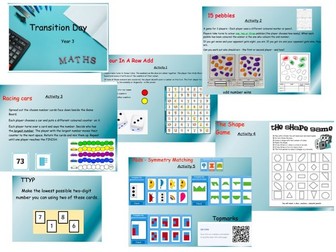
A great fun maths lesson for transition day for Year 2 children moving to Year 3 in September. Now with Flipchart - ActivInspire and PPT.
Simple starter activities - what are these numbers (tens and ones)
Make the highest two digit number using these four number cards.
Make the lowest two digit number using these four number cards.
Children then split into 5 groups with 5 different activities/games. Activities are explained on each slide.
Resource slide will tell you everything you need for each activity and other resources attached .
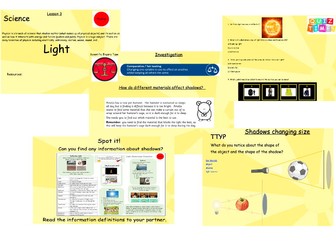
Light Unit of work for Year 3. Six lessons with resources, success criteria stickers and a low stakes quiz for each lesson. Scientific Investigations and differentiated activities/worksheets for majority of lessons. Knowledge Organiser also included.
Lesson 1 - Why do we need light? sorting activity
Lesson 2 - Which surfaces reflect light? Scientific investigation
Lesson 3 - How can we protect our eyes? poster
Lesson 4 - How are shadows formed? How do different materials affect shadows? Scientific investigation
Lesson 5- How do the size of shadows change? Scientific investigation
Lesson 6 - Assess and Review- Mind map and Quiz
Year 1 Everyday Materials Resources to teach the whole topic. Knowledge organiser, MTP and 11 lessons with worksheets or activity. Activ Inspire for each lesson. Topic coverage:
Lesson 1
What is a material?
Lesson 2
What are objects made from?
Lesson 3
How can I describe an object?
Lesson 4
Which materials float and sink?
Lesson 5
Which materials are absorbent?
Lesson 6
Which materials are best for different objects?
Lesson 7
What materials could I use to build a wall? (
Lesson 8
Is the wall I’ve built waterproof? (
Lesson 9 and 10
Which materials can withstand strong winds? (
Lesson 11
Assessment Lesson- Quiz
(Ideas taken for Oak Academy lessons)
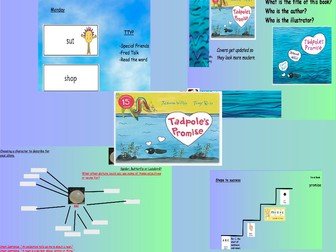
Two weeks of English lessons based on the book Tadpole’s Promise.
ActivInspire Flipchart - Each day has a quick phonics read slide, a LO slide, vocabulary slide and a steps to success slide. A long with the lesson/teaching slides.
Where appropriate a differentiated activity for the less able and resources. Week 1 includes children writing their own promise, making a fact sheet on tadpoles, presenting information, looking at capital letters for days of the week (spag lesson). Week 2 includes sequencing the story, looking at adjectives and nouns related to the story, changing the story opener (changing one character), and thinking of an alternative ending before writing their own story.
I have listed a brief outline of each day.
Week 1 (5 lessons)
Monday - L.O I can show you where I can use a capital letter for the names of people and when I use I.
Looking at the front cover of A Tadpoles Promise and discussing what a promise is. Children write their own promise.
Tuesday- L.O I can add two sentences together using ‘and’.
LO: I can spell some words using the phonemes I have learnt.
Children to read a fact sheet (T led or a copy for each child). Activity – Children to create a fact file (template available) about tadpoles, using ‘and’ to join linked ideas. LA- close procedure worksheet.
Wednesday - L.O I can read aloud my own writing so my friends and the teacher can hear me.
Children discuss what they know about caterpillars and then watch a video (link) and make notes. Children to then present to each other.
Thursday- L.O :I can show you where I can use a capital letter for the days of the week.
-I can spell the days of the week and use them in a sentence.
Read the Hungry Caterpillar – discussion on when we should use capital letters.
What would your caterpillar eat on each day of the week? Children to then write their own choices for their caterpillar.
Friday - LO: I can tell you where I would use a capital letter.
LO: In my writing I use capital letters for the names of
people, places, the days of the week and when I use I.
Looking at nouns and proper nouns. Children to re write the sentences, putting the capital letters in correctly.
Week 2 (6 lessons)
Monday
L.O -to retell the main events of a story in sequence.
What is a story sequence? Look at the traditional tale Jack and the Beanstalk – discuss what is wrong with the sequence. Activity - Children to sequence the pictures of a Tadpoles Promise.
Tuesday- L.O to use adjectives to add detail.
Recap on what adjectives and nouns are.
Children to find the nouns and adjectives in the text- A Tadpoles Promise.
Wednesday – L.O - I can put words together to build sentences. story openers
Thursday – LO - To plan an alternative ending to the story Children to discuss a different ending.
Friday – LO: L.O - I can put words together to build sentences.
write whole story.
*Extra lesson -SPAG based on nouns and plurals adding s and es – link to tadpole’s promise
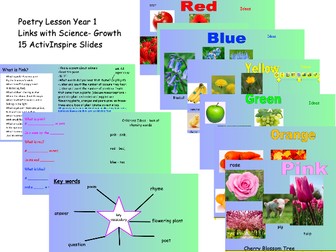
Literacy lesson links with Science and growth
Children to create their own poem based on the poem, What is PInk?
Objectives-
I can join in with a poem.
I can identify rhyming words.
I can use a question mark correctly.
I can identify and name a variety of common wild and garden plants (science).
Poetry frame and poem attached
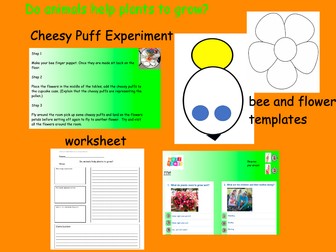
Cheesy Puff Experiment Do animals help plants to grow? Lesson explains simple pollination
Complete lesson (ActivInspire) with templates and worksheet. Lesson starts with a quiz to check understanding.
Children will make a bumble bee (template inc.) and punch out holes to put their fingers through to act as the bees legs. Flowers are put on each table with a pot(cupcake case) of cheesy puffs in the middle. Children cut and colour their bee and punch in holes. Children fly from flower to flower picking landing on the flower petals before flying off. Children to then look at the flowers and discuss findings and complete worksheet. Worksheet has be modelled if necessary.
You will need; the whole afternoon, cheesy crisps, pots for crisps, large hole punch, bee template, scissors, yellow and black crayons and the worksheet.
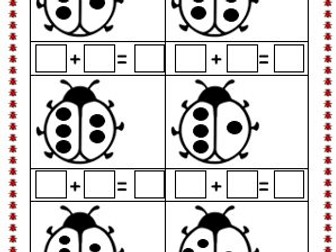
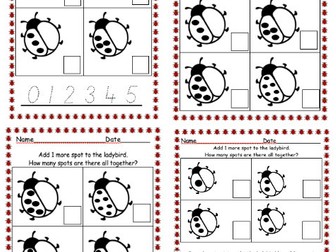
Six worksheets either adding or taking away one spot off the ladybird.
Four sheets add one more differentiated by number of spots (up to 10)
Last two sheets a mixture of adding a spot or taking one away up to 5.
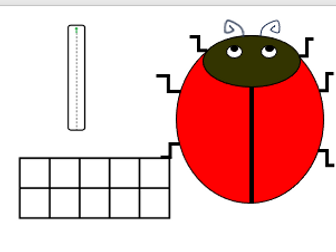
To use either with play dough or once laminated with a whiteboard pen.
Children can draw the spots or make the correct number of balls out of play dough. They an also make the number in the tens frame.
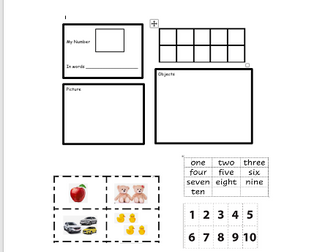
Number Mat (2 different types)
Numbers as words
Numbers as numerals
Pictures of objects 1 to 10
Two different mats one with space for the chosen number in words other mat without.
Mat has a space to cut out and stick or write the number,a space for the number as a written word, tens frame (for child to add correct number of counters and a space to stick the corresponding picture and a space for the child to draw that number of object or add real objects.
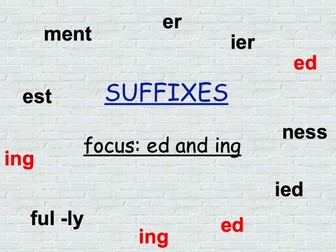
An ActivInspire flipchart with examples, information and activities on the rules of adding the suffix ed and ing. The flipchart contains lots of example words. The lesson can be split into different days depending on what rule you are teaching.
Children can join in with the activities using their own whiteboards to record answers.
Three worksheets also accompany the flipchart.
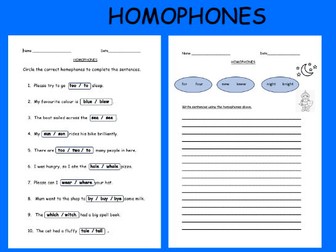
A selection of homophone worksheets (x17) to help reinforce children’s knowledge of homophones.
Worksheets included are:
-Write sentences by selecting from a selection of homophones (x6 worksheets).
-Choose the correct homophone for each definition (x4 worksheets)
-Choose the correct homophone to complete the sentence from a selection of homophones (x4 worksheets).
-Circle the correct homophone to complete the sentences (x3 worksheets).
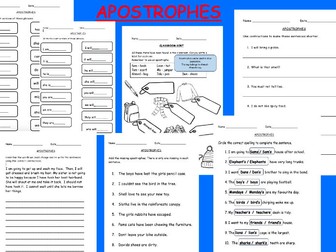
A number of worksheets to support learning apostrophes.
-Writing the short versions of phrases.
-Using contractions to make sentences shorter
-Circling words that need an apostrophe
-Adding the missing apostrophe
-Write the labels for items using an apostrophe
-Find where the apostrophes should go and write the paragraph out correctly.


 Quick View