AI in Everyday LifeQuick View
toni1976

AI in Everyday Life

(0)
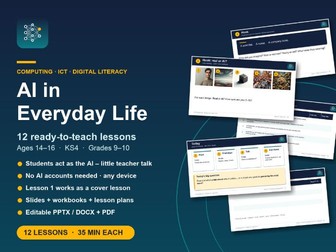
A complete 12-lesson unit where students learn about AI by acting as the AI. They play a recommender algorithm, fact-check an AI biography, predict words like a language model and train a biased classifier. Teacher talk is kept to a minimum and every lesson ends in real discussion. It runs on any device, students never need an AI chatbot account, and Lesson 1 works as a ready-made cover lesson. What makes this unit different Students don’t just hear what AI is: they become it. Each lesson starts with a quick hook. Pairs then take on a hands-on challenge in a slide workbook, and the key idea comes out of the class discussion. Teacher talk stays under 5 minutes per lesson. Every lesson follows the same simple routine (~35 minutes, easy to stretch to 50–60) Hook (3 min): one image, statement or question and a quick vote Challenge (18 min): pair work in an editable slide workbook Talk (9 min): three discussion questions Key idea + exit ticket (5 min): three quick questions to check understanding The 12 lessons AI or Not? – sort everyday tech using the “Learning Test” (independent / cover lesson) Be the Recommender – act as a video-app algorithm… then the boss changes the goal What Your Data Says About You – build a profile from one day of phone data The Turing Case – fact-check an AI biography of Alan Turing that contains 6 hallucinations The Human Language Model – predict the next word, safe vs creative mode Real or AI? – images, deepfakes and the STOP rule Bias: Train the Machine – learn from biased data, then test it on new people AI in Games – write IF–THEN rules for a game guard, then add learning Search Engine vs AI Answer – spot the errors and check the source AI Dilemmas: Who Decides? – vote, argue against yourself, re-vote and write golden rules AI and the Jobs of the Future – break jobs into tasks AI can do, can help with, or can’t do Final Project: The AI Survival Guide – a Canva infographic for younger students, with a rubric
Online Safety Escape Room: Escape the Feed (KS4, no internet)Quick View
toni1976

Online Safety Escape Room: Escape the Feed (KS4, no internet)

(0)
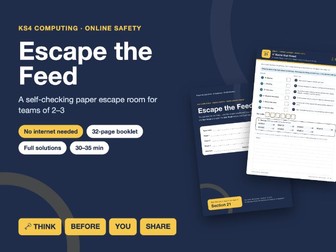
A self-checking paper escape room for Online Safety. Teams of 2–3 race through four zones, win four keys and open the Exit Vault in 30–35 minutes, with no devices or internet needed. Escape the Feed turns four Online Safety lessons into one game-based lesson: being safe online, online reputation, big data and data protection, and the right to privacy. Students “scrolled for too long” and the screen swallowed them. To escape, they must solve 12 challenge rooms and 4 junctions, then pass the Exit Vault and a final showdown. How it works The 32-page team booklet is a real choose-your-own-adventure. The sections are numbered and shuffled, so the next room is never simply the next page. Every room ends with a code lock: teams turn their answers into a code, find it in the lock and go to that section. Wrong codes lead to “Wrong code” sections (−10 points) with a tip and a route back, so the booklet checks itself and looking at the lock does not give the answer away. At each junction teams choose one of three doors. Trap doors explain the mistake, so even wrong turns teach something. What is inside Team booklet (A4, 32 pages, one per team): cover with start section, how to play, score sheet, map with key slots, 12 challenge rooms, 4 junctions, traps, the Exit Vault, a 6-question final showdown (each player answers alone), a certificate and two pages of hints. Teacher guide (A4, 12 pages): timings, scoring and ranks, how the paper codes work, a full route and codes table, every answer with hints and key ideas, the final showdown answers, and 13 cut-out “Help us through” cards so no team ever gets stuck. Challenge types Match up (threats, attackers, laws, rights), sorting (harmful but legal or illegal, true or false, ethical or unethical, the three Vs of big data), spot the posts that could damage a reputation, lock down a social media profile, and four decision junctions (pop-up prizes, password requests, ransomware and app permissions). Content covered Malware, phishing, fake news, targeted advertising, online hate crime, the Dark Web, digital footprints and online reputation, scammers, hackers and impersonators, big data (volume, variety, velocity), ethical uses of data, ransomware, keyloggers, brute force and password guessing, the Data Protection Act (2018), GDPR, Article 8 of the Human Rights Act, the Investigatory Powers Act (2016) and data subject rights.
AS & A Level Computer Science Mock Exams Bundle – Theory + Practical with Mark SchemesQuick View
toni1976

AS & A Level Computer Science Mock Exams Bundle – Theory + Practical with Mark Schemes

(0)
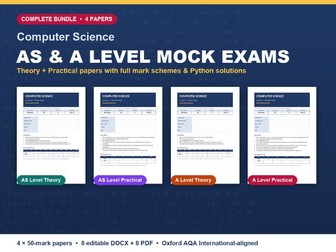
A complete, ready-to-use set of KS5 Computer Science mock exams, aligned to the Oxford AQA International AS and A-level specifications. Ideal for autumn-term mocks, end-of-unit assessment or revision. What’s in the bundle AS Level Theory Paper (9 questions, 50 marks) Trace tables, data types, string manipulation, selection and validation, exception handling, parallel arrays, 2D arrays and subroutines, records, queues and stacks. AS Level Practical Paper (4 programming tasks, 50 marks) Product-code validation, sales processing with exception handling, a 2D car-park grid, and a stack and linear queue built on static arrays. Includes 4 Python model solutions. A Level Theory Paper (9 questions, 50 marks) Polymorphism, dictionaries, encapsulation, hash tables with linear probing, stack trace, binary search trees, inheritance, file handling, and expression trees with recursion. A Level Practical Paper (4 programming tasks, 50 marks) OOP with inheritance and file handling, recursion (call-stack trace and palindrome checker), a hash table class, and a binary search tree stored in arrays with traversals. Includes 4 Python model solutions and a sample data file. Every paper includes A student exam paper with a neutral cover page (blank centre, candidate, class and teacher fields) and an examiner’s mark grid A detailed teacher mark scheme with mark-by-mark guidance and a final marks check Fully editable DOCX and print-ready PDF versions Better value: buying the bundle costs about 30% less than buying the four resources separately. Teacher-created practice resource. Not an official Oxford AQA publication and not endorsed by Oxford AQA.
IGCSE ICT Edexcel Unit 1 Digital Devices: 3 Exam Papers + Mark SchemesQuick View
toni1976

IGCSE ICT Edexcel Unit 1 Digital Devices: 3 Exam Papers + Mark Schemes

(0)
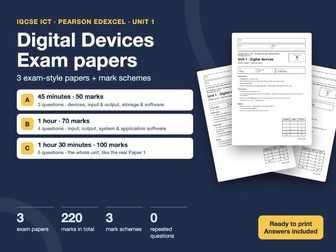
Three original exam-style papers for Pearson Edexcel International GCSE ICT Unit 1 Digital Devices – 45 minutes, 1 hour and 1 hour 30 minutes – each with a full mark scheme in the official style. Every paper is set around a realistic scenario and uses the same layout and command words as the real Paper 1, so students practise exactly what they will meet in the exam. WHAT’S INCLUDED (6 PDF files, A4) • Paper A – 45 minutes, 50 marks: 8-page paper + 5-page mark scheme. Three questions about a wedding photographer. • Paper B – 1 hour, 70 marks: 9-page paper + 7-page mark scheme. Four questions about a hotel manager. • Paper C – 1 hour 30 minutes, 100 marks: 13-page paper + 9-page mark scheme. Five questions about a game developer – the same length and total as the real Paper 1. In total: 220 marks and no repeated questions, so you can use the papers at different points of the course: as an end-of-topic test, a mid-unit check and a full mock. WHAT THE PAPERS COVER Paper A · digital devices and their features (cameras, flash memory, laptops, smartphone interfaces, connectivity and security), input and output devices (scanners, choosing a printer, projectors, monitor resolution, sensors and actuators) and memory, storage and software (RAM and ROM, virtual memory, compression, defragmentation, application software). 6-mark Discuss: SSD or HDD? Paper B · RFID, biometrics, NFC and chip and PIN, tablets and smart sensors; monitors, projectors, plotters, magnetic tape and hard disks; operating system functions, utilities, print spooling, network operating systems and accessibility settings; spreadsheets, databases, project management, web authoring and software licences. 8-mark Discuss: open-source or proprietary software? Paper C · embedded computing, convergence, processors and energy consumption; sound cards, graphics tablets, QR codes, OCR and touch screens; laser and 3D printers, 4K, surround sound and haptic output; EPROM, KiB calculations, optical media, RAM vs ROM and fragmentation; app stores, graphics, freeware, open source and software updates. Two 8-mark Discuss questions: buying a 3D printer, and releasing a game for smartphones and tablets.
IGCSE ICT Edexcel Unit 3 Operating Online: Student Booklet + Teacher's AnswersQuick View
toni1976

IGCSE ICT Edexcel Unit 3 Operating Online: Student Booklet + Teacher's Answers

(0)
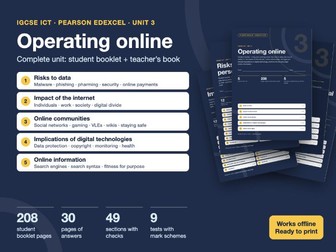
The complete Pearson Edexcel International GCSE ICT Unit 3 Operating online in two print-ready books: a 208-page student booklet and a 30-page teacher’s answer book. It covers all five topics of the unit with clear explanations, the activities from the student book, a check after every section and exam-style tests. No preparation needed and no internet required. WHAT’S INCLUDED (2 PDF files, A4) • Student booklet – 208 pages: unit cover and contents, then five topics, each with its own cover, explanations, section checks, “Try it on paper” tasks, tests and a key terms page. In total: 49 sections, 49 section checks, 40 book activities and 9 tests (253 marks). Ready to print double-sided. • Teacher’s answer book – 30 pages: answers to every check, model answers for every book activity and paper task, and mark schemes for every test. Topics, sections and question numbers match the student booklet one to one. CONTENT Risks to data and personal information (49 pages): unauthorised access, malware, accidental deletion, phishing, smishing and pharming; firewalls and encryption, passwords, PINs and biometrics, CAPTCHA and security questions, anti-malware and file permissions, secure websites, attachments and links, backups and online payment systems. Two tests (26 + 28 marks). Impact of the internet (60 pages): the internet and protocols, information and services, employment, working practices, social impact, staying safe online, working from home, positive and negative impacts on organisations, the digital divide, less restricted access to networks, the information gap and socialising. Two tests (30 + 37 marks). Online communities (23 pages): social networking, online gaming, online work spaces, virtual learning environments, wikis and forums, user-generated content, functions and target audiences, global communication and staying safe. Final test (31 marks). Implications of digital technologies (40 pages): data protection, data across borders, copyright, fair use, DRM and geoblocking, monitoring movements and communications, sustainability, health and safety, and AI and responsibility. Two tests (28 + 28 marks). Online information (31 pages): information sources, search engines, search types and tools, search syntax, fitness for purpose, copyright and plagiarism. Two tests (25 + 20 marks).
IGCSE ICT Edexcel Unit 4 Online Goods and Services: Student + Teacher BooksQuick View
toni1976

IGCSE ICT Edexcel Unit 4 Online Goods and Services: Student + Teacher Books

(0)
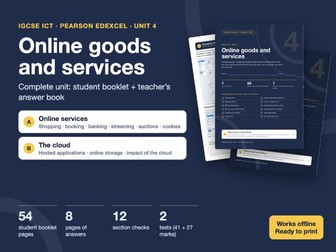
The complete Pearson Edexcel International GCSE ICT Unit 4 Online goods and services in two print-ready books: a 54-page student booklet and an 8-page teacher’s answer book. It covers both chapters of the unit – Online services and The cloud – with clear explanations, the activities from the student book, a check after every section and two exam-style tests. No preparation needed and no internet required. WHAT’S INCLUDED (2 PDF files, A4) • Student booklet – 54 pages: unit cover and contents, 12 sections, 5 book activities, 12 section checks, “Try it on paper” tasks, two end-of-part tests and a key terms page. Ready to print double-sided. • Teacher’s answer book – 8 pages: answers to every check, model answers for every book activity and paper task, and mark schemes for both tests. Sections and question numbers match the student booklet one to one. CONTENT Part A · Online services (Chapter 11): shopping sites (product catalogues, categories, the basket and the checkout); booking systems and e-tickets; banks and education (online banking, loans, libraries and learning platforms); gaming, news and real-time information; entertainment providers (streaming and downloads); auction sites (ratings, alerts and bidding); the impact of online services on lifestyle and behaviour and on organisations; transactional data and cookies (session, persistent and third-party). Test Part A: 41 marks. Part B · The cloud (Chapter 12): hosted applications software and working together online; online data storage, its benefits and drawbacks; the impact of the cloud on organisations and individuals. Test Part B: 27 marks.
IGCSE ICT Edexcel Complete Course Units 1-5: Student Book + Teacher's AnswersQuick View
toni1976

IGCSE ICT Edexcel Complete Course Units 1-5: Student Book + Teacher's Answers

(0)
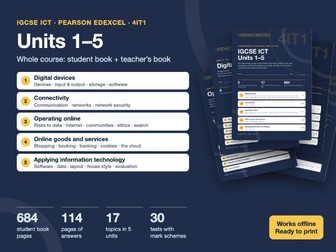
The whole Pearson Edexcel International GCSE ICT (4IT1) theory course in two print-ready books: a 684-page student book covering all five units and a 114-page teacher’s book with every answer and mark scheme. Every topic is explained step by step, checked after each section and tested exam-style – no preparation needed and no internet required. WHAT’S INCLUDED (2 PDF files, A4) • Student book – 684 pages: a course cover and contents, then each unit with its own cover and contents page, and each topic with its own cover, explanations, section checks, “Try it on paper” tasks, tests and a key terms page. In total: 17 topics (including a Unit 1 practice test), 156 sections with a check after each one, 102 book activities and 30 tests (870 marks). Ready to print double-sided. • Teacher’s book – 114 pages: answers to every check, model answers for every book activity and paper task, mark schemes for every test and a self-marking answer guide for the Unit 1 practice test. Units, topics and question numbers match the student book one to one. CONTENT Unit 1 · Digital devices (316 pages): types and features of digital devices, input devices, output devices, storage, memory and processors, system software, disk defragmentation and application software, plus a 40-mark unit practice test. Unit 2 · Connectivity (52 pages): bandwidth and latency, wired and wireless communication, LAN, WAN and PAN, IP and MAC addresses, network components, the internet, peer-to-peer and client-server networks, and network security. Unit 3 · Operating online (208 pages): risks to data and how to protect it, the impact of the internet, online communities, the legal and ethical implications of digital technologies, and finding and using online information. Unit 4 · Online goods and services (54 pages): shopping, booking, banking, entertainment and auction sites, cookies and transactional data, hosted applications, online storage and the impact of the cloud. Unit 5 · Applying information technology (52 pages): choosing the right software, data and information, types of data, purpose, user and layout, house styles and fonts, colour and accessibility, checking content, and evaluating a product against its requirements.
Pearson Edexcel International GCSE ICT Unit 1 Digital Devices in eight print-ready student bookletsQuick View
toni1976

Pearson Edexcel International GCSE ICT Unit 1 Digital Devices in eight print-ready student booklets

(0)
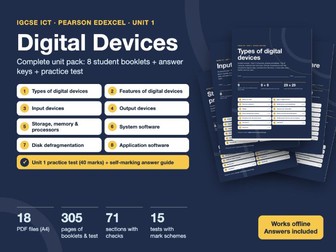
The whole of Pearson Edexcel International GCSE ICT Unit 1 Digital Devices in eight print-ready student booklets, each with a separate answer key, plus a 40-mark unit practice test with a self-marking answer guide. Every topic is explained step by step, checked after each section and tested exam-style – no preparation needed and no internet required. WHAT’S INCLUDED (18 PDF files, A4) Types of digital devices – 39-page booklet + 5-page answer key. Computers, mobile phones, tablets, cameras, home entertainment, games consoles, navigation aids, smart homes and convergence. Two tests (29 + 29 marks). Features of digital devices – 24-page booklet + answer key. Portability, performance, storage, user interface, connectivity, media support, energy consumption, expansion and security, with a “compare the devices” page. Final test (25 marks). Input devices – 39-page booklet + answer key. Keyboards, pointing devices, scanners, barcodes and QR codes, webcams, microphones, touch screens, biometrics, card readers and sensors. Two tests (28 + 34 marks). Output devices – 37-page booklet + answer key. Monitors, dot matrix, inkjet, laser and 3D printers, plotters, data projectors, speakers and actuators. Two tests (29 + 29 marks). Storage, memory and processors – 43-page booklet + answer key. Secondary storage, hard disks, optical, flash and tape, capacity, RAM, ROM, flash memory and processors. Two tests (29 + 30 marks). System software – 47-page booklet + answer key. Utility software, defragmentation, compression, disk formatting, operating systems, network operating systems, memory and resource management, security, print spooling and accessibility. Two tests (25 + 31 marks). Disk defragmentation – 17-page booklet + answer key. A short focused booklet on fragmentation, defragmentation and SSDs. Final test (10 marks). Application software – 51-page booklet + answer key. Apps and app stores, word processing and DTP, spreadsheets, databases, web authoring, image and sound editing, presentations, control, project management, communication software, licensing and updates. Two tests (28 + 32 marks). Unit 1 practice test – 8 pages, 35 minutes, 40 marks (multiple choice, short answers and a 6-mark “discuss” question), with a 9-page answer guide that explains every answer so students can mark their own work.
IGCSE ICT Edexcel Unit 2 Connectivity: Student Booklet + Teacher's AnswersQuick View
toni1976

IGCSE ICT Edexcel Unit 2 Connectivity: Student Booklet + Teacher's Answers

(0)
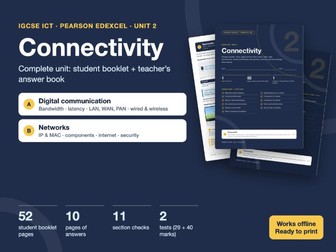
The complete Pearson Edexcel International GCSE ICT Unit 2 Connectivity in two print-ready books: a 52-page student booklet and a 10-page teacher’s answer book. It covers both chapters of the unit – Digital communication and Networks – with clear explanations, the activities from the student book, a check after every section and two exam-style tests. No preparation needed and no internet required. • Student booklet – 52 pages: unit cover and contents, 11 sections, 14 book activities, 11 section checks, “Try it on paper” tasks, two end-of-part tests and a two-page list of 57 key terms. Ready to print double-sided. • Teacher’s answer book – 10 pages: answers to every check, model answers for every book activity and paper task, and mark schemes for both tests (including an example answer for the 8-mark network diagram question). Sections and question numbers match the student booklet one to one.
IGCSE ICT Edexcel Booklets: Digital Devices, Defragmentation, Online CommunitiesQuick View
toni1976

IGCSE ICT Edexcel Booklets: Digital Devices, Defragmentation, Online Communities

(0)
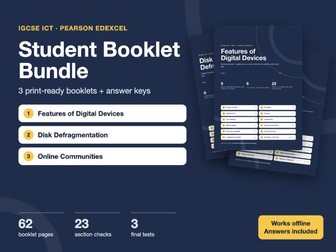
Three print-ready IGCSE ICT student booklets for Pearson Edexcel International GCSE ICT, each with a separate answer key. Students read a short explanation, check their understanding after every section and finish with an exam-style final test – no preparation needed and no internet required. WHAT’S INCLUDED (6 PDF files, A4) • Features of Digital Devices (Unit 1) – 24-page student booklet + answer key. Nine features (portability, performance, storage, user interface, connectivity, media support, energy consumption, expansion capability, security features), a “compare the devices” page, 9 section checks and a 25-mark final test. • Disk Defragmentation (Unit 1, software) – 17-page student booklet + answer key. The hard disk, how fragmentation happens, reading a fragmented file, defragmentation, after defragmentation and why SSDs should not be defragmented. 6 section checks and a 10-mark final test. • Online Communities (Unit 3, Operating online) – 21-page student booklet + answer key. Social networking, online gaming, online work spaces, virtual learning environments, wikis and forums, user-generated content, global communication and staying safe online. 8 section checks and a 30-mark final test. In total: 62 booklet pages, 23 section checks, 3 final tests (65 marks) and 3 answer keys.
KS3 Computing Assessment Pack Years 7–10 | Projects, Exams, Mark Schemes & RubricsQuick View
toni1976

KS3 Computing Assessment Pack Years 7–10 | Projects, Exams, Mark Schemes & Rubrics

(0)
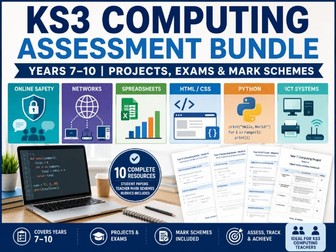
Save planning and assessment time with this comprehensive KS3 Computing Assessment Pack for Years 7–10. This ready-to-use bundle includes project-based assessments, end-of-unit examinations, detailed mark schemes and teacher rubrics covering digital safety, online communication, cyberbullying awareness, networks, spreadsheets, web development, HTML, CSS, introductory Python programming, ICT systems, digital devices, storage, networking and cybersecurity concepts. Designed for secondary Computing teachers, the resource supports formative and summative assessment, independent student work, classroom testing and progress tracking across Key Stage 3. With clearly structured student papers, teacher guidance and standardised marking materials, this bundle provides a complete assessment solution that can be used as end-of-topic tests, revision activities, cover work, project-based learning tasks or departmental assessment materials. Suitable for mixed-ability KS3 learners and adaptable for international curricula, British curriculum schools and Computing departments seeking consistent assessment materials across multiple year groups.
Ready-to-Use Summer Computing Booklets for Years 7–10 – Independent ICT & Computing Challenge PackQuick View
toni1976

Ready-to-Use Summer Computing Booklets for Years 7–10 – Independent ICT & Computing Challenge Pack

(0)
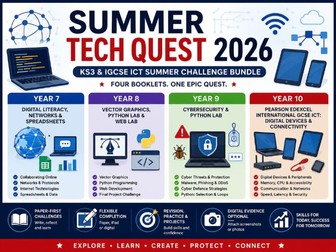
Looking for a high-quality KS3 and IGCSE ICT summer project that keeps students engaged while reinforcing essential Computing knowledge? This Summer Tech Quest 2026 Bundle includes four structured, paper-first challenge booklets for Years 7–10. Students complete a sequence of themed missions covering online safety, networks, internet technologies, spreadsheets, vector graphics, Python programming, web development, cybersecurity, digital devices and connectivity. Each booklet combines revision content, scenario-based tasks, checkpoints, extension opportunities and optional digital evidence activities. Designed for independent learning, holiday work, transition programmes, homework projects or end-of-year enrichment, the resources encourage problem solving, written explanation, practical Computing skills and digital literacy. The Year 10 booklet is aligned to Pearson Edexcel International GCSE ICT topics including Digital Devices and Connectivity, while Years 7–9 progressively develop core Computing knowledge and Python programming skills. Suitable for paper-based completion, iPad annotation or blended digital submission.
Cambridge IGCSE Combined Science 0654 Practice Paper & Mark Scheme | Core/Extended Theory Revision..Quick View
toni1976

Cambridge IGCSE Combined Science 0654 Practice Paper & Mark Scheme | Core/Extended Theory Revision..

(1)
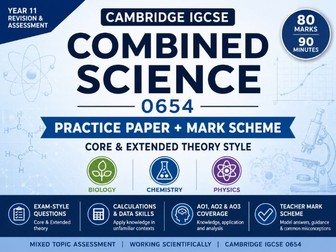
Designed for Cambridge IGCSE Combined Science 0654 revision, this exam-style practice paper and teacher mark scheme pack provides a structured mixed-topic assessment for Year 11 students preparing for Core and Extended theory examinations. The resource includes a full 80-mark student paper, detailed teacher guidance, assessment-objective coverage and topic-linked mark scheme support across Biology, Chemistry and Physics. Questions target AO1, AO2 and AO3 skills using realistic Cambridge-style command words, calculations, scientific explanations, practical methods and data interpretation tasks. Topics include quantitative chemistry, enzymes, disease and immunity, waves, periodic table trends, risk assessment, evolution and scientific calculations. Suitable for mock exams, retrieval practice, homework, revision lessons or end-of-topic assessment, this resource helps students develop confidence with structured responses, exam vocabulary and extended scientific reasoning while supporting teachers with moderation guidance, common misconceptions and follow-up reteaching suggestions. Ideal for independent revision or classroom assessment preparation.
Cybersecurity Independent Learning Pack | Digital Footprint, Social Engineering, Malware & Online...Quick View
toni1976

Cybersecurity Independent Learning Pack | Digital Footprint, Social Engineering, Malware & Online...

(0)
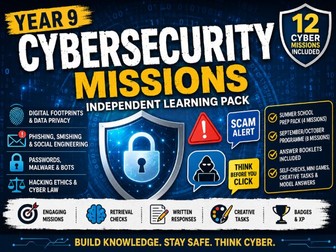
This Year 9 Cybersecurity independent learning bundle is a fully structured KS3 Computing and online safety resource designed for independent study, cover work, homework, revision, summer preparation and flipped learning. The pack includes two student dossiers and matching answer booklets covering digital footprints, data vs information, social engineering, phishing, smishing, blagging, hacking ethics, malware, bots, privacy, targeted advertising, the Computer Misuse Act and cybersecurity threats. Each mission includes clear explanations, retrieval practice, scenario-based activities, self-check tasks, mini creative challenges and exam-style written responses suitable for KS3 Computing, ICT and digital literacy lessons. The resources are written in an engaging “cyber mission” format to improve motivation while maintaining strong curriculum coverage and accurate cybersecurity terminology. Ideal for Year 9 Computing teachers seeking ready-to-use independent learning materials with built-in answers, low-prep structure and consistent progression across multiple weeks of learning.
Year 8 HTML Basics Revision Pack | HTML Tags, Lists, Inline Styles, Exam & WebLab ActivitiesQuick View
toni1976

Year 8 HTML Basics Revision Pack | HTML Tags, Lists, Inline Styles, Exam & WebLab Activities

(0)
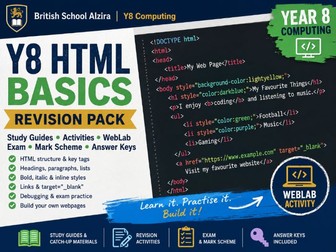
This comprehensive Year 8 HTML Basics Revision Pack is designed for KS3 Computing and ICT lessons and includes everything needed to teach, revise and assess introductory HTML skills. The resource bundle covers HTML structure, headings, paragraphs, bold and italic text, bulleted lists, inline CSS styling, hyperlinks and common coding mistakes through highly scaffolded activities, guided revision tasks and formal assessment materials. Students practise writing and correcting HTML code using structured exercises, WebLab activities and exam-style questions, making the pack ideal for classroom teaching, homework, independent learning, cover lessons, intervention and end-of-unit revision. Included are a detailed study guide, catch-up booklet, revision worksheet, answer key, self-guided HTML links activity, full Year 8 HTML exam and teacher mark scheme. The resources are written in clear student-friendly English and are especially suitable for lower KS3 learners, mixed-ability classes and students needing additional structure or confidence-building support.
Year 7 Computing Impact of Technology Bundle | Digital Literacy, Cyberbullying, Online Safety...Quick View
toni1976

Year 7 Computing Impact of Technology Bundle | Digital Literacy, Cyberbullying, Online Safety...

(0)
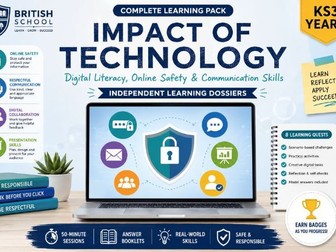
This comprehensive Year 7 Computing and Digital Literacy bundle provides structured independent learning activities focused on online safety, cyberbullying, secure passwords, respectful communication, presentation design, digital collaboration and responsible technology use. Designed for KS3 Computing, ICT and PSHE lessons, the pack includes Summer School transition materials, September/October independent learning dossiers and accompanying answer booklets with model responses and self-check guidance. Learners complete scenario-based challenges, creative digital tasks, reflection checkpoints and practical technology activities covering secure passwords, school email etiquette, cyberbullying reporting, audience awareness, identity protection and presentation skills. The resources are ideal for Year 7 onboarding, computing baseline assessment, homework, cover lessons, digital literacy programmes, transition projects and independent study. Clear teacher-friendly structure, progressive skill development and printable workbook formats make this an easy-to-deploy solution for both classroom and remote learning environments.
Complete Guided ICT Practical Project for IGCSE – Spreadsheets, Graphics & Presentation SkillsQuick View
toni1976

Complete Guided ICT Practical Project for IGCSE – Spreadsheets, Graphics & Presentation Skills

(0)
This comprehensive Pearson Edexcel International GCSE ICT practical skills workbook provides a complete guided project covering Excel spreadsheets, Inkscape vector graphics, Photoshop bitmap editing and PowerPoint presentation design. Built around a realistic GreenTrail Bike Tours business scenario, students practise essential ICT coursework-style skills including formulas, IF statements, VLOOKUP, COUNTIF, charts, page formatting, logo creation, background removal, image editing, slide master design, transitions and hyperlinks. The resource includes a detailed student workbook, full teacher guide, answer key and supporting graphics files for classroom use. Designed for KS4 Computing and ICT lessons, this pack supports practical software development skills while reinforcing business-focused problem solving and digital creativity. Ideal for revision, cover lessons, controlled practice, intervention sessions or end-of-unit assessment preparation, the activities mirror the style and expectations of Pearson Edexcel International GCSE ICT practical tasks while remaining fully accessible for guided classroom teaching and independent learning.
Pearson Edexcel International GCSE ICT Theory Exam | Unit 01 Digital Devices & Unit 02 ConnectivityQuick View
toni1976

Pearson Edexcel International GCSE ICT Theory Exam | Unit 01 Digital Devices & Unit 02 Connectivity

(0)
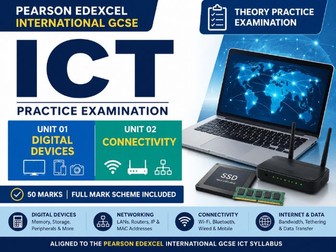
This Pearson Edexcel International GCSE ICT theoretical practice examination is designed specifically for Unit 01 Digital Devices and Unit 02 Connectivity content from the official syllabus. The resource includes a complete 50-mark written theory paper and detailed mark scheme covering digital devices, input and output devices, RAM and ROM, SSDs, storage calculations, LANs, routers, MAC addresses, Wi-Fi, Bluetooth, bandwidth and tethering. Written in a style closely aligned to Pearson Edexcel International GCSE ICT assessment materials, the paper helps students develop confidence with exam terminology, structured written responses and ICT theory knowledge. The assessment includes multiple-choice, short-answer and extended-response theory questions suitable for revision, mock examinations, retrieval practice and end-of-unit assessment. The included mark scheme supports accurate teacher assessment and independent revision. Ideal for KS4 ICT and Computing classrooms, this theory-focused exam resource provides targeted preparation for Pearson Edexcel International GCSE ICT written examinations.
Pearson Edexcel IGCSE Combined Science Double Award 4SD0 Foundation Practice Paper + Mark SchemeQuick View
toni1976

Pearson Edexcel IGCSE Combined Science Double Award 4SD0 Foundation Practice Paper + Mark Scheme

(0)
Prepare students for Pearson Edexcel International GCSE Combined Science Double Award (4SD0) examinations with this complete Foundation-tier practice paper and teacher mark scheme pack for Year 11. Designed in the style of Pearson Edexcel International GCSE Science assessments, this resource includes structured exam-style questions covering Biology, Chemistry and Physics topics alongside detailed marking guidance and assessment objective coverage. Topics include chemical changes, diffusion and osmosis, wave properties, chromatography, quantitative chemistry, bonding, ecosystems, hormonal coordination, electricity, transpiration, working scientifically and momentum. The paper is suitable for mock examinations, revision lessons, intervention sessions, homework, independent study or end-of-topic assessment. A full teacher mark scheme is included with model-answer guidance, common misconceptions, moderation notes and follow-up teaching suggestions, helping teachers deliver targeted feedback and exam preparation. Ideal for Year 11 students studying Pearson Edexcel International GCSE Combined Science Double Award Foundation content and preparing for external examinations.
JavaScript Exam Practice Pack Bundle | English & Spanish | DOM, Arrays, Forms & localStorageQuick View
toni1976

JavaScript Exam Practice Pack Bundle | English & Spanish | DOM, Arrays, Forms & localStorage

(0)
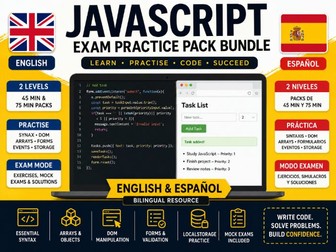
This bilingual JavaScript exam practice bundle includes both English and Spanish versions of two practical coding packs designed for beginners and lower-intermediate learners preparing for JavaScript, web development or programming assessments. Students practise core JavaScript syntax, arrays, objects, functions, loops, DOM manipulation, forms, validation, events and localStorage through structured exercises, mini practical tasks and integrated mock exams. The resources are ideal for classroom use, independent revision, coding bootcamps, ICT and Computing lessons, intervention sessions or exam preparation in browser-based JavaScript environments using Notepad or simple editors. The packs follow a practical “write code first” approach and include worked solutions, debugging guidance and repeatable coding patterns to build confidence and exam technique. Both English and Spanish editions are included, making the resource especially useful for bilingual learners, EAL students, international classrooms or Spanish-speaking Computing and ICT learners.
Pearson Edexcel International AS Science Practice Papers Bundle | Biology, Chemistry & PhysicsQuick View
toni1976

Pearson Edexcel International AS Science Practice Papers Bundle | Biology, Chemistry & Physics

(0)
This Pearson Edexcel International AS Science practice paper bundle is designed for Year 12 students preparing for IAL Biology, IAL Chemistry and IAL Physics assessments. It includes three full 60-mark, 90-minute unit-style practice papers, each supplied with a corresponding teacher mark scheme for efficient marking, feedback and revision. The resources are suitable for International Advanced Level Science courses and provide structured exam-style questions covering practical skills, mathematical requirements, synoptic science and subject-specific content. Each paper uses command words such as calculate, evaluate, explain, describe, state and comment on, helping students practise the style of extended and applied responses expected in Pearson Edexcel IAL Science. The bundle is ideal for mock exams, end-of-topic assessment, Year 12 revision, intervention, independent study or homework. Teachers can use the included mark schemes to identify strengths, address misconceptions and support targeted exam preparation across Biology, Chemistry and Physics.