A human Biology unit which includes:
L1 The Nervous System
L2 Reflexes
L3 Reaction Time Investigation
L4 Reaction Time follow up - Plotting a graph
L5 Drugs and their effects
L6 The Digestive System
L7 Digestive Enzymes
L8 A Balanced Diet
L9 Written Assessment - The Digestive System
L10 The Circulatory System
L11 The Heart
L12 Lifestyle choices: Alcohol
L13 Lifestyle choices: Exercise
L14 Cardiovascular Disease
L15 Homeostasis
All worksheets are on the first few slides of the PPT presentation and formatted for printing on a single or double sided sheet.
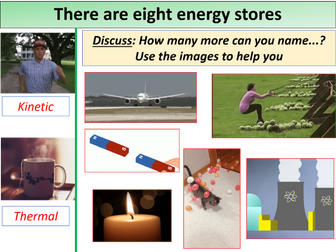
Energy topic reflecting the learning outlined in the KS3 Science National Curriculum.
L1 Energy stores and transfers
L2 Energy in food
L3 Sankey diagrams
L4 Energy efficiency calculation
L5 Conduction
L6 Convection
L7 Radiation
L8 Insulation
L9 Non-renewable energy
L10 Renewable energy
L11 Green paper assessment - Evaluating data
L12 Domestic energy
L13 Climate connection
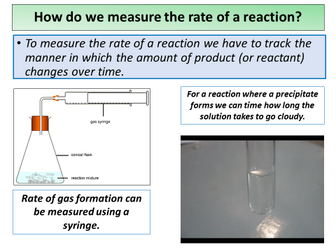
This SoW is for the AQA (Trilogy) GCSE. In this unit students will knowledge of particle model to explain collision theory. Students will learn about how changing conditions affects the rate of reaction, the role of catalysts, and dynamic equilibrium.
L1 Introduction to Rates of Reaction
L2 Factors affecting Rate of Reaction
L3 & L4 Required practical: how concentration affects rate of reaction
L5 Catalysts
L6 Reversible reactions
L7 Dynamic equilibrium
L8 The effect of changing conditions HT ONLY
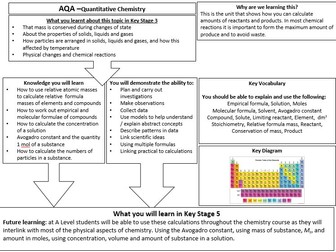
This is the unit that shows how you can calculate amounts of reactants and products. In most chemical reactions it is important to form the maximum amount of produce and to avoid waste.
L1 Conservation of mass
L2 Balancing equations
L3 Relative formula mass
L4 Percentage mass and Pit Stop Quiz
L5 Moles HT ONLY
L6 Masses of reactants and products HT ONLY
L7 Using moles to balance equations HT ONLY
L8 Calculating concentration and limiting reactants HT ONLY
A sequence of lessons that covers AQA GCSE Chemistry (Combined Science Trilogy)
All lessons are complete with resources and homework activities.
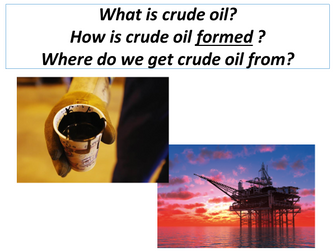
L1 Crude Oil and Hydrocarbons
L2 Fractional Distillation and Petrochemicals
L3 Properties of Hydrocarbons
L4 Burning Hydrocarbon fuels
L5 Cracking and alkanes (2 lessons, including practical)
A sequence of lessons for AQA B6 Inheritance, variation and evolution.
In this section we will discover how the number of chromosomes are halved during meiosis and then combined with new genes from the sexual partner to produce unique offspring. Gene mutations occur continuously and on rare occasions can affect the functioning of the animal or plant. These mutations may be damaging and lead to a number of genetic disorders or death. Very rarely a new mutation can be beneficial and consequently, lead to increased fitness in the individual. Variation generated by mutations and sexual reproduction is the basis for natural selection; this is how species evolve. An understanding of these processes has allowed scientists to intervene through selective breeding to produce livestock with favoured characteristics. Once new varieties of plants or animals have been produced it is possible to clone individuals to produce larger numbers of identical individuals all carrying the favourable characteristic. Scientists have now discovered how to take genes from one species and introduce them in to the genome of another by a process called genetic engineering. In spite of the huge potential benefits that this technology can offer, genetic modification still remains highly controversial.


 Quick View