AQA GCSE Chem Using Resources MCQ TestQuick View
jamesemaj89

AQA GCSE Chem Using Resources MCQ Test

(0)
Description A complete AQA GCSE Chemistry assessment covering Using Resources (C10). Designed as a 50 minute multiple choice test suitable for end of topic assessment, revision, or intervention. This assessment spans the entire Using Resources specification, including sustainability, water treatment, waste water, alternative extraction methods, life cycle assessment, and reducing use of resources. Questions are carefully structured to assess recall, application, and evaluation, with clear targeting of common misconceptions. What is included Full multiple choice assessment 45 marks 50 minutes Six structured sections Resources and sustainable development Potable water Waste water treatment Alternative methods of extracting metals Life cycle assessment Reducing use of resources Balanced demand Foundation accessible questions Higher tier application and evaluation Calculation questions included Select two answer questions included Complete mark scheme provided Answers mapped to AQA specification points Assessment objectives identified Common misconceptions highlighted ** Diagnostic summary included** Marks by topic AO breakdown Foundation and Higher demand split Intervention thresholds provided
AQA AS Chem: Kinetics - Maxwell Boltzmann L3Quick View
jamesemaj89

AQA AS Chem: Kinetics - Maxwell Boltzmann L3

(0)
Description A fully resourced A-Level Chemistry lesson on Maxwell Boltzmann distributions, designed for Year twelve as Lesson 2 in the Rates of Reaction (3.1.5) topic. This lesson develops students understanding of how kinetic energy is distributed among gas particles and explicitly links Maxwell Boltzmann curves to activation energy, successful collisions, and reaction rate, using exam-accurate language throughout. Ideal for first teaching, consolidation, or revision. Whats included Complete lesson (no worksheets needed) Clear I Do > We Do > You Do structure Step-by-step guidance on drawing M-B curves correctly Explicit teaching of all key features: 1. axes meaning 2. most probable energy 3. origin 4. asymptotic tail 5. area under the curve Comparing distributions at different temperatures Activation energy marked and shaded correctly Exam-style written questions with model answers Multiple choice questions to check understanding and consolidation questions Common misconceptions identified and corrected Everything needed is built into the slides.
AQA Chem: Maxwell–Boltzmann (L2 Yr12)Quick View
jamesemaj89

AQA Chem: Maxwell–Boltzmann (L2 Yr12)

(0)
Description A complete A-Level Chemistry lesson on Maxwell Boltzmann distributions, designed for AS as Lesson 2 in the Rates of Reaction (3.1.5) sequence. This lesson builds directly on collision theory and develops students ability to interpret, draw, and apply Maxwell Boltzmann distribution curves, including exam-level explanations linking distributions to activation energy and reaction rate. The lesson is fully scaffolded and suitable for first teaching, intervention, or revision. Whats included Fully resourced lesson Clear I Do > We Do > You Do structure Step-by-step guidance on reading M-B graphs Explicit teaching of key features (origin, peak, asymptote, area) Drawing and interpreting M-B curves at different temperatures Activation energy marked and shaded correctly Exam-style written questions with model answers Multiple choice questions to check understanding and consolidation tasks Common misconceptions addressed and corrected All tasks are built into the slides; no worksheets required.
AQA Chem: Collision Theory (L1 Yr12)Quick View
jamesemaj89

AQA Chem: Collision Theory (L1 Yr12)

(0)
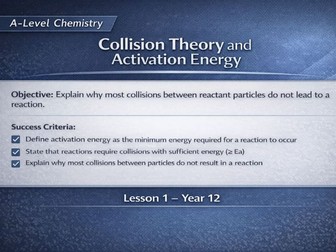
A complete introductory lesson on collision theory and activation energy, designed for Y12 AQA A Level Chemistry (Topic 3.1.5.1). This is lesson 1 of the rates of reaction topic and assumes no prior knowledge of the topic beyond GCSE particle model and energy concepts. Perfect for first-teach or recap, this conceptual theory lesson walks students through the key ideas behind reaction rates, activation energy, and the reasons why most particle collisions do not result in a reaction. Resource includes: Fully scaffolded PowerPoint Starter (Do now) Success criteria with overall learning objective Exam style mini-assessment to consolidate the learning
A2 Organic Reaction PathwaysQuick View
jamesemaj89

A2 Organic Reaction Pathways

(0)
A handy summary sheet that should cover all exam boards that my students found useful in preparing revision for their A2 chemistry exam. I start by getting them to fill it in, mark and check for any mistakes or get them to peer assess each others or give them my version to self assess. Once I know they have a correct version I get them to choose a starting molecule and see how many different compounds they can make from that starting material - Whoever gets the most wins a prize.