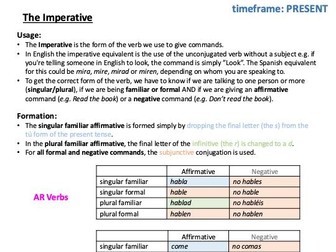
This is a re-hash and extension of lots of the resources already on here but with extras as I needed a 8 lesson project. 4 teaching powerpoints with answers, and a student booklet to cover all 8 lessons. Homework tasks built in. Perfect for a summer term project. Covers personal information, physical and personality descriptions, family members, animals, clothes, food and the traditions surrounding Day of the Dead.
This 2 page sheet explains how to talk about statistics in Spanish and is useful preparation for summary and translation style questions.
It covers percentages, fractions, decimals, ‘times’, and acronyms.
It also suggests ways of introducing statistics, idiomatic expressions and a list of other useful vocabulary.
This workbook contains a variety of practice questions for each topic area in the AQA GCSE. It suggests a ‘main’ question that the students prepare an answer to - e.g. What do you do in your free time?, as well as questions which the same planned answer could be used for e.g. what do you do on the weekend?, what are your hobbies? etc. In this way, students can prepare things to say about the topic area without having an exact answer to exact questions (as the questions are unpredictable but the topics are not).
To encourage a good range of language, each question comes with a tick list of ideas e.g. a comparative, past tense etc.
There is also a box for students to think of a question they could ask the examiner so they have ideas for questions on each topic.
This is a lesson aimed at students of KS3 Spanish. It is linked with the Mod4 Mira Express 1 - ¿Qué haces (en casa)? but is aimed at making students aware of the current situation in Spain.
It looks at basic vocabulary and vocabulary recognition through cognates.
It uses Instagram snapshots that have used the hashtag #mequedoencasa
A one-stop reference booklet to all the tenses, pronouns and other grammar required for Spanish GCSE. A page on each tense/grammar point as well as advice on how to build a routine of regular grammar revision, how to access the top mark bands, and which common errors to watch out for.
Designed to have a reference to everything all in one place, explanations are kept to one page. Website suggestions are given (links) to explore certain topics further if required.
Sections include:
A ‘how to’ guide for routine practice
Konwledge checker: a checklist of grammar required at GCSE.
Core tenses: a single-page spread giving usage, formation, and key irregulars for each tense.
Other core grammar: A single-page or half page on all other required grammar points e.g. pronouns, perphrastic phrases, negation, conditional clauses etc.
Complex language and idiomatic phrasing: suggestions of high level language to get to those top mark bands.
Most common errors: A one-page spread of some of the most common error types at GCSE (a checklist for students).
This is not an exercise book. It is designed for students to use as…
an aid to self-study (for routine practice and mastery)
a reference when completing written work (to give more independence)
a tool to improve linguistic complexity in writing and speaking


 Quick View
![KS3 Spanish Coronavirus lesson [COVID-19] linked with what you do at home #mequedoencasa](https://l.imgt.es/resource-preview-imgs/3920311c-25f2-4a29-8248-b69801266cbf%2FCOVID_Splesson.crop_546x410_135%2C0.preview.png?profile=res-img-med-legacy-v2)