GCSE Foundation Maths Formula Sheet Practice (Exam Aid)Quick View
boznia

GCSE Foundation Maths Formula Sheet Practice (Exam Aid)

(0)
I made this resource as I wanted my students to get comfortable with the information on the Exam Aid/Formula Sheet for the GCSE Foundation Maths exams (ahead of their mock exams). The idea is, they get a copy of the exam aid and this sheet and practice the questions in lessons, consulting the formula sheet. I plan to make a Higher one too, although don’t have a higher class this year so this may not happen quickly. ANSWERS INCLUDED!
MEI LDS7 Hypothesis TestsQuick View
boznia

MEI LDS7 Hypothesis Tests

(0)
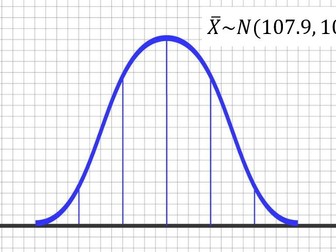
I wrote this worksheet as a resource for my students to practice their normal distribution hypothesis tests using the MEI Large Data 7. Students need to be familiar with the large data set before they enter the exam, so any excuse to use it should be taken. There are limited resources available, so I am beginning to write my own when I have the time. You will need the excel copy of the dataset and share it with your students for this task. Students will also need access to excel (probably in a computer room).
GCSE Two Way Tables - draw yourselfQuick View
boznia

GCSE Two Way Tables - draw yourself

(0)
There are many two way tables worksheets out there, but on the new GCSE students often have to draw the table themselves. I made a worksheet of similar questions.
Isometric drawing - complete these cuboidsQuick View
boznia

Isometric drawing - complete these cuboids

(0)
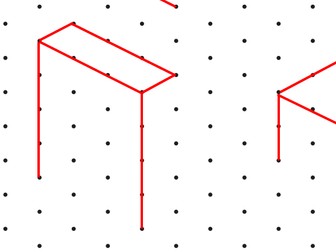
A simple sheet I made to help my KS3 groups who find isometric drawing difficult. Students need to complete the drawings of some cuboids. I often tell classes that a complete cuboid should have three sets of parallel lines (each with 3 lines) - this helps some students, but can confuse others.
Fixed Point Iteration - Graph the methodQuick View
boznia

Fixed Point Iteration - Graph the method

(0)
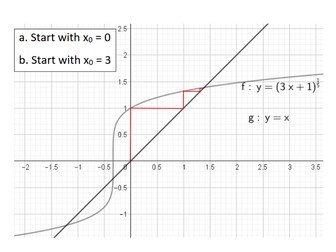
I made this resource to help students to practice drawing ‘staircase’ and ‘cobweb’ diagrams (both converging and diverging) to illustrate the numerical method known as fixed point iteration. I also made an extension which shows a more chaotic behaviour and one where the iterations cycle and therefore neither converge or diverge, however this is beyond the needs of the A Level Course.
Newton Raphson - illustrating the methodQuick View
boznia

Newton Raphson - illustrating the method

(0)
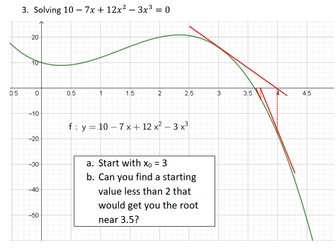
I made a selection of graphs for students to illustrate the Newton Raphson method. There are a few different graphs to illustrate some of the different behaviours of the method. Students can learn when the method is effective and when it is less so. Each graph has an initial x value for the students to start with, so that they can be assessed/compared as required.
Finding equations of exponential graphsQuick View
boznia

Finding equations of exponential graphs

(0)
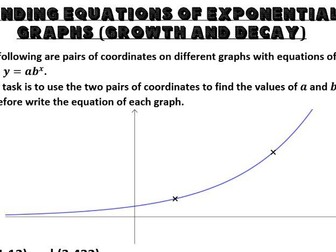
9 questions on finding the equations of exponential graphs for higher tier GCSE. There is an extension included within the 9 and the answers are also provided. This was written for a top set.
Mixed Linear EquationsQuick View
boznia

Mixed Linear Equations

(0)
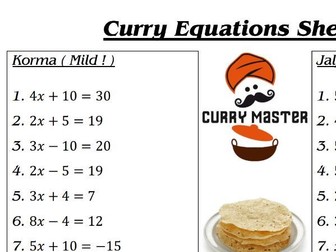
Here we have a sheet of different styles of linear equations for students to solve. The different difficulties are represented by different heats of curry. Answers provided.
Learning to solve quadratics by factorisationQuick View
boznia

Learning to solve quadratics by factorisation

(0)
This is a slightly informal way of learning to solve quadratics by factorisation. My class had already learnt to factorise in previous lessons and we followed this up with these activities. Included are a starter and a main worksheet both WITH ANSWERS. Designed such that students learn to solve by substitution and do so largely by themselves. The starter should be followed by a discussion of why the last few substitutions give zero, followed by some board questions which are asked verbally (factorised quadratics equal to zero). Then the main sheet can be started.