A step-by-step guide to writing an essay for Paper 4 CIE English in the WorldQuick View
tiredzzz

A step-by-step guide to writing an essay for Paper 4 CIE English in the World

(0)
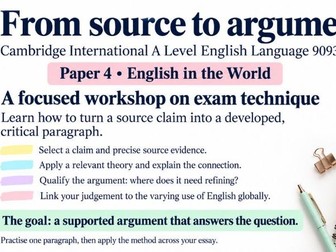
This resource teaches a specific exam skill: turning an issue raised by a source text into a developed, supported and critically considered argument for Cambridge International A Level English Language 9093, Paper 4: English in the World. Students may recall theorists confidently but struggle to explain how their ideas illuminate a particular source. This pack makes that connection explicit. Colour-coded claims, a structured planning grid and a completed model guide students through selecting precise evidence, applying a relevant concept, explaining its significance and qualifying their argument before returning to the question. The Theory Top Trumps provide an accessible starting point for recalling and comparing concepts. Students choose theories according to their relevance to the evidence; the ratings offer a discussion prompt rather than a formula for deciding which theorist to use. The completed grid supports teacher modelling and discussion, while the blank version allows students to practise the process themselves. Particular attention is given to meaningful qualification: considering where an explanation is useful, where its application is limited and what else needs to be taken into account. The aim is to build independence. As students become more confident, the scaffold can be gradually removed and the approach transferred to unfamiliar sources. The emphasis throughout is on purposeful theory selection, precise source connections and a clear argument that answers the question.
Cambridge 9093 Paper 4 Language and the SelfQuick View
tiredzzz

Cambridge 9093 Paper 4 Language and the Self

(1)
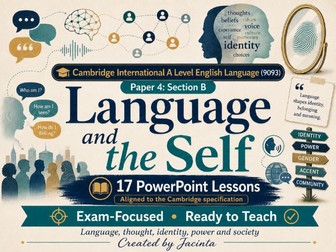
A complete 17-lesson Cambridge 9093 Paper 4 Language and the Self course, with ready-to-teach PowerPoints and two revision summary sheets. This comprehensive Language and the Self teaching sequence is designed for Cambridge International A Level English Language 9093, Paper 4. Across 17 carefully sequenced lessons, students explore the relationship between language, thought, identity, interaction and society, building both theoretical knowledge and the ability to apply ideas critically to language data and discussion. The course moves from foundational questions about language and cognition into increasingly sophisticated exploration of social identity, power, communities, gender, accent and linguistic judgement. Topics include: Language and Thought Language, Cognition and Development Behaviourism and Empiricism Nativism and Innateness Interaction The Concept of Face Conversation, Power and Accommodation Group Identity Theory Speech and Discourse Communities Giddens, Identity and Implied Meaning Language, Gender and Identity Accent, Prejudice, Slang and Linguistic Judgement Language, Metaphor and the Construction of Identity Paper 4 recap and consolidation Language and the Self revision a dedicated Theory Hit List The lessons are designed to encourage students to do more than memorise theorists. Students are repeatedly asked to consider how linguistic choices construct identity, relationships, belonging, power and social meaning. The sequence combines: clear explanation of key theories and concepts discussion and enquiry applied language analysis theoretical comparison opportunities for independent thinking recap and retrieval Paper 4-focused consolidation structured revision Ideal for: Cambridge International A Level English Language 9093 Paper 4: Language and the Self whole-class teaching online or face-to-face lessons revision and intervention teachers looking for a coherent, ready-to-teach Paper 4 sequence *Includes 17 editable PowerPoint lessons A structured, engaging and theory-rich approach to Language and the Self — ready to teach.
Cambridge International AS & A Level English Language 9093 Essential TheoristsQuick View
tiredzzz

Cambridge International AS & A Level English Language 9093 Essential Theorists

(0)
A clear, comprehensive revision guide to the essential theorists, models and concepts required for Cambridge International AS & A Level English Language 9093 Papers 3 and 4. This professionally designed 24-page booklet helps students move beyond simply memorising names. Each theory is explained concisely, connected to relevant linguistic evidence and accompanied by guidance on its most effective application and possible limitations. The guide covers all four key areas: • Language Change • Child Language Acquisition • English in the World • Language and the Self It includes: • Core terminology and concepts • Essential theorists and models • Accurate summaries of central arguments • Evidence, applications and limitations • Developmental stages and language functions • World Englishes and global-language models • Accent, identity, gender, power and linguistic relativity • Cross-topic connections • Retrieval questions and mini application tasks • Analytical and discursive paragraph guidance • Exam-focused sentence stems • Answer guidance • Selected further reading Particularly useful theories and thinkers include Aitchison, Labov, Hopper and Traugott, Skinner, Chomsky, Bruner, Vygotsky, Tomasello, Halliday, Kachru, Schneider, Jenkins, Phillipson, Sapir and Whorf, Giles, Goffman, Butler, Lakoff, Tannen, Cameron and many more. The resource has been written to support the Cambridge International 9093 syllabus for examinations from 2024–2028. It is suitable for classroom teaching, independent study, revision lessons, homework, intervention work and exam preparation. The editable Word format allows teachers to adapt, shorten or personalise the material for their own students. Please note: this is an independently produced educational resource and is not affiliated with or endorsed by Cambridge University Press & Assessment.
Cambridge International A level English 9093 Paper 3 Q1 Language ChangeQuick View
tiredzzz

Cambridge International A level English 9093 Paper 3 Q1 Language Change

(0)
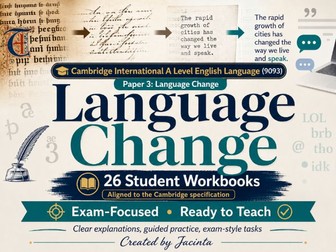
A complete 26-workbook Language Change course for A Level English Language, with clear teaching, guided practice and exam-focused application. This comprehensive set of 26 student workbooks takes learners step by step through the Language Change topic, building the knowledge, terminology and analytical confidence needed for exam success. The workbooks are designed to make a challenging area of the course feel manageable and purposeful. Rather than overwhelming students with theory, each workbook introduces key ideas clearly before giving them opportunities to recognise patterns, apply terminology and practise analysis. Each workbook follows a consistent structure: The Big Idea – introduces the key concept and explains why it matters Core Knowledge – clear, accessible teaching of essential content Guided Practice – supported, low-stakes activities Exam-Style Application – opportunities to practise the skills required in the examination Reflection and Retrieval – helping students consolidate their learning and identify gaps Across the sequence, students develop their ability to identify and explain language change, use linguistic terminology accurately, connect language to context, and move from simple observations towards confident analytical writing. The materials are particularly useful for teachers who want a coherent, ready-to-teach Language Change programme rather than a collection of disconnected activities. They can be used for whole-class teaching, independent study, revision, homework or intervention. The workbooks are presented as editable PowerPoint files, making them easy to adapt to your own classes or use digitally. Ideal for: A Level English Language Language Change teaching and revision Building confidence with linguistic terminology Developing exam analysis skills Independent or teacher-led learning 26 workbooks included – a complete, carefully sequenced Language Change teaching programme.
Cambridge 9093 CLA – Complete WorkbooksQuick View
tiredzzz

Cambridge 9093 CLA – Complete Workbooks

(0)
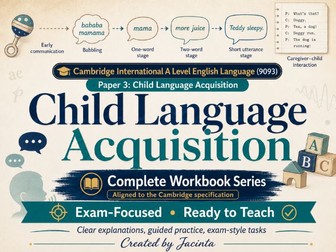
A complete, exam-focused CLA workbook series for Cambridge International A Level English Language 9093 Paper 3, Section B. This carefully sequenced Child Language Acquisition (CLA) resource is designed to take students from the foundations of language acquisition through to confident, exam-ready analysis. The workbooks combine clear teaching with guided practice, transcript analysis, theory and regular opportunities to apply knowledge to the kinds of tasks students will encounter in Cambridge International A Level English Language 9093. Students are supported in developing the essential skills needed for Paper 3, including: analysing child language transcripts identifying and discussing linguistic features applying relevant language acquisition theories explaining patterns of language development using accurate linguistic terminology linking theory closely to language data moving beyond feature-spotting towards developed analysis The course explores key areas of Child Language Acquisition, including Child-Directed Speech (CDS), phonology, lexis, grammar, pragmatics, interaction and the nature/nurture debate, alongside the major theories and theorists students need to understand. Activities are varied and student-friendly, with a mixture of: accessible explanations of key concepts guided analysis transcript-based activities retrieval and consolidation tasks discussion and critical thinking exam-focused practice stretch questions independent tasks and homework The workbooks are designed to make a theory-heavy topic feel manageable. Students are encouraged not simply to memorise theorists, but to use theory as a tool for interpreting real language data. Ideal for: Cambridge International A Level English Language 9093 Paper 3, Section B: Child Language Acquisition whole-class teaching independent learning revision and intervention students who need additional structure and support teachers looking for a coherent, ready-to-teach CLA programme A complete, structured and exam-focused approach to Child Language Acquisition – ready to use in the classroom.
Cambridge 9093 Paper 4 English in the WorldQuick View
tiredzzz

Cambridge 9093 Paper 4 English in the World

(0)
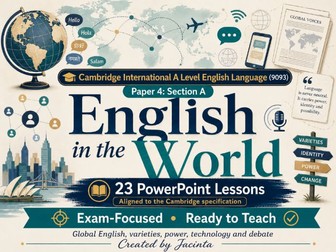
A complete 23-lesson Cambridge 9093 Paper 4 Section A course, covering English in the World through engaging, exam-focused PowerPoint lessons. This comprehensive English in the World teaching sequence is designed for Cambridge International A Level English Language 9093, Paper 4 Section A. The course takes students from the foundations of Global English through to sophisticated debates about power, identity, ownership, technology and the future of English, while continually developing the knowledge and argument skills needed for the examination. Rather than relying on lengthy note-taking, the lessons use discussion, enquiry, case studies, source material, debate and applied tasks to help students engage critically with the issues. Topics covered across the course include: the rise of English as a global language colonialism and the historical spread of English English as a lingua franca World Englishes and attitudes towards different varieties Kachru’s Circles and models of Global English the influence of the USA English, business and international communication linguistic imperialism language death and the position of minority languages borrowing, hybridisation and the influence of other languages sociolects and code-switching cultural and linguistic ownership English and the internet digital language machine translation English as a language of science advantages and disadvantages of Global English distinctions between World, Global and International English the future of English exam technique, essay development and revision The sequence has been developed with recurring themes from Cambridge past papers in mind, including Global English, varieties and attitudes, technology, language death, colonialism, lingua franca use, cultural influence, science and the future of English. Lessons encourage students to move beyond simple description and consider competing perspectives. For example, students explore how English can simultaneously create opportunity and international communication while also raising questions about inequality, linguistic prestige and cultural power. The resources are suitable for: whole-class teaching online or face-to-face lessons independent study revision exam preparation teachers looking for a coherent, ready-to-teach Paper 4 Section A course Includes 23 editable PowerPoint lessons covering the complete English in the World teaching sequence. A structured, engaging and intellectually challenging approach to Cambridge 9093 Paper 4 — ready to teach.
An introduction to clause analysisQuick View
tiredzzz

An introduction to clause analysis

(0)
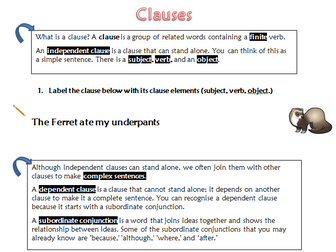
This is for year 12 and 13 English Language A level students. It explains the various types of clauses and there are activities for students to work through.