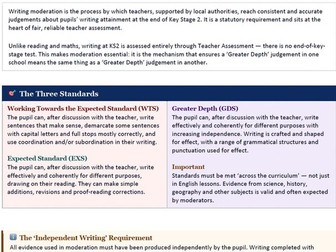
A complete teacher’s guide to Year 6 writing moderation covering the TAF, evidence gathering, standardisation, moderation meetings and preparation checklists.
This resource is designed for Year 6 class teachers, English subject leaders and senior leaders preparing for external moderation visits. It covers the full moderation process from building your evidence portfolio in January through to the external LA visit in the summer term.
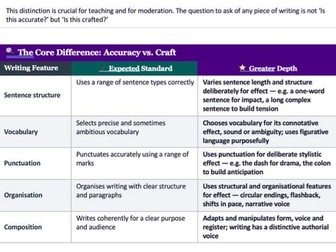
Aligned to the KS2 Teacher Assessment Framework (TAF), it explains the three writing standards (WTS, EXS and GDS) in plain language, sets out exactly what moderators look for, and helps teachers articulate their judgements with confidence.
Includes a detailed standards breakdown table, a Do/Don’t evidence guide, advice on internal standardisation, and a Spring and Summer term preparation checklist.
Suitable for use in staff meetings, INSET days, or as a personal reference guide throughout the year.
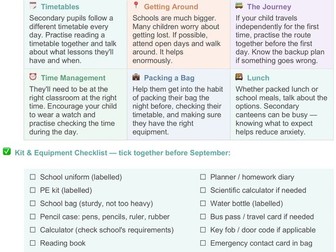
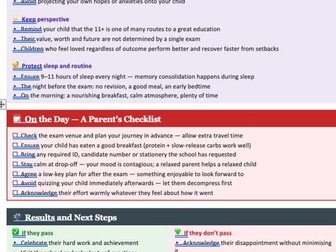
A warm, comprehensive, and beautifully designed parent information leaflet to help Year 6 families prepare for the move to secondary school — covering everything that matters, all in one place.
Organised into four clear sections — Practical, Academic, Social & Emotional, and Wellbeing — this leaflet gives parents and carers real, actionable advice without being overwhelming. Each section includes tip cards, checklists, and conversation starters to use at home, making it a resource families actually engage with rather than file away.
Highlights include a full kit checklist, a ‘Signs Your Child is Settling Well’ guide, a ‘When to Contact School’ section, and the popular ‘10 Things Every Year 6 Should Know’ — an honest, reassuring list that parents and children can read together.
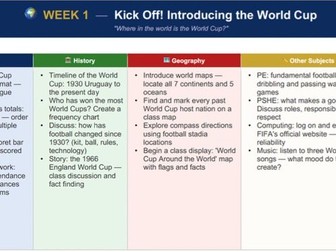
Save hours of planning with this comprehensive, fully editable six-week cross-curricular scheme of work for Years 3 and 4, built around the greatest sporting event on earth — the Football World Cup.
Mapped to the KS2 National Curriculum across ten subjects — English, Maths, Geography, History, Science, Art & Design, PE, Computing, Music, and PSHE — this scheme uses football as a powerful, high-interest lens through which pupils explore the whole world: its countries, cultures, people, and data.
Each week has its own enquiry theme, from investigating the science of forces to writing country profiles, analysing statistics, designing football kits, performing football poetry, and competing in a class World Cup tournament. A running class competition thread links all six weeks together.
Includes weekly planning grids, learning objectives for all subjects, key vocabulary, assessment guidance, and a full resources list.
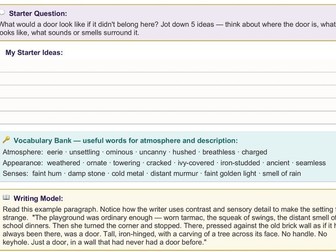
A complete, print-ready five-lesson creative writing booklet for Year 5 and Year 6, built around one powerful stimulus: a door that shouldn’t be there.
Pupils write a full short story across five carefully sequenced lessons — setting the scene, developing a character, building an imaginative world, writing action and tension, and crafting a purposeful ending. Every lesson includes a warm-up starter, a high-quality annotated writing model, a scaffolded main task with generous writing space, a stretch challenge, and a self-assessment checklist.
Fully aligned to the KS2 National Curriculum for Writing, the booklet covers atmosphere, characterisation, world-building, tension techniques, figurative language, and story endings — all in one beautifully designed, pupil-facing resource.
Includes a cover page, lesson tracker, final reflection, and 7-skill self-assessment grid. Fully editable Word document. Print and go.
What’s Included
✔ Lesson 1 — The Door Appears Atmosphere and sensory description. Vocabulary bank, writing model, 12-line writing space, metaphor/personification challenge, and lesson checklist.
✔ Lesson 2 — Meet the Character Characterisation through action and thought. 5-trait planner, sketch box, writing model with analysis task, 14-line writing space, and emotion challenge.
✔ Lesson 3 — World-Building Imaginative setting and figurative language. 5-sense planning grid, writing model, double-page sketch + writing spread, and mood-shift challenge.
✔ Lesson 4 — Something Goes Wrong Tension, pacing, and sentence variety. Tension toolkit with techniques, writing model, 16-line writing space, and cliffhanger challenge.
✔ Lesson 5 — Resolution & Reflection Story endings with purpose and impact. Ending-type selector, planning bullets, writing model, 16-line writing space, and motif/symbol challenge.
✔ Final Reflection Page Story title, summary, pride and challenge questions, and a 7-skill self-assessment grid for pupils to rate their own progress.
✔ Cover Page & Lesson Tracker Name/class/date fields, a booklet introduction, and a lesson tracker pupils tick off as they progress through the unit.
✔ Writing Models — All 5 Lessons Every lesson includes a high-quality annotated writing model to read, discuss, and learn from before pupils write independently.
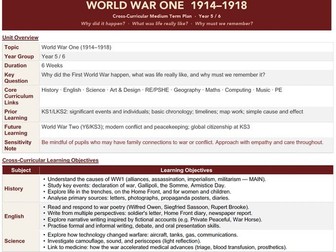
Save hours of planning with this powerful, fully editable six-week cross-curricular medium term plan on World War One for Years 5 and 6.
Mapped to the KS2 National Curriculum across ten subjects — History, English, Science, Art & Design, Geography, Maths, Music, RE/PSHE, Computing, and PE — this plan goes far beyond a standard history unit to create a genuinely connected learning experience that stays with pupils long after the topic ends.
Each week explores a different dimension of the war — from the causes and trench life to war poetry, propaganda, the Home Front, and Remembrance — with detailed activity ideas for History, English, and cross-curricular sessions built in throughout.
Includes key vocabulary, learning objectives for all subjects, assessment opportunities, sensitivity guidance, and a curated resource list. Suitable for mixed-ability classes.
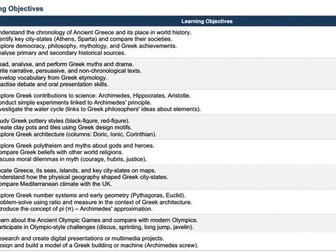
Save hours of planning time with this comprehensive, fully editable six-week cross-curricular medium term plan on Ancient Greeks for Years 5 and 6.
Mapped to the KS2 National Curriculum across nine subjects — History, English, Science, Art & Design, Geography, Maths, RE/PSHE, PE, and Computing/DT — this plan gives you everything you need to deliver an engaging, well-structured unit without starting from scratch.
Each week has a clear theme — from democracy and philosophy to Greek mythology, Archimedes’ inventions, and the Olympic Games — with detailed activity ideas for both History/Topic and English sessions, plus rich cross-curricular links built in throughout.
Also includes a key vocabulary list, cross-curricular learning objectives, assessment guidance, and a resource list. Suitable for mixed-ability classes.
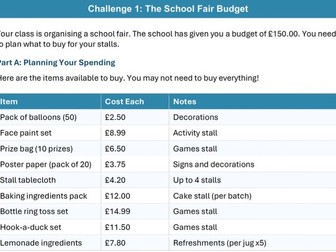
A complete, fully resourced 15-page maths investigation for Year 6 that brings real-world financial literacy into the classroom through five progressive, curriculum-linked challenges.
Pupils take on the role of a financial planner, working through a school fair budget, a class trip cost breakdown, best value shopping comparisons, a personal monthly budget, and , as the final Big Investigation, planning a birthday party for 20 guests within a £200 budget.
Every challenge builds on the last, covering addition, subtraction, multiplication, division, decimals, percentages, fractions, and reasoning — all six Year 6 National Curriculum objectives for number and measure are addressed.
Includes a full teacher mark scheme, differentiation suggestions (support and extension), and a pupil self-assessment grid. Print and go — no preparation needed.
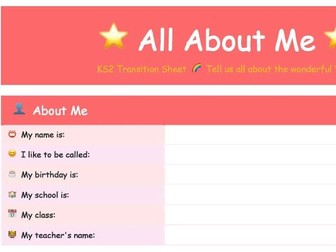
Bright, fun KS2 transition sheet where children share who they are with their new teacher. Fully editable. Perfect for end-of-year handover and settling-in!
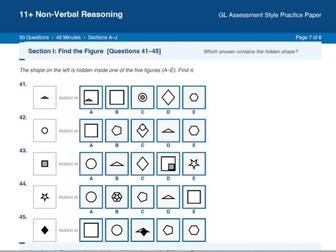
Printable 11+ non-verbal reasoning practice paper in GL Assessment style. 50 visual shape questions across 10 sections with full answer key included.
This resource is a full-length timed practice paper designed to prepare children for the GL Assessment-style 11+ Non-Verbal Reasoning exam. All questions are presented as real visual diagrams — shapes, patterns, grids and sequences — printed in an authentic exam format to build familiarity and confidence under timed conditions.
What’s included:
The paper contains 50 questions across 10 clearly labelled sections. Each section targets a distinct reasoning skill assessed in the real GL exam:
**Section A **— Complete the Series: Identify what comes next in a sequence of shapes changing in size, rotation, fill or pattern.
Section B — Odd One Out: Find the shape that does not share a property with the other four.
Section C — Complete the Matrix: Work out the rule governing a 3×3 grid and find the missing shape.
Section D — Reflections: Identify the correct mirror image of a given shape.
Section E — Rotations: Choose which option shows the shape correctly rotated by 90°.
Section F — Shape Analogies: Apply the same transformation from one pair of shapes to a second pair.
Section G — Shape Codes: Decode two-letter codes that describe shape properties and apply the rules to a new shape.
Section H — Nets and Cubes: Decide which net could be folded to produce a given cube.
Section I — Find the Figure: Identify which of five larger figures contains a smaller target shape hidden within it.
Section J — Pattern Completion: Complete a 2×2 grid by identifying the missing shape that fits the pattern.
Format and design:
The paper is fully print-ready in A4 format. Every question uses actual drawn diagrams — circles, squares, triangles, pentagons, arrows, stars and more — rendered clearly in black and greyscale. Answer options are labelled A–E with space clearly below each shape. A timed test cover page includes fields for name, school, date and score.
Recommended use:
Suggested time is 45 minutes, mirroring real exam conditions. A clearly laid-out answer key on the final page organises answers by section for quick marking. Suitable for home or tutoring use with children in Year 5 or Year 6 preparing for selective school entry.
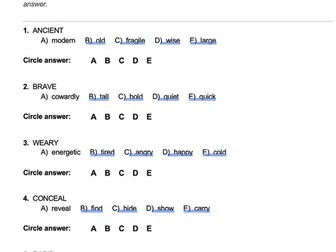
Printable 11+ verbal reasoning practice paper in GL Assessment style. 50 questions across 10 sections with answer spaces and full answer key included.
This resource is a full-length timed practice paper designed to prepare children for the GL Assessment-style 11+ Verbal Reasoning exam. It covers all major question types found in real GL papers and is presented in an authentic exam format to build familiarity and confidence.
What’s included:
The paper contains 50 questions organised into 10 clearly labelled sections: Synonyms, Antonyms, Odd One Out, Word Analogies, Hidden Words, Move a Letter, Letter Series, Letter and Number Codes, Complete the Sentence, and Compound Words. Each section opens with a worked instruction so pupils understand exactly what is required before they begin.
Format and design:
The document is fully print-ready in A4 format. Multiple choice questions feature clearly spaced options with a circle-the-letter answer prompt. Written answer questions include bordered answer boxes sized for handwriting. A timed test cover page includes spaces for the pupil’s name, school, date, and final score.
Recommended use:
Suggested time is 50 minutes (roughly one minute per question), mirroring real exam conditions. A detachable answer key on the final page makes marking quick and straightforward. Suitable for use at home or in a tutoring setting with children in Year 5 or Year 6 preparing for selective school entry.
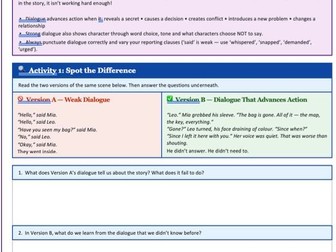
Year 6 writing worksheet on using dialogue to advance action. Includes model texts, analysis, an upgrade task and independent writing. Perfect for KS2 English!
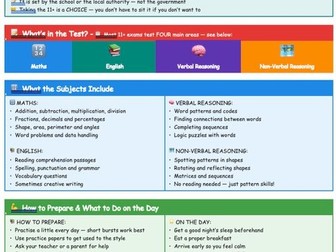
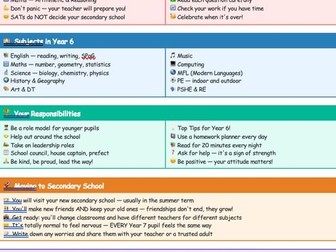
Bright, fun one-page Year 6 guide covering SATs, subjects, responsibilities and the move to secondary school. Perfect for pupils, parents and new starters!


 Quick View