Macbeth - Quotation cards (excellent Teaching and Learning resource)Quick View
mickduxbury

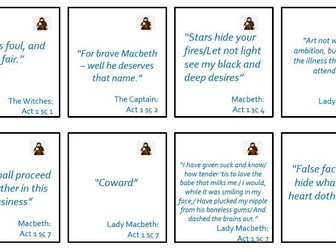
Macbeth - Quotation cards (excellent Teaching and Learning resource)

(1)
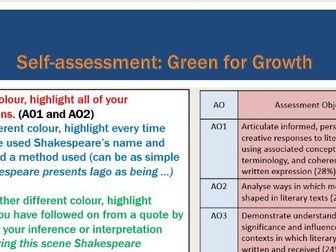
A series of key themes/ideas and quotations for Shakespeare’s Macbeth. 48 cards which contain quotations from all five acts in Macbeth. Quotations are taken from throughout the play and each Act is colour coded. The pack comes with seven engaging teaching and learning ideas to use with them. Students love these resources and they are a great tool to support students’ understanding of the play and help students to memorise key quotations (a key exam skill). Teaching and learning ideas that come with the pack are: Lower ability: arrange quotes in chronological order. Use this then to talk through key points in the text (in chronological order to ensure students have sound knowledge). Essay planning: show students essay title. Identify key theme. Students then select five/six quotations from the text that they will use when responding to the task. This provides students with a structure to their response. Focusing on how writers structure texts: students select a quotation from the exposition, development and resolution of the text. Students are to then discuss/explain how these quotations connect to one another. Connections: paired work. Students each select a quotation; they then discuss how their two chosen quotes can be connected to one another (could work particularly well for the poetry quotations). Evaluation: give students theme or character. Students select quotations (three) which they think are most significant for this theme or character. Discussion based activity where students justify their choices. Memory games: can be set for homework activities or starter/plenaries. Students are challenged to memorise quotes or a certain number of quotes – Act 1 for Macbeth for example. Test and re-test so that quotations “stick”. Language analysis: select quotation(s) – students provide a close analysis of the language used by the writer (authorial method/dramatic methods). Students write PEEL paragraph analysing the quotation. Students can be directed to focus on the following Which themes could this quote relate to? What method(s) is the writer using in the quote? What is the significance of this quote?
Unseen Poetry - Structure Strip (AQA Literature Paper 2)Quick View
mickduxbury

Unseen Poetry - Structure Strip (AQA Literature Paper 2)

(0)
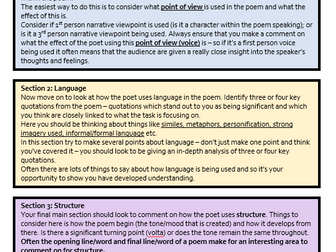
This resource provides students with a clear and logical structure to follow when responding to the Unseen Poetry questions in AQA English Literature Paper 2. The resource has a structure strip for both the 24 mark question and the 8 mark question. Students are given guidance as to how long they should spend on each section and how they should look to structure their responses so that all key assessment objectives for this part of the exam are addressed. A good way to use these is to talk through them with students, explaining each section and discussing the logical progression of points. Students can then glue them in their exercise books to refer back to for support when composing their own responses. Teachers may wish to use, withdraw, use again the structure strip so that students develop and enhance their independence. Also, having them glued into students’ exercise books is a great way to evidence differentiation.
AQA Anthology Poetry - Structure strip for exam response (AQA)Quick View
mickduxbury

AQA Anthology Poetry - Structure strip for exam response (AQA)

(0)
This resource provides students with a clear and logical structure to follow when responding to exam questions on the AQA GCSE Poetry anthology. The structure can be applied to both the Love and Relationships cluster of poems and the Power and Conflict cluster of poems. A good way to use the resource is to talk through the structure with students, explaining each section and discussing the logical progression of points. Students can then glue them in their exercise books to refer back to for support when composing their own responses. Teachers may wish to use, withdraw, use again the structure strip so that students’ independence is developed and enhanced. Also, they make for an excellent differentiation tool.
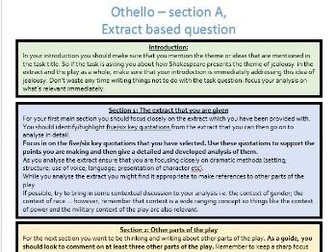
Macbeth- Structure strip for exam response (AQA) - differentiated for higher and lower ablilityQuick View
mickduxbury

Macbeth- Structure strip for exam response (AQA) - differentiated for higher and lower ablility

(0)
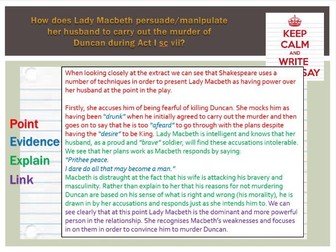
These resources provides students with a clear and logical structure to follow when responding to extract based exam questions on Macbeth. The guidance provided within these structure strips ensures that students are able to address all key assessment objectives for this section of the Shakespeare and the 19th Century novel examination. A good way to use the resources is to talk through the structure with students, explaining each section and discussing the logical progression of points. Students can then glue them in their exercise books to refer back to for support when composing their own responses. Included are two differentiated versions: one for higher ability students and one for lower ability students. Teachers may wish to use, withdraw, use again the structure strip so that students’ independence is developed and enhanced.
Othello - AQA English Literature Spec AQuick View
mickduxbury

Othello - AQA English Literature Spec A

(1)
Scene by scene resources and activities desgined for teaching Othello as part of the AQA Spec A for English Literature. There are 25 fully resourced PowerPoints which cover all of the scenes in play. For each Act there is an exam style assessment question with PowerPoint to accompany. Activities within PowerPoints include: group work independent work interleaving work assessment skills All tasks are created to ensure students are developing and honing their abilities to respond to the play and the AQA specified Assessment Objectives. Key quotation cards (can be used in a number of ways to add a creative element to teaching) are included within the unit of work. Resources covering critical interpretations of the play, its characters and concepts are also included.
An Inspector Calls - Structure Strip (Character based questions) (AQA Literature)Quick View
mickduxbury

An Inspector Calls - Structure Strip (Character based questions) (AQA Literature)

(0)
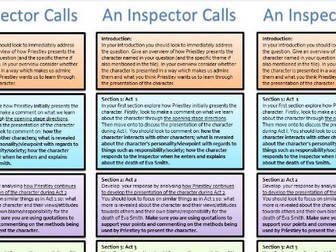
This resource provides students with a clear and logical structure to follow when responding to character based exam questions. A good way to use these is to talk through them with students, explaining each section and discussing the logical progression of points. Students can then glue them in their exercise books to refer back to for support when composing their own responses. Teachers may wish to use, withdraw, use again the structure strip so that students develop and enhance their independence. Also, having them glued into students’ exercise books is a great way to evidence differentiation.
Romeo and Juliet - Structure strip for exam response (AQA English Literature - Paper 1)Quick View
mickduxbury

Romeo and Juliet - Structure strip for exam response (AQA English Literature - Paper 1)

(0)
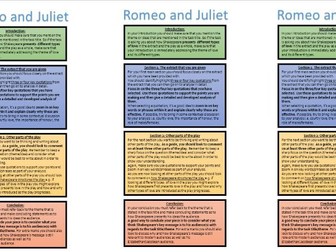
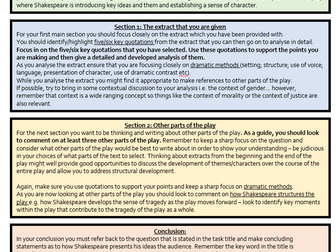
This resource provides students with a clear and logical structure to follow when responding to extract based questions in the Shakespeare section of English Literature Paper 1 (Shakespeare and the 19th Century novel). A good way to use these is to talk through them with students, explaining each section and discussing the logical progression of points. Students can then glue them in their exercise books to refer back to for support when composing their own responses. Teachers may wish to use, withdraw, use again the structure strip so that students’ independence is developed and enhanced. Also, they make for an excellent differentiation tool.
The Tempest - Structure strip for exam response (AQA English Literature - Paper 1)Quick View
mickduxbury

The Tempest - Structure strip for exam response (AQA English Literature - Paper 1)

(0)
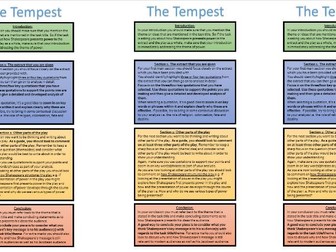
This resource provides students with a clear and logical structure to follow when responding to extract based questions in the Shakespeare section of English Literature Paper 1 (Shakespeare and the 19th Century novel). A good way to use these is to talk through them with students, explaining each section and discussing the logical progression of points. Students can then glue them in their exercise books to refer back to for support when composing their own responses. Teachers may wish to use, withdraw, use again the structure strip so that students’ independence is developed and enhanced. Also, they make for an excellent differentiation tool.
Structure strip: A Christmas CarolQuick View
mickduxbury

Structure strip: A Christmas Carol

(0)
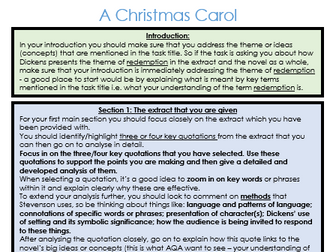
Structure strip for supporting exam responses for A Christmas Carol. This resource provides students with a logical structure to support extended written exam responses for A Christmas Carol. The information provided within the structure strip guides students to produce a response which ensures top end criteria of the mark scheme is addressed.
Jekyll and Hyde - Structure strip for exam response (AQA) Differentiated - higher and lower abilityQuick View
mickduxbury

Jekyll and Hyde - Structure strip for exam response (AQA) Differentiated - higher and lower ability

(0)
This resource provides students with a clear and logical structure to follow when responding to extract based exam questions on Jekyll and Hyde. The guidance provided within these structure strips ensures that students are able to address all key assessment objectives for this section of the Shakespeare and the 19th Century novel examination. A good way to use the resources is to talk through the structure with students, explaining each section and discussing the logical progression of points. Students can then glue them in their exercise books to refer back to for support when composing their own responses. Included are two differentiated versions: one for higher ability students and one for lower ability students. Teachers may wish to use, withdraw, use again the structure strip so that students’ independence is developed and enhanced. In addition, they make for an excellent differentiation tool.
Othello (A Level - AQA Spec B 2015onwards)Quick View
mickduxbury

Othello (A Level - AQA Spec B 2015onwards)

(0)
Full scheme of work with activities and assessment tasks for studying Othello at A Level. Fully resources PowerPoints for every Act of the play, lots of engaging activities to enable students to develop secure understanding of the text. Exam style assessments are used throughout with modelled answers and a sharp focus on how students can hit the key assessment objectives.
Julius Caesar - Structure strip for exam response (AQA English Literature - Paper 1)Quick View
mickduxbury

Julius Caesar - Structure strip for exam response (AQA English Literature - Paper 1)

(0)
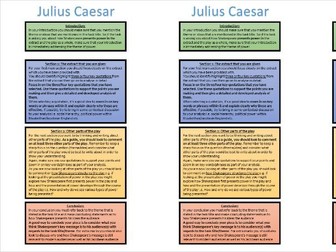
This resource provides students with a clear and logical structure to follow when responding to extract based questions in the Shakespeare section of English Literature Paper 1 (Shakespeare and the 19th Century novel). A good way to use these is to talk through them with students, explaining each section and discussing the logical progression of points. Students can then glue them in their exercise books to refer back to for support when composing their own responses. Teachers may wish to use, withdraw, use again the structure strip so that students’ independence is developed and enhanced. Also, they make for an excellent differentiation tool.
Much Ado About Nothing - Structure strip for exam response (AQA English Literature - Paper 1)Quick View
mickduxbury

Much Ado About Nothing - Structure strip for exam response (AQA English Literature - Paper 1)

(0)
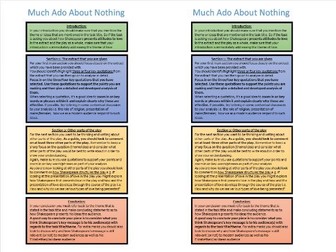
This resource provides students with a clear and logical structure to follow when responding to extract based questions in the Shakespeare section of English Literature Paper 1 (Shakespeare and the 19th Century novel). A good way to use these is to talk through them with students, explaining each section and discussing the logical progression of points. Students can then glue them in their exercise books to refer back to for support when composing their own responses. Teachers may wish to use, withdraw, use again the structure strip so that students’ independence is developed and enhanced. Also, they make for an excellent differentiation tool.
An Inspector Calls - key themes and quotations (Teaching and Learning activities)Quick View
mickduxbury

An Inspector Calls - key themes and quotations (Teaching and Learning activities)

(0)
A series of key themes/ideas and quotations for An Inspector Calls 32 cards which contain quotations from all three Acts of An Inspector Calls. The pack comes with seven engaging teaching and learning ideas to use with them. Students love these resources and they are a great tool to support students’ understanding of the play and help students to memorise key quotations (a key exam skill). Teaching and learning ideas that come with the pack are: Lower ability: arrange quotes in chronological order. Use this then to talk through key points in the text (in chronological order to ensure students have sound knowledge). Essay planning: show students essay title. Identify key theme. Students then select five/six quotations from the text that they will use when responding to the task. This provides students with a structure to their response. Focusing on how writers structure texts: students select a quotation from the exposition, development and resolution of the text. Students are to then discuss/explain how these quotations connect to one another. Connections: paired work. Students each select a quotation; they then discuss how their two chosen quotes can be connected to one another (could work particularly well for the poetry quotations). Evaluation: give students theme or character. Students select quotations (three) which they think are most significant for this theme or character. Discussion based activity where students justify their choices. Memory games: can be set for homework activities or starter/plenaries. Students are challenged to memorise quotes or a certain number of quotes – Act 1 for Macbeth for example. Test and re-test so that quotations “stick”. Language analysis: select quotation(s) – students provide a close analysis of the language used by the writer (authorial method/dramatic methods). Students write PEEL paragraph analysing the quotation. Students can be directed to focus on the following Which themes could this quote relate to? What method(s) is the writer using in the quote? What is the significance of this quote?
The Merchant of Venice - Structure strip for exam response (AQA English Literature - Paper 1)Quick View
mickduxbury

The Merchant of Venice - Structure strip for exam response (AQA English Literature - Paper 1)

(0)
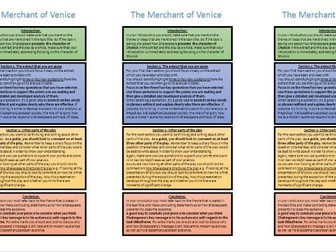
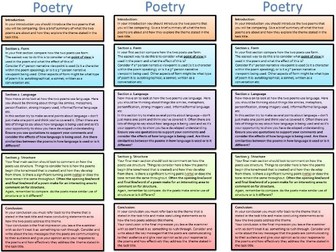
This resource provides students with a clear and logical structure to follow when responding to extract based questions in the Shakespeare section of English Literature Paper 1 (Shakespeare and the 19th Century novel). A good way to use these is to talk through them with students, explaining each section and discussing the logical progression of points. Students can then glue them in their exercise books to refer back to for support when composing their own responses. Teachers may wish to use, withdraw, use again the structure strip so that students’ independence is developed and enhanced. Also, they make for an excellent differentiation tool.
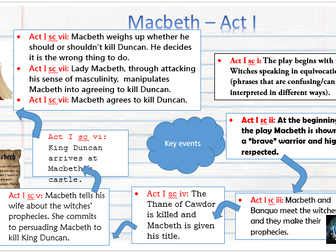
Revision resources for answering an extract based question on Macbeth for AQA GCSE LiteratureQuick View
mickduxbury

Revision resources for answering an extract based question on Macbeth for AQA GCSE Literature

(0)
Lots of activities and revision strategies to support students when responding to extract based question on Macbeth. Included are: Worked examples of making flash cards for Macbeth Worked examples of using Cornell notes to revise for key scenes Structure strips for answering extract based questions Quotation cards including key quotations and themes Example exam questions with exemplar responses
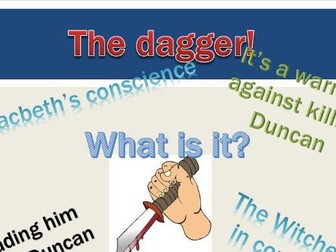
Macbeth - "Is this a dagger ..." (Activities and resources designed for exam assessment objectives)Quick View
mickduxbury

Macbeth - "Is this a dagger ..." (Activities and resources designed for exam assessment objectives)

(0)
A series of activities and resources focused on Macbeth’s “Is this a dagger …” soliloquy in Act II sc i of the play. The resources and activities are designed to enable students to recognise the importance of interpretations when studying Literature. Students are encouraged to consider a range of interpretations of what the dagger might represent, evaluate interpretations and present their own interpretation.