Lesson 2 Application of paper and board KS5 Paper 1Quick View
jdebruin

Lesson 2 Application of paper and board KS5 Paper 1

(0)
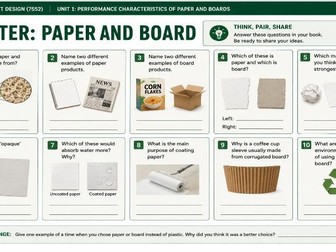
This lesson develops students’ knowledge of the papers and boards specified in the A-Level Product Design course. By the end of it, students should be able to distinguish between the physical properties of a material (characteristics it has regardless of forces applied — e.g. weight, absorbency, translucency, printability) and its mechanical properties (how it behaves under applied forces — e.g. strength, rigidity, resistance to tearing or creasing), and to justify the selection of a specific paper or board for a given application. Selection and justification questions are a staple of the written exam, so students need both the vocabulary and concrete product examples.
Lesson 1 Performance of paper and board KS5 Paper 1Quick View
jdebruin

Lesson 1 Performance of paper and board KS5 Paper 1

(0)
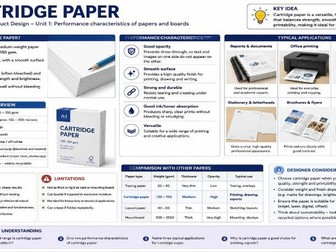
Students should leave the lesson able to describe how paper and board are manufactured, explain how they are classified by weight and size, and identify a range of standard papers and boards — their physical and mechanical properties and why each is chosen for particular applications. The specified materials are bleed proof, cartridge, grid, layout and tracing papers, plus corrugated card, duplex board, foil-lined board, foam core board, inkjet card and solid white board.
Lesson 3 Recycling of paper and board KS5 Paper 1Quick View
jdebruin

Lesson 3 Recycling of paper and board KS5 Paper 1

(0)
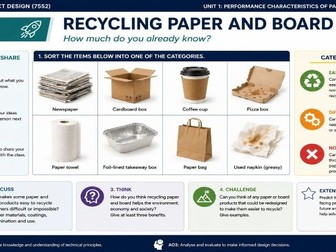
Paper and board are among the most successfully recycled materials in the UK, and this topic sits at the intersection of materials knowledge, manufacturing processes and the environmental/sustainability strand of the A Level specification. Students need to understand both the industrial process itself and its consequences: what recycling saves, what it cannot achieve, and why designers’ material choices (coatings, laminates, adhesives, inks) determine whether a paper product is recyclable at all. The headline arguments for recycling are resource and energy conservation. Making paper from recovered fibre avoids felling virgin timber, and uses substantially less energy and water than pulping virgin wood. It also diverts material from landfill, where decomposing paper generates methane, a potent greenhouse gas. Recycled fibre is now the single largest source of fibre for UK paper mills, and the UK recovers a high proportion of its paper and card — corrugated packaging in particular achieves very high recovery rates because it is collected in bulk from retail and industry and is easy to reprocess.
Lesson 5 Application of Polymers KS5 Paper 1Quick View
jdebruin

Lesson 5 Application of Polymers KS5 Paper 1

(0)
This lesson builds directly on addition polymerisation. Students should recall that alkene monomers (containing a C=C double bond) join together under high pressure with a catalyst to form long-chain saturated polymers, with no other product formed. The repeat unit is derived from the monomer by opening the double bond. Naming follows the poly(monomer) convention, e.g. ethene → poly(ethene), chloroethene → poly(chloroethene)/PVC. It is worth having a quick recap question ready, as the structure–property reasoning later in the lesson depends on students picturing polymers as very long covalent chains.
Lesson 4 Performance of Polymers KS5 Paper 1Quick View
jdebruin

Lesson 4 Performance of Polymers KS5 Paper 1

(0)
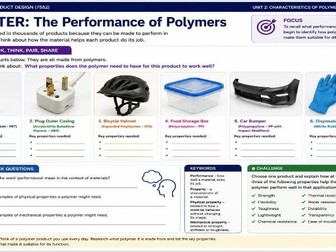
This lesson explains why different polymers behave so differently — why polythene is flexible while melamine is rigid, and why PVC can be either. The central idea is that the bulk (macroscopic) properties of a polymer are determined by its molecular structure and, in particular, by the strength of the intermolecular forces between polymer chains and how easily those chains can move past one another. By the end of the lesson, students should be able to explain how chain length, branching, side groups, cross-linking, crystallinity and chain flexibility affect properties such as strength, flexibility, density and melting behaviour, and how properties can be deliberately modified (e.g. by cold drawing or adding plasticisers).
Lesson 6 Stock forms of Polymers KS5 Paper 1Quick View
jdebruin

Lesson 6 Stock forms of Polymers KS5 Paper 1

(0)
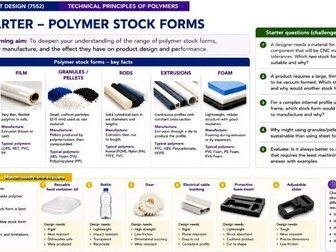
Polymers are supplied to manufacturers in a range of standard, commercially available formats known as stock forms. Designers and manufacturers select a stock form to suit the processing method that will be used, the scale of production and the geometry of the final product. Choosing the correct stock form and standard size minimises processing, reduces waste and keeps costs down, because material bought close to its final form needs less energy and fewer operations to convert into a product. Students should be able to name the main stock forms, link each one to the manufacturing processes that use it, and justify a choice of form and size for a given product.
Cover lesson SCAMPERQuick View
jdebruin

Cover lesson SCAMPER

(0)
This is one design and technology cover lesson, that can be taught by a specialist or non specialist. It is based on the design strategy SCAMPER. Students can redesign a lamp and/or another product if they choose File can be used to teach with and printed out as work booklet for students.
Design and technology cover lessonQuick View
jdebruin

Design and technology cover lesson

(0)
One Design and Technology cover lesson. Can be taught by a specialist or non-specialist teacher. Lesson teaches the design design strategy ‘in the style of’ using existing products as a starting point for designing. Can be used as teaching presentation or printed as a student workbook.