River Landscapes TopicQuick View
lozel1

River Landscapes Topic

(0)
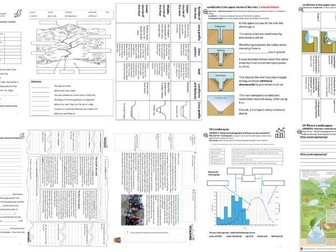
This unit provides a clear, specification-aligned introduction to river landscapes, using the River Tees as the AQA case study. It covers river processes and drainage basins, then explores how the upper, middle, and lower course of a river change in terms of landforms, channel characteristics, and processes. Students examine key Tees landforms such as V-shaped valleys, High Force waterfall, meanders, floodplains, and the estuary. The unit also covers flooding, including causes, impacts, and the interpretation of storm hydrographs, before moving on to hard and soft engineering strategies and the specific management of the River Tees. Guided reading tasks and embedded exam-style questions support understanding and prepare students for AQA assessment, with opportunities to practise describe, explain, and evaluate questions throughout the unit.
Describing A Place with AssessmentQuick View
lozel1

Describing A Place with Assessment

(0)
KS3 Geography Lesson: Describing a Place Using Geographical Skills Lesson Focus: How can we describe a place in Geography? This engaging KS3 lesson develops students’ geographical skills by exploring how to describe places using appropriate vocabulary and structured writing. Lesson Includes: A clear focus on key geographical terminology to support accurate place descriptions Whole-class feedback opportunities to model and refine descriptive writing Editable worksheets that guide students in describing their local area (adaptable to suit your classroom context) A structured assessment task with a scaffolded writing frame and mark scheme A high-quality WAGOLL (What A Good One Looks Like) to exemplify expectations
Coastal Landscape Lesson 3- Erosional Processes and LandformsQuick View
lozel1

Coastal Landscape Lesson 3- Erosional Processes and Landforms

(0)
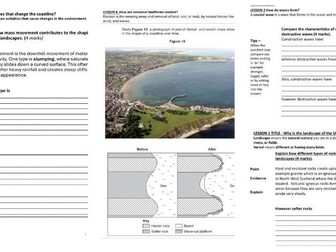
This two-part lesson focuses on key erosional coastal landforms, including headlands and bays, wave-cut platforms, and the formation of caves, arches, stacks, and stumps. Throughout the lessons, there are embedded opportunities for whole-class feedback to address misconceptions and reinforce key concepts. Students will engage with a range of exam-style questions, helping them to familiarise themselves with how these topics may be assessed and to build exam confidence through structured practice.
Coastal Landscape WorkbookQuick View
lozel1

Coastal Landscape Workbook

(0)
This comprehensive booklet covers the entire Coastal Landscapes topic for AQA GCSE Geography, designed to support both teaching and independent student learning. All accompanying lessons are available for download, providing ready-to-use resources that align with the booklet content. A separate exam practice booklet is also available for purchase, offering a range of exam-style questions to reinforce learning and develop exam skills.
Coastal Landscapes - Exam Question Booklet (AQA Geography)Quick View
lozel1

Coastal Landscapes - Exam Question Booklet (AQA Geography)

(0)
This dedicated exam question booklet focuses on the Coastal Landscapes topic for AQA GCSE Geography, providing a wide range of exam-style questions with structures and WAGOLLs designed to build confidence and improve exam technique. It complements the full topic booklet and lessons (available to download separately) and is ideal for use in class, homework, revision, or intervention sessions. The exam booklet is available for purchase as a standalone resource.
Coastal Landscape Lesson 1 - Introduction to WavesQuick View
lozel1

Coastal Landscape Lesson 1 - Introduction to Waves

(0)
This lesson focuses on constructive and destructive waves, with a key emphasis on exploring the question: “How do waves form?” Students will develop a clear understanding of wave formation and the differences between wave types. The lesson includes opportunities for whole-class feedback to address misconceptions and consolidate learning. It concludes with a structured approach to exam practice through an “I do, We do” model, helping students apply their knowledge to an exam-style question with guided support.
Weather and Climate worksheetsQuick View
lozel1

Weather and Climate worksheets

(1)
Fully differentiated worksheet for a Weather and Climate topic (GCSE) . The sheets should be printed on A3 paper but were created for mixed ability groups (target grade from 2-9). For each lesson the work sheets are differentiated - usually with 3 worksheet. Worksheet 1- Global circulations (Easy and harder) Worksheet 2- Tropical Rainforests climate (easy and harder) Worksheet 3- Semi arid landscape climate (easy, medium and harder) Worksheet 4- UK climate features (easy, medium, harder) Worksheet 5- The influence of air pressure (easy, medium and harder) Worksheet 6- UK changeable weather (easy, medium and harder) I will be adding my worksheets to the lesson once I have completed them.
Sustainable Management of Tropical RainforestQuick View
lozel1

Sustainable Management of Tropical Rainforest

(1)
Title- How can the tropical rainforest be managed sustainably? Learning Objectives - Bronze- To be able to recall key facts about the biomes Silver- To describe how people can manage the TRF Gold- To identify and explain how people can manage the TRF Work is differentiated through exam style questions structure (Higher fishbone and worksheet and Foundation fishbone and worksheet) Video clips and Worksheets are also embedded within the PowerPoint. - Also answers are available on the PowerPoint.
What is Development?Quick View
lozel1

What is Development?

(1)
This is based on a KS3 Development lesson for mixed ability students. The activities are differentiated and have a challenge section to stretch the most able students. All lessons start with a silent starter to engage the students from the start of the lesson. Learning Objectives- Bronze- To understand what development means Silver-To be able to categorise features of a highly and poorly developed country Gold - To be able to evaluate the importance of the different features which make a country a highly developed country
Development Assessment LessonQuick View
lozel1

Development Assessment Lesson

(1)
This Assessment should be completed after a series of lessons based on Development. The students are asked to explain which country is more developed based on a series of development indicators and a brief history about country A and country B. The mark scheme/ marking grid is designed for the students to use during their assessment. There are also a PowerPoint which helps the students to break down the question and a writing frame for lower ability students.
Causes of Deforestation in Tropical RainforestQuick View
lozel1

Causes of Deforestation in Tropical Rainforest

(0)
Title- What causes deforestation within Tropical Rainforest? Learning Objectives Bronze- To be able to recall key facts about the biomes Silver- To describe what caused the deforestation within the TRF Gold- To identify and explain what causes deforestation within the TRF The students have got very structured activity built into the PowerPoint,
What are Asia’s physical features?Quick View
lozel1

What are Asia’s physical features?

(0)
This lesson is based on a mixed ability KS3 class. The lesson is differentiated so all students are able to access the information and activities, while challenging others. It has elements of map skills in the lesson as well as focusing on the different features. Learning objectives Bronze- To be able understand what a physical feature is. Silver- To be able to identify different physical features in Asia Gold- to be able to describe the difference between physical features found in Asia.
What are the causes and effects of floods in Bangladesh?Quick View
lozel1

What are the causes and effects of floods in Bangladesh?

(0)
Flooding lesson based on KS3 mixed ability year 8 class. The lesson and activities are fully integrated into the PowerPoint. The lesson starts with a silent starter which allows the students to engage in the lesson of flooding. The students will have a range of activities to complete, Information sort (causes of the flood), Highlight text (effects) and a differentiated question. There are extension activities and possible homework activities included. Learning Objectives. Bronze - Identify the human and physical cause of floods Silver - Describe the effects of the floods Gold - Classify the effects of floods
How did the development gap grow?Quick View
lozel1

How did the development gap grow?

(0)
The lesson focuses on why there is a development gap and how the development gap grew. The lesson is differentiated and homework is included in the lesson. Silent starter (differentiated) starts the lesson with activities and progress checks throughout. Learning Objectives Bronze- Understand what the term development gap means Silver- To explain why the development gap grew Gold- To be able to evaluate the reasons for poverty.
How do you measure development?Quick View
lozel1

How do you measure development?

(0)
This is based on a KS3 Development lesson for mixed ability students. The activities are differentiated and have a challenge section to stretch the most able students. All lessons start with a silent starter to engage the students from the start of the lesson. Learning Objectives- Bronze- To be able to recall key information about different development indicators Silver- To be able to describe different indicators. Gold- to be able to compare and contrast the key indicators and analyse which indicator is most effective
How do you escape poverty? - based on Migration/ RefugeesQuick View
lozel1

How do you escape poverty? - based on Migration/ Refugees

(0)
The lesson is based on a mixed ability year 9 lesson. The lesson starts with an optional silent starter (Literacy based). The students will also have to complete a serious of activities to be able to answer the question. As it is based on a mixed ability lesson the work is differentiated and there are extension activities embedded into the PowerPoint. Learning Objectives- Bronze- Understand what the key terms associated with development Silver- To describe why people are forced to leave an area Gold- To be able to explain the effects on a person who has to leave an area
What are the causes and effects of floods in York?Quick View
lozel1

What are the causes and effects of floods in York?

(0)
Flooding lesson based on KS3 mixed ability year 8 class. The lesson and activities are fully integrated into the PowerPoint. The lesson starts with a silent starter which allows the students to engage in the lesson of flooding. The students will have a range of activities to complete, Information sort (causes of the flood), Highlight text (effects) and a differentiated question. The students will also have to compare the Bangladesh flood and York flood to be able to understand which flood is the most sever. Peer assessment or self assessment tasks are also embedded within the PowerPoint. There are extension activities and possible homework activities included. Learning Objectives. Bronze - Identify the human and physical cause of floods Silver - Describe the effects of the floods Gold - Classify the effects of floods and be able to explain which flood was the most server.
How is development mapped?Quick View
lozel1

How is development mapped?

(0)
This is based on a KS3 Development lesson for mixed ability students. The activities are differentiated and have a challenge section to stretch the most able students. All lessons start with a silent starter to engage the students from the start of the lesson. Learning Objectives- Bronze- To be able to recall key information about development Silver- To be able to describe different patterns created through development. Gold- To be able to compare and contrast the different way in which development can be mapped
Is the One Child Policy successful?Quick View
lozel1

Is the One Child Policy successful?

(0)
This is part of the development topic, which focuses on China and how it has developed into a super power. The students will look at the rise of China and how the One Child Policy was needed to stop rapid population growth. This lesson encourages independent learning and can be taught as a stand alone lesson or part of the China SOW. Bronze- Be able to understand key facts about the one child policy Silver-Be able to understand why the one child policy was implements Gold-Be able evaluate the one child policy.
OCR A level Exam Question SpottingQuick View
lozel1

OCR A level Exam Question Spotting

(0)
This is a list of Exam Questions for Human Geography Topics. The questions come from Past Papers, SAMs and ZigZag resources etc. Changing Spaces Migration Human Rights Disease Dilemmas
Where is China and how has it changed?Quick View
lozel1

Where is China and how has it changed?

(0)
The lesson is based on a year 9 mixed ability SoW. The students will be able to understand where China is and how it has changed (the rise of China). The lesson starts with a silent started and the students will be able to describe the location of China as well as being able to explain the population distribution of China. The students will also be able to explain and evaluate how China has changed. All the activities are differentiated with extension activities in the Presentation and a possible homework included. Learning objectives- Bronze- To be able to describe the location of China Silver-To be able to explain how China has developed and changed Gold-To be able to evaluate the success and problems in China’s rapids development